Real Estate Broker Resume Examples: the lines they read
Build a Real Estate Broker Resume That Shows Office Production
By Mustafa Tarabya, founder of CVBooster · Published · Updated
Real estate broker resume example and guide covering agent recruiting, office volume, supervision duties, compliance review and split structures.
Sample resumes for a real estate broker
The same real estate broker content laid out in three CVBooster templates, so you can see what the finished document looks like before you write a word.
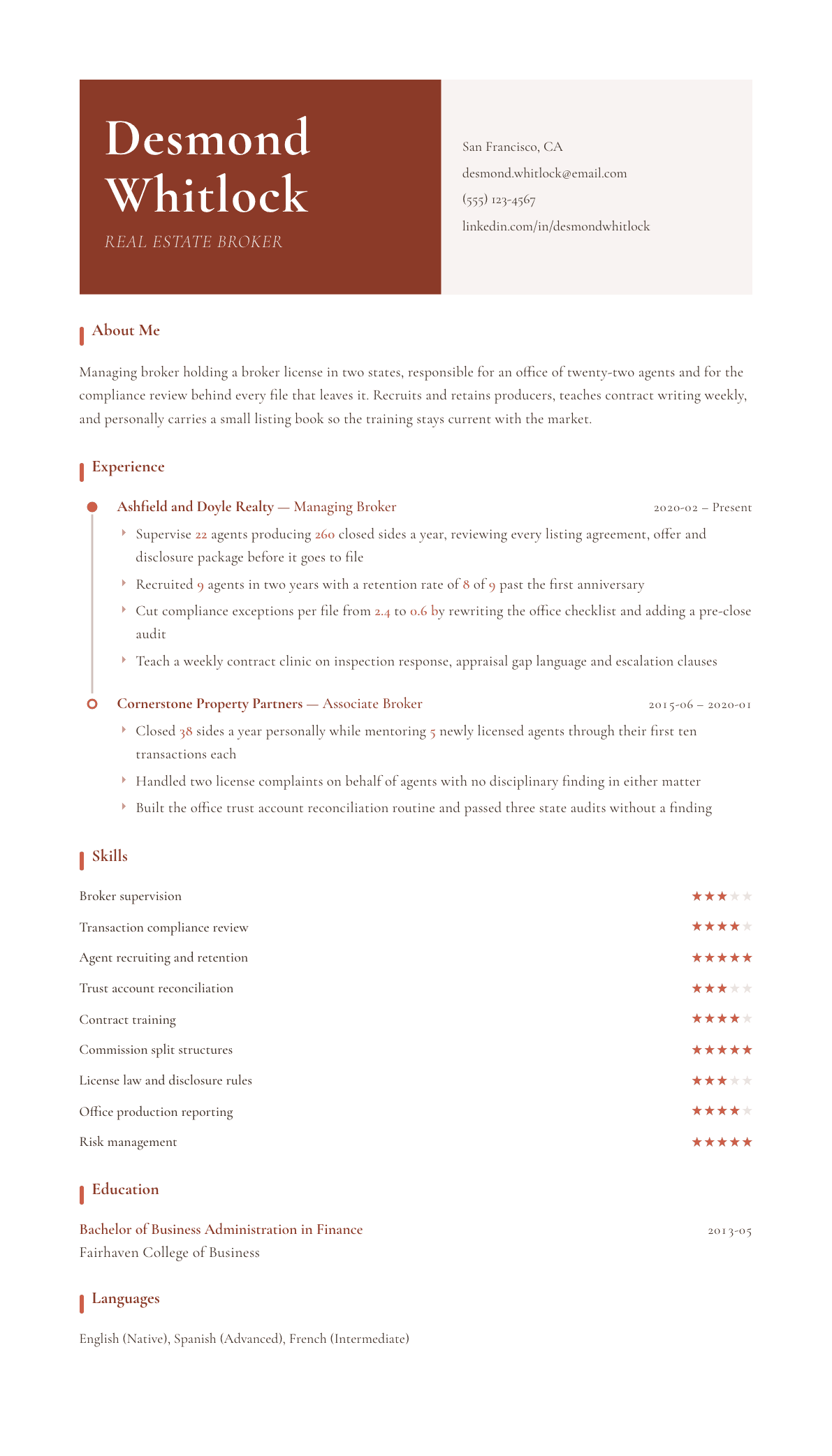
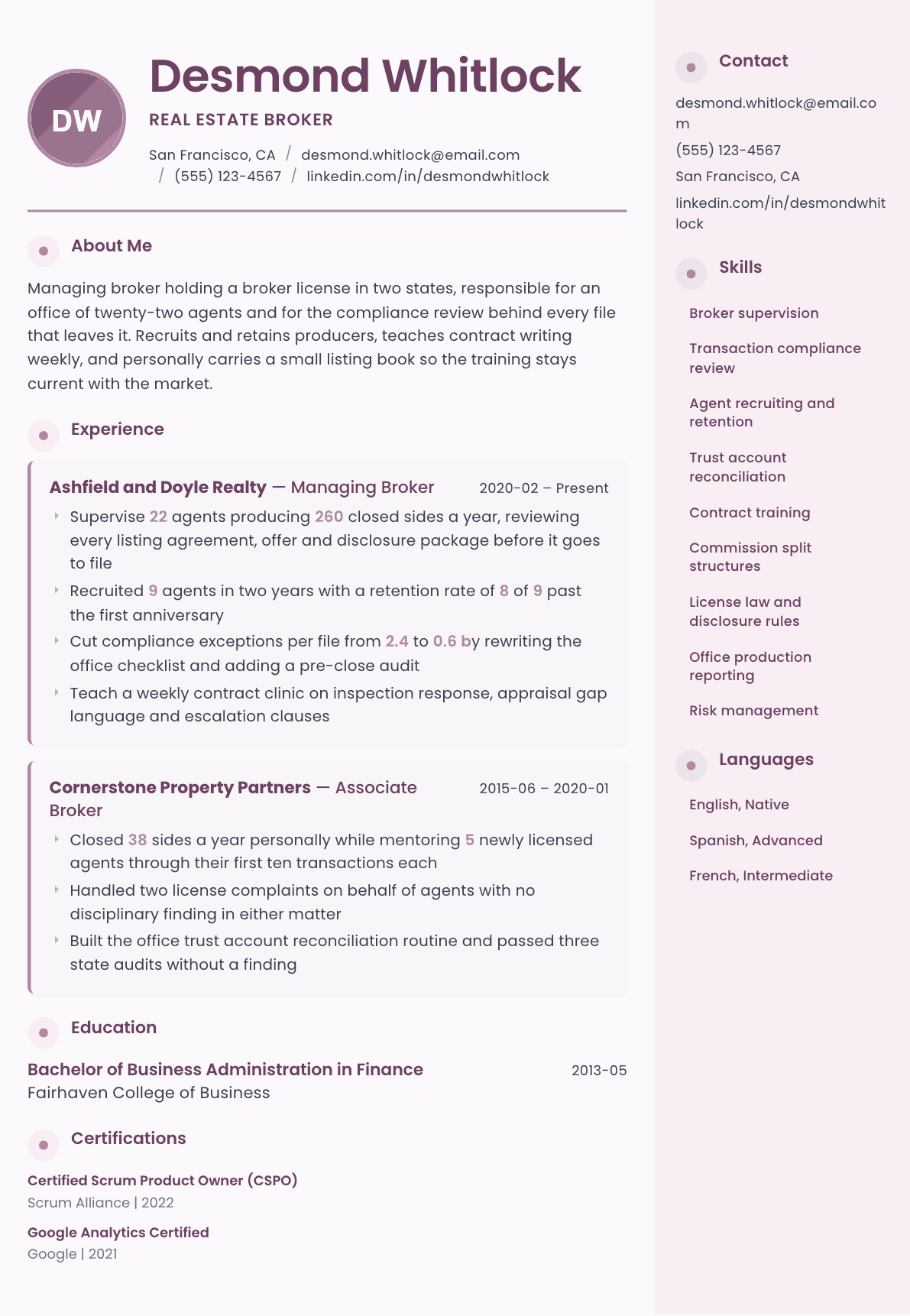
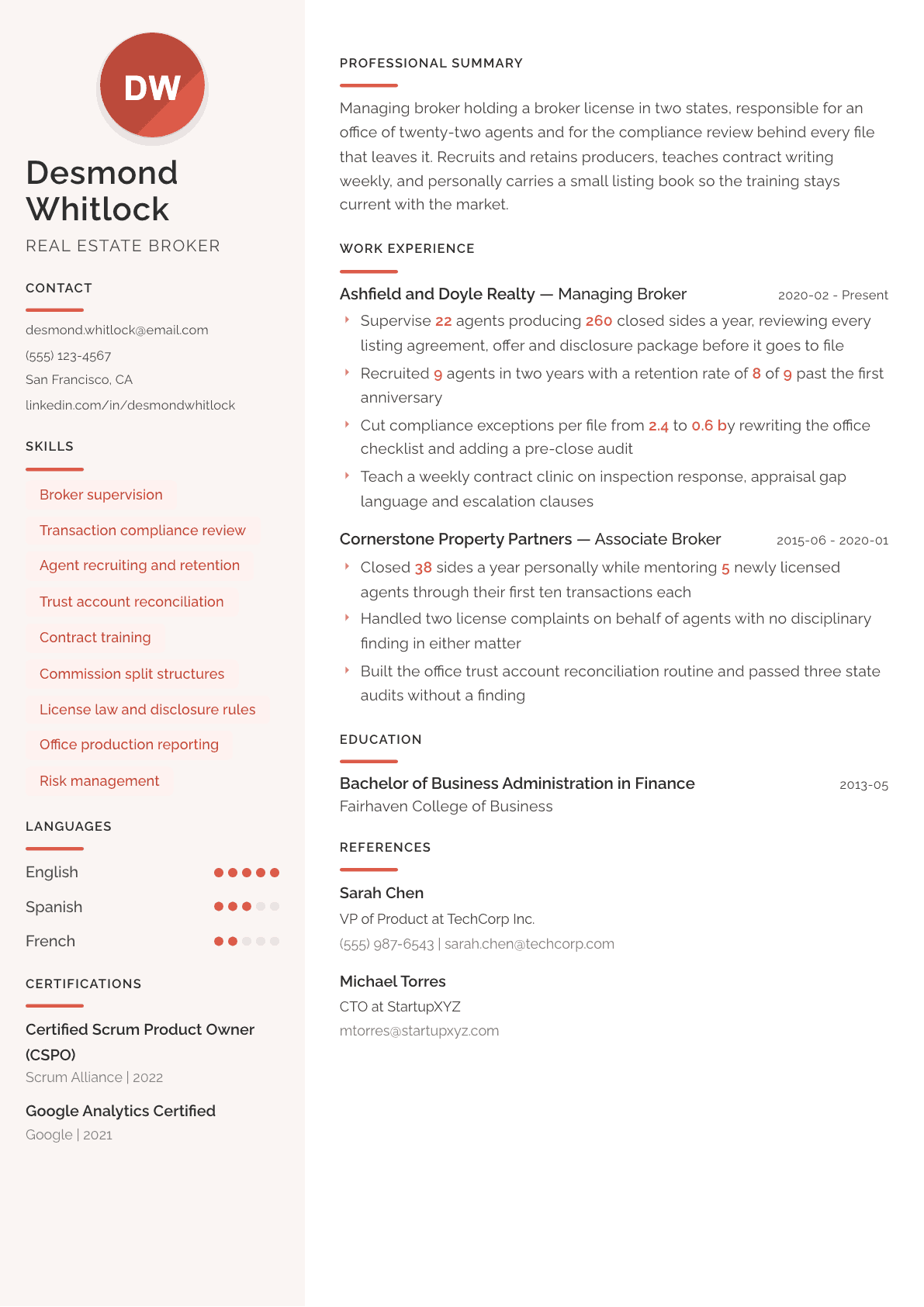
Example Real Estate Broker summary
Managing broker licensed in two states, supervising twenty-two agents and the compliance review behind every file the office produces. Recruited nine agents in two years and kept eight of them past the first anniversary. Rewrote the file checklist and pre-close audit that cut exceptions per file by three quarters, passed three state trust account examinations without a finding, and still carries a small personal listing book to keep contract training current.
Skills to list on a Real Estate Broker resume
- Broker supervision and oversight
- Transaction file compliance review
- Agent recruiting
- Agent retention and coaching
- Trust and escrow account reconciliation
- License law application
- Disclosure package review
- Contract drafting and training
- Commission plan administration
- Office production analysis
- Errors and omissions risk management
- Complaint and mediation response
- Brokerage policy manuals
- Recruiting pipeline management
What actually gets this resume read
- Lead with the number of agents you supervise and the office volume they produce, because that is the scale a company buys.
- State every broker license you hold and the state that issued it, plus any reciprocity or license you keep active elsewhere.
- Show your compliance record: file audits, exceptions per file, and any state examination you have been through.
- Give recruiting and retention as two separate numbers, since hiring agents and keeping them are different skills.
- Explain the trust or escrow account work you own, because that is the duty a company is most exposed on.
- Say whether you still produce personally and how much, so a hiring owner can judge your split of time.
- Name the split and cap structures you have administered, without attaching a dollar figure to a former employer.
How to write a real estate broker resume
A real estate broker resume is read by an owner or a regional director who is buying two things at once: the production an office generates under you, and the sleep they get because your files are clean. Those are separate skills, and a page that only proves the first one reads like an agent resume with a bigger title on it.
Supervision is the part candidates underwrite badly. A broker of record signs off on advertising, reviews disclosure packages, reconciles a trust account, answers a state complaint and keeps the office out of an errors and omissions claim. None of that shows up if the resume simply says responsible for overseeing brokerage operations.
What follows is the structure that works for a broker page: how to present supervision scale, recruiting and retention as separate figures, the compliance record, and the personal production you may or may not still carry. Three summaries, before and after bullets, and the questions brokers ask when they move from producing to managing.
Format: supervision scale up top, licenses by state, production last
One page works until you have run more than one office; two pages is normal for a career broker with multiple licenses and a supervision history worth listing. Open with a scale line under the summary: agents supervised, offices, annual closed sides for the office, and the states you are licensed in. An owner reads that line and decides whether to keep going.
License placement matters more here than for an agent. A broker license, the state that issued it, the license number line and any state where you serve as broker of record or qualifying broker belong in their own block near the top. Reciprocity and inactive licenses go in the same block with their status marked, since an owner planning a market entry may care about a license you are not currently using.
- Scale line: agents supervised, office count, annual office sides, and states where you hold a broker license.
- License block: broker license by state with status, plus broker of record or qualifying broker appointments.
- Supervision duties named explicitly: advertising review, disclosure review, trust account reconciliation, complaint response.
- Personal production, if you still carry a book, goes after the supervision record rather than ahead of it.
Summary: what you supervise, what you built, what you keep clean
Three lines that answer scale, growth and risk. Name the agent count and office volume, one thing you built that outlasted you, and one compliance outcome. A broker who writes that they are an experienced leader with a track record of success has said nothing an owner can act on.
If you are moving from producing agent to managing broker for the first time, say so plainly and name the transferable evidence: agents you have already mentored, the office systems you wrote, and the review work you were already doing informally. Owners hire first time managing brokers regularly, but they want the transition acknowledged rather than disguised.
Recruiting and retention: two numbers, never one
Recruiting is a pipeline job and retention is a coaching job, and plenty of brokers are strong at one and weak at the other. Give recruits added over a period, then how many were still with the office after a year, then what happened to their production while they were with you. An owner reading a recruiting figure with no retention beside it assumes the worst.
Say where recruits came from. Newly licensed agents from a school pipeline, experienced agents from competing offices, and returning agents rebuilding a book each demand different onboarding, and an owner is usually hiring for one of them specifically. If you built the onboarding program, describe what a new agent goes through in their first month rather than calling it comprehensive.
Compliance, trust accounting and complaint history
This is the section that separates a broker resume from an inflated agent resume. Write the review process you run: which documents you read before a file closes, what you check on each, how many exceptions you find and how you drove that number down. An exceptions per file figure with a before and after is more persuasive than any adjective available to you.
Trust and escrow account work deserves its own lines. Reconciliation cadence, separation of funds, the audit examinations you have been through and their outcomes. If you have handled a license complaint or a mediation, say so and give the outcome, because an owner would far rather read that history from you than discover it later. A broker who has never had a complaint should say that plainly too.
Keywords, designations and the systems an office runs on
Brokerage postings and recruiter searches use a narrow vocabulary: managing broker, broker of record, qualifying broker, designated broker, agent supervision, transaction compliance, trust account, license law, errors and omissions, recruiting, retention, commission plan. Use the exact title your target state uses, since designated broker and broker of record mean the same job under different statutes.
Name the office systems you have administered: the transaction management platform, the commission and back office accounting system, the customer database the office standardizes on, and the intranet or training library you maintain. Owners weigh a broker who has migrated an office between platforms very differently from one who has only ever used the incumbent.
Real Estate Broker resume summary examples
New broker license
Newly licensed broker after seven years as a producing agent averaging 31 sides a year, already mentoring 5 agents and writing the office contract clinic. Completed the broker education requirement in 2023 and now seeking a managing broker seat in a single office.
Managing broker, one office
Managing broker supervising 22 agents producing 260 sides a year, licensed in two states. Recruited 9 agents in two years and retained 8 past the first anniversary. Rewrote the file checklist and pre-close audit that cut compliance exceptions per file from 2.4 to 0.6.
Broker of record, multiple offices
Broker of record for three offices and 74 agents across two states, accountable for advertising review, disclosure compliance and trust account reconciliation in all of them. Passed six state examinations without a finding and built the onboarding track every new agent completes in month one.
Work experience bullets: before and after
Before: Oversaw daily operations of the real estate office.
After: Supervised 22 agents producing 260 closed sides a year, personally reviewing every listing agreement, offer and disclosure package before it went to file.
Naming the review scope turns a vague oversight claim into a supervision workload an owner can price.
Before: Recruited new agents to the brokerage.
After: Recruited 9 agents over two years from competing offices and a local school pipeline, retaining 8 past the first anniversary and lifting median new agent production to 11 sides in year one.
Recruiting, retention and the production that followed are three different results, and this bullet gives all three.
Before: Ensured compliance with real estate regulations.
After: Cut compliance exceptions from 2.4 to 0.6 per file by rewriting the office checklist, adding a pre-close audit and returning incomplete disclosure packages to the agent within one business day.
A measured before and after with the mechanism behind it reads as management rather than as a job description.
Before: Managed the company escrow account.
After: Reconciled the trust account monthly against bank statements and the transaction ledger, and passed three state audits with no finding across five years of custody.
Cadence, method and audit outcome are the three facts a state examiner and an owner both ask about.
Before: Trained agents on contracts and procedures.
After: Taught a weekly contract clinic covering inspection response, appraisal gap language and escalation clauses, and walked 5 newly licensed agents through their first ten transactions each.
Specific curriculum and a mentoring count show what the training was, not merely that training happened.
Hard skills
- Agent supervision and file review
- Transaction compliance auditing
- Trust and escrow account reconciliation
- License law and disclosure requirements
- Advertising and marketing review
- Recruiting pipeline management
- Commission plan and cap administration
- Errors and omissions risk control
- Complaint and mediation response
- Brokerage policy manual authorship
- Office production and pipeline reporting
- Back office and commission accounting systems
Soft skills
- Telling a top producer that a file will not close as written
- Recruiting without promising what the office cannot deliver
- Coaching an agent through a first failed transaction
- Keeping a level tone in a complaint or mediation meeting
- Balancing personal production against the office that needs you
Certifications worth listing
- Certified Real Estate Brokerage Manager (CRB) (Real Estate Business Institute)
- Graduate, REALTOR Institute (GRI) (National Association of REALTORS)
- Certified Residential Specialist (CRS) (Residential Real Estate Council)
Mistakes that cost real estate broker candidates the interview
- Writing a broker resume that is really an agent resume, with personal sides at the top and supervision squeezed in at the end.
- Giving a recruiting number with no retention figure beside it, which invites the reader to assume the recruits left.
- Describing compliance as ensuring adherence to regulations rather than naming the documents reviewed and the exception rate.
- Omitting the states you are licensed in, when an owner planning expansion is scanning specifically for that list.
- Hiding a past complaint or audit finding, which an owner will find during reference checks and read as a character issue.
- Naming a supervision title from your own state without translating it to the term the target state uses.
Real Estate Broker resume questions
Should a managing broker still show personal production?
Show it, but place it after supervision. Owners like a broker who stays in the market enough to teach current contracts, and they worry about one whose personal book competes with the agents they are meant to be coaching.
How do I present a first move from agent to managing broker?
Say the transition out loud in your summary, then evidence it with mentoring you already do, systems you wrote for the office and any review or training work you performed informally. Owners hire first time brokers often, but not ones who pretend they have done it.
What if the office I ran shrank while I was there?
Give the market context and the actions you took: agents retained against the market, production per agent, expense changes and the recruiting pipeline you left behind. A declining office managed honestly reads better than a growth claim that reference checks contradict.
How much detail should I give about a license complaint?
One line with the nature of the matter and its outcome is enough. Brokers who have supervised for years usually have one, and an owner is far more concerned by discovering it late than by reading a calm sentence about it on your resume.
Do designations matter for a broker role?
Management designations carry more weight than sales ones at this level, because they signal training in supervision, recruiting and brokerage economics rather than in listing appointments. List the full name and the abbreviation so both forms turn up in a recruiter search.
Related resume examples
- Real Estate Agent Resume example
- Real Estate Appraiser Resume example
- Realtor Resume example
- Commercial Real Estate Agent Resume example
- Real Estate Transaction Coordinator Resume example
- Mortgage Processor Resume example