Real Estate Agent Resume Examples: the lines they read
Real Estate Agent Resume and CV for Real Estate, With a Full Sample
By Mustafa Tarabya, founder of CVBooster · Published · Updated
Example real estate resume and CV for real estate agents: a full sample with the production block, summaries from new license to team lead, broker keywords.
Sample resumes for a real estate agent
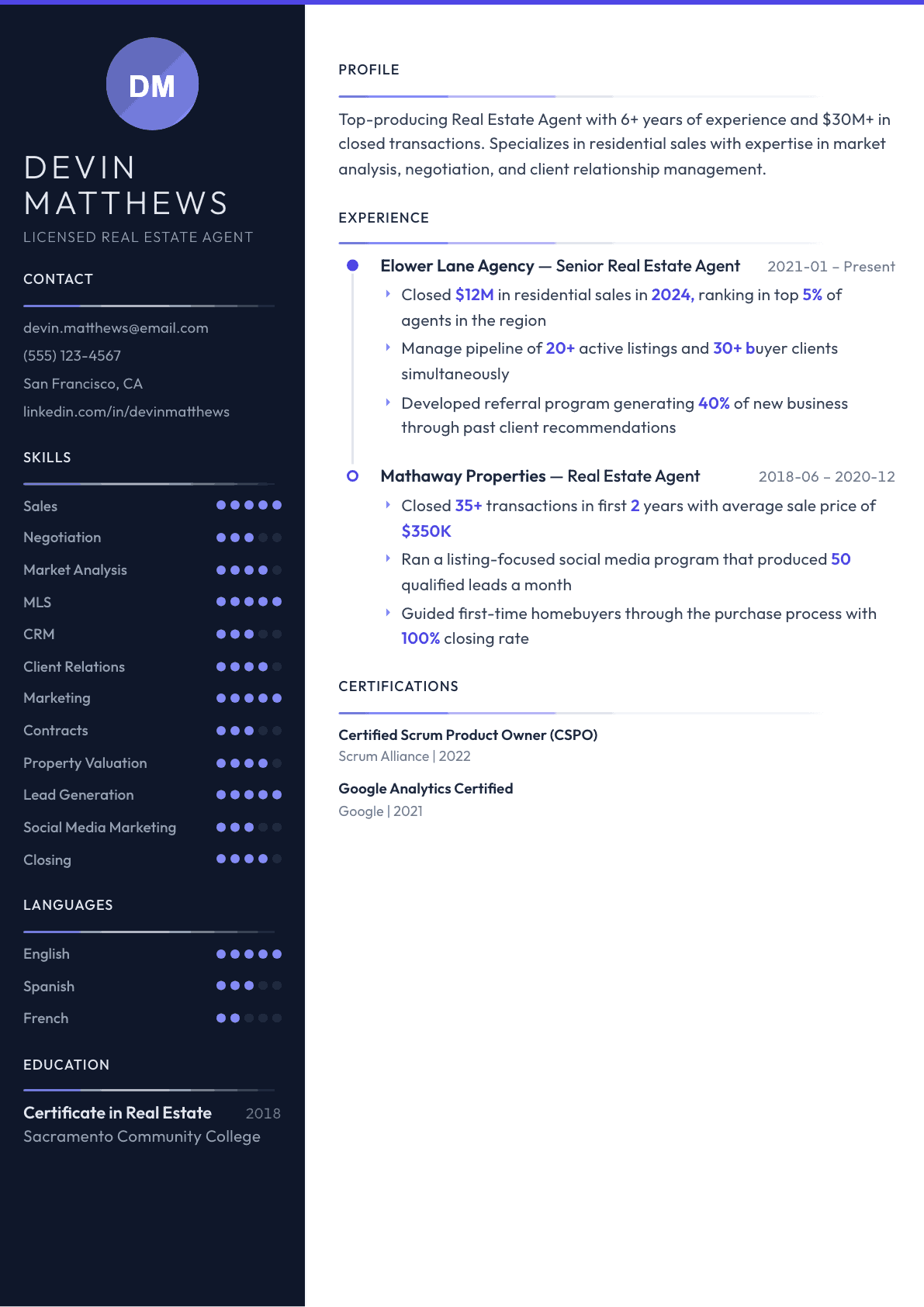
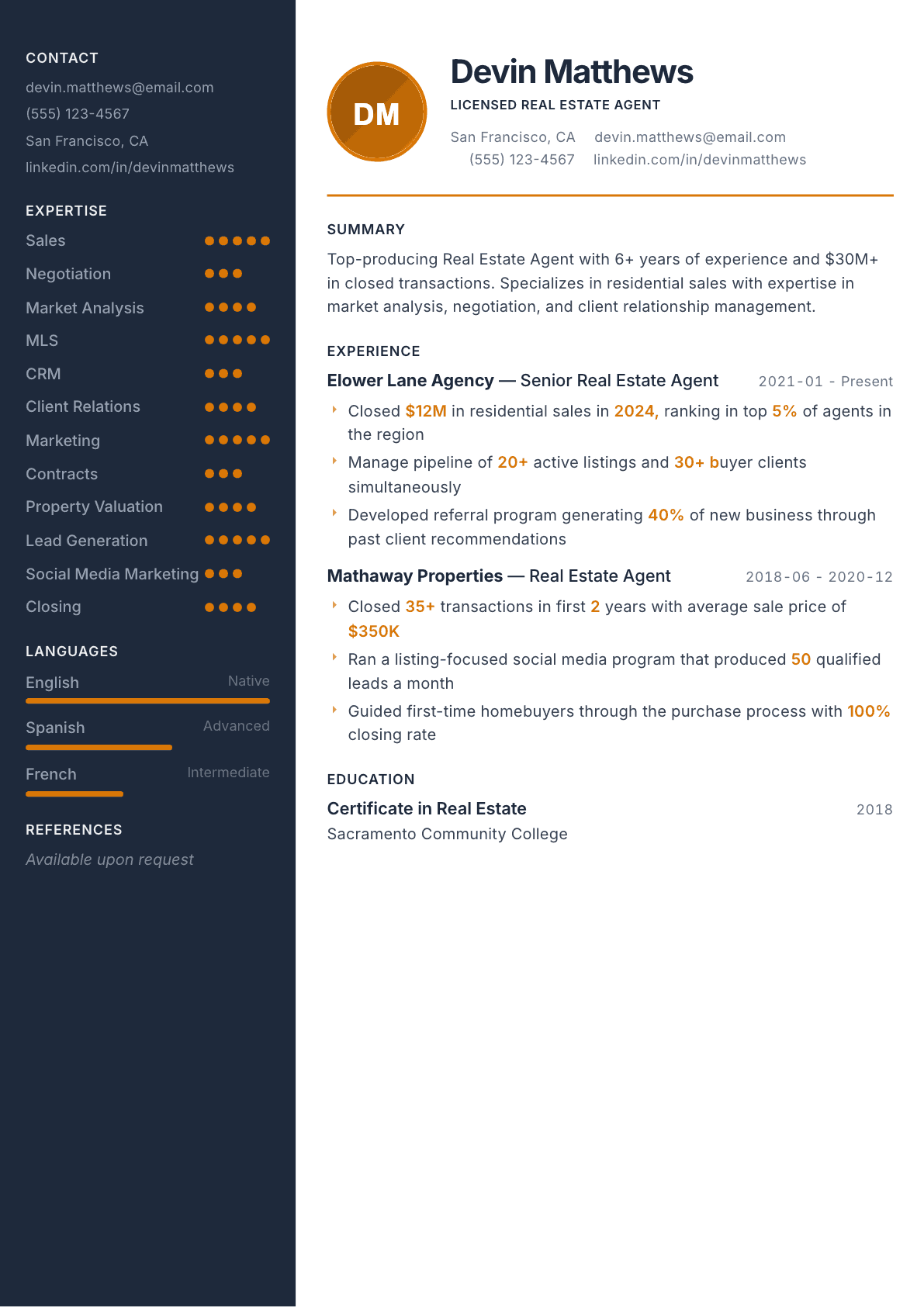
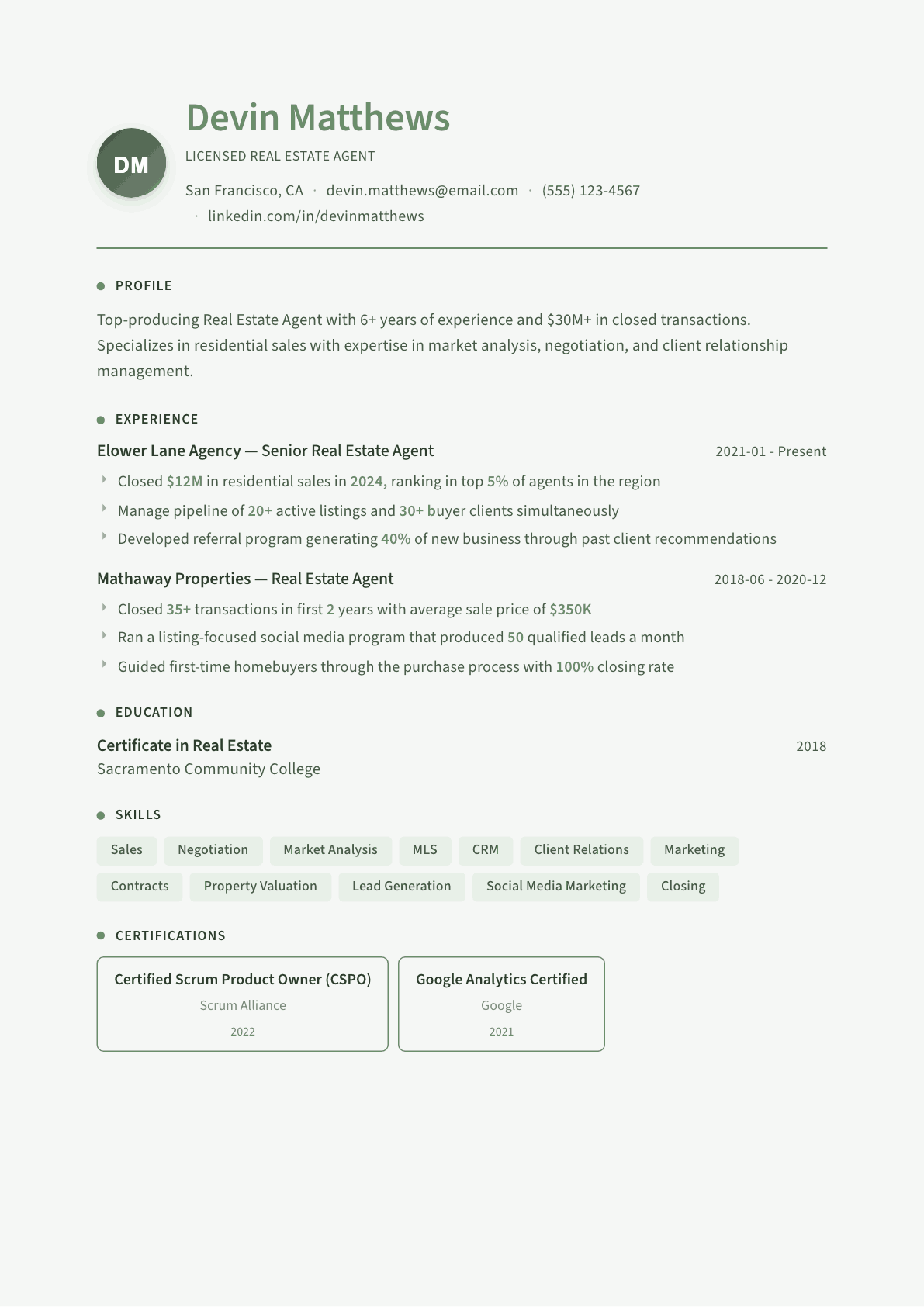
The same real estate agent content laid out in three CVBooster templates, so you can see what the finished document looks like before you write a word.
Example Real Estate Agent summary
Licensed residential agent, 6 years, $30M closed and $12M of it last year, which ranked in the top 5% of agents in the region. Carries 20 active listings and 30 buyer clients at once, and gets 40% of new business from a past-client referral program.
Skills to list on a Real Estate Agent resume
- Sales
- Negotiation
- Market Analysis
- MLS
- CRM
- Client Relations
- Marketing
- Contracts
- Property Valuation
- Lead Generation
- Social Media Marketing
- Closing
What actually gets this resume read
- Lead with total sales volume and transaction count.
- Show rankings or awards (top producer, million dollar club).
- Include marketing skills: social media, staging, photography.
- Highlight client satisfaction and referral rates.
- List real estate designations (CRS, ABR, GRI).
How to write a real estate agent resume
A real estate agent resume has an unusual audience. Most agents are independent contractors, so the reader is a managing broker or a team lead deciding whether to give you desk space, a lead source and a split. That reader is not scanning for duties. They are scanning for production: closed sides, volume, average sale price, days on market, list to sale price ratio and how much of your business came from your own sphere rather than the office pipeline.
The second audience is corporate. Relocation firms, new home builders, brokerages hiring salaried listing coordinators and institutional owners of single family rentals all run applicant tracking systems and want the license number, the MLS boards, the transaction management platform and the compliance record spelled out.
If a brokerage or builder asks for a CV for real estate work, this is the same document under another name. This guide covers an example real estate resume from top to bottom, what to put in the production block, how to write experience when you have been self-employed the whole time, summaries for a newly licensed agent, a producing agent and a team lead, before and after bullets, and the questions agents ask when a slow year sits in the middle of the record.
Format: one page, with a production block above experience
Reverse chronological, single column, one page unless you have run a team. The distinguishing feature of a strong agent resume is a short production block sitting directly under the summary: closed sides and volume by year, buyer and seller split, average sale price, and your primary property type. A managing broker can read that block and know whether to schedule a call.
Say who you hang your license with. Agents write brokerage names as if they were employers, which is fine, but add the structure: solo agent under a brokerage, member of a named team, or team lead with agents under you. Those are three very different candidates and the title alone hides which one you are.
- Header: name, city and the markets you serve, phone, email, license number and the state that issued it.
- Section order: summary, production snapshot, experience by brokerage, designations and license, marketing and systems, education.
- Name the MLS boards and associations you belong to, since board membership is a practical hiring detail in most markets.
Writing production without inventing numbers
Report sides, not just dollars. Twenty-two closed sides at a median price near the market median reads more honestly than a single volume figure, and it protects you in markets where one luxury sale would distort the picture. Split the sides into listings taken and buyers closed, because listing-heavy agents and buyer-heavy agents are hired for different seats.
Then add the quality metrics that a broker uses to judge how you work: average days on market against the board average, list price to sale price ratio, and the share of listings that closed rather than expired. Those three lines tell a broker whether you price property correctly, which is the skill they are actually screening for.
If you are new and have no production, do not fabricate a block. Replace it with the pipeline you built: open houses hosted, buyer consultations run, listings you supported for a mentor, and the lead sources you worked. Broker interviews for new agents are about work habits, not results that do not exist yet.
Experience: the transaction, the marketing, the compliance
Each brokerage entry needs bullets in three families. Transaction work: listing presentations, comparative market analyses, offer strategy in competitive situations, inspection and appraisal negotiation, and coordination with lenders, title and escrow through closing. Marketing: pricing strategy, photography and staging direction, single property sites, targeted social campaigns, open house programs and mailers into a defined farm area.
Compliance is the family agents skip and brokers notice. Disclosure handling, agency relationship documentation, clean file submission through the transaction management platform, and fair housing practice. A broker whose last hire generated a complaint reads that bullet closely.
Name the tools by product. MLS by board name, plus the customer relationship platform, the transaction platform such as Dotloop or SkySlope, the e-signature tool, and the customer relationship manager you actually keep current rather than the one your brokerage pays for.
Designations, license and continuing education
The National Association of Realtors designations are the ones brokers recognize on sight: the Accredited Buyer's Representative, the Seller Representative Specialist, the Graduate Realtor Institute, the Certified Residential Specialist and the Certified International Property Specialist. List them with the awarding body and skip the invented ones brokerages hand out internally.
Give the license its own line with the state, the number and the status, and add whether you hold a broker license or an associate broker license, because that determines whether you can supervise. If you are licensed in more than one state, say so and name them, since border markets treat dual licensure as a hiring advantage.
Keywords the screener is scanning for
Corporate and team postings repeat a small vocabulary: listing presentation, comparative market analysis, buyer consultation, contract to close, lead conversion, sphere of influence, farming, referral pipeline, relocation, new construction, and the platform names. Mirror the ones you can prove once in the summary and once in a bullet.
Adjust the vocabulary to the seat. A relocation team wants corporate client service, referral network and inventory knowledge. A new home builder wants onsite sales, model home hours and builder contract familiarity. An investor services desk wants rental analysis, cap rate discussion and off market sourcing. One resume sent to all three underperforms in all three.
Example real estate resume: a full sample
Here is an example real estate resume for a licensed agent with five years in residential sales, applying to join a larger team. It shows where the production block goes and how much detail each section needs.
If you have not closed many sides yet, keep the same shape and fill the production block with what you can prove: listings taken, open houses held, buyers under contract and the training you completed.
- Header: Daniel Brooks, Licensed Real Estate Agent, license number, state, MLS boards, phone, email.
- Production: closed sides over the last three years, total volume, average sale price, average days on market and the share of business from your own sphere, each on one line.
- Summary: Residential agent with five years in suburban resale and new construction, working mostly with first-time buyers and move-up sellers. Generates most business from a sphere database and open houses, and manages every file in the brokerage transaction platform from contract to close.
- Experience: one entry per brokerage, with bullets on listings, buyer representation, marketing and compliance.
- Designations and education: license, any designations such as ABR or SRS, and continuing education completed.
- Tools: MLS, the CRM by name, the transaction management platform, and e-signature software.
Real Estate Agent resume summary examples
Newly licensed
Newly licensed Real Estate Agent in the greater metro market, active on the local board MLS, with a background in retail sales and 40 open houses hosted while supporting a two-agent listing team. Completed the Accredited Buyer's Representative course. Seeking a mentored buyer-side seat.
Producing agent, five years in
Real Estate Agent with six years in residential resale, closing 24 to 30 sides a year at roughly 60% listings. Averages 14 days on market against a board average near 27, with a list-to-sale ratio above 99%. Half of annual business comes from past client referrals.
Team lead and associate broker
Associate Broker and team lead running four buyer agents and a transaction coordinator across two counties, with 140 closed sides last year. Owns lead routing, pricing review on every listing, and file compliance. Certified Residential Specialist licensed in two states.
Work experience bullets: before and after
Before: Helped buyers and sellers with residential transactions.
After: Closed 27 residential sides in the past year, 16 listings and 11 buyers, across single family resale and townhome inventory in three adjacent zip codes.
Sides, the listing to buyer split and the property type let a broker judge fit instead of guessing at scale.
Before: Priced homes competitively and marketed listings.
After: Built comparative market analyses for every listing and paired them with professional photography, staging direction and a single property site, holding average days on market at 14 against a board average near 27.
The method and a comparison against the board benchmark turn a claim about pricing into evidence of it.
Before: Generated leads through networking and social media.
After: Farmed a 600-home neighborhood with quarterly market mailers and two annual client events, converting the sphere into 12 listing appointments and 5 closed listings in a year.
A defined farm, a cadence and the appointments it produced show a repeatable lead system rather than activity.
Before: Negotiated offers on behalf of clients.
After: Negotiated 9 multiple-offer transactions to contract by structuring appraisal gap and inspection terms, and renegotiated repair credits after inspection on 14 files without a single contract falling apart.
Naming the negotiation levers and the outcome shows contract skill, which is what a broker is really hiring.
Before: Kept paperwork organized and on time.
After: Submitted every file through Dotloop with disclosures, agency documentation and signed addenda complete at contract, clearing broker compliance review with no returned files over two years.
Compliance is invisible until it fails, so a clean review record is a real differentiator to a managing broker.
Hard skills
- Comparative market analysis
- Listing presentations
- Buyer consultations
- Contract negotiation
- MLS listing input and search
- Dotloop and SkySlope transaction management
- CRM pipeline management
- Open house and farming campaigns
- Staging and photography direction
- Disclosure and agency compliance
- Fair housing practice
- Relocation and referral network
Soft skills
- Client advocacy
- Negotiation under pressure
- Follow-up discipline
- Expectation setting
- Local market storytelling
- Availability and responsiveness
Certifications worth listing
- Accredited Buyer's Representative (ABR) (Real Estate Buyer's Agent Council, National Association of Realtors)
- Seller Representative Specialist (SRS) (Real Estate Business Institute, National Association of Realtors)
- Graduate, Realtor Institute (GRI) (National Association of Realtors)
- Certified Residential Specialist (CRS) (Residential Real Estate Council)
- Certified International Property Specialist (CIPS) (National Association of Realtors)
- Seniors Real Estate Specialist (SRES) (National Association of Realtors)
- At Home With Diversity (AHWD) (National Association of Realtors)
Mistakes that cost real estate agent candidates the interview
- Reporting volume without sides, which lets one unusual sale stand in for a year of production and reads as evasive to a broker.
- Leaving the license number and issuing state off the header when brokers and relocation firms verify it before the first call.
- Describing yourself as passionate about helping people find their dream home, a line on almost every agent resume and evidence of nothing.
- Hiding whether you were solo, on a team or leading one, when that single fact changes which seat you are a candidate for.
- Skipping the compliance record entirely, so a managing broker cannot tell whether your files arrive clean.
- Using a resume aimed at buyers and sellers rather than at a broker or team lead, who is the actual reader.
Real Estate Agent resume questions
How do I write a real estate agent resume with no closed transactions?
Replace the production block with activity and preparation: open houses hosted, buyer consultations run, listings supported for a mentor, the board you joined, and the lead sources you are working. Brokers hiring new agents screen for work habits and coachability.
Should I include commission income on my resume?
No. Report closed sides, sales volume and average sale price instead. Income depends on your split and your brokerage cap, so it tells the reader more about your contract than about your ability, and most brokers will read it as odd.
How do I explain a slow year in the middle of my record?
State it plainly in the experience entry rather than leaving a gap. Inventory shortages, a market pause, a relocation, a licensing move or a leave are all normal, and a one-line explanation next to the year keeps the reader from assuming something worse.
Is a CV for real estate different from a real estate resume?
In the US, no. Brokerages, builders and relocation firms that ask for a CV for real estate jobs want the same one or two page document: license and MLS boards in the header, the production block, then experience and designations. Keep a longer academic style CV for teaching, research or expert witness work in real estate.
What goes on a resume for a corporate or relocation real estate role?
Shift the emphasis from personal branding to process: contract to close coordination, service level agreements, referral network management, corporate client reporting and the transaction platform you used. Those roles run applicant tracking systems, so mirror the posting wording exactly.
Related resume examples
- Sales Representative Resume example
- Account Manager Resume example
- Property Management Resume example
- Home Stager Resume example
- Realtor Resume example
- Real Estate Assistant Resume example