Home Inspector Resume Examples: the lines they read
Write a Home Inspector Resume That Shows Licensing and Report Quality
By Mustafa Tarabya, founder of CVBooster · Published · Updated
Home inspector resume example, keyword list and writing guide covering inspection volume, licensing, ancillary services, report software and referral sources.
Sample resumes for a home inspector
The same home inspector content laid out in three CVBooster templates, so you can see what the finished document looks like before you write a word.
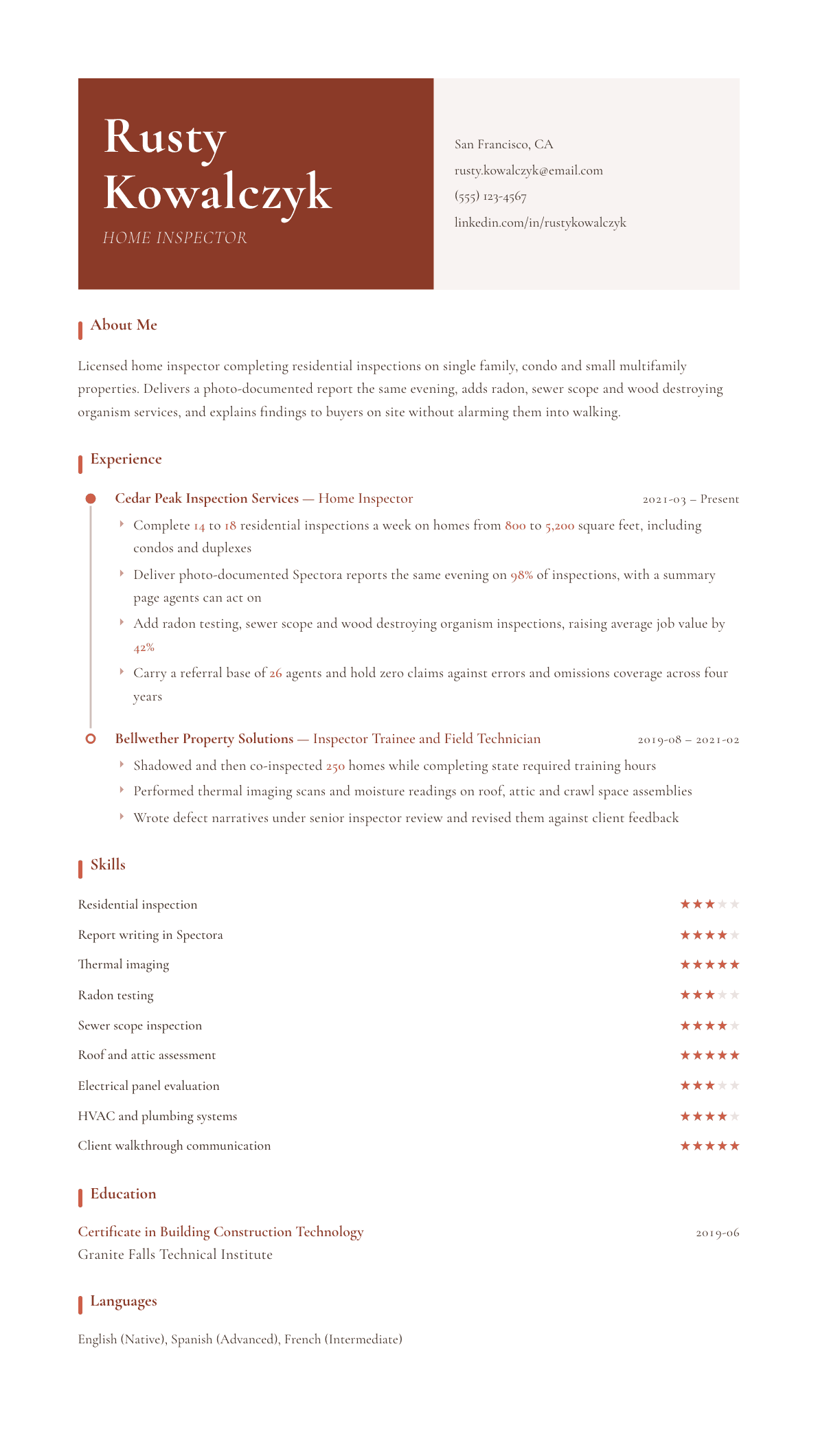
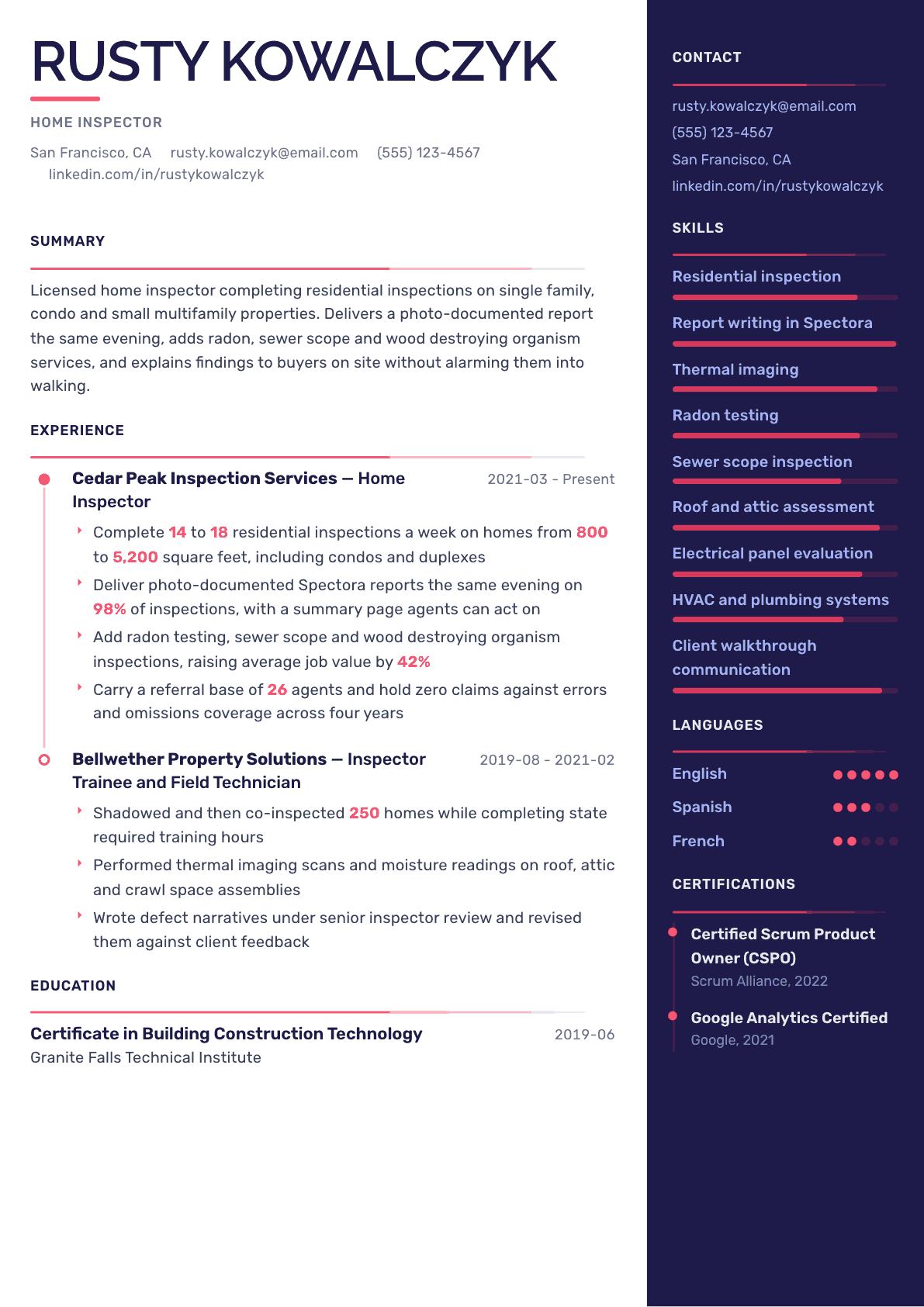
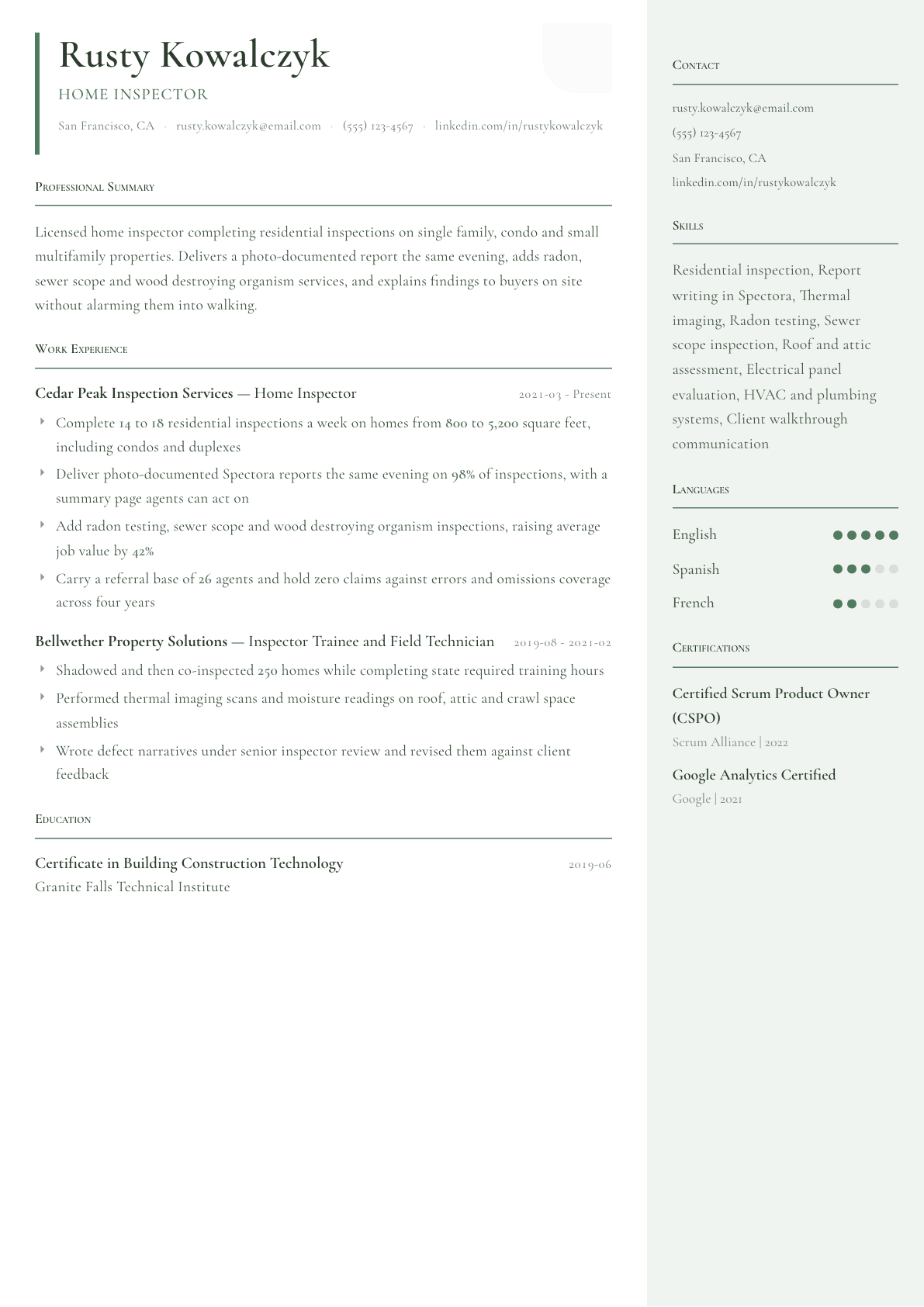
Example Home Inspector summary
Licensed home inspector with five years completing fourteen to eighteen residential inspections a week across single family homes, condos and duplexes. Delivers photo-documented Spectora reports the same evening and adds radon, sewer scope and pest services on most jobs. Carries a referral base of more than two dozen agents and no claims against errors and omissions coverage. Trained in thermal imaging and moisture diagnostics.
Skills to list on a Home Inspector resume
- Residential property inspection
- Structural and foundation assessment
- Roof and exterior evaluation
- Electrical system inspection
- Plumbing system inspection
- HVAC evaluation
- Attic, insulation and ventilation
- Crawl space and moisture inspection
- Thermal imaging
- Radon measurement
- Sewer scope inspection
- Wood destroying organism inspection
- Spectora and HomeGauge reporting
- Defect narrative writing
- Client walkthrough and consultation
What actually gets this resume read
- Put your state inspector license number and expiry near your name, since many states will not let you work without it.
- Give weekly or annual inspection volume and the property types you cover, from condos to small multifamily.
- Name your ancillary services, because radon, sewer scope, mold and pest work is where inspection income grows.
- State your report software and turnaround time, since agents choose inspectors on same day delivery more than on price.
- List your errors and omissions coverage and any claims record, because that is the first question a firm owner asks.
- Show where work comes from: agent referrals, past clients, relocation companies or direct search traffic.
- Mention the trades background you came from, whether electrical, roofing, HVAC or general construction.
How to write a home inspector resume
A home inspector resume is read either by an inspection firm owner adding capacity or by a franchise deciding whether to bring you on as a contractor. Both are asking the same practical questions: are you licensed here, how many inspections can you turn in a week, how fast is your report, and has anyone ever made a claim against you.
The version that fails reads like a general trades resume. It lists construction knowledge, attention to detail and customer service, and never states inspection volume, report software or ancillary services. Inspection is a production business with a liability tail, and the resume has to speak to both halves.
This guide covers licensing and continuing education, how to state volume and property types, why report turnaround is a competitive metric, how to present ancillary services as revenue, and how to describe your referral base and claims history without overstating either.
Format: license first, production second, trades background third
One page is enough for most inspectors. The reader is checking eligibility and throughput, and a long narrative about building science will not change either answer.
If you are applying to a multi-state firm, put every state license you hold in the header with its number and expiration month. Firms buy geographic coverage, and an inspector licensed in two adjoining states is immediately more useful than one who is not.
- Header: name, service area, phone, email, state inspector license numbers, and errors and omissions coverage status.
- Order the page as summary, inspection volume and property types, services offered, experience, credentials, trades background.
- Under each role state weekly or annual inspection count, typical square footage range, and report turnaround.
- Add a short equipment line covering thermal camera, moisture meter, gas detector, sewer camera and drone if you fly one.
Volume and property types: what you can actually cover
Give inspections per week and the size range of the homes. Fourteen to eighteen a week on properties from small condominiums to homes over five thousand square feet is a workload statement, and it is the number a firm owner divides into their schedule.
Name the property types. Single family resale, condominiums with limited scope, small multifamily, new construction phase inspections, manufactured homes on permanent foundations and homes on well and septic all require different knowledge and different report sections. Firms often need a specific one covered.
If you inspect older housing stock, say so. Knob and tube wiring, cast iron and galvanized supply lines, asbestos containing materials and undersized service panels are the findings that generate calls after the report, and an inspector who writes them clearly is worth more in an older market.
The report is the product
Buyers and agents judge you on the report, not the walkthrough. Say which software you use and what you deliver: a photo documented report with a summary section that separates safety items from maintenance items, delivered the same evening.
Turnaround is a competitive metric because inspection contingency periods are short. State your same day or next morning delivery rate, and if you cap daily inspections to protect it, say that too. It reads as discipline rather than limited capacity.
Describe your writing standard. Defect narratives that state the observation, the implication and the recommended action, without predicting cost or naming a contractor, keep the report defensible. That is a real skill and few resumes claim it in concrete terms.
Ancillary services and revenue per job
Ancillary work is where inspection income grows, so list what you are certified and equipped to add: radon measurement, sewer scope, wood destroying organism inspection where your state allows it, mold sampling, water quality testing, thermal imaging scans and pool or septic evaluations.
Say what share of jobs include an add-on or how much they lift average job value. A firm owner reading that number is calculating revenue per inspector, and it is one of the few places a home inspector can put a business result on a resume.
Note any service that requires a separate state license or registration, such as radon measurement or pest inspection, and confirm you hold it. Claiming a service you cannot legally perform in that state is the fastest way to lose an offer.
Liability, referrals and where the work comes from
State your errors and omissions and general liability coverage status and your claims history. A clean record over a stated number of years is a strong line, and firm owners ask about it in the first conversation because their premium depends on the answer.
Then referrals. Count the real estate agents who sent work in the last year, and mention relocation companies, past client repeat business and direct search inquiries separately. An inspector who arrives with a referral base is bringing revenue, not just labor.
Close with the trades background you came from. Electrical, roofing, HVAC, plumbing or general construction experience explains why your findings are reliable, and it is the part of your history that a client cares about when you are standing in their crawl space explaining what you found.
Home Inspector resume summary examples
Newly licensed inspector
Newly licensed home inspector with 250 co-inspected homes completed during training and eight years as a residential electrician before that. Comfortable with thermal imaging and moisture readings, writes defect narratives to a reviewed standard, and delivers reports the same evening on every inspection.
Full-time inspector
Licensed home inspector completing 14 to 18 residential inspections a week on single family homes, condominiums and duplexes. Delivers photo documented reports the same evening on 98% of jobs, adds radon, sewer scope and pest services, and carries a referral base of 26 agents with no claims in four years.
Lead inspector and trainer
Lead inspector with eleven years and roughly six thousand inspections across resale, new construction phase work and small multifamily. Trains and reviews two junior inspectors, holds radon measurement and pest credentials, and rebuilt the firm report template to separate safety findings from maintenance items.
Work experience bullets: before and after
Before: Performed home inspections for buyers and sellers.
After: Completed 14 to 18 residential inspections a week on homes from 800 to 5,200 square feet, including condominiums, duplexes and properties on well and septic.
Weekly volume, size range and property types tell a firm owner exactly what you can be scheduled for.
Before: Wrote detailed inspection reports for clients.
After: Delivered photo documented Spectora reports the same evening on 98% of inspections, with a summary page separating safety items from routine maintenance.
Turnaround rate, the software and the report structure describe the product a client actually receives.
Before: Offered additional testing services during inspections.
After: Added radon testing, sewer scope and wood destroying organism inspections to most jobs, raising average job value by 42% without extending time on site.
Ancillary services with a revenue effect turn a service list into a business result an owner can price.
Before: Used thermal imaging and other tools during inspections.
After: Ran thermal imaging and moisture meter scans on roof, attic and crawl space assemblies, identifying active leaks that visual inspection alone would not have found.
Naming where the tools are applied and what they catch shows technique rather than equipment ownership.
Before: Built good relationships with real estate agents.
After: Maintained a referral base of 26 agents who booked repeat work, supported by same evening reports and a post-inspection call to explain findings without alarming the buyer.
A counted referral base with the reasons behind it shows a book of business that would travel with you.
Hard skills
- Residential property inspection
- Structural and foundation assessment
- Roof covering and flashing evaluation
- Electrical service and panel inspection
- Plumbing supply and drainage inspection
- HVAC system evaluation
- Attic insulation and ventilation assessment
- Crawl space and moisture intrusion diagnosis
- Thermal imaging
- Radon measurement
- Sewer scope inspection
- Wood destroying organism inspection
- Spectora and HomeGauge reporting
- Defect narrative writing
Soft skills
- Explaining findings without frightening a buyer
- Neutrality between buyer and agent
- Physical stamina in attics and crawl spaces
- Time management across three inspections a day
- Saying what you did not inspect and why
Certifications worth listing
- ASHI Certified Inspector (ACI) (American Society of Home Inspectors)
- Certified Professional Inspector (CPI) (International Association of Certified Home Inspectors)
- National Home Inspector Examination (Examination Board of Professional Home Inspectors)
- National Radon Proficiency Program Measurement Certification (American Association of Radon Scientists and Technologists)
Mistakes that cost home inspector candidates the interview
- Leaving the state license number and expiration off the header when licensing decides eligibility outright.
- Describing construction knowledge without stating how many inspections you complete in a week.
- Omitting report software and turnaround, which is what agents actually choose an inspector on.
- Listing ancillary services you are not separately licensed to perform in the states you are applying to.
- Skipping the claims and coverage line, the first question a firm owner asks because it affects their premium.
- Failing to name the trades background that makes your findings credible to a client on site.
- Writing defect narratives on the resume that predict repair cost, which signals a habit that creates liability.
Home Inspector resume questions
Does every state require a home inspector license?
No. Some states license and regulate inspectors, others have no licensing at all, and a few require registration with continuing education. Put whatever your state requires in the header and add your association credentials, which carry weight in unlicensed states where firms need another quality signal.
How many inspections a week should I claim?
Report your realistic sustained number rather than your busiest week, and mention whether you cap the daily count to protect report quality. An owner scheduling you will plan around the figure you give, so an inflated number creates a problem in your first month.
Is it worth listing ancillary services if I only do them occasionally?
Yes, provided you hold the required credential and equipment. List the service and the credential, and be honest about frequency in the interview. Firms value the capability because it lets them quote a full package without subcontracting the extra work.
Should I mention a past claim against my inspection work?
Do not put it on the resume, but be prepared to discuss it factually if asked during underwriting for coverage or in an interview. What helps is describing the process changes you made afterward, such as a revised report disclaimer or a change to how you document limited access areas.
How do I transition into inspection from a trade?
Lead with the trade years and what they let you see that others miss, then add your training hours, examination result and any co-inspections completed. Firms hire from the trades regularly because system knowledge is harder to build than report writing, which can be taught quickly.
Related resume examples
- Building Inspector Resume example
- Construction Inspector Resume example
- Real Estate Appraiser Resume example
- Real Estate Agent Resume example
- Home Stager Resume example
- Commercial Real Estate Agent Resume example