Composer Resume Examples: free score, then the gap list
Write a Composer Resume That Wins the Scoring Call
By Mustafa Tarabya, founder of CVBooster · Published · Updated
Composer resume examples for film, game and concert work, covering credits, orchestration, delivery specs and the links a music supervisor opens.
Sample resumes for a composer
The same composer content laid out in three CVBooster templates, so you can see what the finished document looks like before you write a word.
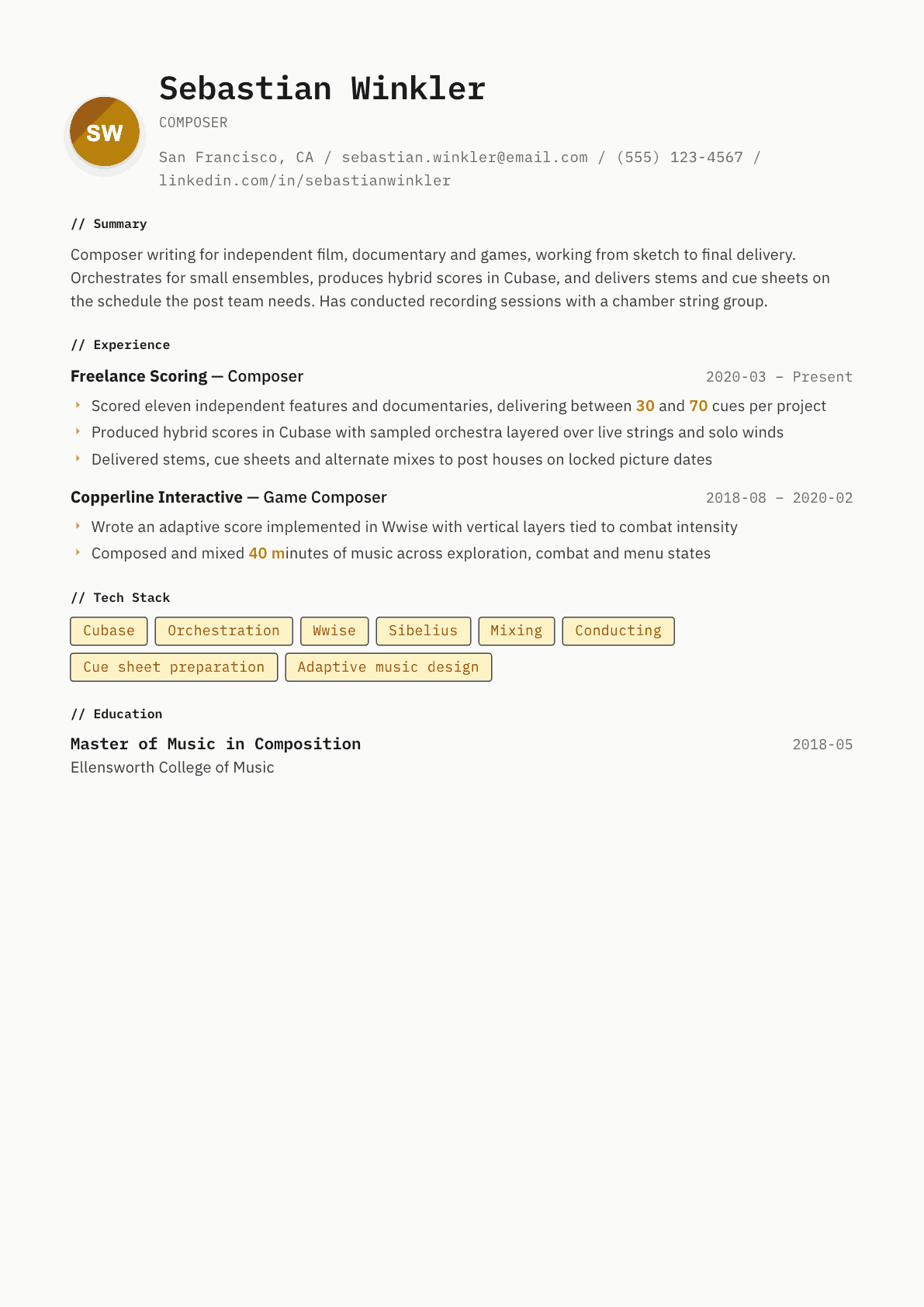
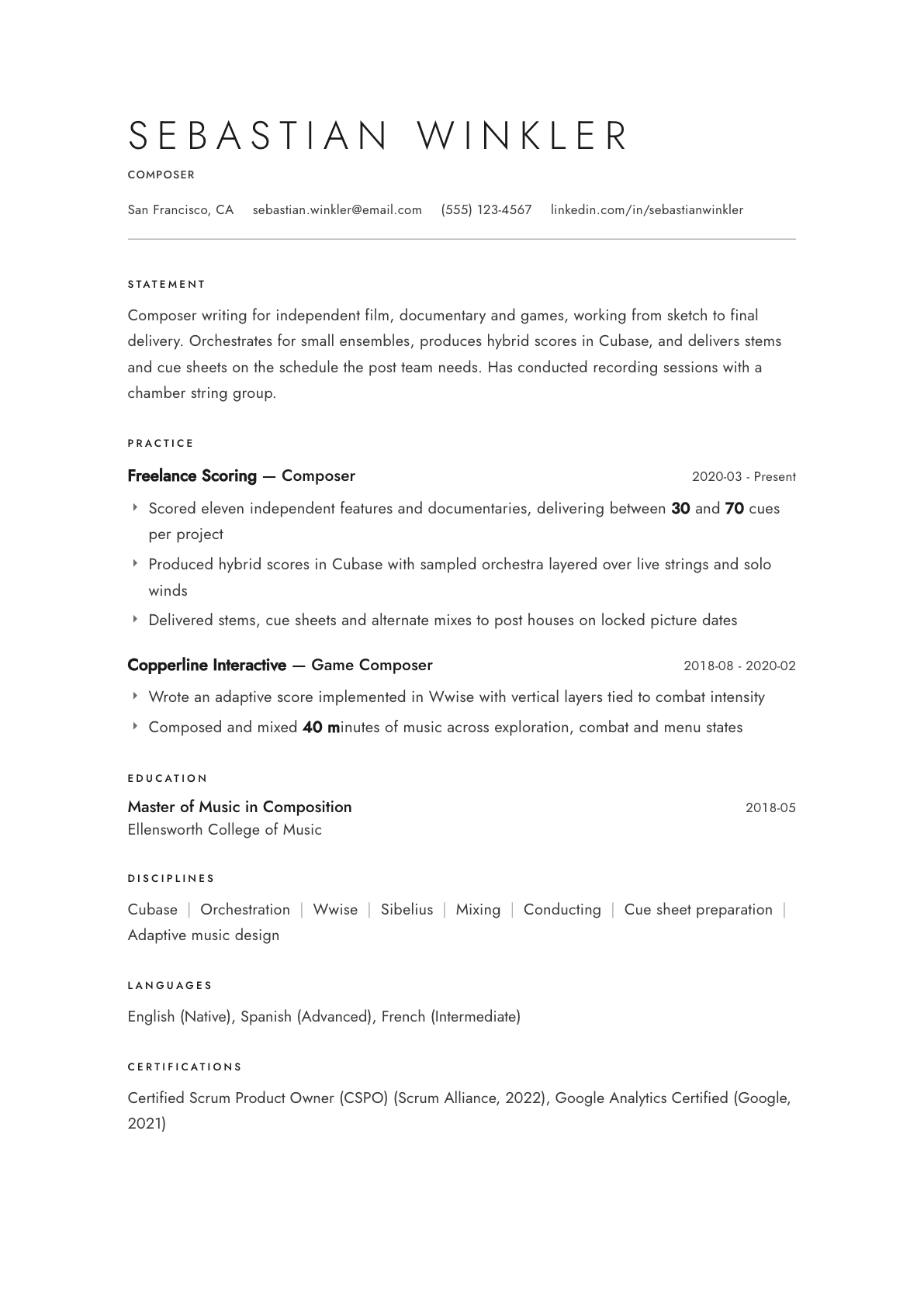
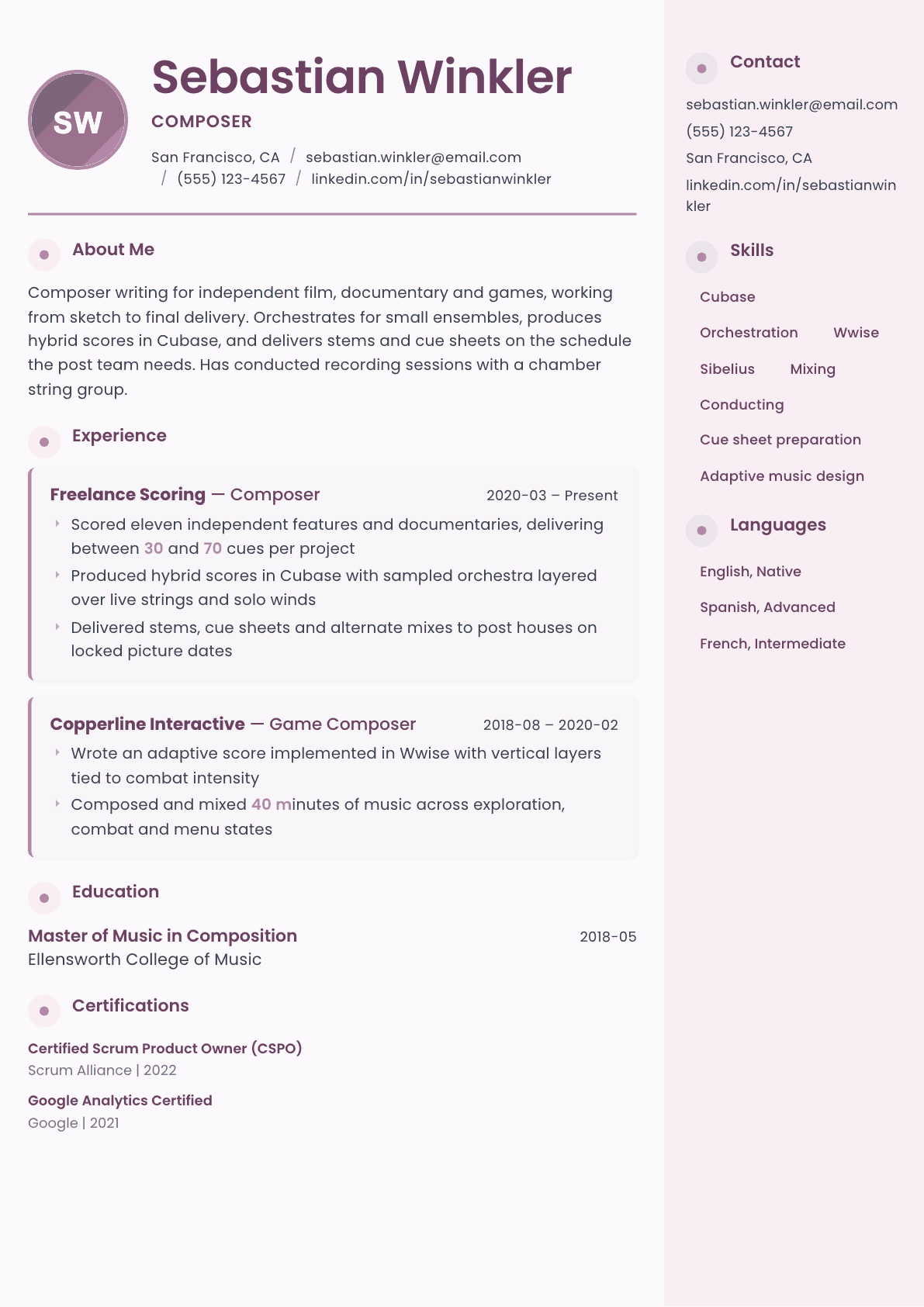
Example Composer summary
Composer with credits across independent film, documentary and games, writing hybrid scores that mix sampled orchestra with live players. Orchestrates and conducts small ensemble sessions, produces in Cubase, and implements adaptive music in Wwise. Delivers cues, stems and cue sheets on locked picture dates without chasing from the post team. Comfortable in spotting sessions with directors who do not read music.
Skills to list on a Composer resume
- Composition
- Orchestration
- Arranging
- Cubase
- Logic Pro
- Sibelius
- Dorico
- Wwise
- Adaptive music design
- Sampled orchestral production
- Mixing and stem delivery
- Conducting
- Session preparation
- Cue sheet preparation
- Spotting sessions
What actually gets this resume read
- Put a link to three contrasting cues at the top, because a director listens before reading a single credit line.
- List credits with the project title, the format, the director and the number of cues you actually wrote.
- Separate film, television, game and concert work, since each field checks different technical skills.
- Name your notation and audio tools, whether Cubase, Logic, Sibelius, Dorico or Wwise, because pipelines are tool specific.
- Say whether you orchestrate, conduct, mix and deliver stems yourself, since that decides the budget a producer needs.
- Mention cue sheets and rights administration, because paperwork competence is a real reason composers get rehired.
How to write a composer resume
A director hires a composer with their ears and keeps them with paperwork. The music decides the first conversation, which is why three contrasting cues belong at the top of the page. The second conversation is entirely practical: can this person orchestrate, can they deliver stems on the locked picture date, do they know what a cue sheet is, and will the post supervisor have to chase them.
That practical half is where most composer resumes go quiet, and it is exactly where a producer forms an opinion about risk. A composer who delivers alternates, correctly labeled stems and a completed cue sheet without being asked is rehired regardless of budget, because the alternative costs the production real time in the final week.
This guide covers cue links and credit formatting, how to separate film, television, game and concert work, what to say about orchestration and conducting, how to write about adaptive music implementation, and the delivery vocabulary that reassures a post team.
Format: three cues at the top, credits underneath
One page, with a link to three contrasting cues directly under your name and a one line description of each. A director listens before reading, and a labeled trio of cues that show range answers more in ninety seconds than a full credit list does in five minutes.
Below the cues, list credits in a consistent shape: project title, format, director or studio, and the number of cues or minutes of music you wrote. Cue counts and minutes are the only honest scale measure in scoring work, and they let a producer judge whether you have carried a project the size of theirs.
- Header: name, city, email, link to three labeled cues, portfolio or catalog page.
- Sections: film and documentary, television, games and interactive, concert and commissioned work.
- A technical block covering notation software, digital audio workstation, middleware and delivery formats.
- A short line on what you handle yourself: orchestration, conducting, mixing, stem delivery, cue sheets.
Summary: the kind of score you write and how much of it you handle
Say what the music sounds like in concrete terms, whether that is hybrid orchestral and electronic, chamber acoustic, synth driven or song based, and say the formats you write for. A director casting a documentary and a studio casting a game cinematic are looking for different sentences and only one of them is yours.
Then say how much of the chain you own. A composer who orchestrates, produces, conducts a small session and mixes to stems removes three line items from a budget, and a producer working with limited money reads that line as the reason to call you first.
Credits: cue counts, formats and the people who directed
Give each credit the project format explicitly: feature, short, documentary, series, game, trailer, concert commission. Each format has its own delivery culture, and a documentary scored over months is a different working experience from a trailer turned around in days.
Name the director or the studio where you can, because in scoring the relationship is the credential. Say whether you worked from a temp score, from a spotting session, or from a brief, because a director wants to know how you take direction on music they cannot describe in musical language.
For game work, describe the implementation. Adaptive scores written in vertical layers or horizontal transitions and implemented in middleware such as Wwise or FMOD are a technical skill, and studios screen for the middleware name directly.
Craft: orchestration, sessions and the live element
Say whether you orchestrate your own music and prepare your own parts. Session preparation, meaning clean parts, clear rehearsal marks and a workable session plan, is a competence that keeps a recording day on schedule, and musicians and contractors notice when it is missing.
If you have conducted, name the ensemble size and the setting. Recording a chamber string group over a sampled mock up is a common and demanding format, and a composer who has stood in front of players and fixed a cue in the room is a lower risk hire than one who has only produced in a box.
Delivery: the vocabulary a post team wants to see
Write the delivery terms plainly: stems by instrument group, alternate mixes, printed masters at the required specification, cue sheets, session archives. Post supervisors have been burned by late or mislabeled deliveries, and seeing the correct words on a resume is a genuine reassurance.
Mention rights administration lightly but clearly: registration with a performing rights organization, cue sheet preparation and licensing of any sampled or third party material. Paperwork competence is an unglamorous but real reason composers get called back for the next project.
Composer resume summary examples
First scoring credits
Composer writing for student and independent short films, producing hybrid cues from a home setup with sampled orchestra and a small live overdub. Orchestrates and mixes own material, delivers labeled stems and completed cue sheets, and reads and writes notation for chamber sized live sessions.
Working screen composer
Composer with credits across independent film, documentary and games, writing hybrid scores that mix sampled orchestra with live players. Orchestrates and conducts small ensemble sessions, produces in Cubase, and implements adaptive music in Wwise. Delivers cues, stems and cue sheets on locked picture dates.
Established composer
Composer with feature, series and interactive credits, running a small team of orchestrators and assistants across overlapping schedules. Leads spotting sessions with directors who do not read music, conducts recording days with chamber and mid sized ensembles, and manages delivery, licensing and cue sheet administration.
Work experience bullets: before and after
Before: Wrote music for independent films.
After: Scored eleven independent features and documentaries, writing between 30 and 70 cues per project from spotting session through to final delivery.
Project count and cue range give a producer a real sense of scale and workload capacity.
Before: Made hybrid orchestral music.
After: Produced hybrid scores in Cubase with sampled orchestra layered under live strings and solo winds, recording the overdubs in a single session day per project.
Naming the live layer and the session structure shows the workflow, not just the genre label.
Before: Delivered the music to the post team.
After: Delivered stems by instrument group, alternate mixes and completed cue sheets to post houses on locked picture dates, with a labeled session archive for each project.
The delivery specifics answer the risk question a post supervisor is silently asking.
Before: Composed music for a video game.
After: Wrote an adaptive score implemented in Wwise with vertical layers tied to combat intensity, and mixed 40 minutes of music across exploration, combat and menu states.
Middleware, the adaptive structure and total minutes prove interactive scoring rather than linear writing.
Before: Worked closely with directors.
After: Ran spotting sessions with directors who do not read music, translating references and temp cues into a written cue list with agreed timings before writing began.
It describes a repeatable process for turning vague feedback into music, which is the job behind the job.
Hard skills
- Composition
- Orchestration
- Arranging
- Cubase
- Logic Pro
- Sibelius
- Dorico
- Wwise
- Adaptive music design
- Sampled orchestral production
- Mixing and stem delivery
- Conducting
- Session preparation and part writing
- Cue sheet preparation
- Spotting sessions
Soft skills
- Taking notes on unfinished music
- Working to locked dates
- Translating a director reference
- Managing assistants
- Calm in the final week
- Clear client updates
Mistakes that cost composer candidates the interview
- Linking a long playlist instead of three labeled contrasting cues, which asks a director to do the curating for you.
- Listing project titles with no format, director or cue count, so a producer cannot judge the size of anything you have done.
- Leaving out delivery detail, which is the exact area where post supervisors have been burned and now screen carefully.
- Writing about game scores without naming the middleware or the adaptive structure, which reads as linear music placed in a game.
- Claiming orchestration and conducting without saying the ensemble size or setting, which invites an easily failed question.
- Ignoring cue sheets and rights administration, the unglamorous competence that decides whether a production rehires you.
Composer resume questions
What should a composer link to at the top of a resume?
Three contrasting cues with a one line description of each, chosen to show range rather than to show the biggest project. A director listens first, and a labeled trio answers more than a long catalog page does.
How do I list scoring credits?
Project title, format, director or studio, and the number of cues or minutes of music you wrote. Format matters because documentary, trailer, series and game work each have different delivery cultures and a producer is matching theirs.
Do I need to say whether I orchestrate my own music?
Yes, because it changes the budget. A composer who orchestrates, prepares parts, conducts and mixes removes several roles from the production, and one that does not needs those roles funded from somewhere.
How much technical detail belongs on a composer resume?
Enough to prove pipeline fit: notation software, digital audio workstation, middleware, sample libraries and delivery formats. Keep it to one compact block so it informs the practical reader without crowding out the credits.
How do I get started with no professional scoring credits?
Score student and independent shorts, write cues to picture as portfolio pieces, and treat each one as a real delivery with stems and a cue sheet. Directors hire on the sound plus the evidence that working with you will be uneventful.