Illustrator Resume Examples: free ATS score and gap list
Design an Illustrator Resume That Captures Attention
By Mustafa Tarabya, founder of CVBooster · Published · Updated
Create a professional illustrator resume highlighting your artistic range, client work, and visual storytelling with creative resume templates.
Sample resumes for a illustrator
The same illustrator content laid out in three CVBooster templates, so you can see what the finished document looks like before you write a word.
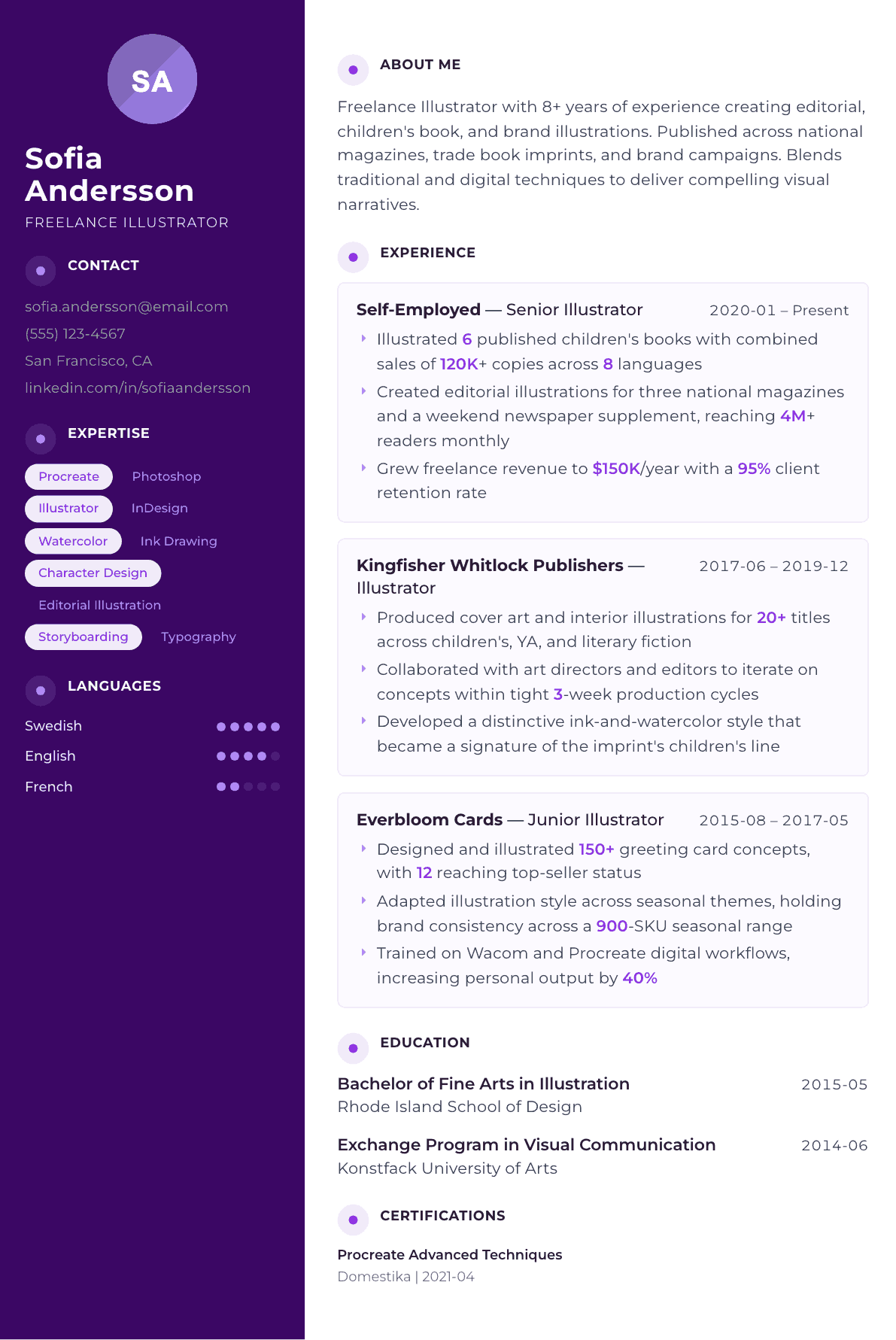
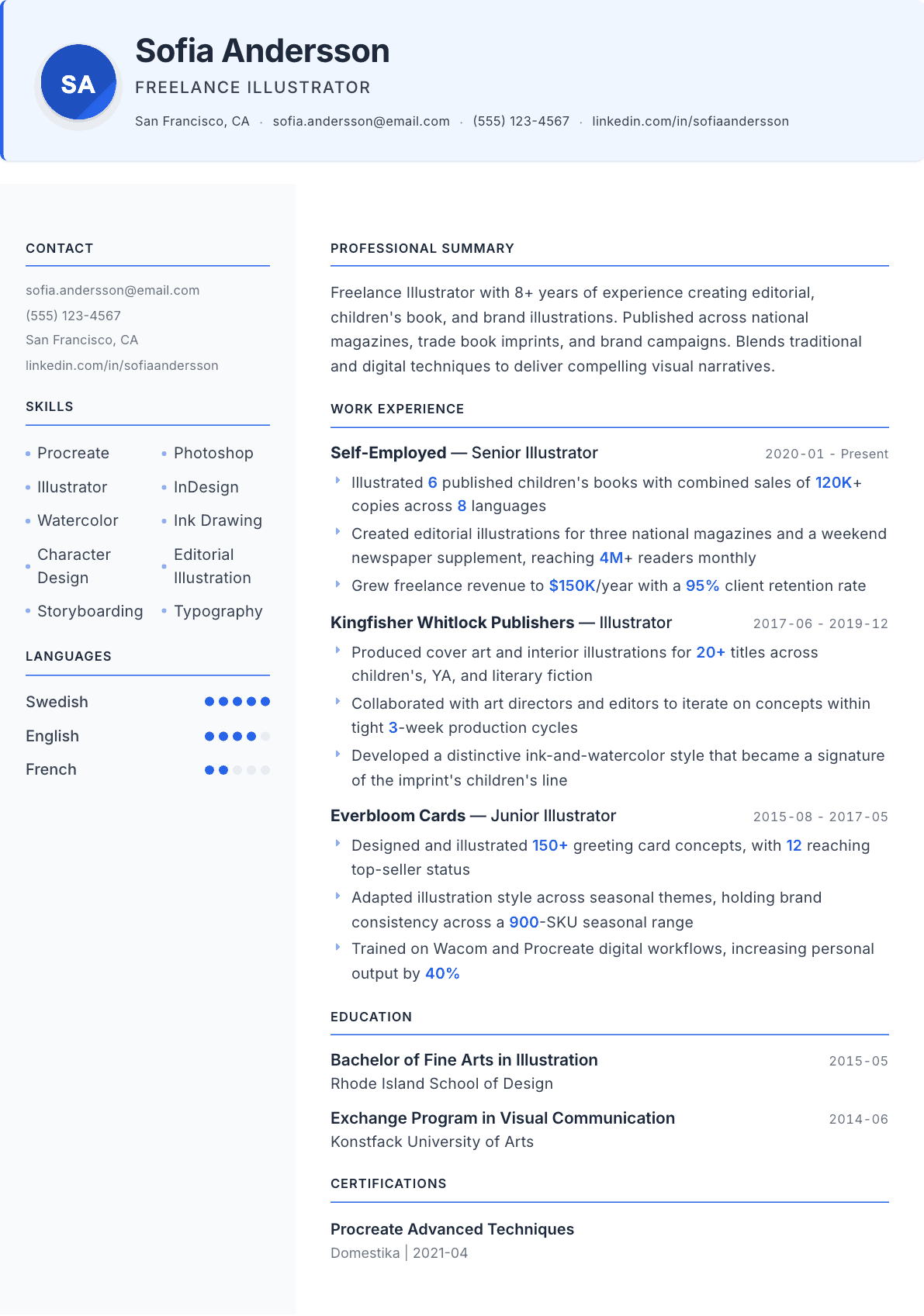
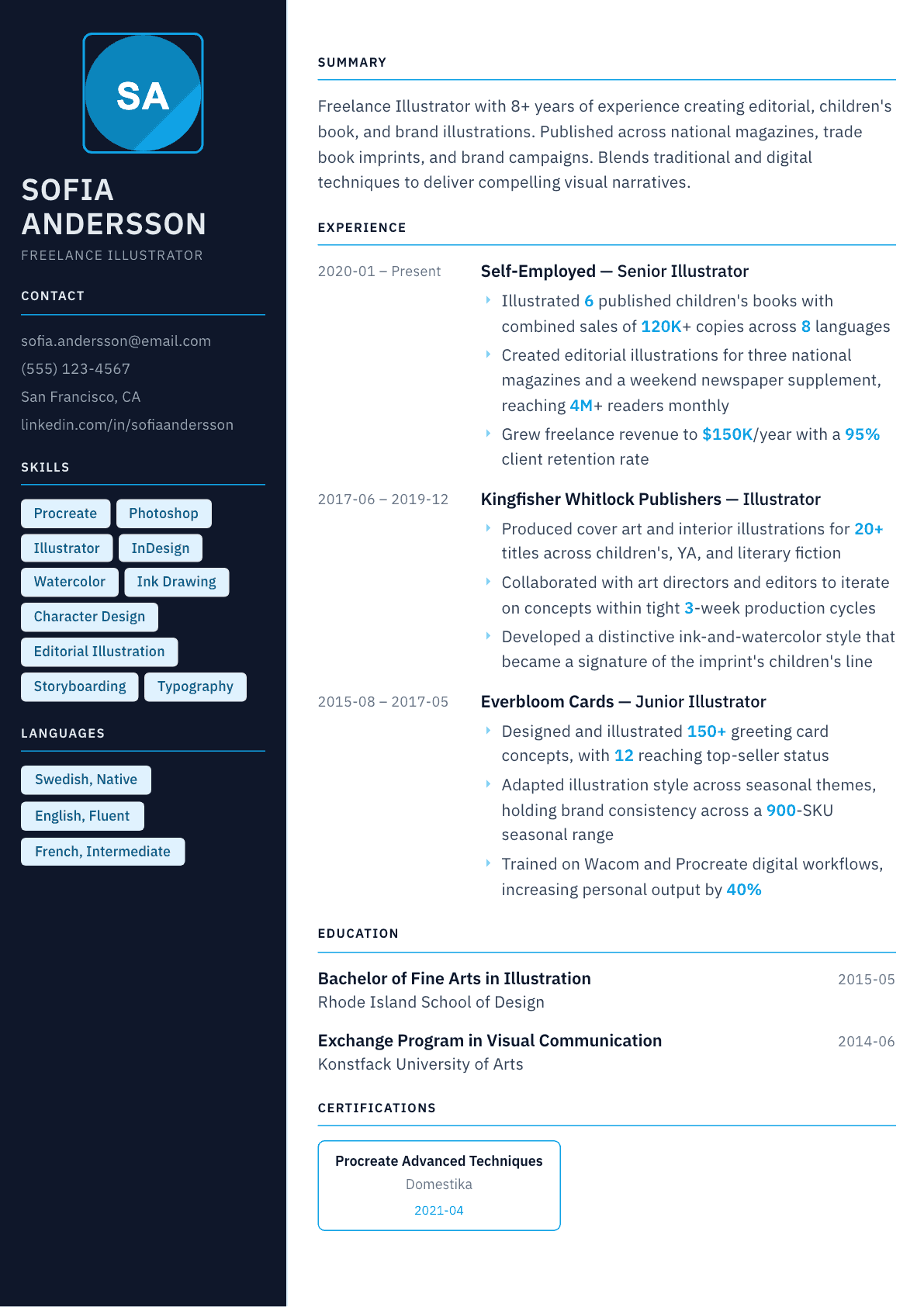
Example Illustrator summary
Illustrator with 8 years in editorial, children's book, and brand work. Six published picture books with 120K+ copies sold in 8 languages, plus regular editorial commissions for national magazines. Works in ink and watercolor alongside Procreate and Photoshop.
Skills to list on a Illustrator resume
- Digital Illustration
- Traditional Media
- Character Design
- Editorial Illustration
- Children's Book Illustration
- Procreate
- Photoshop
- Illustrator
- InDesign
- Watercolor
- Ink & Pen
- Typography
- Storyboarding
- Concept Art
What actually gets this resume read
- Your portfolio link is the most important element -- place it prominently at the top of your resume.
- Mention published work by name and publisher to build immediate credibility.
- Show versatility by listing different illustration styles and mediums (digital, watercolor, ink, vector).
- Quantify where possible: number of published works, print runs, audience reach, or revenue generated.
- Include client testimonials or notable awards (Society of Illustrators, Communication Arts, etc.).
- Tailor your resume to the role: editorial illustration emphasizes speed; children's books emphasize storytelling.
How to write a illustrator resume
Illustration hiring runs on two tracks that need two different resumes. Freelance and commissioned work is won by an art director who wants a specific style for a specific brief, and that person cares about your published credits, your subject range and whether you deliver on a deadline. Staff illustration jobs, the ones inside a studio, a publisher, a game team or an in-house brand team, are won by a hiring manager who also cares about file discipline, working inside someone else brand or art direction, and taking revisions without friction.
Both readers want the same things named quickly: your medium and style, the markets you have illustrated for (editorial, children publishing, packaging, games, advertising, medical or technical), your turnaround, and the clients or titles a stranger can verify. Vague creative language buries all of that.
This guide covers the format an art director expects, how to write credits so they carry weight, three summaries at different career stages, before and after bullets, and the questions illustrators ask about pricing, rights and how to describe self-directed work.
Format: portfolio first, credits second, one clean page
The portfolio link is the most valuable line on the page and belongs in the header. Everything below it exists to explain what the art director is looking at. Keep the document to one page unless you have a long list of published titles, and use plain type rather than turning the resume into an illustration in its own right.
A clients and publications line near the top does more work than any summary paragraph. Naming the magazines, publishers, brands or studios you have illustrated for lets a reader calibrate you instantly. If those names are under agreement, describe the category instead: "national newspaper opinion section", "trade childrens publisher", "consumer beverage brand".
- Header: name, discipline line such as "Editorial and Childrens Book Illustrator", city, email, portfolio and social links.
- Order: selected clients, published work, experience or commissions, skills and media, education, awards and exhibitions.
- Agent representation, if you have it, goes directly under the header.
- Include a one-line note about how you price and deliver if you work freelance.
Summary: style, market and speed
Two or three lines naming the market you work in, the media you work in, and something true about your working rhythm. An editorial illustrator turning around a concept in a day and a picture book illustrator carrying a thirty-two page project across nine months are selling different things, and the summary should make clear which you are.
Say what your work looks like in words. Line-led and graphic, painterly and textured, flat vector with limited palette, ink and wash, character driven, diagrammatic: an art director builds a mental image and then checks it against the portfolio. Avoid describing yourself as versatile, which usually signals that no style has settled yet.
Published and commissioned work: name the title and the publisher
List published books with the title, the publisher, the author if you were not also the writer, and the year. List editorial work by publication and section rather than by individual piece, since one credit line covering an ongoing relationship reads stronger than twenty separate entries.
For commercial commissions, say what the illustration was used for: packaging across a product line, a campaign that ran in print and out of home, a set of app onboarding scenes, a mural, a book cover series. Usage is what an art director is buying, and it also signals which rights conversations you have already had.
For game, animation or concept work, name the studio, the project, and your part of it: character design, environment design, prop and item art, background paintings, storyboards, or style exploration for a pitch. Working inside an existing art direction is a distinct skill and worth stating.
Media and technical skills: what you draw in and what you deliver
Split traditional media from digital tools. Watercolor, gouache, ink, colored pencil, screen print and oil sit on one line; Procreate, Adobe Photoshop, Adobe Illustrator, Clip Studio Paint and Fresco on another. If you scan and finish traditional artwork digitally, say so, because that hybrid process is common and worth naming.
Then the delivery details that separate a professional from a hobbyist: working at print resolution, understanding color modes and how a piece will reproduce on uncoated stock, building layered files a designer can adjust, preparing separations for screen print, and supplying formats for both print and screen. Add animation basics if you have them, since many editorial and social commissions now ask for a moving version of a still.
- Traditional: ink, watercolor, gouache, colored pencil, screen print, collage.
- Digital: Procreate, Photoshop, Illustrator, Clip Studio Paint, InDesign for layout.
- Delivery: print resolution, color modes, layered files, separations, spot color.
- Extras: simple loops in After Effects, sequential and storyboard work, hand lettering.
Awards, exhibitions and self-directed work
Recognized annuals, society shows and competition placements go in a short verifiable list with the body named. Group exhibitions, zines, published sketchbooks and print runs you sold yourself all count too, and they answer the question of whether you keep drawing when nobody has commissioned you.
Self-directed projects deserve a line when they are finished and public: a completed comic, a sold-out print series, a body of work shown together, an illustrated typeface or pattern collection. Half-finished personal projects belong in the sketchbook, not the resume.
Illustrator resume summary examples
Emerging illustrator
Illustration graduate working in ink and digital color with a character-led, line-driven style. Has completed six paid editorial commissions for student and regional publications, a self-published comic sold at two zine fairs, and an internship supporting a childrens book studio with color flats.
Six years freelance
Freelance editorial illustrator with six years of commissions for national newspapers and business magazines, working in flat vector with a limited palette. Turns concept sketches around within a day, delivers final art within three, and has illustrated two nonfiction book covers and a beverage packaging series.
Published and studio-experienced
Illustrator with twelve years across childrens publishing and advertising, illustrator of nine picture books with three trade publishers and lead illustrator on two national campaigns. Works in gouache finished digitally, art directs junior illustrators, and has taught illustration at degree level.
Work experience bullets: before and after
Before: Illustrated books for children.
After: Illustrated four 32-page picture books for a trade publisher, delivering character studies, roughs, full-color spreads and cover art on an eight-month schedule for each title.
Page count, publisher type, the deliverable stages and the schedule show you can carry a book, not just draw a page.
Before: Did editorial illustrations for magazines.
After: Produced weekly editorial illustrations for a business magazine opinion section for two years, working from an article draft to a concept sketch within 24 hours and final art within three days.
An ongoing relationship plus a real turnaround answers the reliability question an art director asks first.
Before: Created artwork for a product packaging project.
After: Created illustrated packaging artwork for a nine-product line, delivering layered files with spot-color separations and adapting the artwork for shelf, social and out-of-home usage.
Line size, file discipline and usage across formats show commercial illustration rather than a single picture.
Before: Good at working with clients and taking feedback.
After: Runs commissions through a fixed process of two concept routes, one round of sketch revisions and one round on final art, agreed in writing before work starts.
A named process is verifiable evidence of professionalism where a claim about feedback is not.
Before: Self-published a comic.
After: Wrote, illustrated and risograph-printed a 48-page comic in a run of 300, sold it through two independent bookshops and three zine fairs, and sold the edition out within a year.
Length, print method, run size and distribution turn a personal project into a completed body of work.
Hard skills
- Character design
- Editorial concept development
- Procreate
- Adobe Photoshop
- Adobe Illustrator
- Ink and line work
- Watercolor and gouache
- Digital color and texture
- Book cover and jacket art
- Sequential art and storyboarding
- Hand lettering
- Print resolution and color modes
- Layered file delivery and separations
Soft skills
- Concept thinking from a brief
- Meeting commission deadlines
- Revision handling
- Client and art director communication
- Self-direction between commissions
- Negotiating usage and rights
Mistakes that cost illustrator candidates the interview
- Burying the portfolio link at the bottom of the page when it is the only thing an art director truly needs.
- Describing yourself as versatile instead of naming a style, which makes it harder for a director to picture you on a brief.
- Listing individual editorial pieces separately instead of grouping an ongoing relationship into one credible credit line.
- Leaving out usage on commercial work, so nobody can tell whether a piece ran on one poster or across a product line.
- Showing a portfolio with no roughs or process, which hides the concept ability an editorial commission is bought on.
- Padding the credits with unfinished personal projects instead of the completed ones that show follow-through.
- Ignoring file delivery skills entirely, when a badly prepared file is the fastest way to lose a repeat client.
Illustrator resume questions
Do illustrators need a resume or just a portfolio?
Freelance commissions are usually won on portfolio alone, but staff roles at studios, publishers, agencies and game teams still ask for a resume. Keep both current: the portfolio shows the work, the resume shows the credits, the process and the reliability.
How should I list unpublished or personal illustration work?
Put finished, public self-directed projects in their own section: a completed comic, a sold print series, an exhibited body of work. Leave out unfinished studies and exercises, which read as filler next to commissioned credits.
Should I show more than one illustration style?
Lead with one clear style so an art director knows what she is commissioning. A second style can sit further down the portfolio, but mixing several with equal weight on the front page usually reads as an artist who has not yet decided.
How do I show that I can meet deadlines?
State your real turnaround for each stage: concept sketches, revisions and final art. Then name an ongoing commission relationship that ran for months or years, because repeat work from the same client is the strongest evidence of reliability there is.
What should an illustrator say about rights and usage?
On the resume, name the usage each project was licensed for rather than the fee. It shows you understand that illustration is licensed rather than sold outright, and it prepares an art director for the contract conversation that follows.