Interpreter Resume Examples: free ATS score and gap list
Build an Interpreter Resume Around Modes, Settings and Credentials
By Mustafa Tarabya, founder of CVBooster · Published · Updated
Interpreter resume examples plus a guide to simultaneous and consecutive modes, medical and legal settings, credentials and assignment volume.
Sample resumes for a interpreter
The same interpreter content laid out in three CVBooster templates, so you can see what the finished document looks like before you write a word.
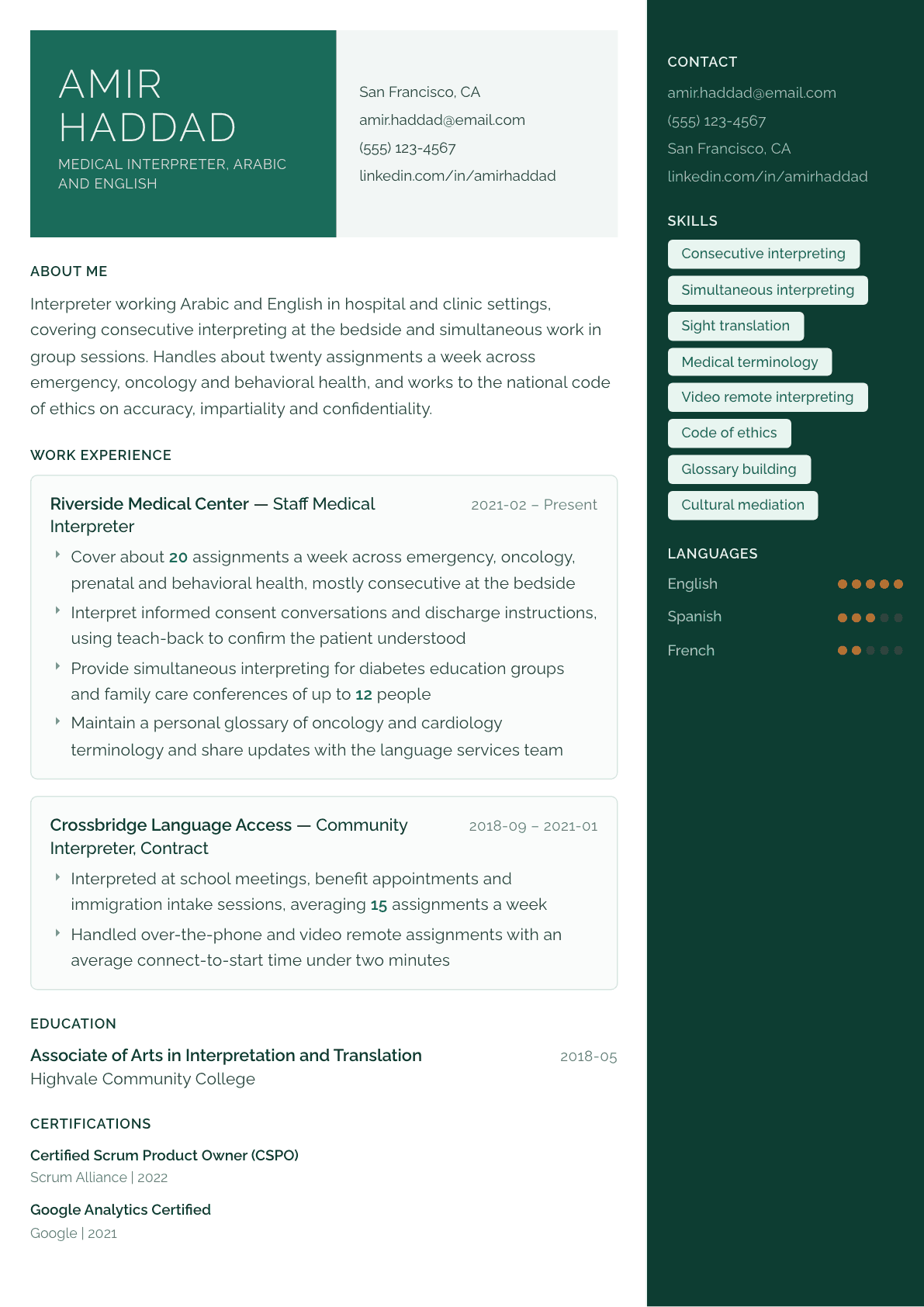
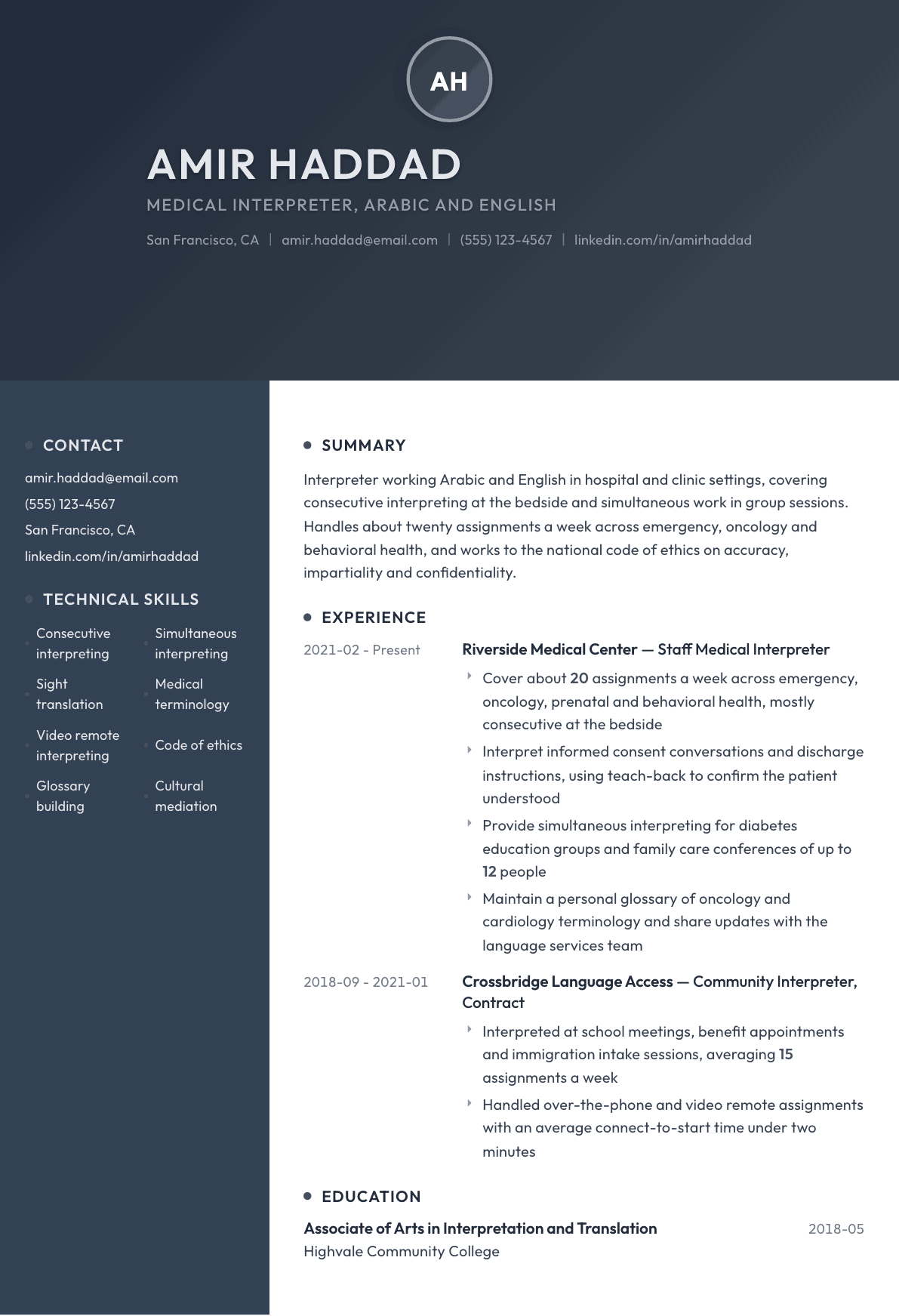
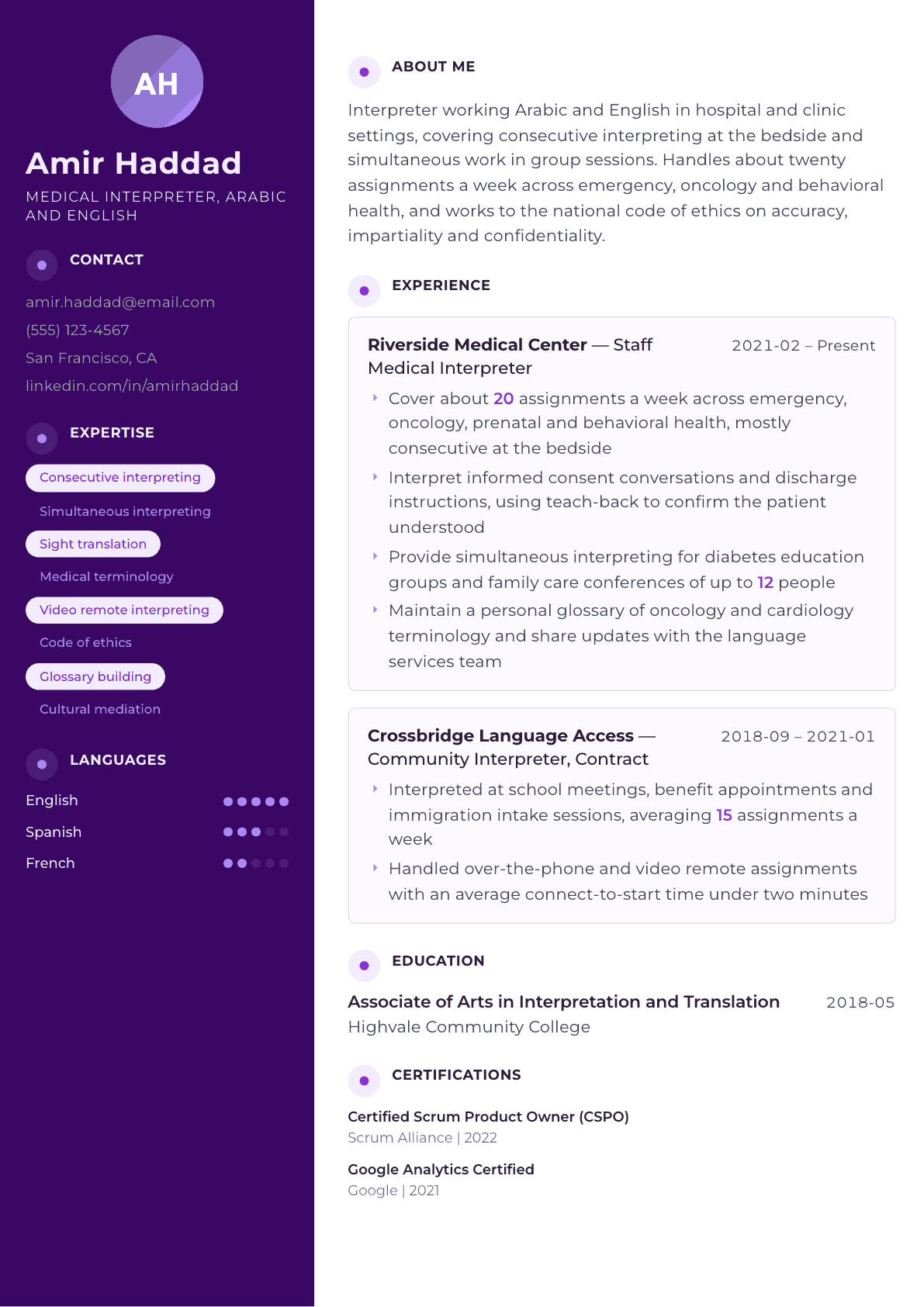
Example Interpreter summary
Interpreter working Arabic and English in hospital settings, covering roughly twenty assignments a week across emergency, oncology, prenatal and behavioral health. Strong in consecutive interpreting at the bedside, simultaneous work in education groups, and sight translation of consent and discharge documents. Follows the national code of ethics on accuracy, impartiality and confidentiality, and maintains a shared clinical glossary.
Skills to list on a Interpreter resume
- Consecutive interpreting
- Simultaneous interpreting
- Sight translation
- Medical terminology
- Legal terminology
- Video remote interpreting
- Over-the-phone interpreting
- Cultural mediation
- Code of ethics and confidentiality
- Glossary and terminology building
- Note-taking technique
- Patient education support
- Conference interpreting
What actually gets this resume read
- State your languages and direction first, then the modes you work in: consecutive, simultaneous and sight translation.
- Name the setting, since medical, legal, conference and community interpreting are hired through different pipelines.
- Give weekly assignment volume and the specialties you cover, because staffing managers schedule against that.
- List certification with its issuing body, such as CCHI or the National Board, and include your working languages.
- Include video remote and over-the-phone platforms you have worked on, as most employers now cover all three channels.
- Reference the code of ethics you follow on accuracy, impartiality and confidentiality rather than claiming to be discreet.
How to write a interpreter resume
Interpreting is spoken, live and unrepeatable, so the resume has to substitute for a performance nobody can review. The person reading it is a language services manager or a scheduler, and she is answering practical questions in order: which languages and directions, which mode, which setting, which credential, and how many assignments a week can this person absorb. A resume that leads with adjectives about being bilingual answers none of them.
The settings matter more than candidates expect. Medical, legal, conference, educational and community interpreting are hired through different pipelines, tested differently, and governed by different codes of conduct. An interpreter who describes the work generically forces the reader to guess, and schedulers do not guess when the next resume is specific.
This guide covers how to lead with languages, modes and settings, how to write bullets about live work, three summaries from first contract assignments to staff lead, and the credentials that separate a certified interpreter from a bilingual volunteer on paper.
Format: languages, modes and credential in the top three lines
Put the language pair in the title line and the modes immediately underneath: consecutive, simultaneous and sight translation. Then the certification with its issuing body. A scheduler filling a hospital rota should be able to confirm your fit without scrolling, because the shift she is covering starts in an hour.
One page is standard. Interpreting is measured in assignments rather than projects, so long narrative entries add nothing. Use a compact structure with volume figures and specialties, and keep a second page only for a long list of conference engagements or a teaching history.
- Header: name, languages and directions, modes, certification, city and state, phone and email.
- Section order: summary, credentials, interpreting experience, settings and specialties, channels, training.
- State whether you work on site, over the phone, by video, or all three, and name the platforms.
Summary: languages, setting, weekly volume, code of ethics
Open with the pair and the setting: Arabic and English in hospital and clinic settings, for instance. Follow with the modes and the specialties, then weekly assignment volume, because a staffing manager builds a schedule from that number rather than from your years of experience.
Close by naming the professional code you work to on accuracy, impartiality, confidentiality and role boundaries. It is a stronger signal than calling yourself trustworthy, since the boundaries of the role are the thing new interpreters most often get wrong and the thing supervisors most often have to correct.
Experience: assignments, settings and what the encounter required
Give assignments per week and break them by department or venue. Emergency, oncology, prenatal, behavioral health, physical therapy and discharge planning each require different vocabulary and different emotional footing. A resume that names the departments proves familiarity that no general statement about medical interpreting can.
Then describe the high-consequence encounters you handle. Informed consent conversations, discharge instructions confirmed with teach-back, goals of care discussions, mental health assessments, and interpretation during a procedure are moments where accuracy is not negotiable, and naming them tells a manager you have been trusted with them.
Show mode range with the setting attached. Consecutive at the bedside, simultaneous for a diabetes education group or a family care conference, and sight translation of consent forms and instructions are three different skills. A candidate who claims simultaneous without naming where they did it invites a hard question in the interview.
Add the work between assignments: glossary building in your specialties, sharing terminology with the language services team, briefing a clinician on a cultural point before an encounter, and documenting the assignment as the department requires.
Credentials, channels and the role boundary
List certification with the full issuing body and the languages it covers, because credentials in this field are language-specific and settings-specific. Medical interpreting has national certification bodies, court interpreting is certified at federal and state level, and sign language interpreting has its own national credential. Training hours from a recognized program belong here too if you are working toward certification.
Name the channels and the platforms. Most employers now cover on-site, over-the-phone and video remote work, and a candidate who has only ever worked in a room is a partial fit. Give the practical details that experienced remote interpreters know matter: connect-to-start time, audio quality checks, and how you manage turn-taking when nobody can see you.
- Say how you handle a request to step outside the interpreter role, since supervisors screen for that judgment.
- Note any experience training clinicians or staff on working with an interpreter.
- Include continuing education hours if your certification requires them, since lapsed credentials are a common problem.
Skills, keywords and how schedulers search
The searched terms repeat: consecutive interpreting, simultaneous interpreting, sight translation, medical terminology, video remote interpreting, over-the-phone interpreting, language access, cultural mediation, code of ethics and the language name itself. Mirror them once in a skills block and once in a bullet where the work is shown.
Keep soft claims out of the skills list and into the experience, where they can be demonstrated. Composure during a difficult delivery of news is proven by naming the setting you worked in, not by writing the word compassionate. The interview will test register, note-taking and role boundaries directly.
Interpreter resume summary examples
First contract assignments
Community interpreter working Arabic and English after completing a 60-hour medical interpreter training program. Covers school meetings, benefit appointments and clinic visits, averaging 15 assignments a week in consecutive mode, with sight translation of intake forms and appointment letters.
Four years in a hospital
Staff medical interpreter working Arabic and English across emergency, oncology, prenatal and behavioral health, covering about 20 assignments a week. Interprets informed consent and discharge instructions using teach-back, provides simultaneous interpreting for education groups of up to 12, and maintains a shared clinical glossary.
Lead interpreter
Lead interpreter coordinating a language services team of six across on-site, phone and video channels. Certified in medical interpreting, handles goals of care and ethics consultations personally, trains clinicians on working with an interpreter, and rebuilt the department glossary for oncology and cardiology.
Work experience bullets: before and after
Before: Interpreted for patients at the hospital.
After: Covered about 20 assignments a week across emergency, oncology, prenatal and behavioral health, mostly consecutive interpreting at the bedside.
Weekly volume and named departments let a scheduler place you against a real rota rather than a general claim.
Before: Helped patients understand their care.
After: Interpreted informed consent conversations and discharge instructions, using teach-back so the clinician could confirm the patient understood before release.
A named high-consequence encounter with the confirmation method shows judgment inside the role boundary.
Before: Did simultaneous interpreting sometimes.
After: Provided simultaneous interpreting for diabetes education groups and family care conferences of up to 12 people, working without equipment in whispered mode.
Naming the venue, the group size and the technique makes the mode claim checkable.
Before: Kept a list of medical terms.
After: Built and maintained a personal glossary of oncology and cardiology terminology and shared quarterly updates with the language services team.
Terminology work shared with a team is professional infrastructure rather than a private habit.
Before: Worked on phone and video calls too.
After: Handled over-the-phone and video remote assignments with an average connect-to-start time under two minutes, including audio checks and turn-taking management.
Remote-specific detail proves channel experience that on-site-only interpreters cannot claim.
Hard skills
- Consecutive interpreting
- Simultaneous interpreting
- Sight translation
- Medical terminology
- Legal terminology
- Video remote interpreting
- Over-the-phone interpreting
- Note-taking technique
- Glossary and terminology building
- Cultural mediation
- Code of ethics and confidentiality
- Patient education support
- Conference interpreting
Soft skills
- Composure in distressing encounters
- Impartiality and role discipline
- Accurate memory under pressure
- Register matching across speakers
- Managing turn-taking politely
- Reliability on short-notice calls
Certifications worth listing
- Certified Healthcare Interpreter (CHI) (Certification Commission for Healthcare Interpreters)
- Certified Medical Interpreter (CMI) (National Board of Certification for Medical Interpreters)
- Federal Court Interpreter Certification (Administrative Office of the United States Courts)
- National Interpreter Certification (NIC) (Registry of Interpreters for the Deaf)
Mistakes that cost interpreter candidates the interview
- Leading with the word bilingual instead of the languages, directions, modes and setting a scheduler filters on.
- Claiming simultaneous interpreting with no venue attached, which collapses in the first interview question.
- Leaving the certification issuing body off, so the reader cannot tell a national credential from a course certificate.
- Giving no weekly assignment volume, which is the number a staffing manager uses to build a rota.
- Describing yourself as discreet rather than naming the professional code you work to on impartiality and confidentiality.
- Ignoring remote channels, when most employers now staff on-site, phone and video from the same roster.
- Blurring interpreting and translation into one line, when they are separate skills hired through separate processes.
Interpreter resume questions
Do I need certification to work as an interpreter?
It depends on the setting. Court work generally requires state or federal certification, hospitals increasingly require a national healthcare credential, and community work often accepts recognized training hours. List the training hours and the program while you work toward the credential.
How do I list languages on an interpreter resume?
Name the languages with the directions you work in, and add the varieties or dialects you are comfortable with. Vague fluency labels invite doubt, so tie each language to the settings where you have interpreted in it professionally.
Should interpreters and translators use the same resume?
No. Interpreting is live and measured in assignments, modes and settings; translation is written and measured in words per day, tools and subject fields. Keep two documents and send the one matching the posting, even when you do both.
How do I show experience with remote interpreting?
Name the channels and the platforms, and give the operational details that matter to a manager: connect-to-start time, how you introduce the interpreter role remotely, how you manage turn-taking without visual cues, and how you handle poor audio.
What should an interpreter avoid claiming on a resume?
Avoid claiming clinical, legal or advisory judgment. Interpreters convey meaning and manage communication, and a resume that suggests you advise patients or parties reads as a boundary problem to any supervisor who has had to correct one.