Radio Host Resume Examples: free ATS score and gap list
Create a Radio Host Resume That Captures Your On-Air Presence
By Mustafa Tarabya, founder of CVBooster · Published · Updated
Build a professional radio host resume showcasing on-air personality, audience engagement, and broadcasting expertise for radio stations and digital audio platforms.
Sample resumes for a radio host
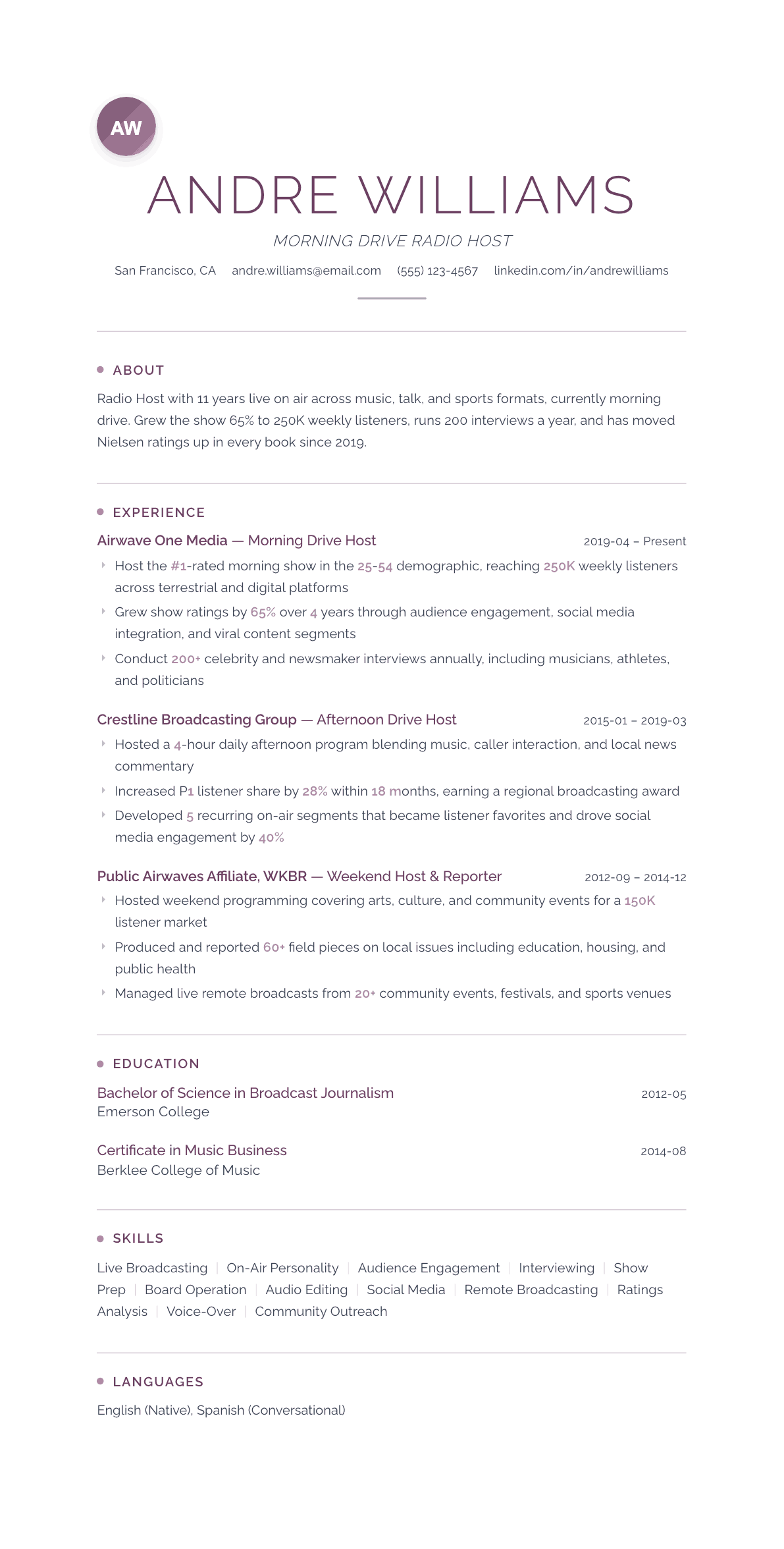
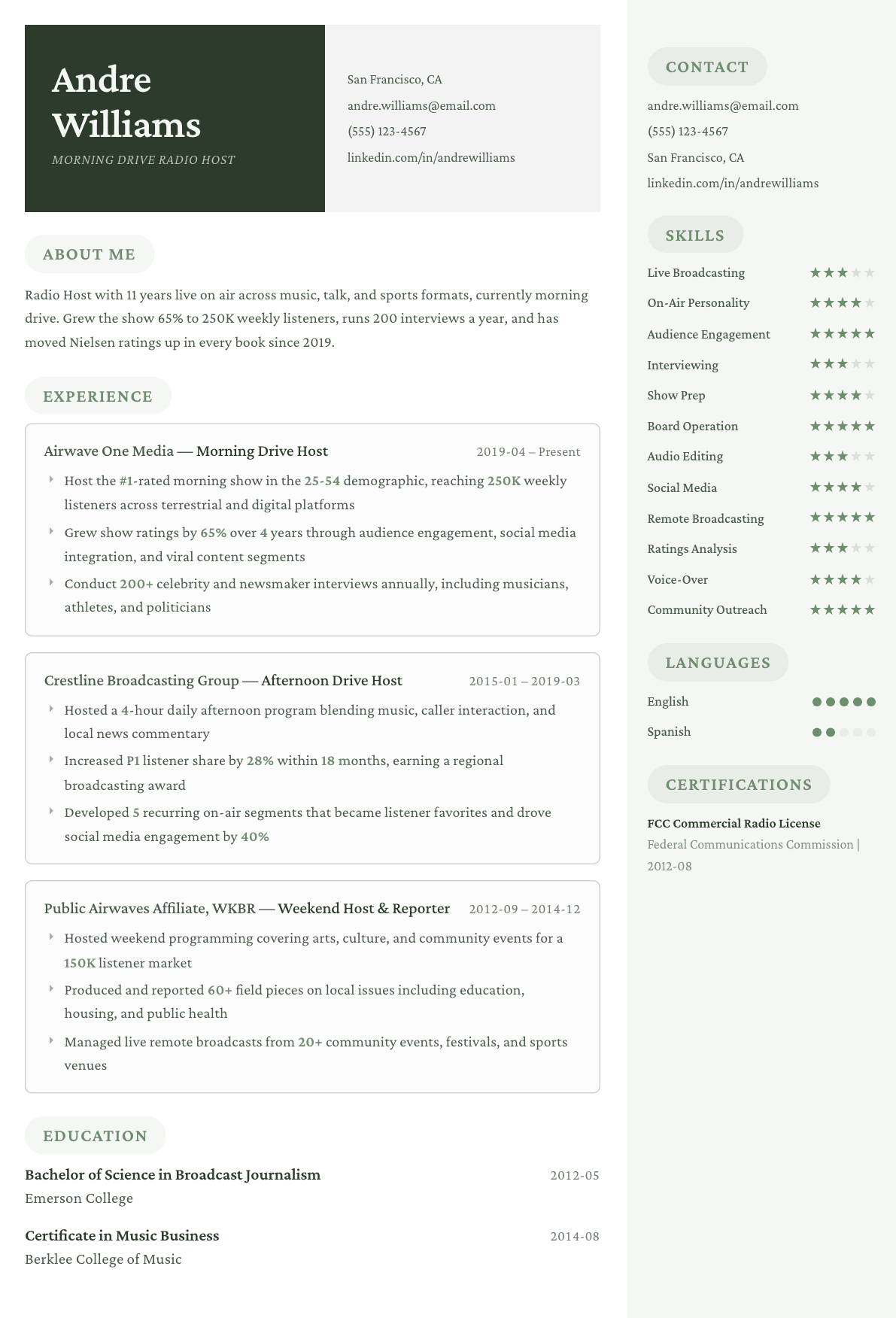
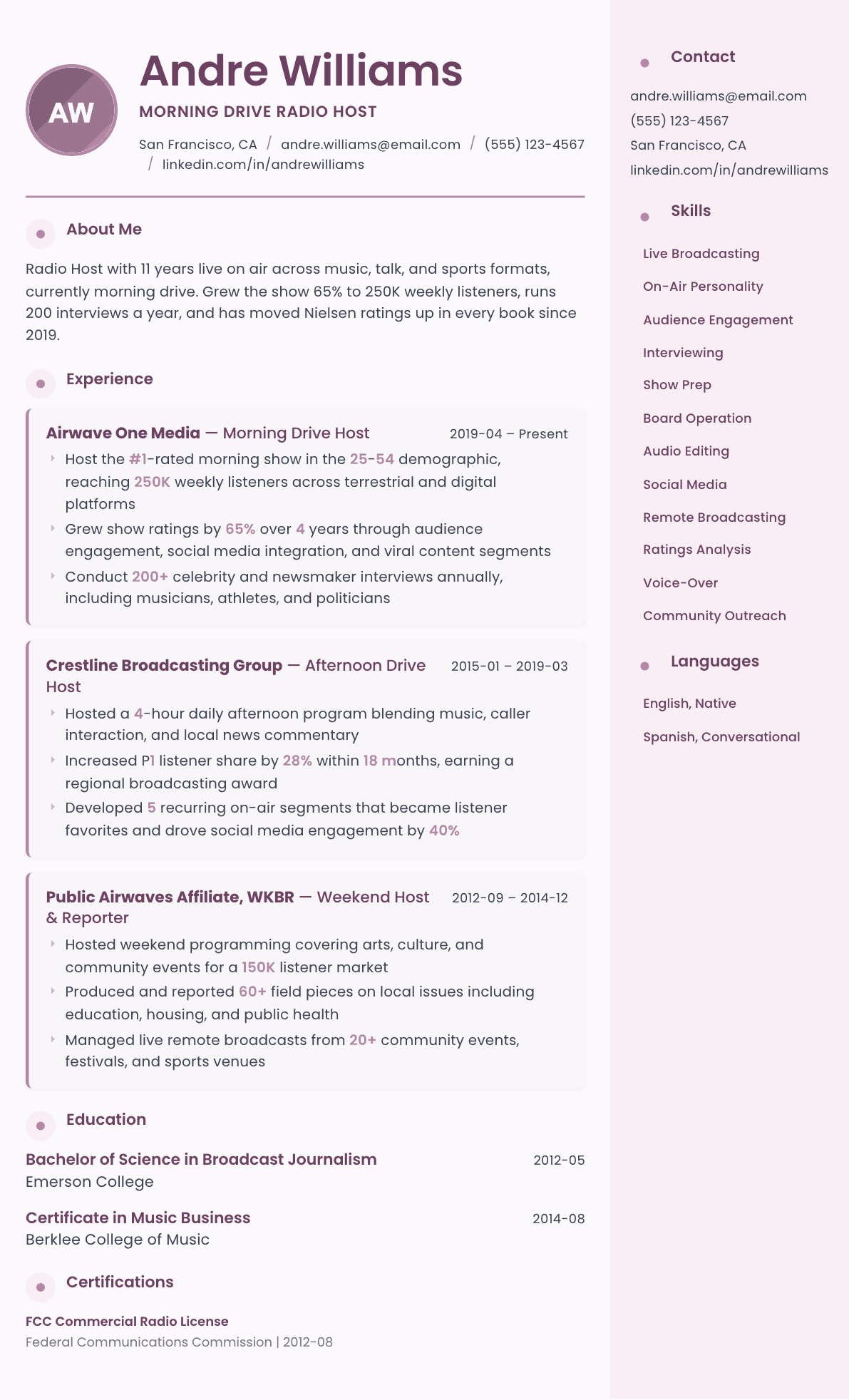
The same radio host content laid out in three CVBooster templates, so you can see what the finished document looks like before you write a word.
Example Radio Host summary
Radio Host, 11 years live on air, currently the top-rated morning show in the 25-54 demo at 250K weekly listeners. Grew ratings 65% over four years, books and conducts 200 interviews a year, and carries the show across podcast and social.
Skills to list on a Radio Host resume
- Live Broadcasting
- On-Air Talent
- Audience Development
- Interviewing
- Show Preparation
- Board Operation
- Audio Production
- Social Media Strategy
- Remote Broadcasts
- Ratings & Analytics
- Voice-Over
- Podcast Production
What actually gets this resume read
- Lead with audience size, market rank, and ratings growth. These are the currency of broadcasting.
- Include your format expertise: music, talk, news, sports, or mixed format.
- Highlight interviewing ability by mentioning notable guests and the volume of interviews conducted.
- Showcase digital skills: podcast production, social media audience building, and streaming platform experience.
- Include a link to your aircheck reel or demo. Program directors expect to hear you before hiring.
How to write a radio host resume
A radio host resume is read by a program director who has fifteen minutes and a hole in the schedule. He wants to know your format, your daypart, your market, your ratings trend and whether you can run your own board. He will listen to your aircheck before he finishes the first page, so the document exists to make him want to press play and to explain what he is about to hear.
Formats do not transfer automatically and the resume has to respect that. Country, adult contemporary, urban, classic rock, sports talk, news talk and public radio each reward a different clock, a different break length and a different relationship with the audience. A morning drive personality and a midday music host are doing different jobs. Name the format and the daypart in the first two lines so the reader can place you immediately.
What follows is the section order program directors expect, three summaries at different career points, before and after bullets built on ratings and break content, and the questions on-air talent asks when the aircheck is ready but the resume is not.
Format: one page, aircheck link in the header, station history in reverse order
One page, two only after fifteen years of markets. The header carries name, on-air name if it differs, market, phone, email and a link to a current aircheck, ideally a scoped one that runs three to five minutes. Say plainly what the aircheck contains: breaks only, or breaks with music and spots, and how recent it is.
List stations in reverse order with call letters, format, market and market rank, your daypart, and the dates. Market rank matters in radio in a way it does not in most industries, because moving from a small market to a large one is the career, and a program director reads the rank as a level.
- Header: name, on-air name, market, phone, email, aircheck link, and station social handles if the audience follows you there.
- Every station entry needs call letters, format, market, daypart and dates. Missing any of those slows a program director down.
- Include voice tracking, syndication and network fill work as separate lines, since they are different skills from live local.
- Keep a short line on the automation and playout systems you have operated.
Summary: format, daypart, market and a ratings fact
Three lines. Give the format and the daypart you own, the market size, and one ratings or audience fact you can defend, expressed in the language of the trade: share in a target demographic, cume, or a trend across books. Program directors think in demos, so say which demo the number belongs to.
Then add the thing that is uniquely yours. Some hosts win on interviews, some on phones and listener interaction, some on bits and produced comedy, some on live remotes and community presence. Pick one and let the aircheck prove it.
Experience: the show, the break, and the numbers behind them
Open each station entry with the shape of the show: hours per day, live or voice tracked, solo or an ensemble, and whether you ran your own board. Board operation, phone screening and self producing are still a real dividing line in hiring, especially at stations that consolidated their staff.
Then write the content bullets around what actually happens on air: recurring features and benchmarks you created, interviews you landed, contests and station promotions you fronted, live remotes and appearances, and the digital extension of the show. A program director is buying a body of repeatable content, not a personality in the abstract.
Ratings belong in the bullets with the right context. Give the demo, the daypart and the movement across books rather than a single flattering number. If your daypart grew while the station overall was flat, say so, because that is the comparison a director makes anyway.
- Name the benchmarks you built, because a program director can imagine them on his own station.
- Separate live local hosting from voice tracking, and say how many markets you voice track for.
- List remotes, station events and appearances with the attendance if you have it.
- Commercial production, imaging and voice work are extra revenue for a station, so give them their own bullet.
Technical and production: the board, the automation, the audio
Radio hiring assumes you can run the show alone. List the automation and playout systems you have driven, the console classes you are comfortable on, phone and delay systems for call-in work, and the editing tools you produce in, usually Adobe Audition or Pro Tools. If you have run a delay on live callers or handled emergency alert procedures, say so, because that is a compliance duty a director has to staff.
Digital is now part of the on-air job. Streaming, the station app, podcast versions of your show, social clips and daily written content all come with the shift. Give one bullet to the digital side with volume and result rather than a claim that you are active on social media.
Keywords and the trade vocabulary
Radio postings reuse a tight vocabulary and a resume that avoids it reads as an outsider: daypart, break, stop set, clock, cume, share, target demo, voice tracking, imaging, remote, live read, appearances, board op, show prep. Use the words you have genuinely worked in, once where they are demonstrated and once in a skills line. Public radio postings swap in different terms, including underwriting, pledge drive, newscast and local content, so match the vocabulary of the station you are approaching.
Radio Host resume summary examples
Weekends and fill
Radio host with two years of weekend and overnight shifts on a country station in a mid-size market, running my own board and producing every break. Voice tracks two additional dayparts, handles live reads and covers weekday fill shifts on short notice.
Middays in a top 50 market
Midday host on an adult contemporary station in a top 50 market, five hours live daily with full board operation and phones. Built three recurring listener features, hosted 30 station remotes a year, and grew the daypart share among women 25 to 54 across four consecutive books.
Morning drive personality
Morning drive host with fourteen years across three markets, currently leading a three person show on a top 20 market rock station. Responsible for show prep, benchmark content, celebrity and newsmaker interviews, station appearances, and mentoring two junior air talents.
Work experience bullets: before and after
Before: Hosted a daily radio show and talked to listeners.
After: Hosted a four hour live midday show five days a week, running my own board, screening and airing 20 listener calls a day on a seven second delay.
Hours, live status, board operation and call volume tell a program director exactly what shift you can be dropped into.
Before: Improved the station ratings.
After: Grew the midday share among adults 25 to 54 across four consecutive ratings books while station cume held flat, making the daypart the highest performing non-drive shift.
The demo, the trend and the comparison against the rest of the station make the claim checkable instead of decorative.
Before: Created content and segments for the show.
After: Created three recurring daily benchmarks including a listener call-in feature that ran for six years and became the station promotion department's most requested remote tie-in.
Benchmarks that survive years and travel into promotions are the proof a host can build format, not just fill time.
Before: Did remote broadcasts and public appearances.
After: Fronted 30 live remotes a year from dealerships, festivals and charity drives, including a station food drive that drew 4,000 attendees to a single afternoon broadcast.
Remotes are how a station bills clients, so the count and a turnout figure translate directly into revenue value.
Before: Also worked on the station website and social media.
After: Produced a daily podcast version of the show plus 5 social clips per shift, and wrote the station's morning blog, adding a digital audience that streamed the show outside the terrestrial signal.
It gives volume and a specific output for each channel rather than claiming general digital involvement.
Hard skills
- Live on-air hosting
- Board operation
- Voice tracking
- Show prep and content planning
- Call screening and profanity delay
- Interviewing
- Commercial production and imaging
- Adobe Audition
- Automation and playout systems
- Live remote broadcasting
- Live reads and endorsements
- Ratings and audience analysis
- Podcast and stream production
- Emergency alert procedures
Soft skills
- Audience rapport
- Improvisation on air
- Ensemble chemistry
- Timing to the clock
- Handling live callers
- Community presence
Certifications worth listing
- Society of Broadcast Engineers Certification (Society of Broadcast Engineers)
Mistakes that cost radio host candidates the interview
- Leaving the aircheck link off the header, which is the only part of the application a program director truly evaluates.
- Listing stations without call letters, format, market and daypart, so the reader cannot tell what level you have worked at.
- Quoting one flattering ratings number with no demo and no book, which every program director reads as cherry picking.
- Describing yourself as energetic and relatable instead of naming the benchmarks, interviews and remotes that fill a show.
- Hiding that a shift was voice tracked, since live local hosting and voice tracking are priced and staffed differently.
- Omitting board operation, production and digital duties, which are now assumed to be part of every on-air job.
Radio Host resume questions
How long should a radio host aircheck be and where does it go?
Three to five minutes of scoped breaks, current within the last few months, linked directly in the header next to your name. Say on the resume what the aircheck is, so a program director knows whether he is hearing a full show or an edited best of.
Should I put ratings numbers on a radio host resume?
Yes, when you can state the demo, the daypart and the trend across books rather than one isolated figure. A share that rose over several books in the target demo says far more than a single high number with no context around it.
How do I move from a small market to a larger one?
Make the market rank and format of each station explicit, then lead with the parts of your show that scale: benchmark content, interviews, remotes and digital audience. A director in a larger market is buying content he can imagine surviving a bigger clock and a tighter format.
Does a radio host need production and technical skills listed?
Yes. Most stations expect on-air talent to run the board, cut their own production, handle imaging or voice work, and produce a podcast and social version of the show. Leaving those out makes you look more expensive to staff than the next candidate.
How do I present a career that includes both radio and podcasting?
Keep them in one experience list in date order, and give each entry the metrics its medium uses: dayparts and ratings for radio, downloads and cadence for podcasting. That shows range without making a program director translate one medium into the other.