Lean Six Sigma Black Belt Resume Examples: free score
Write a Lean Six Sigma Black Belt Resume With Verified Results
By Mustafa Tarabya, founder of CVBooster · Published · Updated
A Lean Six Sigma Black Belt resume built on DMAIC projects, statistical proof and verified savings, with a sample resume and a section by section guide.
Sample resumes for a lean six sigma black belt
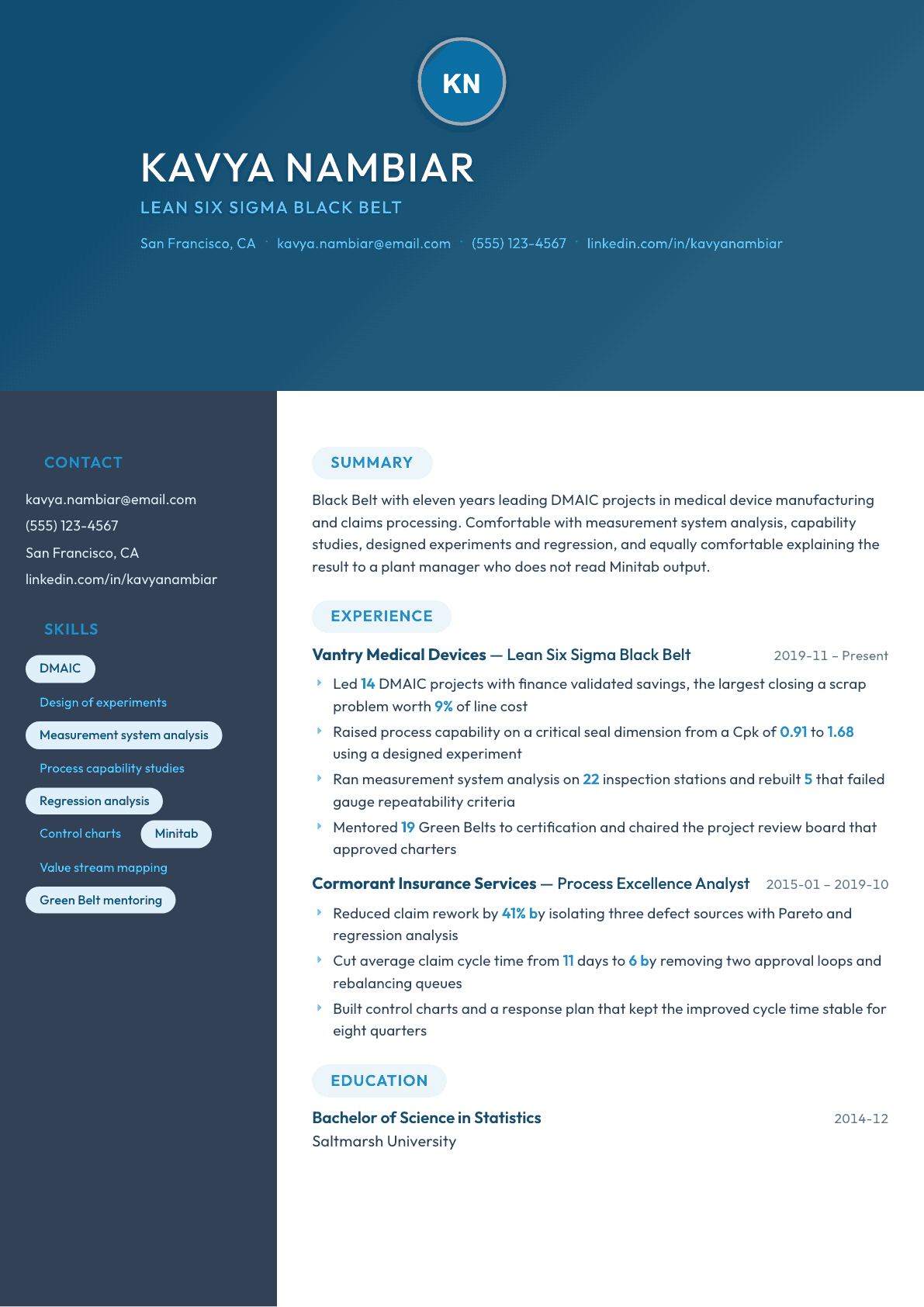
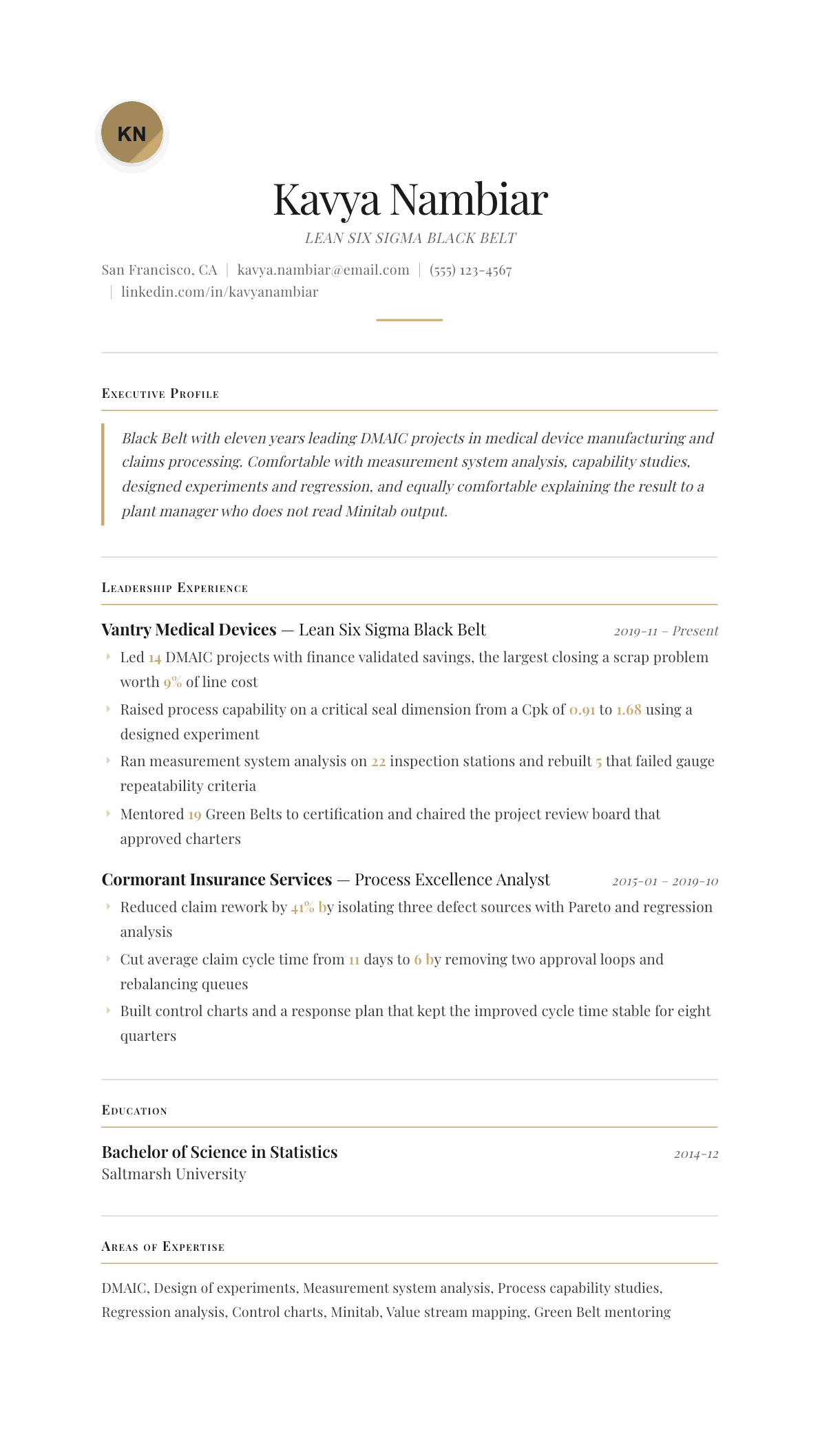
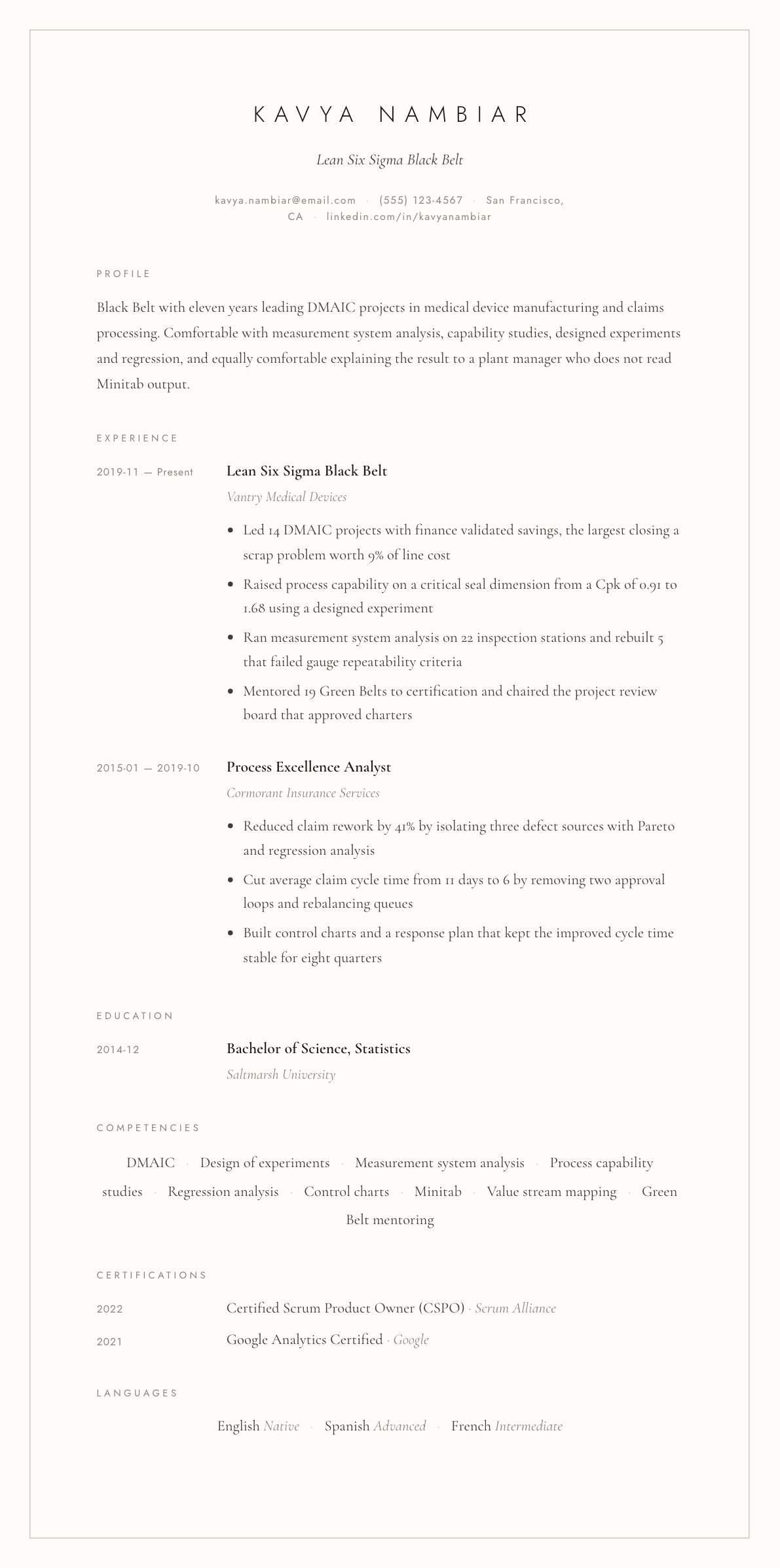
The same lean six sigma black belt content laid out in three CVBooster templates, so you can see what the finished document looks like before you write a word.
Example Lean Six Sigma Black Belt summary
Lean Six Sigma Black Belt with eleven years of DMAIC delivery in medical device manufacturing and insurance claims. Raised capability on a critical dimension through a designed experiment, rebuilt failing measurement systems, and mentored nineteen Green Belts to certification. Every savings figure quoted here was validated by a finance controller before the project closed.
Skills to list on a Lean Six Sigma Black Belt resume
- DMAIC
- Design of experiments
- Measurement system analysis
- Process capability analysis
- Hypothesis testing
- Regression analysis
- Statistical process control
- Failure mode and effects analysis
- Value stream mapping
- Minitab
- Project chartering
- Green Belt mentoring
- Control plans
- Change management
What actually gets this resume read
- State who certified you and whether the certification required a completed project, because that distinction is checked.
- Structure the strongest projects as a short DMAIC story: the defect, the root cause found, the fix and the held result.
- Use the statistical tool by name, since a hiring manager wants to know you can defend a designed experiment in a review.
- Report savings that finance validated and say so, as self reported savings carry little weight in a screening call.
- Count the Green Belts you mentored, because most Black Belt postings expect you to build capability, not just deliver projects.
- Show one project outside manufacturing if you have it, since transactional process work is where many Black Belt roles now sit.
How to write a lean six sigma black belt resume
A Lean Six Sigma Black Belt resume has an unusual problem. The certification is the easiest part to write down and the least interesting part to read, because certifications are issued by dozens of bodies with wildly different standards. What a hiring manager wants to know is whether your certification required a completed, validated project, and whether you can still defend a designed experiment two years after the training.
The resumes that pass a technical screen are structured around projects, not around tools. Each project shows the defect being attacked, the measurement system that made the data trustworthy, the analysis that found the cause, the change that removed it, and the control that held it. A candidate who lists twenty tools and no project narrative is usually a Green Belt with a longer certificate.
This guide covers the layout, how to write a DMAIC project in five lines, three example summaries at different levels, before and after bullets from the phrasing that appears on almost every belt resume, and the questions candidates ask when moving between manufacturing and transactional environments.
Format: certification block, then a project ledger
Two pages, reverse chronological, single column, no graphics. Directly under the summary, place a short certification block with the belt level, the issuing body and whether project completion was required. That single detail decides how the rest of the page is read.
Under each employer, open with a scope line and then write projects rather than duties. A Black Belt is hired to deliver a portfolio, so the resume should read as a ledger of what that portfolio contained.
- Header: name, city and state, phone, email, and the belt level after your name.
- Sections: summary, certification and methodology, professional experience, tools, education.
- Per project: the defect, the analysis, the change, the result and the control.
Summary: environment, statistics, and validated delivery
Name the environment and the analytical depth in the same breath. Medical device manufacturing with capability studies and designed experiments is a different profile from claims processing with regression and queue analysis, and postings screen for one or the other.
Say that your savings were validated by finance if they were, and say how many belts you have mentored. Those two facts answer the questions a hiring manager was going to ask on the call anyway.
Projects: write DMAIC without the acronym
A good project bullet names the defect and its cost driver, then the analytical step that isolated the cause. Isolated three defect sources through Pareto and regression analysis is specific. Used data driven methods to identify improvement opportunities is not, and a technical interviewer will treat the second phrasing as a warning sign.
Include the measurement work. Measurement system analysis is the step most candidates skip on the page and the step most respected by people who have actually run projects, because a study built on an unreliable gauge produces confident nonsense. If you rebuilt inspection stations that failed gauge repeatability and reproducibility criteria, that belongs in a bullet.
Finish with control. A capability index that moved, a control chart with a written response plan, a control plan handed to the process owner, or a stability window you can quote. Improvements that were never controlled are the reason many companies have stopped trusting improvement claims.
Mentoring, governance and the project pipeline
Black Belt roles almost always include developing Green Belts and screening project charters. Count the belts you mentored to certification, say whether you chaired or sat on a review board, and describe how projects entered the pipeline. A candidate who has run governance can be trusted with a program rather than a project.
If you built the benefits validation process itself, working with a controller to agree what counts as a hard saving and what counts as a cost avoidance, say so. That is a rare and valuable thing to have done, and it settles the credibility question permanently.
Tools and the vocabulary a screener matches
Name the statistical software you use and be specific about the methods: hypothesis testing, analysis of variance, regression, designed experiments, capability studies, measurement system analysis, control charts, failure mode and effects analysis. These are the terms in the posting and each should appear where a project used it.
Add the lean half honestly. Value stream mapping, standard work, changeover reduction and flow work belong on a Lean Six Sigma resume, and a candidate who is strong in statistics but has never touched a shop floor should not pretend otherwise, because the interview will find out.
Lean Six Sigma Black Belt resume summary examples
Newly certified Black Belt
Newly certified Black Belt with 5 years as a process engineer in insurance operations, where I reduced claim rework by 41% by isolating three defect sources through Pareto and regression analysis. Comfortable with hypothesis testing, control charts and facilitating a project team that does not report to me.
Delivering a project portfolio
Lean Six Sigma Black Belt with 11 years across medical device manufacturing and claims processing. Led 14 projects with finance validated savings, raised process capability on a critical seal dimension from a Cpk of 0.91 to 1.68 using a designed experiment, and mentored 19 Green Belts to certification.
Master Black Belt level
Master Black Belt with 17 years leading improvement programs across 6 sites, responsible for the project pipeline, belt curriculum and benefits validation standard agreed with finance. Has personally trained 60 belts and coaches site leadership teams on selecting projects worth chartering in the first place.
Work experience bullets: before and after
Before: Led Six Sigma projects that improved processes.
After: Led 14 DMAIC projects with finance validated savings, the largest closing a scrap problem worth 9% of line cost on a high volume molded component.
A project count, financial validation and the size of the largest win give the reader a portfolio rather than an assertion.
Before: Used statistical analysis to solve a quality problem.
After: Raised process capability on a critical seal dimension from a Cpk of 0.91 to 1.68 by running a designed experiment on mold temperature, hold pressure and cure time.
The capability figures and the named factors prove the analysis happened rather than describing it in general terms.
Before: Improved the accuracy of inspection data.
After: Ran measurement system analysis across 22 inspection stations and rebuilt 5 that failed gauge repeatability and reproducibility criteria before any capability work began.
Naming the study, the station count and the sequence shows the discipline that separates a real belt from a trained one.
Before: Reduced processing time for claims.
After: Cut average claim cycle time from 11 days to 6 by removing two approval loops and rebalancing work queues against arrival patterns rather than headcount.
Before and after figures plus the specific structural change make the improvement testable instead of merely claimed.
Before: Made sure improvements were sustained.
After: Built control charts with a written response plan owned by the operations supervisor, holding the improved claim cycle time stable across eight consecutive quarters.
A named control mechanism, an accountable owner and a stability window turn sustainability into something the reader can verify.
Hard skills
- DMAIC project leadership
- Design of experiments
- Measurement system analysis
- Process capability studies
- Hypothesis testing
- Analysis of variance
- Regression analysis
- Statistical process control
- Failure mode and effects analysis
- Value stream mapping
- Control plan development
- Minitab
- Project chartering and pipeline governance
Soft skills
- Coaching belts
- Explaining statistics to non-specialists
- Facilitating cross-functional teams
- Negotiating scope
- Executive reporting
Certifications worth listing
- Certified Six Sigma Black Belt (CSSBB) (American Society for Quality)
- Certified Six Sigma Green Belt (CSSGB) (American Society for Quality)
- Lean Six Sigma Black Belt (International Association for Six Sigma Certification)
- Certified Manager of Quality/Organizational Excellence (CMQ/OE) (American Society for Quality)
- Project Management Professional (PMP) (Project Management Institute)
Mistakes that cost lean six sigma black belt candidates the interview
- Leading with the certificate and leaving the reader unsure whether a completed project was ever required to earn it.
- Listing statistical tools in a block without a single project showing one of them producing a decision.
- Skipping measurement system analysis, which technical interviewers treat as the tell of a paper belt.
- Quoting savings with no validation source, in a field where inflated savings claims have made readers skeptical.
- Omitting the control phase entirely, so every result on the page could have evaporated the month after handover.
- Failing to count the Green Belts mentored, when capability building is half of what a Black Belt is hired for.
- Writing manufacturing language into a transactional application, or the reverse, instead of matching the environment.
Lean Six Sigma Black Belt resume questions
Does it matter who issued my Black Belt certification?
Yes. Hiring managers know that standards vary widely between providers, so name the issuing body and say whether a completed and validated project was required. A certification tied to a real delivered project carries far more weight in a screen.
How many projects should a Black Belt resume list?
Show three to five in detail and summarize the rest as a count with a validated savings statement. Choose projects that vary in method, one designed experiment, one measurement system study, one flow project and one transactional example.
Can I apply for Black Belt roles with transactional experience only?
Yes, and many openings now sit in finance operations, claims, healthcare and shared services. Describe cycle time, defect rates, queue behavior and rework in the same rigorous way a manufacturing belt describes scrap and capability.
What is the difference between a Black Belt and a continuous improvement manager?
A Black Belt is defined by statistical project delivery and belt mentoring. A continuous improvement manager typically owns a broader system, including daily management, lean rollout and site coaching, with less emphasis on advanced statistics.
Should I include projects that failed to deliver savings?
Not on the resume. Keep the page to delivered and validated work, then use one failed project in the interview to talk about what the data actually showed and how you closed the charter honestly instead of forcing a result.
Related resume examples
- Quality Manager Resume example
- Operations Manager Resume example
- Continuous Improvement Manager Resume example
- Quality Assurance Inspector Resume example
- Operations Consultant Resume example
- VP Operations Resume example