Contract Administrator Resume Examples: read this first
Create a Contract Administrator Resume That Reads as Reliable
By Mustafa Tarabya, founder of CVBooster · Published · Updated
Contract administrator resume examples covering drafting, redlines, renewals and compliance, with ATS keywords and a full section-by-section guide.
Sample resumes for a contract administrator
The same contract administrator content laid out in three CVBooster templates, so you can see what the finished document looks like before you write a word.
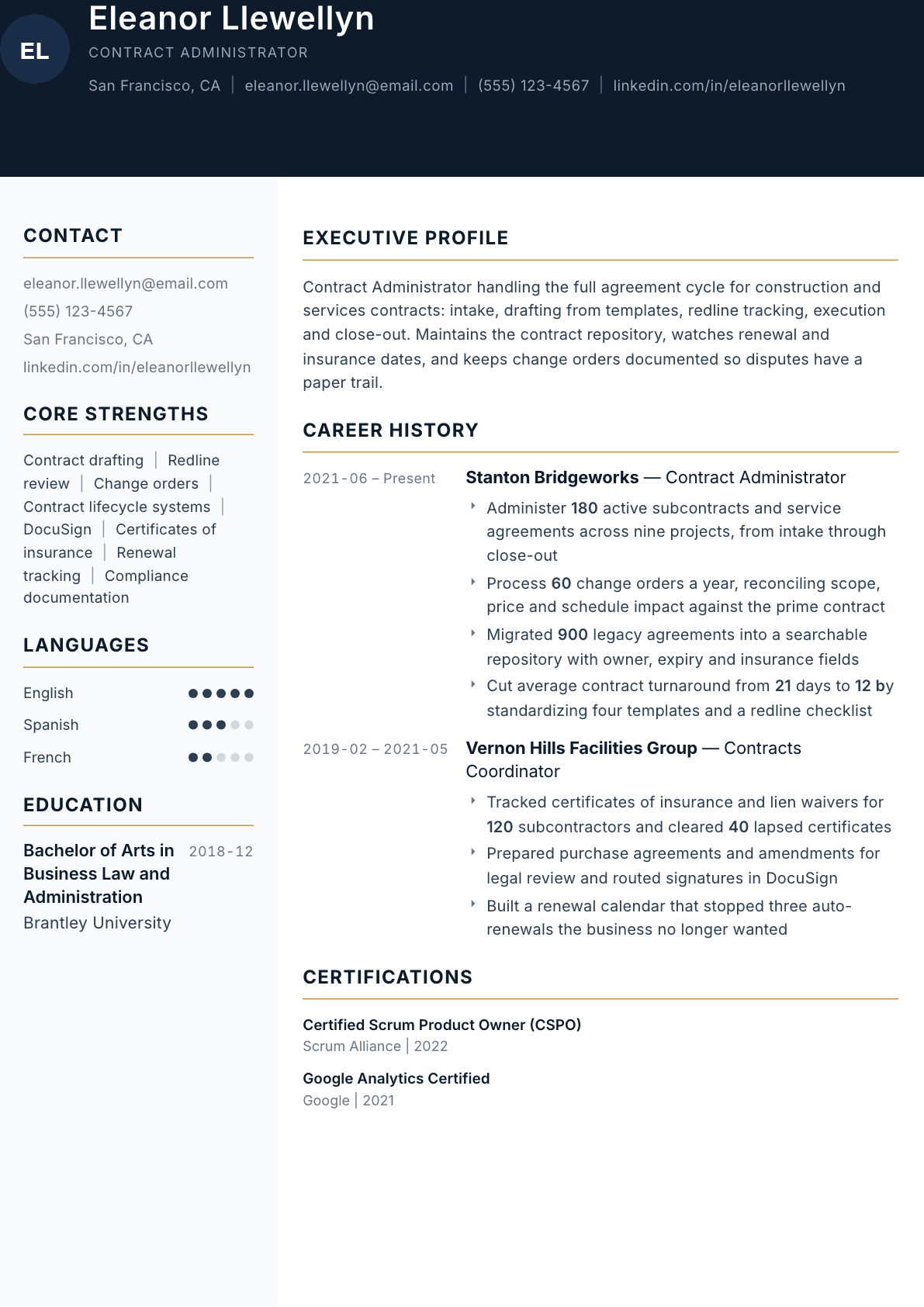
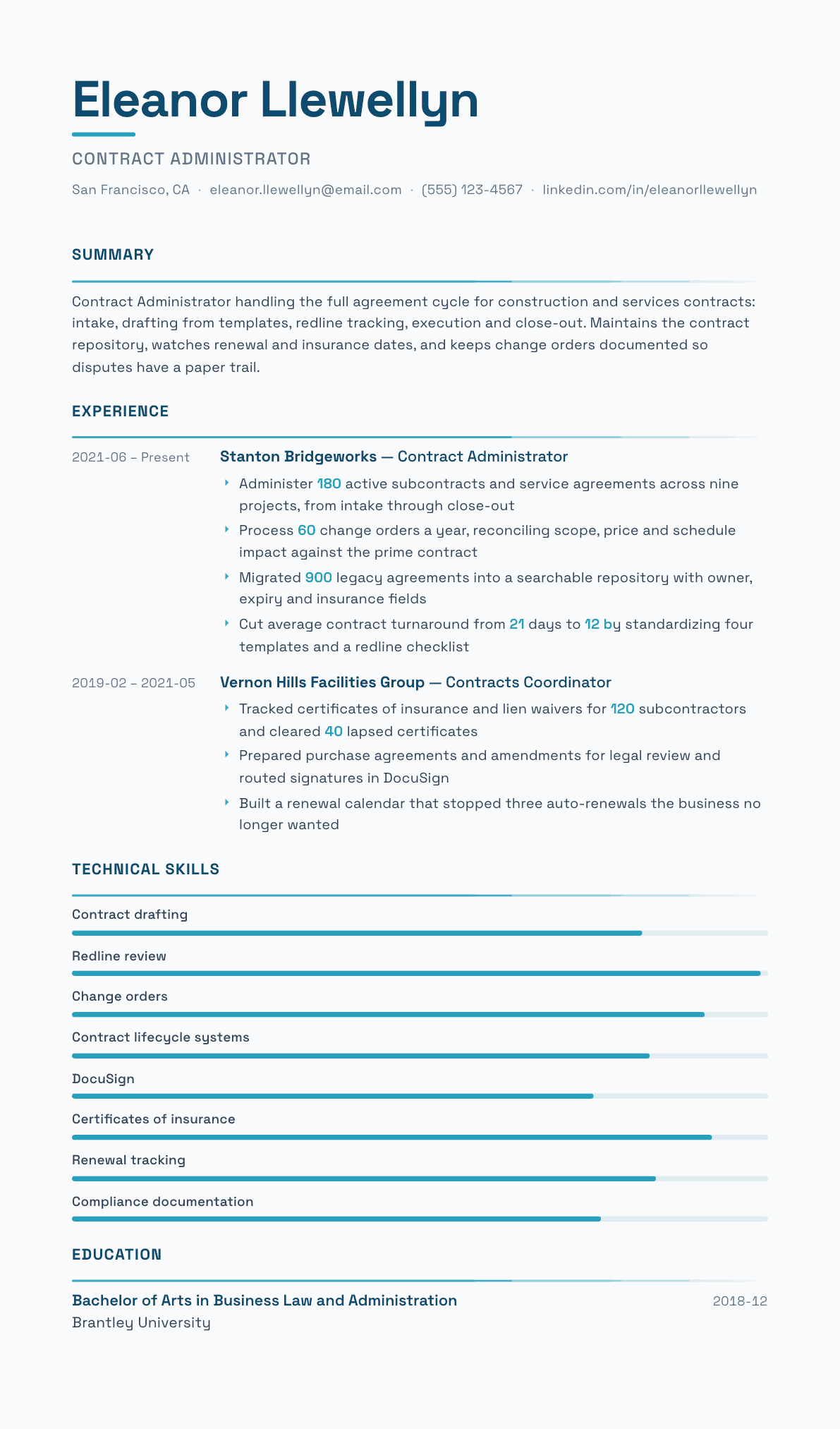
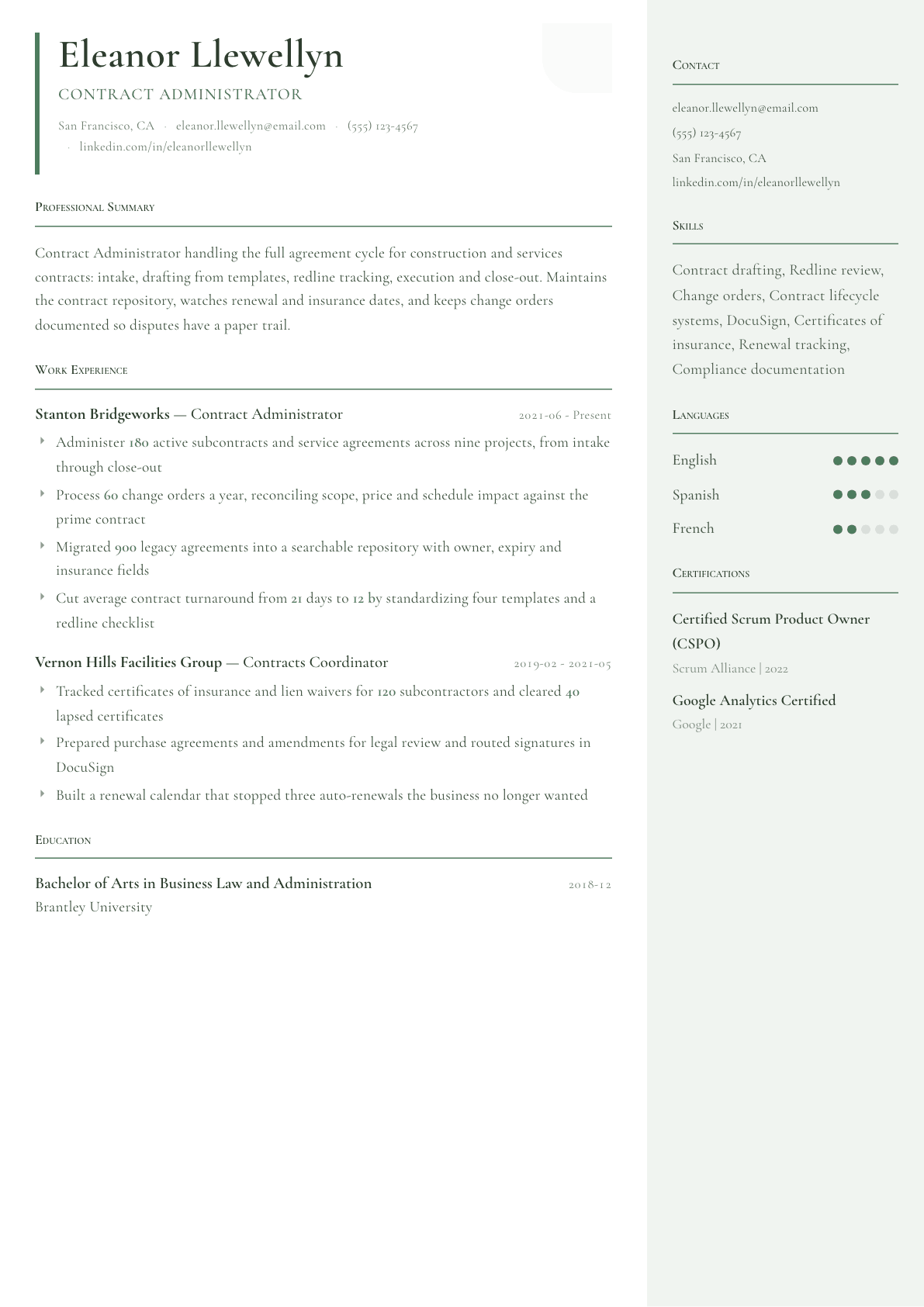
Example Contract Administrator summary
Contract Administrator with six years running subcontracts and service agreements for a heavy civil builder. Administers 180 active contracts across nine projects, processes 60 change orders a year, and cut average turnaround from 21 days to 12 by standardizing templates and a redline checklist. Migrated 900 legacy agreements into a searchable repository with owner and expiry tracking.
Skills to list on a Contract Administrator resume
- Contract administration
- Contract drafting
- Redline and markup review
- Change order management
- Contract lifecycle management
- DocuSign
- Renewal and expiry tracking
- Certificates of insurance
- Compliance monitoring
- Vendor and subcontractor coordination
- Recordkeeping
- Purchase agreements
- Risk flagging
- Close-out documentation
What actually gets this resume read
- Name the contract types you administer: subcontracts, master service agreements, purchase agreements or government awards.
- Give the volume you handle, in active agreements and in documents processed per month or per year.
- Show turnaround time, because contract administrators are hired to move agreements through faster without new risk.
- List the contract lifecycle and signature systems you use, such as Icertis, Agiloft, Conga, Ironclad or DocuSign.
- Highlight the tracking work that prevents loss: renewal dates, insurance certificates, bonds and change order logs.
- If you support federal or state awards, say so and name the clause sets, since that is a separate hiring lane.
How to write a contract administrator resume
Contract administration is judged on reliability. The manager reading your resume, often a contracts manager, general counsel or project executive, is trying to work out whether agreements will move through you quickly and come out the other side complete. Missing insurance certificates, unsigned amendments and auto renewals nobody noticed are the failures that get people fired in this job, and the resume needs to show that none of them happen on your watch.
Volume and turnaround are the two numbers that do most of the work. How many active agreements you administer, how many documents you process, and how long a contract takes from intake to signature. Candidates almost never include them, which means a resume that does stands out immediately.
This guide walks the page in the order a contracts hiring manager reads it, shows the difference between a duty list and evidence of control, gives summaries for three levels of responsibility, and answers the questions people ask when moving between construction, government and commercial contract work.
Format: plain, dated, and easy to verify
Reverse chronological order, single column, conservative typography. Legal and contracts teams read a lot of documents and a busy layout reads as poor judgment about form. Keep dates unambiguous and continuous.
Under each title, state the contract types you administered, the number active, and the business you supported. Contract administration in heavy construction, in software, and in federal contracting are three different jobs sharing one title, and the reader needs to place you at once.
- Scope line: contract types, active agreements administered, business area supported.
- Section order: summary, contract types and systems, experience, education, certifications.
- One page under eight years, two pages once you administer a portfolio across multiple entities.
Summary: contract types, volume, turnaround
Three or four lines. Name the agreements you handle, the volume, the systems, and the turnaround time from intake to execution. Add one control result: a repository you built, an audit you passed, or a set of renewals you caught before they rolled.
Say clearly what you do and do not do. Many administrators draft from approved templates and route non standard terms to counsel. Stating that boundary is a strength, because the hiring manager needs to know where your judgment stops and legal review begins.
Experience: intake, drafting, redlines, execution, close-out
Walk the lifecycle. Intake and triage: how requests reach you, what you check before work starts, and how you decide what needs counsel. Drafting: which templates you own, which clauses you are authorized to adjust, and any playbook you helped build.
Redlines and negotiation support: how you track versions, summarize counterparty changes for the business, and hold a position on the terms that matter, typically indemnity, limitation of liability, insurance, termination and payment.
Execution and administration: signature routing, distribution, obligations tracking, change orders and amendments, and the calendar that catches expiry and renewal windows. Change order volume is a strong number in construction and services work.
Close-out: final documentation, retention releases, lien waivers where relevant, and archiving. Administrators who describe close-out stand out, because most resumes stop at signature.
Systems and records: where the portfolio actually lives
Name the contract lifecycle system, the signature platform, and the document repository. If you migrated a portfolio into a new system, that is a project bullet with a number attached: how many agreements, what metadata you captured, and what became searchable that was not before.
Include the compliance records you maintain. Certificates of insurance, bonds, licenses, subcontractor qualifications and diversity documentation each have expiry dates, and tracking them is a large part of the daily job.
- Lifecycle and signature: Icertis, Agiloft, Conga, Ironclad, DocuSign, Adobe Sign.
- Project and construction: Procore, Oracle Aconex, Autodesk Build, e-Builder.
- Records: certificates of insurance, bonds, lien waivers, subcontractor qualification files.
Keywords a contracts posting is written from
The recurring language includes contract lifecycle management, redline review, master service agreement, statement of work, amendment, change order, obligations tracking, renewal management, certificate of insurance, indemnification and termination for convenience. Government postings add solicitation, modification, clause flowdown and the relevant acquisition regulation.
Use the exact contract type names from the posting. A reader hiring for subcontract administration will not match on the phrase general agreements, however capable you are.
Contract Administrator resume summary examples
Contracts coordinator
Contracts Coordinator tracking certificates of insurance and lien waivers for 120 subcontractors and preparing purchase agreements and amendments for legal review. Cleared 40 lapsed insurance certificates and built the renewal calendar that stopped three unwanted auto renewals. Seeking a full contract administrator role.
Contract administrator
Contract Administrator handling 180 active subcontracts and service agreements across nine construction projects, from intake through close-out. Processes 60 change orders a year against the prime contract and cut average turnaround from 21 days to 12 by standardizing four templates and a redline checklist.
Senior contract administrator
Senior Contract Administrator supporting three business units and a portfolio of 600 active agreements, including master service agreements, statements of work and reseller contracts. Owns the clause playbook, trains two coordinators, and led the migration of the portfolio into a contract lifecycle system.
Work experience bullets: before and after
Before: Managed contracts for the company.
After: Administered 180 active subcontracts and service agreements across nine projects, covering intake, drafting, redline tracking, execution and close-out.
Volume and the stages you own replace a sentence that could describe any office role.
Before: Processed change orders as needed.
After: Processed 60 change orders a year, reconciling scope, price and schedule impact against the prime contract before routing for owner approval.
The reconciliation detail shows you understand what a change order does to a project, not just how to file one.
Before: Organized contract files and records.
After: Migrated 900 legacy agreements into a searchable repository tagged with owner, expiry, insurance status and renewal notice period.
Naming the metadata proves the archive is usable, which is the entire point of a repository.
Before: Helped speed up the contract process.
After: Cut average contract turnaround from 21 days to 12 by standardizing four templates and introducing a redline checklist that routed only non standard terms to counsel.
A before and after with the mechanism attached shows process ownership rather than effort.
Before: Kept track of insurance documents.
After: Tracked certificates of insurance and lien waivers for 120 subcontractors, clearing 40 lapsed certificates before the annual owner audit.
Counts and a deadline turn routine tracking into demonstrable risk control.
Hard skills
- Contract drafting from templates
- Redline and version control
- Change order and amendment processing
- Contract lifecycle management systems
- DocuSign and electronic signature routing
- Obligations and milestone tracking
- Renewal and expiry management
- Certificates of insurance and bonds
- Subcontractor qualification records
- Close-out documentation
- Purchase and service agreements
- Records retention
Soft skills
- Precision with detail
- Following a process without being reminded
- Clear written summaries for non legal readers
- Diplomatic follow up
- Prioritization across deadlines
- Discretion with confidential terms
Certifications worth listing
- Certified Professional Contracts Manager (CPCM) (National Contract Management Association)
- Certified Commercial Contracts Manager (CCCM) (National Contract Management Association)
- Certified Federal Contracts Manager (CFCM) (National Contract Management Association)
- Certified Paralegal (National Association of Legal Assistants)
Mistakes that cost contract administrator candidates the interview
- Describing the job as filing and tracking without a single volume or turnaround figure.
- Failing to name the contract types, which leaves a specialist hiring manager unable to place your experience.
- Blurring the line between drafting from templates and giving legal advice, which makes counsel uneasy.
- Omitting the contract lifecycle or signature system, one of the first filters recruiters apply.
- Skipping renewal and expiry management, the failure mode that most often costs a company money.
- Ending the story at execution and never mentioning obligations tracking or close-out.
Contract Administrator resume questions
What is the difference between a contract administrator and a contract manager?
An administrator runs the process: intake, drafting from templates, redline tracking, execution, records and renewals. A manager owns commercial positions and negotiates outcomes. Many postings mix the two, so read the duties and mirror their language.
Do I need a law degree to be a contract administrator?
No. Most administrators come from business, paralegal or project backgrounds. What matters is knowing which terms carry risk, when to escalate to counsel, and how to keep a portfolio complete and current without being chased.
How do I show attention to detail without simply claiming it?
Use counts and consequences. Lapsed certificates cleared, auto renewals stopped, amendments reconciled, audits passed with no findings. Each of those is detail orientation demonstrated instead of asserted, and interviewers accept them at face value.
Should I list specific contract clauses on my resume?
Name the clause families you routinely review, such as indemnification, limitation of liability, insurance requirements, payment terms and termination. That signals you can read an agreement, without pretending to authority over legal positions.
How do I move from commercial contracts into government contracting?
Learn the solicitation and modification vocabulary, note any experience with flowdown clauses or public bids, and pursue a federal contracts credential. Emphasize documentation discipline, because agencies value a complete file above negotiating flair.
Related resume examples
- Contract Manager Resume example
- Procurement Manager Resume example
- Contract Specialist Resume example
- Procurement Specialist Resume example
- Project Coordinator Resume example
- Operations Coordinator Resume example