Pattern Maker Resume Examples: free ATS score and gap list
Build a Pattern Maker Resume Around Blocks, Grading and Fit
By Mustafa Tarabya, founder of CVBooster · Published · Updated
Pattern maker resume examples with CAD, grading, tech pack and fit session keywords, sample bullets and a complete apparel writing guide.
Sample resumes for a pattern maker
The same pattern maker content laid out in three CVBooster templates, so you can see what the finished document looks like before you write a word.
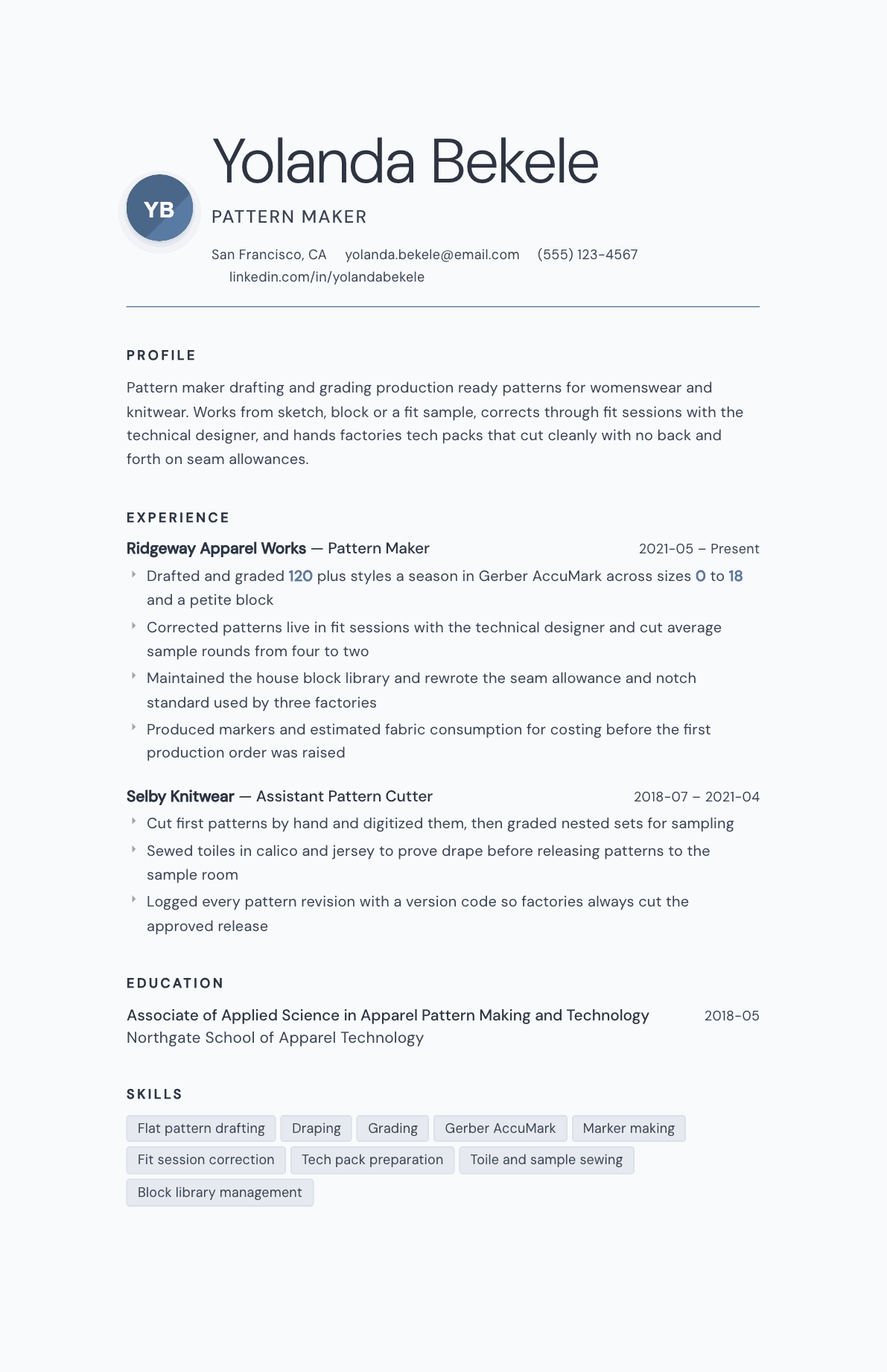
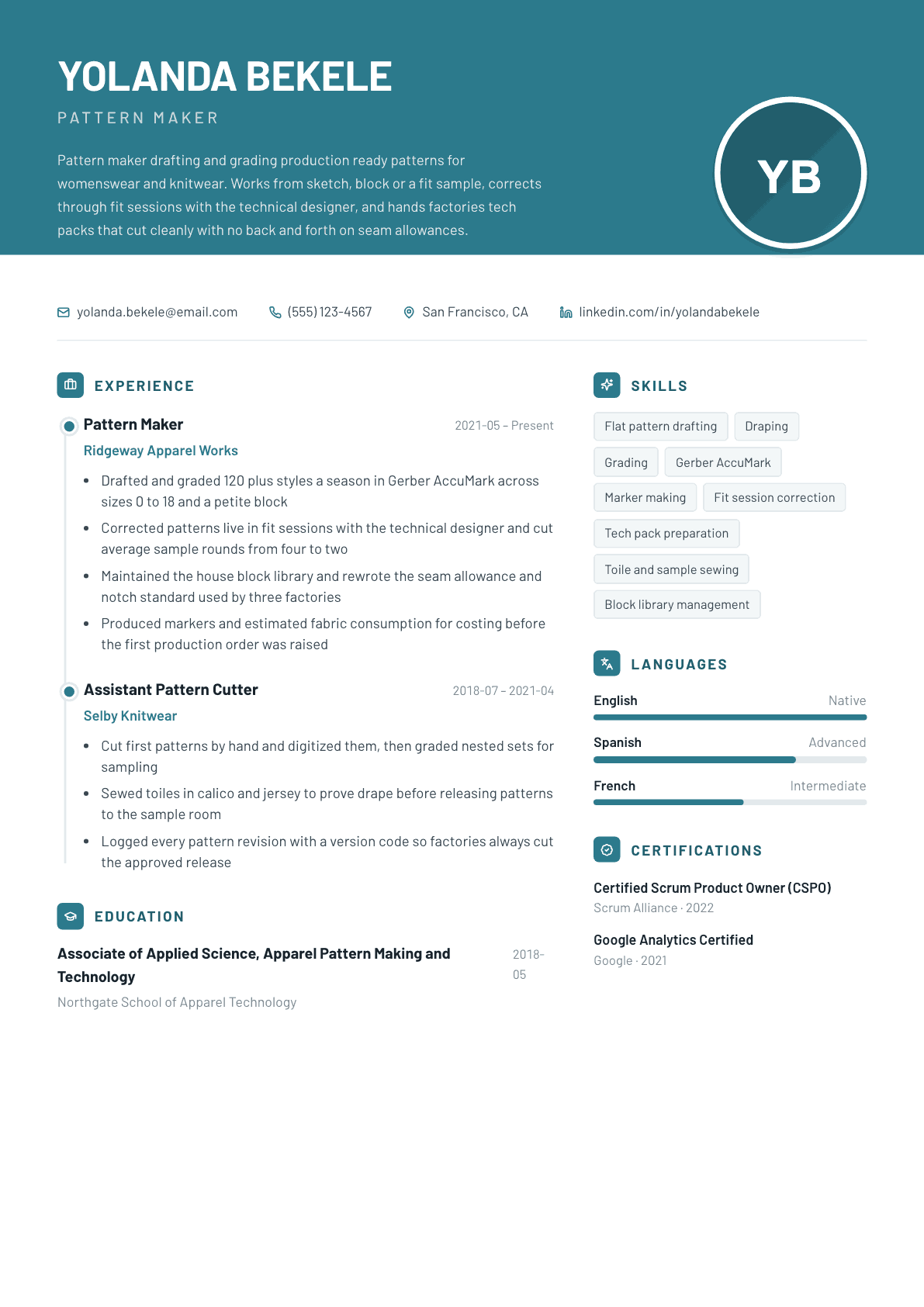
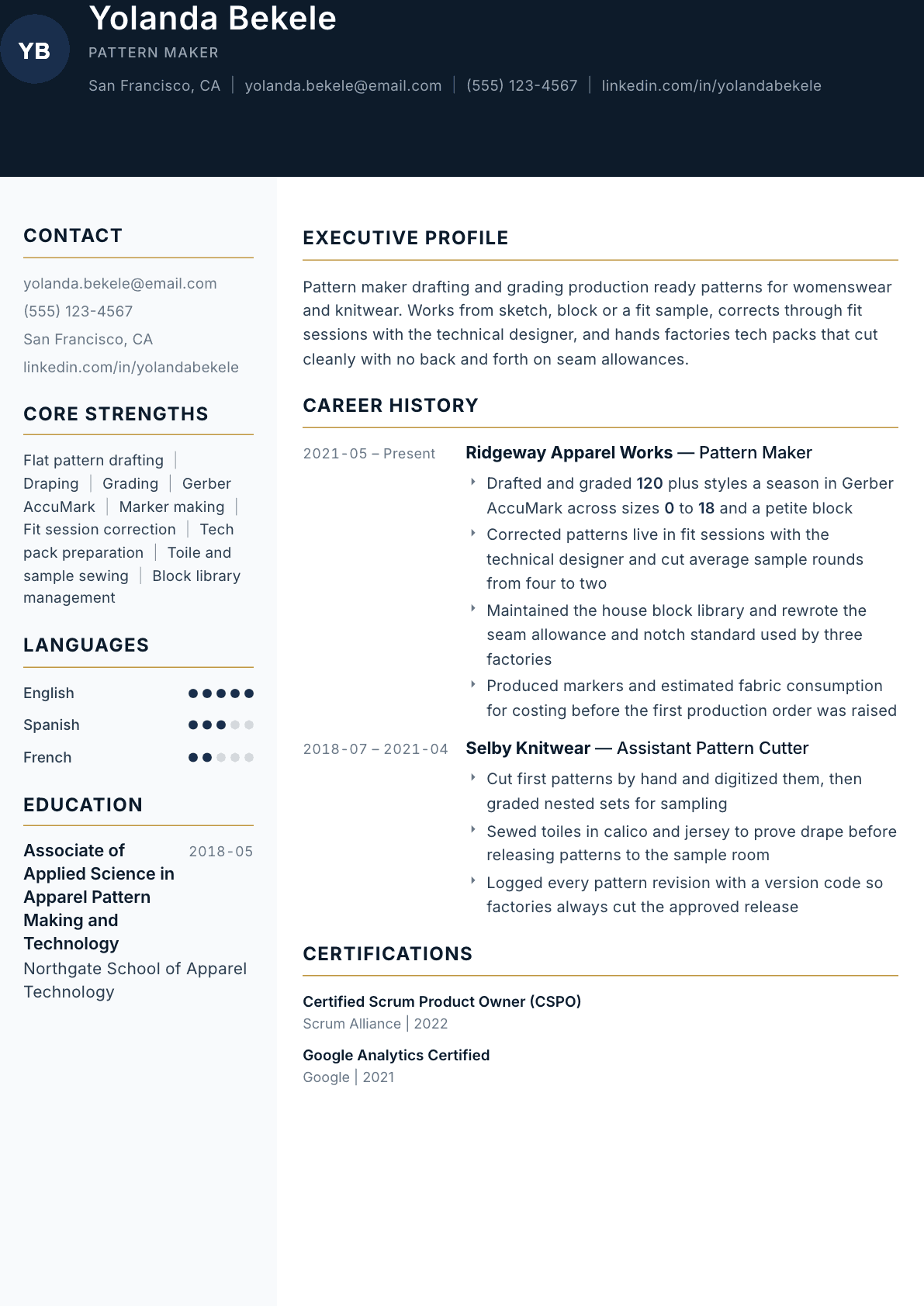
Example Pattern Maker summary
Pattern maker with six years drafting, draping and grading production ready patterns for womenswear and knitwear. Fluent in CAD grading across a full size range and confident correcting fit live with technical design and the sample room. Owns block libraries, seam allowance standards and pattern release so overseas factories cut from one approved version every time.
Skills to list on a Pattern Maker resume
- Flat pattern drafting
- Draping on the stand
- Pattern grading
- Gerber AccuMark
- Lectra Modaris
- Optitex
- Marker making and fabric consumption
- Block library development
- Fit session correction
- Tech pack and spec sheets
- Toile and prototype sewing
- Seam allowance standards
- Garment construction
- Digitizing hand patterns
What actually gets this resume read
- Name the CAD system you draft and grade in, because employers filter on Gerber, Lectra, Optitex or Clo directly.
- State the product categories you have patterned: knitwear, tailoring, denim, outerwear, swim, each behaves differently.
- Give the size range and blocks you have graded across, including petite, tall or extended sizing if you have it.
- Show fit session work, since a pattern maker who corrects live in the room is worth more than one who only drafts.
- Mention marker making and fabric consumption if you have done it, because it ties your work to costing.
- Include how you version and release patterns to factories, which is the detail production managers ask about.
How to write a pattern maker resume
A pattern maker resume is filtered on three technical facts before anyone reads a sentence: the CAD system you draft and grade in, the product categories you have patterned, and the size range and blocks you have graded across. Gerber AccuMark, Lectra Modaris and Optitex are not interchangeable to a technical manager staffing a room, and a resume that says CAD proficient gets sorted out immediately.
The second thing a reader wants is evidence that your patterns cut cleanly at the factory. Sample rounds are expensive and slow, so a pattern maker who corrects live in a fit session and hands over tech packs with unambiguous seam allowances, notches and grade rules is worth measurably more than one who only drafts to a sketch and waits for comments.
This guide covers how to state your CAD and category experience, how to write bullets about grading, fit correction and marker making, what belongs in a portfolio of flats and nested sets, and the questions pattern makers ask when they move between apparel categories or from bench to CAD.
Format: one page, technical facts at the top
One page in almost every case, single column, no decoration. Put a short technical profile directly under the header: CAD systems, categories patterned, size ranges graded, and whether you draft, drape or both. A technical designer scanning ten resumes for a knitwear opening will read that block and nothing else on the first pass.
Follow with reverse chronological experience. Each job opens with the company, the role, and the product it made, because a pattern maker at a bridal house and one at a denim brand have very different skills even with the same title.
- Header: name, city, phone, email, and a link to a portfolio of flats, nested grades and finished samples.
- Technical profile block: CAD systems, categories, size ranges, blocks, hand or digital drafting.
- Sections in this order: profile, experience, technical skills, education and apprenticeship.
CAD and hand skills: be exact about both
Say which system, which modules and what you do inside it. Drafting, grading with rule tables, marker making, digitizing hand patterns and plotting are different competencies inside the same software, and a room that needs a grader will hire the person who says grading explicitly.
Do not drop the hand skills. Many employers still want a pattern maker who can cut a first pattern by hand, drape on the stand to prove a drape idea, and then digitize it. Stating both keeps you eligible for sample rooms and for CAD only positions.
Experience: draft, grade, fit, release
Write bullets along the pattern cycle. Drafting from sketch, block or an existing fit sample. Grading nested sets across the size range, including any petite, tall or extended blocks. Fit sessions, where the correction happens live with the technical designer and the model. Then release, where the pattern goes to the factory with a version code that survives the next revision.
Volume and size range are the two numbers a reader looks for. Styles drafted and graded per season, and the sizes covered, place you against the room they are staffing. A hundred plus styles a season across a full size range and a second block is a different job from twelve couture patterns a year, and both are respectable when stated plainly.
Sample rounds are your outcome metric. If your fit correction work cut average rounds from four to two, say so, because every round costs fabric, factory time and calendar. It is the clearest commercial argument a pattern maker can make on paper.
Standards, markers and costing
Owning a block library, a seam allowance and notch standard, or a grade rule library is senior work and should be stated as ownership. A factory that cuts from one documented standard raises fewer queries, and a technical manager reading that line understands you reduce their inbox.
Marker making and fabric consumption estimates tie your work to costing, which most pattern maker resumes never mention. If you have produced markers and given consumption figures used to cost a style before the first production order, that connects you to the commercial side of the business and separates you from a purely technical candidate.
Portfolio and tech packs
Keep a portfolio that shows flats, nested grades, a marker and photographs of the finished garment on a body. A pattern that looks correct on screen and hangs badly in calico proves nothing, so pair the technical drawing with the toile or the sample.
Mention the tech pack work explicitly: spec sheets, points of measure, construction callouts and grade tables. Overseas factories build from the tech pack, and a pattern maker who writes clear ones removes an entire category of back and forth.
Pattern Maker resume summary examples
Assistant pattern cutter
Assistant pattern cutter with two years cutting first patterns by hand, digitizing them and grading nested sets for sampling. Sews toiles in calico and jersey to prove drape before release, and logs every revision with a version code so the sample room always cuts the approved pattern.
Pattern maker
Pattern maker with six years drafting and grading production ready patterns for womenswear and knitwear. Works 120 plus styles a season in Gerber AccuMark across sizes 0 to 18 plus a petite block, corrects live in fit sessions, and cut average sample rounds from four to two.
Senior pattern maker
Senior pattern maker with twelve years across tailoring, outerwear and knitwear, fluent in Gerber AccuMark and Lectra Modaris. Owns the house block library and the seam allowance standard used by three overseas factories, produces markers for costing, and mentors two assistant cutters.
Work experience bullets: before and after
Before: Created patterns for the design team.
After: Drafted and graded 120 plus styles a season in Gerber AccuMark across sizes 0 to 18 and a separate petite block, working from sketch, block or an approved fit sample.
Volume, software, size range and the three starting points a pattern maker actually works from replace an unmeasurable claim.
Before: Attended fit sessions.
After: Corrected patterns live in fit sessions with the technical designer and fit model, cutting average sample rounds on new styles from four to two.
Live correction plus a round count turns attendance into the commercial outcome a technical manager cares about.
Before: Kept the pattern files organized.
After: Maintained the house block library and rewrote the seam allowance and notch standard adopted by three factories, so bulk cutting queries dropped to occasional exceptions.
Owning a standard used by named parties is senior work, while organizing files is administration.
Before: Made markers for production.
After: Produced markers and estimated fabric consumption per style so costing could be finalized before the first production order was raised.
Linking the marker to costing shows the business consequence of the technical task.
Before: Sewed samples when needed.
After: Sewed calico and jersey toiles to prove drape and hang before releasing patterns to the sample room, catching balance issues that screen review would not show.
The fabrics and the specific class of error caught prove judgment rather than willingness to help out.
Hard skills
- Flat pattern drafting
- Draping on the stand
- Pattern grading and rule tables
- Gerber AccuMark
- Lectra Modaris
- Optitex
- Marker making and fabric consumption
- Digitizing and plotting
- Block library development
- Fit session correction
- Tech packs and points of measure
- Seam allowance and notch standards
- Toile and prototype sewing
- Garment construction knowledge
Soft skills
- Precision and patience
- Working with technical design
- Clear written specification
- Problem solving on fit
- Mentoring assistants
- Working to a sampling calendar
Mistakes that cost pattern maker candidates the interview
- Writing CAD proficient instead of naming Gerber, Lectra, Optitex or Clo, which is the first filter a technical manager applies.
- Leaving out the size range and blocks graded, so nobody can tell whether you have handled extended or petite sizing.
- Failing to name the product categories, when tailoring, denim, knitwear, swim and outerwear behave nothing alike.
- Describing drafting only and never fit correction, which prices you as a technician rather than a pattern maker.
- Omitting how patterns are versioned and released, the exact question a production manager asks in interview.
- Sending a portfolio of flats with no toile or finished garment photographs to prove the pattern hangs correctly.
Pattern Maker resume questions
Which CAD system should a pattern maker learn first?
Learn the one used by the employers you are targeting, since job postings filter by name. Gerber AccuMark and Lectra Modaris dominate large apparel manufacturing, while Optitex and three dimensional tools appear more in brands doing virtual sampling. Name every system you have worked in.
Do pattern makers need a portfolio?
Yes. Show flats, a nested grade, a marker and photographs of the finished garment on a body or a stand. The technical drawings prove method and the garment photographs prove the pattern actually hangs, which no screen image can demonstrate on its own.
How do I move from hand cutting into a CAD role?
State the hand skills first, since they are the foundation employers value, then evidence digitizing and any CAD grading you have done even on a training license. Name specific styles you took from hand pattern to plotted nested set without supervision.
Should I list the brands I have patterned for?
List the employer and describe the product it makes, since that tells the reader the category and price level. If you worked at a contractor serving several brands under agreement, describe the categories and volumes instead of naming clients you cannot disclose.
What do employers want from a pattern maker working with overseas factories?
Unambiguous tech packs, documented seam allowance and notch standards, disciplined version control on pattern release, and comments written so they survive translation. Say that you have worked across time zones and how you handled fit comments arriving on sample photographs.