Lighting Designer Resume Examples: the lines they read
Build a Lighting Designer Resume Production Managers Read
By Mustafa Tarabya, founder of CVBooster · Published · Updated
Lighting designer resume examples with plot and paperwork credits, console experience, rig sizes and the keywords venues search for.
Sample resumes for a lighting designer
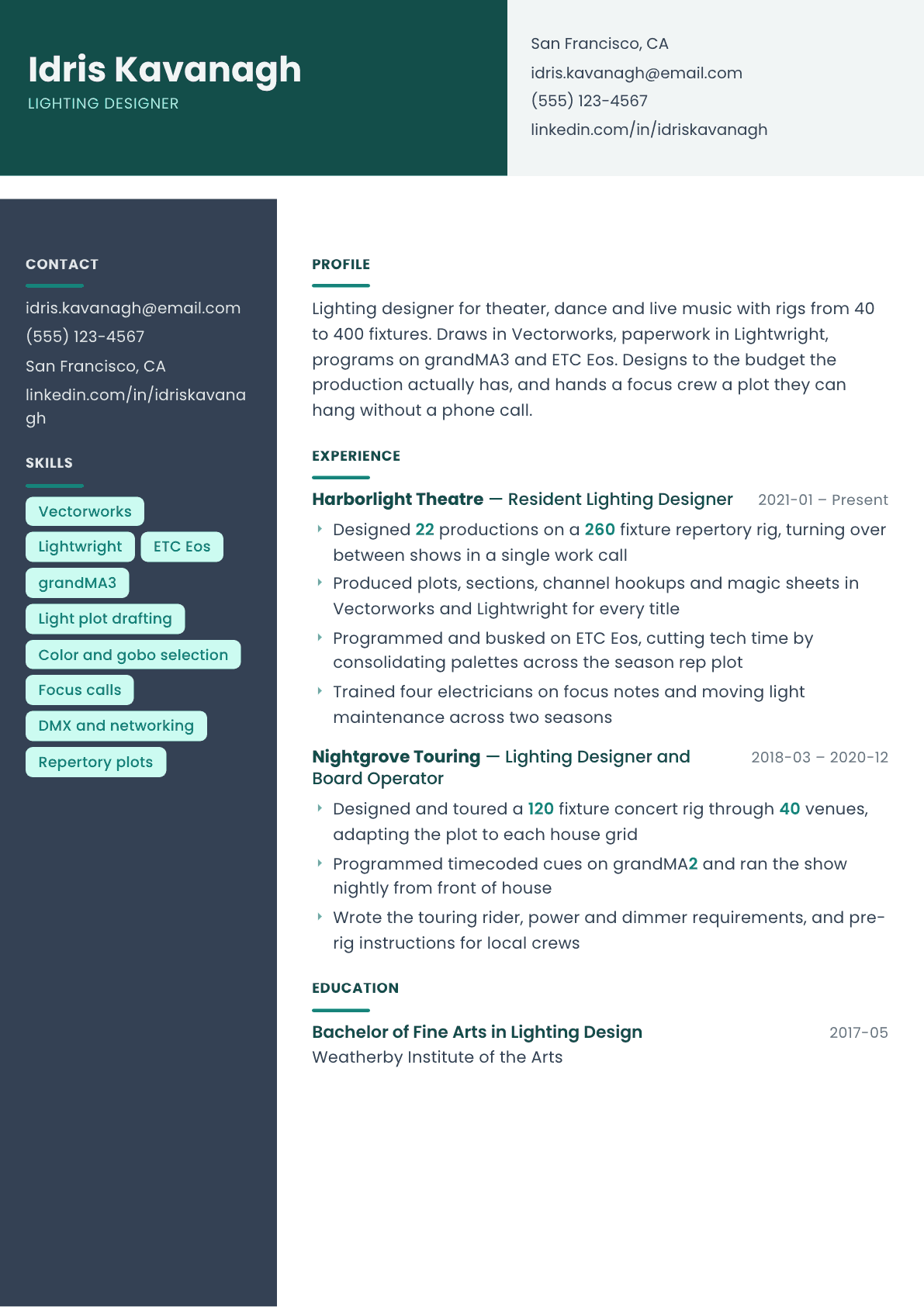
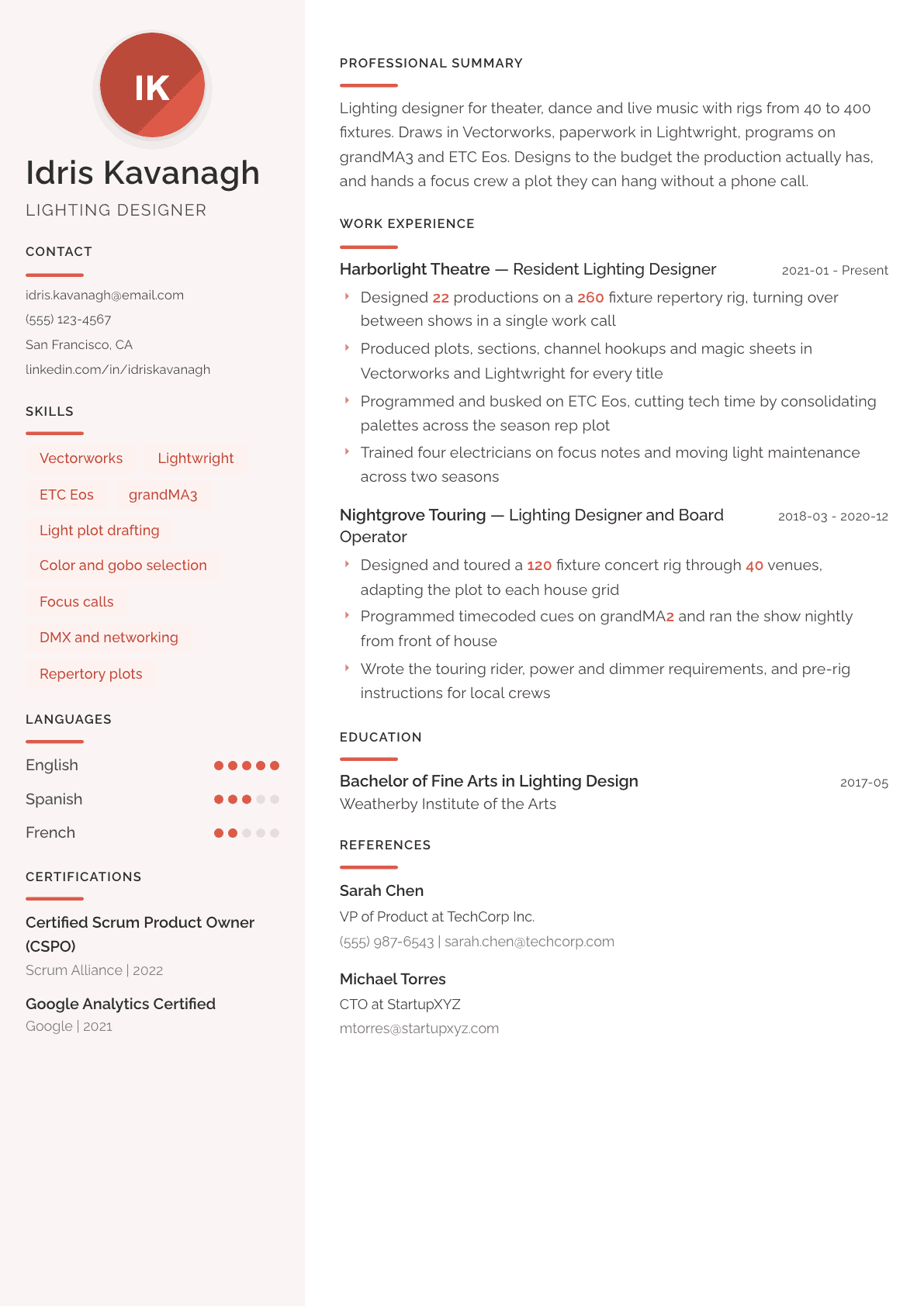
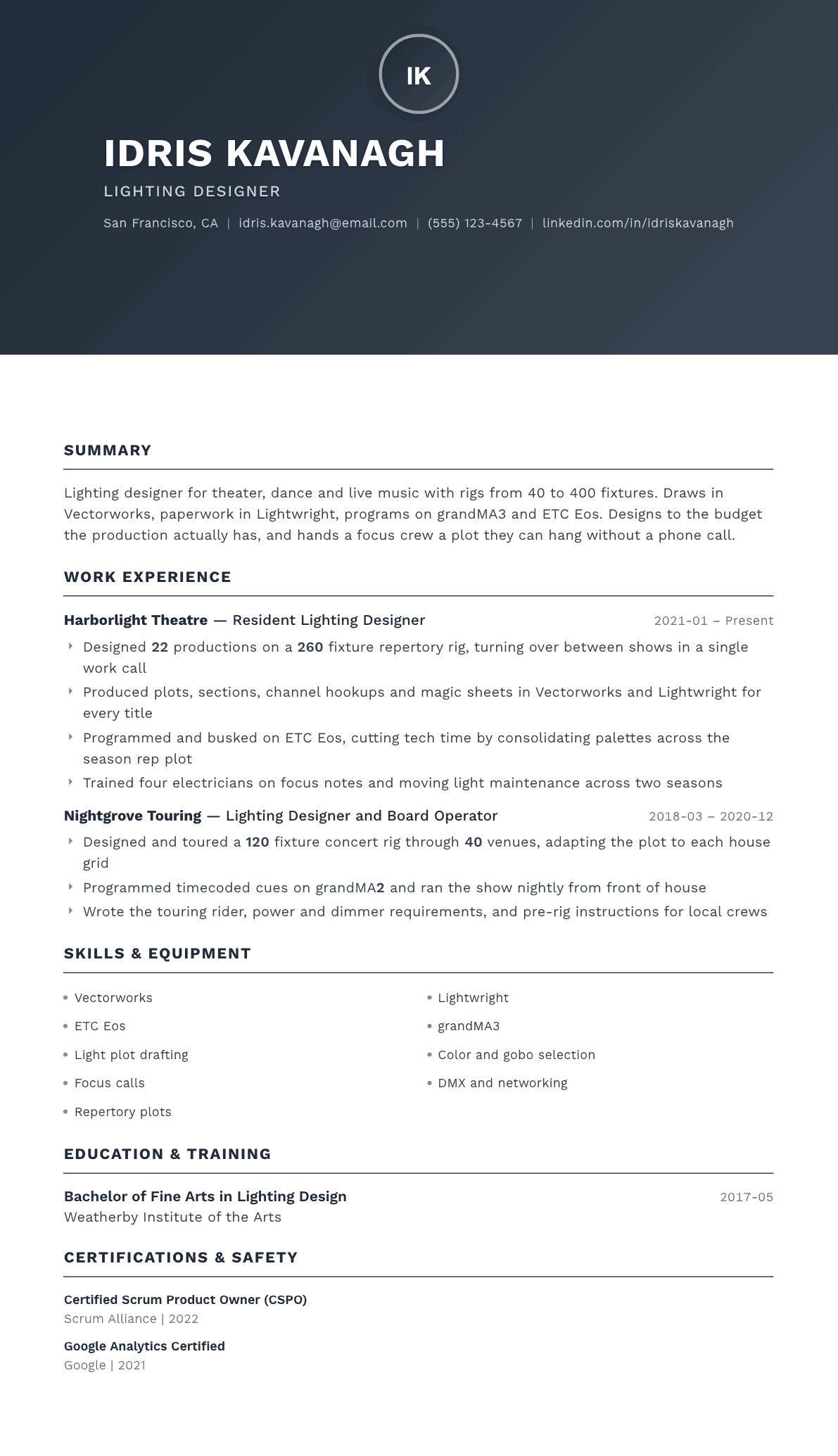
The same lighting designer content laid out in three CVBooster templates, so you can see what the finished document looks like before you write a word.
Example Lighting Designer summary
Lighting designer working across theater, dance and live music with rigs from 40 to 400 fixtures. Drafts in Vectorworks, keeps paperwork in Lightwright, and programs on ETC Eos and grandMA3. Designed 22 productions on a repertory plot that turned over in one work call, and toured a concert rig through 40 rooms without a redraw.
Skills to list on a Lighting Designer resume
- Light plot drafting
- Vectorworks
- Lightwright
- ETC Eos
- grandMA3
- Moving light programming
- Color theory
- DMX and sACN networking
- Focus calls
- Repertory plots
- Rigging and hang plots
- Cue writing
- Budget estimating
- Followspot calling
What actually gets this resume read
- List credits with the production, the venue, the rig size and the console you programmed on.
- Name your drafting and paperwork tools, because a production electrician needs files they can open.
- Separate theater, dance, concert and corporate design, since each hires on different evidence.
- Say whether you program yourself or work with a programmer, and name the consoles for both.
- Show one repertory or touring credit if you have it, because plot reuse is a distinct skill.
- Add an assistant and associate lighting design section rather than folding those credits into your own.
How to write a lighting designer resume
A lighting designer is hired on two things a resume can prove and one it cannot. The two are scale and toolchain: how many fixtures you have hung and controlled, and which drafting, paperwork and console systems you work in. The third is taste, and that belongs in a portfolio. Confusing the resume with the portfolio is the most common reason a good designer gets passed over by a production manager who never opened the images.
Production managers and technical directors read for the practical risk. Can this person hand a production electrician a plot, a channel hookup and a magic sheet that the crew can hang without a phone call? Can they program on the console the venue owns, or do they arrive with a programmer in the budget? Have they designed inside the fixture count the house actually has?
This guide covers the credit format venues expect, how to state rig sizes and console experience without inflating either, how to separate theater from dance and concert work, and the questions lighting designers ask when they build a resume for a resident post or a touring package.
Format: credits first, paperwork tools right behind them
Reverse-chronological credits with fixed columns: production, producing organization, venue, rig size, console and director. One page until the list overflows honestly. A production manager scans the rig size and console columns first, so put them where a scan finds them rather than inside a sentence.
Keep the page plain. A lighting designer resume that shows off gradients and colored blocks is amusing to exactly nobody in a production office, and colored text is the first thing to break when the file is printed for a hiring meeting.
- Header: name, city, phone, email, portfolio address and union status where it applies.
- Sections in this order: lighting design credits, associate and assistant credits, programming credits, software and consoles, training, awards.
- Add a separate line for repertory and touring work, since plot reuse and adaptation are distinct skills.
Rig size and console: the two numbers that decide the interview
Give the fixture count on every credit, and give your honest range across the whole page. A designer who has worked from a 40 fixture studio rig up to a 400 fixture repertory plot is telling a venue it can hire them for either. A resume with no fixture counts anywhere reads as a designer who has only worked small and is hoping nobody asks.
Name the console you programmed on for each credit, and be explicit about whether you programmed yourself or worked with a programmer. Both are legitimate, but a venue budgeting a tech period needs to know which one it is buying. If you program, name the desks: ETC Eos, grandMA3, and any earlier desks you can still sit down at cold.
Drafting and paperwork: name the files a crew will receive
The deliverable a lighting designer owes a production is a package, not an idea. Say which drafting tool you plot in and which paperwork tool you run, then list what the package contains: light plot, section, channel hookup, instrument schedule, color and gobo call, magic sheets and focus notes. A production electrician who knows what is arriving and in what format is a production electrician who says yes.
Add the network side if you have it. DMX universes, sACN, node counts, dimmer versus distro, and whether you write your own patch. On a modern rig those details decide whether load-in runs on schedule, and few designer resumes mention them at all.
- State whether you deliver drawings in a format the venue drafting standard accepts.
- Note focus call length you typically need for your largest rig.
- Mention followspot calling and cue writing separately from plotting.
Split the disciplines: theater, dance, concert, corporate
Each of those hires on different evidence. Theater buys cue writing and storytelling with a fixed plot. Dance buys sidelight, booms and a designer who protects the floor and the body. Concert buys timecoded programming, busking and a touring rider. Corporate buys speed, reliability and a clean look under camera. Sorting your credits into those groups lets a reader find the ones that match their posting.
Touring belongs in its own group. Adapting a 120 fixture concert rig into forty different house grids without redrawing the plot is a specific skill, and it should be visible as one credit line with the venue count rather than buried.
Keywords and skills a venue scans for
The language repeats across postings: light plot, channel hookup, magic sheet, focus call, repertory plot, moving light programming, cue writing, DMX, sACN, production electrician. Use the exact wording the posting uses once in your skills block and once inside a credit line, since the same reader is doing a keyword pass and a judgment pass in the same sitting.
Keep the skills section technical. Creativity and collaboration are claimed by every applicant, so let them show through in a credit that says you consolidated palettes across a season rep plot to cut tech time.
Lighting Designer resume summary examples
First designs
Lighting designer with eight productions on rigs of 40 to 90 fixtures across a studio theater and a dance program. Drafts plots and paperwork in Vectorworks and Lightwright, programs on ETC Eos, and hands a focus crew a hookup and magic sheet before the hang. Seeking assistant work on a full season.
Six years in
Lighting designer working theater, dance and live music on rigs of 60 to 250 fixtures. Programs ETC Eos and grandMA3, writes timecoded concert cues, and adapts a touring plot to a new house grid without a redraw. Recent work includes a season repertory plot turned over between titles in one work call.
Resident designer
Resident lighting designer with rigs from 40 to 400 fixtures across twenty two productions in a repertory season plus a forty venue concert tour. Drafts in Vectorworks, keeps paperwork in Lightwright, programs on Eos and grandMA3, writes touring riders and power requirements, and trains house electricians on moving light maintenance.
Work experience bullets: before and after
Before: Designed lighting for many productions at a regional theater.
After: Designed 22 productions on a 260 fixture repertory rig, turning the plot over between titles inside a single work call.
Production count, fixture count and the turnover constraint show a production manager exactly what you can carry.
Before: Created light plots and paperwork.
After: Produced plots, sections, channel hookups, instrument schedules and magic sheets in Vectorworks and Lightwright for every title in the season.
Naming the documents and the tools tells an electrician what package arrives and whether they can open it.
Before: Programmed lighting consoles for shows.
After: Programmed and busked on ETC Eos, consolidating color and beam palettes across the season rep plot to cut roughly two hours from each tech.
The desk, the technique and the time saved turn a generic claim into a reason to hire you over a programmer for hire.
Before: Toured with a band as lighting designer.
After: Designed and toured a 120 fixture concert rig through 40 venues, adapting the plot to each house grid and running timecoded cues nightly from front of house.
Fixture count, venue count and the timecode detail describe a touring package rather than a job title.
Before: Trained crew members on the lighting rig.
After: Trained four house electricians on focus notes, moving light maintenance and patch changes across two seasons, reducing repeat notes after each rep changeover.
Headcount, the specific curriculum and the outcome make a mentoring line into evidence of a designer a venue can keep.
Hard skills
- Light plot drafting
- Vectorworks
- Lightwright
- ETC Eos
- grandMA3
- Moving light programming
- Cue writing
- DMX and sACN networking
- Channel hookups and magic sheets
- Focus calls
- Repertory plots
- Rigging and hang plots
- Budget estimating
- Followspot calling
Soft skills
- Design collaboration
- Tech period pacing
- Crew instruction
- Note discipline
- Working to a fixed budget
- Director communication
Certifications worth listing
- ETCP Certified Entertainment Electrician (Entertainment Technician Certification Program)
- ETCP Certified Rigger, Theatre (Entertainment Technician Certification Program)
- OSHA 10-Hour General Industry (Occupational Safety and Health Administration)
- Vectorworks Certified Professional, Spotlight (Vectorworks)
Mistakes that cost lighting designer candidates the interview
- Treating the resume as the portfolio and writing about mood and atmosphere instead of rig sizes and consoles.
- Leaving fixture counts off every credit, which a reader will interpret as the smallest plausible rig.
- Claiming a console you have watched someone else run, which is discovered in the first tech.
- Folding associate and assistant design credits into your own design list.
- Listing no drafting or paperwork software, so an electrician cannot tell what files will arrive.
- Sending one page to a dance company and a concert promoter when the two hire on completely different credits.
Lighting Designer resume questions
Do I need a portfolio as well as a lighting designer resume?
Yes, and they do different work. The resume proves scale, toolchain and reliability so a production manager will look; the portfolio proves taste once they do. Put the portfolio address in the header and keep images off the resume itself.
How do I list console experience honestly?
Separate desks you program from desks you have designed on with a programmer, and say which is which on each credit. Every venue finds out during tech anyway, and the designer who was clear about it is the one who gets hired again.
Should I put fixture counts on every credit?
Yes. Rig size is the number a technical director uses to price your design and judge whether you have worked at their scale. A credit list without fixture counts asks the reader to guess, and readers guess low.
How do I show assistant and associate lighting design work?
Give it a section of its own with the designer you assisted, the production and the venue. Assisting a well known designer on a large rig is a real credential, and it only reads as one when it is clearly labeled rather than mixed into your own designs.
What belongs in the skills section of a lighting designer resume?
Drafting and paperwork software, consoles, network protocols, and the practical crafts such as focus calls, cue writing and followspot calling. Leave adjectives about creativity out, since they occupy space that a console name or a protocol would use better.