Textile Designer Resume Examples: the lines they read
Build a Textile Designer Resume That Wins Studio Interviews
By Mustafa Tarabya, founder of CVBooster · Published · Updated
Write a textile designer resume with print and weave examples, repeat and colorway keywords, and a guide to presenting your portfolio.
Sample resumes for a textile designer
The same textile designer content laid out in three CVBooster templates, so you can see what the finished document looks like before you write a word.
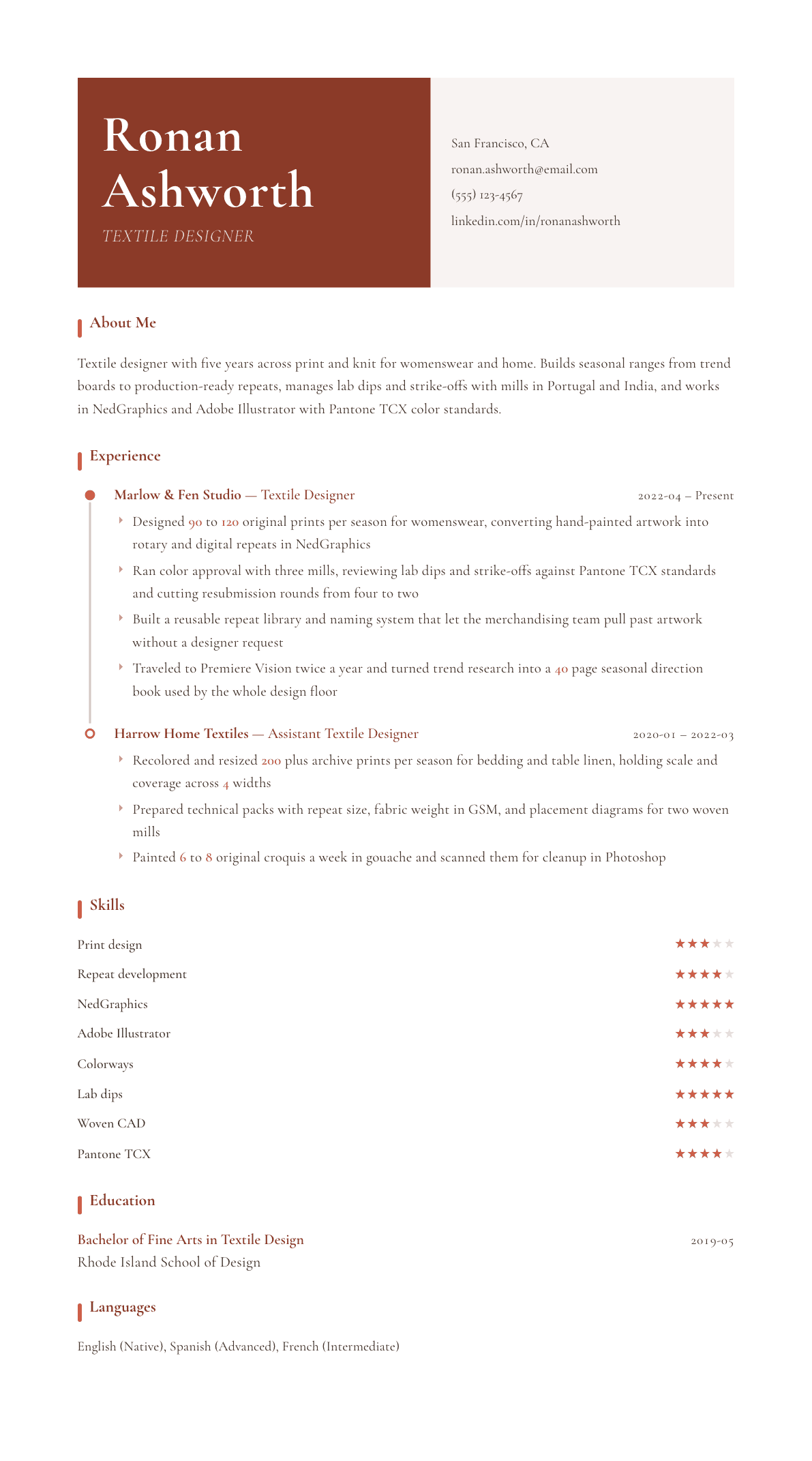
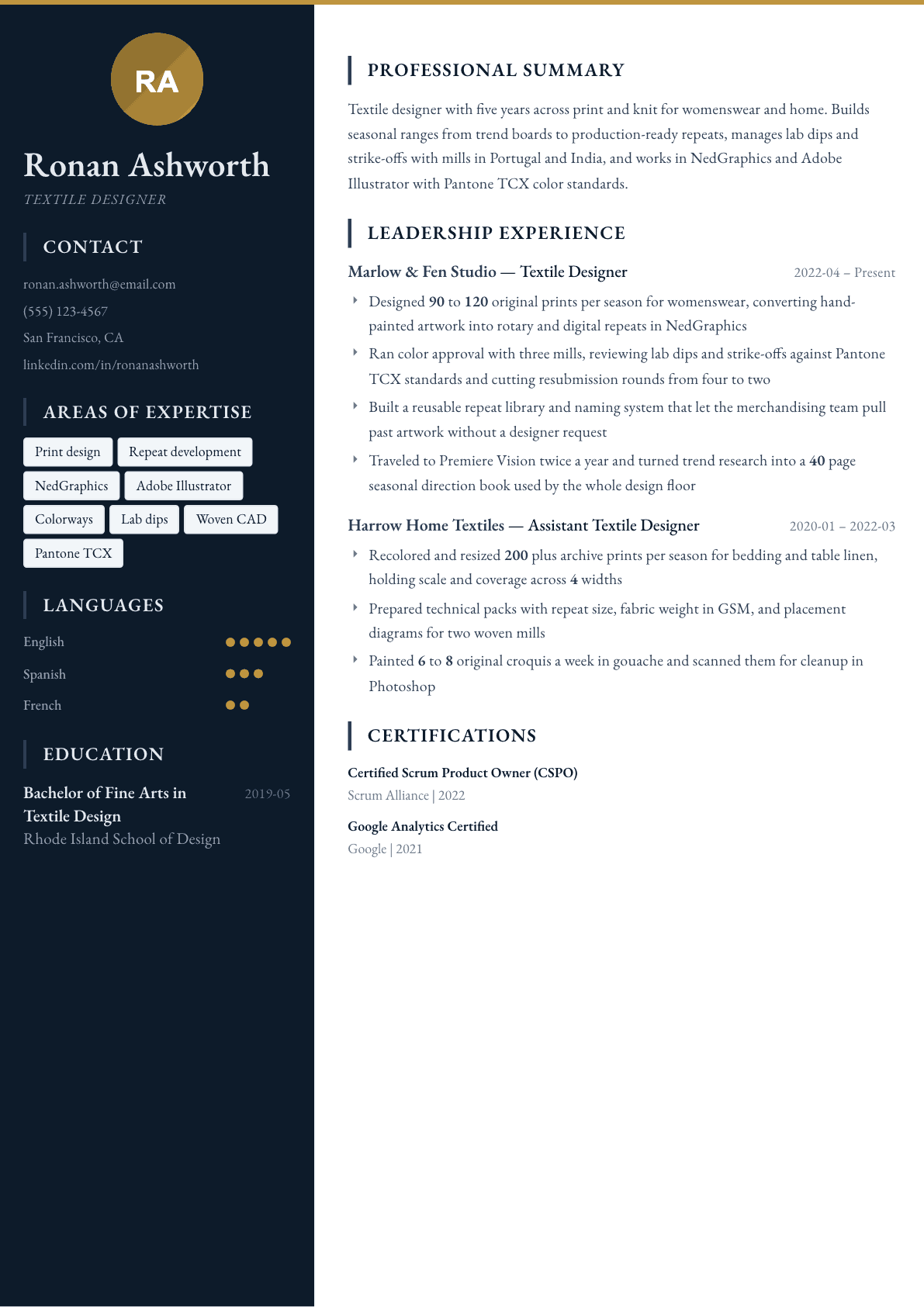
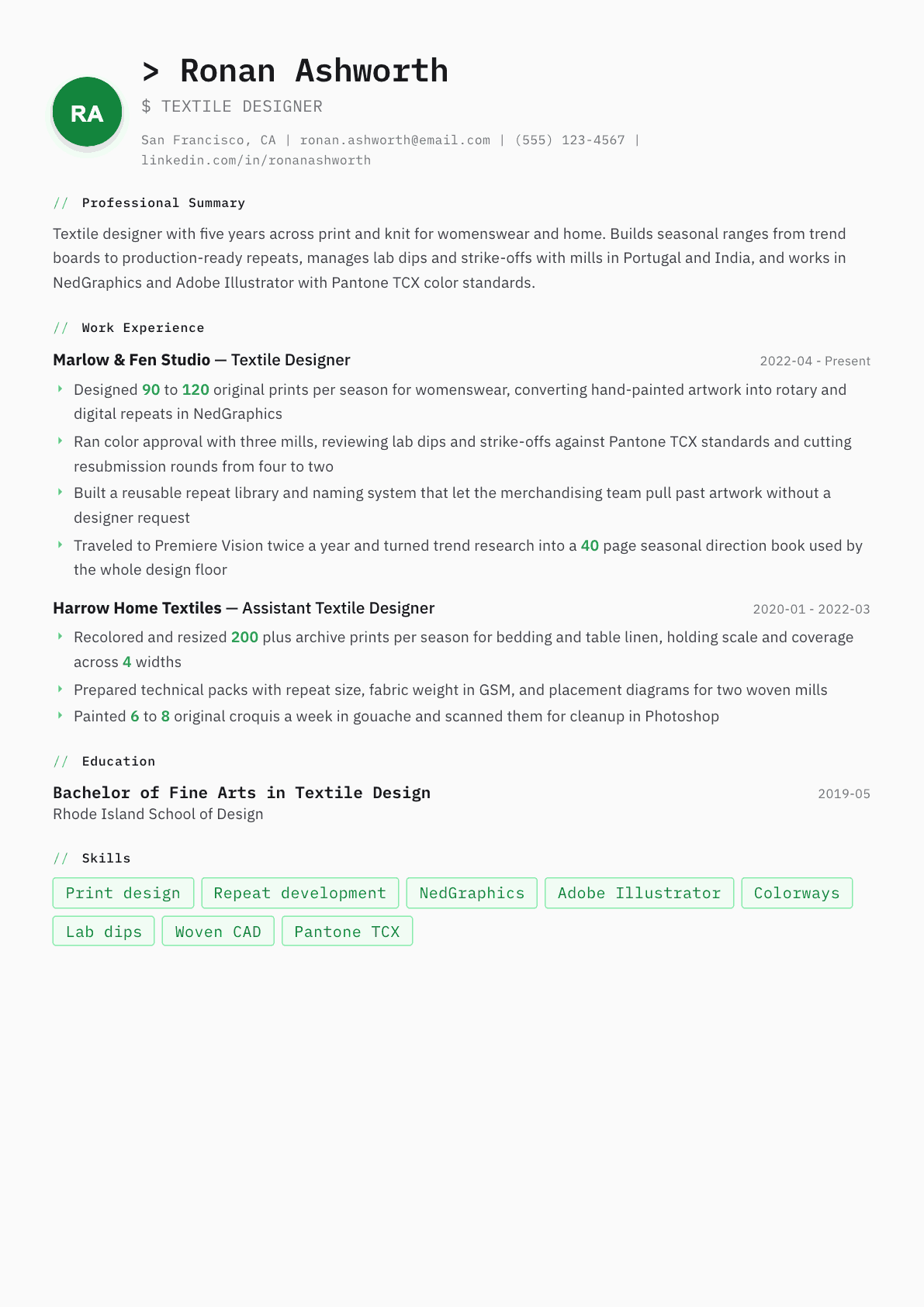
Example Textile Designer summary
Textile designer with five years in womenswear print and home linen, building seasonal ranges from trend boards through production-ready repeats. Fluent in NedGraphics, Illustrator and Photoshop, with hands-on color approval experience across mills in Portugal, Turkey and India. Known for artwork that survives the move from gouache to rotary screen without losing its hand.
Skills to list on a Textile Designer resume
- Print design
- Repeat development
- Colorways
- Woven design
- Knit design
- NedGraphics
- Pointcarre
- Adobe Illustrator
- Adobe Photoshop
- Pantone TCX
- Lab dip approval
- Trend research
- Technical packs
- Screen separation
- Digital printing
- Hand painting
What actually gets this resume read
- Name the product category you design for, because bedding, activewear and upholstery hire from different applicant pools entirely.
- State the repeat types you can build by hand: half-drop, brick, tossed, engineered placement, and border prints.
- List the CAD systems by name, since a studio on NedGraphics screens differently than a studio on Pointcarre.
- Show that you can take artwork to production by mentioning lab dips, strike-offs, and mill communication in a bullet.
- Put your portfolio link in the header and make sure it opens to prints, not to a general design site.
- Give the fiber and construction you know best, whether that is jersey knit, jacquard, canvas, or fine cotton poplin.
How to write a textile designer resume
A textile designer resume is read by a design director who wants two answers quickly: what product category your artwork has actually been sold into, and whether you can carry a painting all the way to an approved strike-off. Studios hire for an end use, so bedding, swimwear, shirting and upholstery draw from applicant pools that barely overlap.
The portfolio decides the interview, but the resume decides whether the portfolio gets opened. That means the CAD systems, the repeat types you can build, the fibers and constructions you know, and your history with mills have to sit on the first half of the page rather than being implied by pretty images.
This guide covers the section order studios expect, summaries for three career stages, before and after bullets drawn from real print and weave work, and the questions designers ask when they rewrite for a new market.
Format: one page, with the portfolio link in the header
One page until you have run a range on your own, then two at most. Put the portfolio link on the same line as your email and make sure it opens on prints or weaves, not on a general creative site with logos and photography mixed in. If the site is password protected, put the password beside the link.
Reverse chronological order, plain single column, no icons. Small studios read the resume in a browser and print it flat for the interview panel, so anything that depends on background color tends to vanish.
- Header: name, city, phone, email, portfolio link and password if the site is gated.
- Order: summary, experience, education, software, technical skills, exhibitions or awards if any.
- Graduating students move education up and add a section for internships and mill visits.
Summary: category, repeat type, and the CAD you actually work in
Three lines. Name the market, the years, the range of work per season, and the software. A director scanning for a knit print role stops at the word knit, so the market has to appear before any adjective about creativity.
If you are moving between markets, say it. A home textile designer aiming at activewear should name the transferable part, which is usually engineered placement, scale control on stretch fabric, and color standards, instead of hoping the reader makes the leap.
Experience: how much artwork, and what happened to it after you painted it
Each job needs the studio or brand, the categories you covered, and the seasonal rhythm. Then bullets that carry a number and a destination: original croquis per season, recolors, repeats released to mills, ranges that reached retail.
The bullets that separate a hired designer from a rejected one are about production. Lab dips, strike-offs, screen counts and separations, repeat size against fabric width, and the number of approval rounds you needed. Anyone can paint. Studios pay for artwork that survives rotary printing and comes back looking like the original.
Add one line on trend work if you did it: the fairs you attended, the direction books you built, the presentations you gave to merchandising or buying.
Skills: split the software from the craft
Two short lists read better than one long one. The software list is a filter, so spell the systems out exactly as the studio would write them, including the CAD you use for weave or knit structure rather than only the Adobe tools everybody has.
The craft list is where you prove range: hand painting media, repeat types, screen separation, jacquard and dobby structure, digital print preparation, and the color systems you approve against.
- Software: name the print CAD and the weave or knit CAD separately.
- Repeats: half-drop, brick, tossed, engineered placement, border and panel prints.
- Color: the standard library you work to, plus lab dip and strike-off review.
Keywords a textile studio screens for
Larger apparel and home companies filter on nouns. Work the ones that match your history into the bullets and the skills list, and leave out anything you cannot discuss for ten minutes: repeat development, colorways, croquis, lab dip, strike-off, screen separation, jacquard, dobby, rotary print, digital print, technical pack, GSM, and the fiber names for your category.
Textile Designer resume summary examples
Recent graduate
Textile design graduate with two studio internships in womenswear print. Paints in gouache and ink, then builds clean half-drop and tossed repeats in Illustrator and Photoshop. Produced 40 original croquis during a placement, six of which were bought for a resort range. Comfortable preparing files for digital print and reading a technical pack.
Five years in
Print designer with five years across womenswear and bedding, delivering 90 to 120 original prints a season plus recolors. Works in NedGraphics and the Adobe suite, and takes artwork through separation, lab dip and strike-off approval with mills in Portugal and India. Known for hand-painted florals that keep their texture on rotary screen.
Senior or studio lead
Senior textile designer leading a team of four across print and jacquard for a home brand. Sets seasonal direction from fair research, allocates artwork across categories, and owns the color standard with three mills. Cut average strike-off approval from four rounds to two by rewriting the separation and specification process the studio uses.
Work experience bullets: before and after
Before: Designed prints for the seasonal collection.
After: Designed 110 original prints per season for womenswear, converting hand-painted gouache artwork into rotary and digital repeats and releasing 38 of them into production.
Volume, technique, output format and the number that actually sold turn a job description into evidence.
Before: Worked with mills on color.
After: Ran color approval with three mills, reviewing lab dips and strike-offs against a standard color library and reducing average resubmission rounds from four to two.
The specific approval steps and the change in rounds show production judgment, not just contact with a factory.
Before: Created colorways for existing designs.
After: Recolored and resized 200 archive prints a season for bedding and table linen, holding coverage and scale across four fabric widths.
Recoloring sounds trivial until you name the volume and the technical constraint that makes it hard.
Before: Did trend research for the design team.
After: Attended two European fabric fairs a year and turned the research into a 40 page seasonal direction book used by design, merchandising and sales.
It names the source of the research and the artifact it produced, so the reader can see the deliverable.
Before: Helped with technical packs.
After: Prepared technical packs for two woven mills with repeat size, fabric weight in GSM, yarn count and placement diagrams, cutting sampling questions from the mill by half.
Naming the fields inside the pack proves you understand what a mill needs to weave the design correctly.
Hard skills
- Print design
- Repeat development
- Colorway development
- Woven and jacquard design
- Knit design
- NedGraphics
- Pointcarre
- Adobe Illustrator and Photoshop
- Screen separation
- Lab dip and strike-off approval
- Digital textile printing
- Technical packs
- Hand painting in gouache and ink
- Trend research and direction books
Soft skills
- Giving and taking design critique
- Working to a locked seasonal calendar
- Written communication with overseas mills
- Presenting a range to merchandising
- Attention to scale and detail
Certifications worth listing
- Adobe Certified Professional (Adobe)
Mistakes that cost textile designer candidates the interview
- Hiding the market. A reader cannot tell whether your florals were for duvet covers or for silk scarves, and those are different jobs.
- Listing only Illustrator and Photoshop when the posting names a textile CAD system you have actually used.
- Describing artwork with adjectives instead of counts, repeat types and what reached production.
- A portfolio link that opens on a home page full of branding work, forcing the reader to hunt for prints.
- Leaving out mill and color approval work, which is the part that makes a designer expensive to replace.
- One resume sent to both a home textiles studio and a swimwear brand, with nothing swapped except the greeting.
Textile Designer resume questions
How long should a textile designer resume be?
One page for anyone with under six years of studio work, two pages once you have led a range or managed designers. The portfolio carries the visual argument, so the resume should stay short and factual rather than becoming a second lookbook.
Should I put images on my textile design resume?
No. Keep the document plain and let the portfolio do the visual work. A small thumbnail strip rarely reproduces well in print or in an applicant tracking system, and it pushes the production detail that studios screen for onto a second page.
Do I need to know a textile CAD system to get hired?
For print roles Illustrator and Photoshop are often enough at junior level, but weave and knit roles usually expect a dedicated system. If you learned one at school, list it and say what you built with it rather than claiming daily professional use.
How do I show freelance textile work on a resume?
Group it under one heading with your own studio name and the date range, then list the clients or agents by category. Give the volume of artwork sold and the markets it went into, since buyers of freelance prints care about sell-through more than hours worked.
What belongs in a textile designer summary?
The market you design for, your years, the seasonal volume you handle, and the CAD systems you use. Add one line on the part of the process you are strongest in, whether that is hand painting, structure and weave, or taking artwork through mill approval.