Set Designer Resume Examples: free ATS score and gap list
Build a Set Designer Resume Around Productions, Drawings and Budgets
By Mustafa Tarabya, founder of CVBooster · Published · Updated
Set designer resume example with production credits, drafting skills, budget detail, keywords and a full writing guide.
Sample resumes for a set designer
The same set designer content laid out in three CVBooster templates, so you can see what the finished document looks like before you write a word.
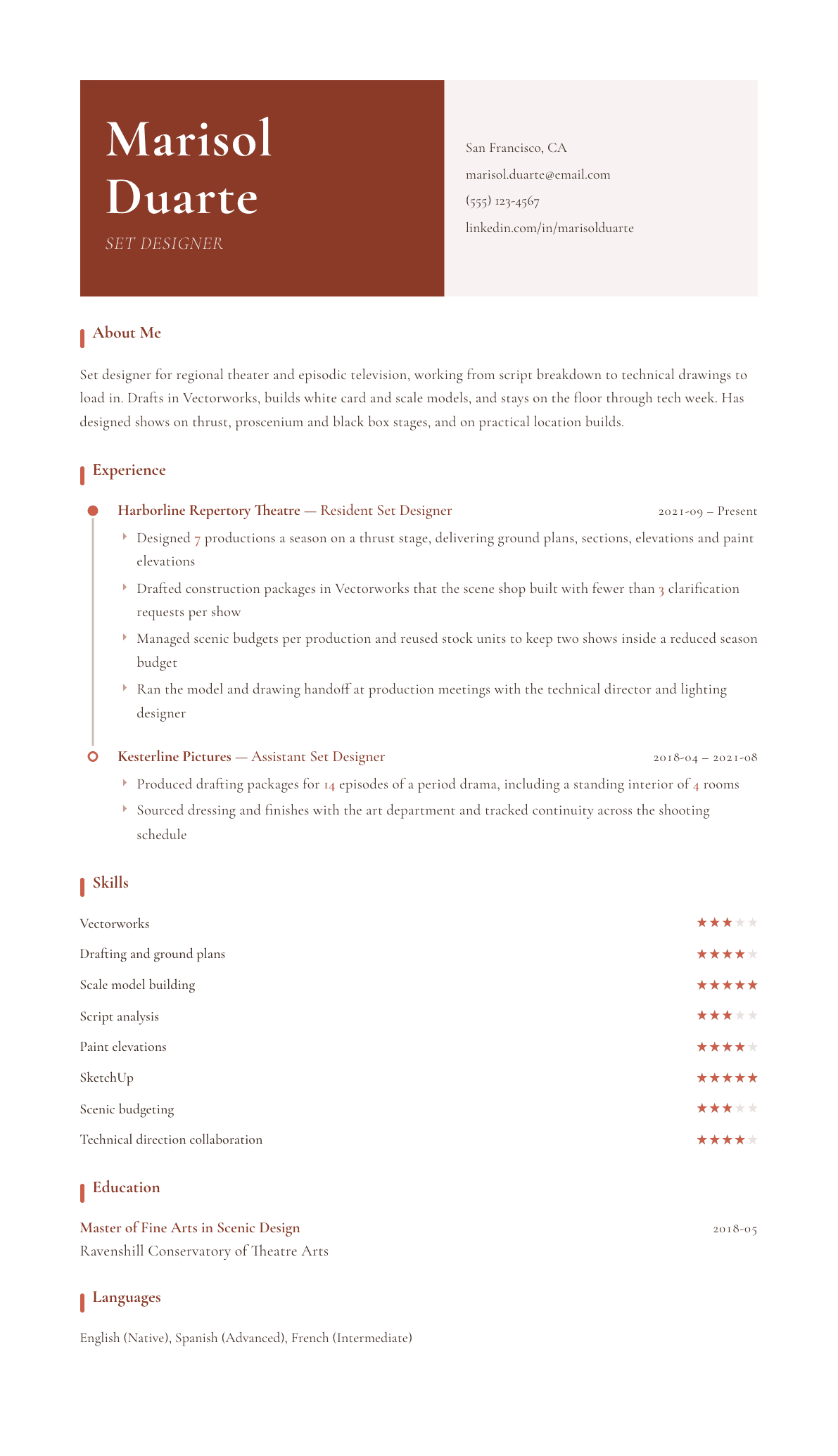
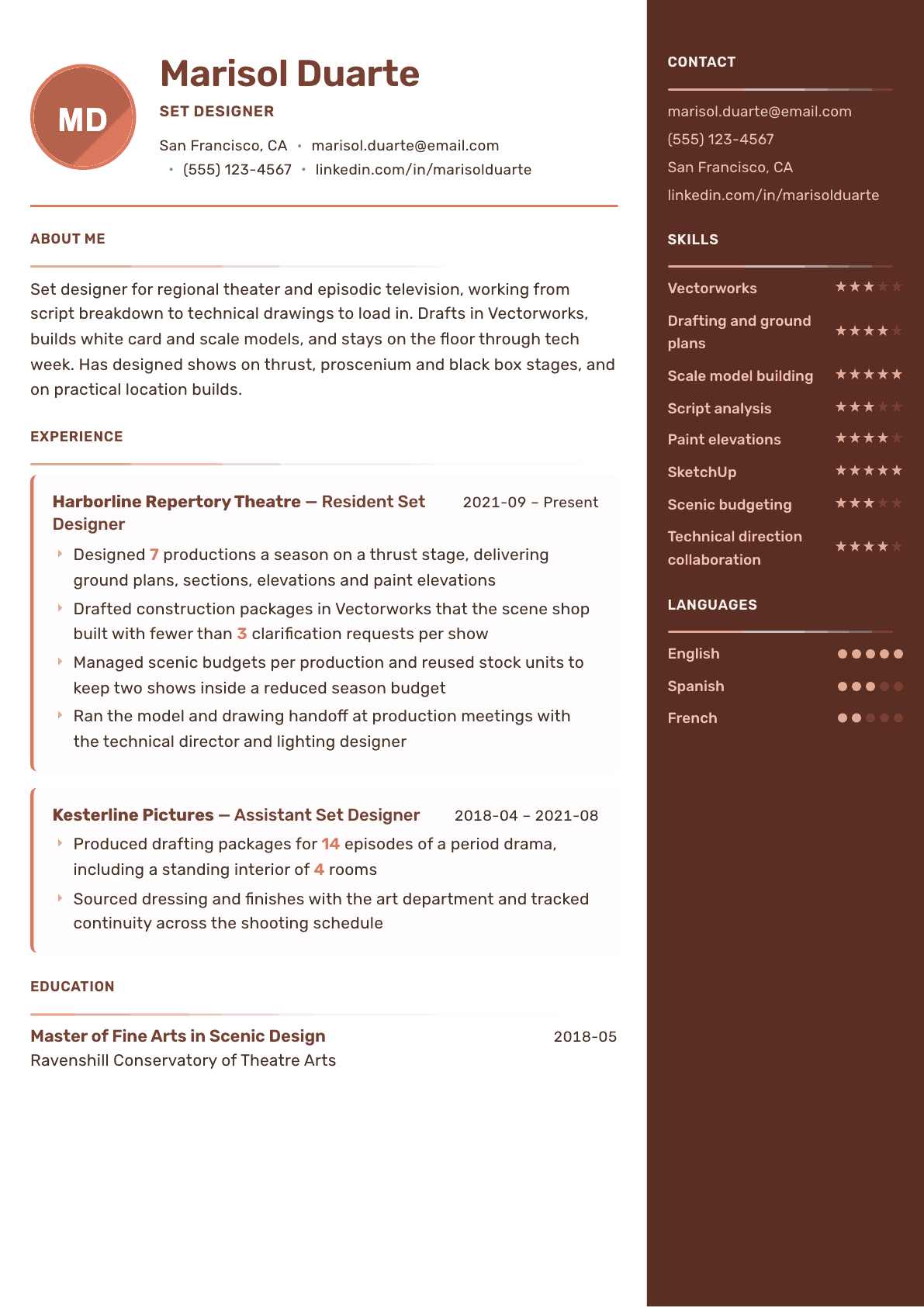
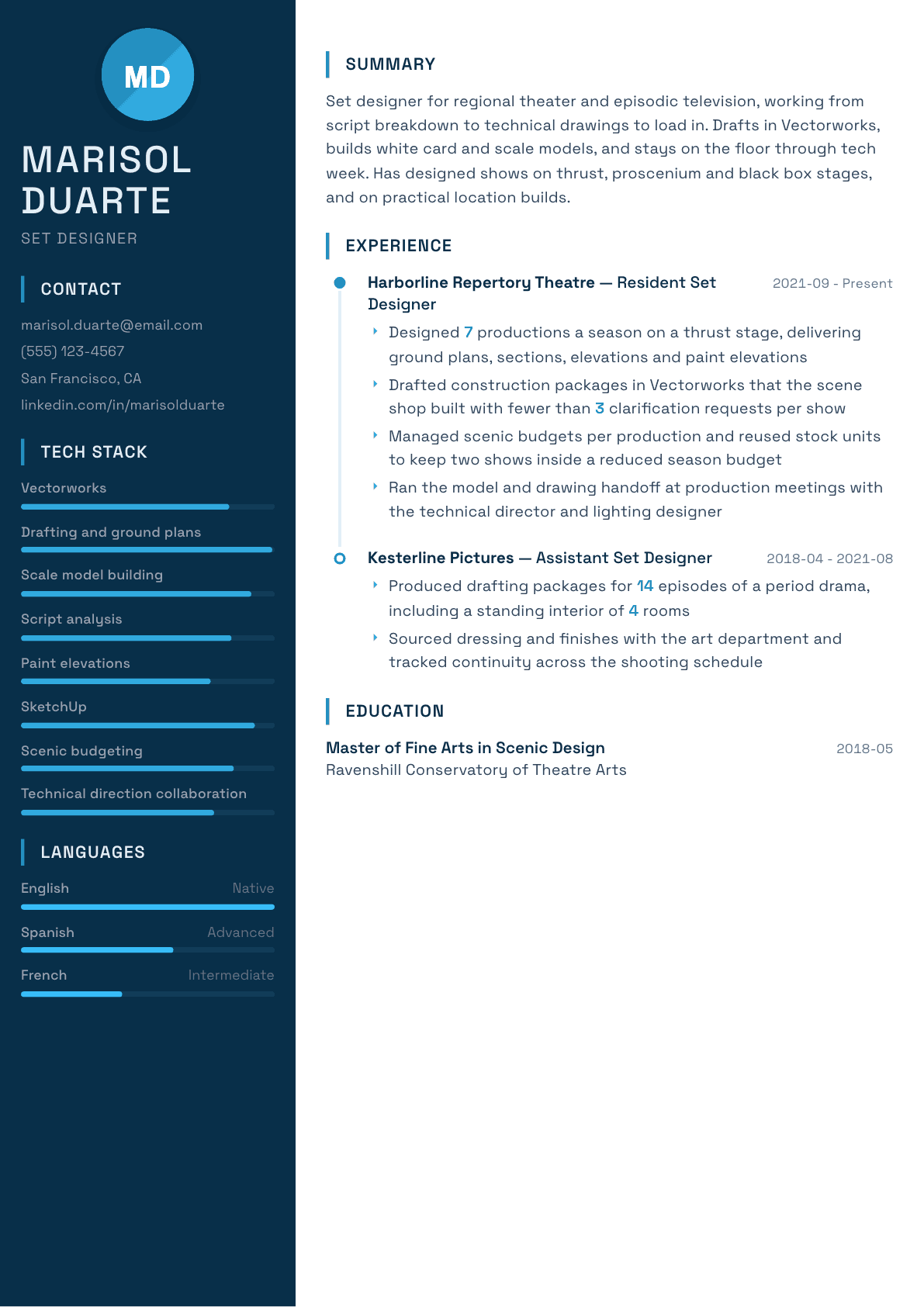
Example Set Designer summary
Set designer with eight years across regional theater and episodic television, from script breakdown to technical drawings to load in. Drafts full construction packages in Vectorworks, builds white card and finished scale models, and holds scenic budgets without losing the design. Comfortable on thrust, proscenium and black box stages and on location builds. Seeking resident or freelance design work with a company that rehearses properly.
Skills to list on a Set Designer resume
- Vectorworks
- AutoCAD
- SketchUp
- Drafting and ground plans
- Sections and elevations
- Scale model building
- White card models
- Paint elevations
- Script analysis
- Scenic budgeting
- Materials and construction methods
- Rendering
- Research and period accuracy
- Production meetings
What actually gets this resume read
- List productions as credits with the show, the venue or production company, the director and the year.
- Separate theater, film, television and live event credits, because those hiring pipelines rarely overlap.
- Name your drafting software and what you deliver: ground plans, sections, elevations, paint elevations, models.
- State budget responsibility and stage type, since a black box build is a different problem from a proscenium one.
- Show collaboration with the technical director, scene shop and lighting designer through the build and tech week.
- Keep a portfolio with drawings, models and production photographs side by side so the reader sees intent and result.
How to write a set designer resume
A set designer resume is really a credits document with a technical appendix. The artistic director, production designer or department head reading it wants to know three things in the first fifteen seconds: what you have designed, who you designed it for, and whether your drawings are good enough that the shop can build from them without a stream of questions. Everything else on the page is supporting evidence.
The technical half is what separates candidates. A beautiful rendering means little if the ground plan does not match the sight lines, the elevations are missing dimensions, or the design cannot be built for the money in the budget. Theaters and art departments hire designers who deliver a complete, buildable package and then stay on the floor through the build and technical rehearsals.
This guide covers how to structure a credits list, how to separate theater from film and television experience, what drafting deliverables to name, how to write about budget responsibility, and how to present a portfolio that shows both intent and result.
Format: credits first, technical skills right behind them
Two pages are normal in this field once the credits accumulate, and nobody will penalize you for it. Lead with a credits table: production, venue or production company, director, and year, in reverse order. That block is the resume as far as most readers are concerned, and everything else supports it.
Follow with a short technical section covering drafting software, deliverables, model building and construction knowledge, then education and any teaching or assistant work. Keep the layout plain and readable, since these documents are often printed and passed around a production meeting.
- Header block: name, design title, base city, phone, email, portfolio address, and union status where applicable.
- Credits: production, company or venue, director, year, and your role if it was assistant or associate.
- Technical: drafting software, drawing package contents, model types, materials knowledge.
Separate theater, film, television and live events
These hiring pipelines barely overlap, and mixing them into one list makes a reader work to find what they came for. Give each its own credits block. A regional theater artistic director wants to see stage credits and the stage configurations you have designed on. A television art department wants standing sets, swing sets, continuity and shooting schedules.
Name the stage type in theater credits: thrust, proscenium, black box, arena, or a found space. A designer who has solved a thrust with sight lines on three sides has demonstrated something a proscenium credit does not, and directors recruit for that specific experience.
The drawing package: say exactly what you deliver
List the deliverables by name: ground plans, sections, elevations, detail drawings, paint elevations, prop and dressing lists, and the model. Then name the software. A technical director reading that you draft complete construction packages in a standard drafting application knows immediately whether their shop can work with your files.
Give the quality evidence a technical director cares about most: how few clarification requests the shop raised, whether your dimensions and section cuts were consistent, and whether the build matched the drawings. That is the single most useful thing you can say about your drafting, and almost nobody says it.
Include model building. White card models for early director conversations and finished scale models for production meetings are separate skills, and both signal that you communicate space rather than only images.
Budget and materials: the constraint the design lives inside
Every scenic design is a money problem. Say what you have been responsible for: holding a per production scenic budget, working with stock units and reused platforming, choosing materials that the shop can fabricate in the time available, and adjusting a design during the build when a price came back high.
Materials and construction knowledge belongs alongside it. Framing, platforming, soft goods, scenic paint techniques, translucent surfaces, moving scenery and automation basics. A designer who understands how the thing gets made designs things that can be made.
- Budget: per show scenic budgets, stock reuse, revisions to hold a number during the build.
- Materials: timber and steel framing, platforming, soft goods, scenic paint and texture treatments.
- Collaboration: technical director, scene shop, paint charge, props, lighting designer.
Portfolio: drawings, model and production photographs together
Show each production as a set: the research and concept image, the drafting page, the model photograph, and the production photograph of the finished set with the lighting on it. Side by side, that sequence proves you can carry an idea from script analysis all the way to a stage, which is the entire job.
Include at least one full drawing package page in the portfolio, even though it is less attractive than a rendering. Technical directors and production designers look for it specifically, and its absence is often what quietly removes a candidate.
Set Designer resume summary examples
Assistant designer
Assistant set designer with 3 years in a television art department, producing drafting packages for 14 episodes of a period drama including a standing interior of 4 rooms. Sources dressing and finishes with the department and tracks continuity across the shooting schedule. Seeking associate or lead design work in theater or episodic television.
Resident designer
Set designer with 8 years across regional theater and episodic television, from script breakdown to technical drawings to load in. Designs 7 productions a season on a thrust stage, delivering ground plans, sections, elevations and paint elevations, and holds each scenic budget by reusing stock platforming where the design allows.
Lead or production designer
Scenic designer with 16 years of theater and film credits, including 4 seasons as a resident designer and lead design on two feature builds. Runs script analysis and research, delivers full construction packages, manages scenic budgets with the technical director, and mentors assistant designers through drafting standards.
Work experience bullets: before and after
Before: Designed sets for the theater season.
After: Designed 7 productions a season on a thrust stage, delivering ground plans, sections, elevations and paint elevations for each, plus a finished scale model presented at the first production meeting.
Volume, stage configuration and the named deliverables tell an artistic director exactly what you produce.
Before: Drafted plans for the scene shop.
After: Drafted complete construction packages that the scene shop built with fewer than 3 clarification requests per production, with consistent dimensions and section cuts through every unit.
A shop facing measure of drawing quality is the strongest evidence a technical director can be given.
Before: Stayed within the scenic budget.
After: Held the scenic budget on every production by reusing stock platforming and revising two wall treatments during the build after material prices came back high.
Naming the trade offs shows budget skill rather than luck or an unusually generous season.
Before: Worked with the technical director and lighting designer.
After: Ran the model and drawing handoff at production meetings with the technical director and lighting designer, resolving sight lines, masking and lighting positions before the build began.
Naming what got resolved shows you use collaboration to prevent problems rather than to report them.
Before: Helped build sets for a television show.
After: Produced drafting packages for 14 episodes of a period drama, including a standing interior of 4 rooms with removable walls planned for camera access and lighting positions.
Camera and lighting access is the detail that shows genuine screen department experience.
Hard skills
- Vectorworks
- AutoCAD
- SketchUp
- Ground plans and sections
- Elevations and detail drawings
- Paint elevations
- White card and finished scale models
- Script analysis and breakdown
- Period and architectural research
- Scenic budgeting
- Materials and construction methods
- Rendering and visualization
- Sight line and masking analysis
- Production meeting documentation
Soft skills
- Collaboration with directors
- Communicating with a scene shop
- Working through technical rehearsals
- Problem solving during the build
- Presenting a design to a company
Certifications worth listing
- OSHA 10-Hour General Industry Outreach Training (US Department of Labor, Occupational Safety and Health Administration)
Mistakes that cost set designer candidates the interview
- Writing prose paragraphs instead of a credits list, which forces a reader to hunt for the productions.
- Mixing theater, film and television credits into one block when the hiring pipelines are separate.
- Showing renderings without a single drafting page, which is what a technical director looks for.
- Omitting stage configuration, so a director cannot tell a black box design from a proscenium one.
- Saying nothing about budget, when every scenic conversation eventually becomes a budget conversation.
- Leaving off the director name in credits, which is often how a reader recognizes and verifies your work.
Set Designer resume questions
How should a set designer list production credits?
One line per production with the title, the producing company or venue, the director, and the year, in reverse order. Add your exact role when you were an assistant or associate, because misrepresenting that is the fastest way to lose a reference.
Which drafting software should I name?
The one you draft production packages in, most often a dedicated entertainment drafting application, plus any general drafting or modeling tool you use for research and visualization. Shops care about file compatibility, so state the formats you can deliver.
Do I need to build physical models?
For theater, usually yes. White card models drive early director conversations and finished models anchor production meetings. For screen work, digital models and elevations often replace them, so match the emphasis to the pipeline you are applying into.
What belongs in a scenic design portfolio?
Each production shown as research image, drafting page, model photograph and production photograph together. That sequence proves you carry an idea from script to stage, and the drafting page is the piece technical directors specifically look for.
How do I move from theater into film or television design?
Reframe the resume around drawing packages, research depth and budget control, then add camera specific language such as standing sets, wild walls and continuity. An assistant or draftsperson credit in an art department is the usual entry route.