Court Clerk Resume Examples: free ATS score and gap list
Build a Court Clerk Resume That Clears the Personnel Screen
By Mustafa Tarabya, founder of CVBooster · Published · Updated
Court clerk resume example with docketing and case management detail, courtroom keywords, and a step by step writing guide.
Sample resumes for a court clerk
The same court clerk content laid out in three CVBooster templates, so you can see what the finished document looks like before you write a word.
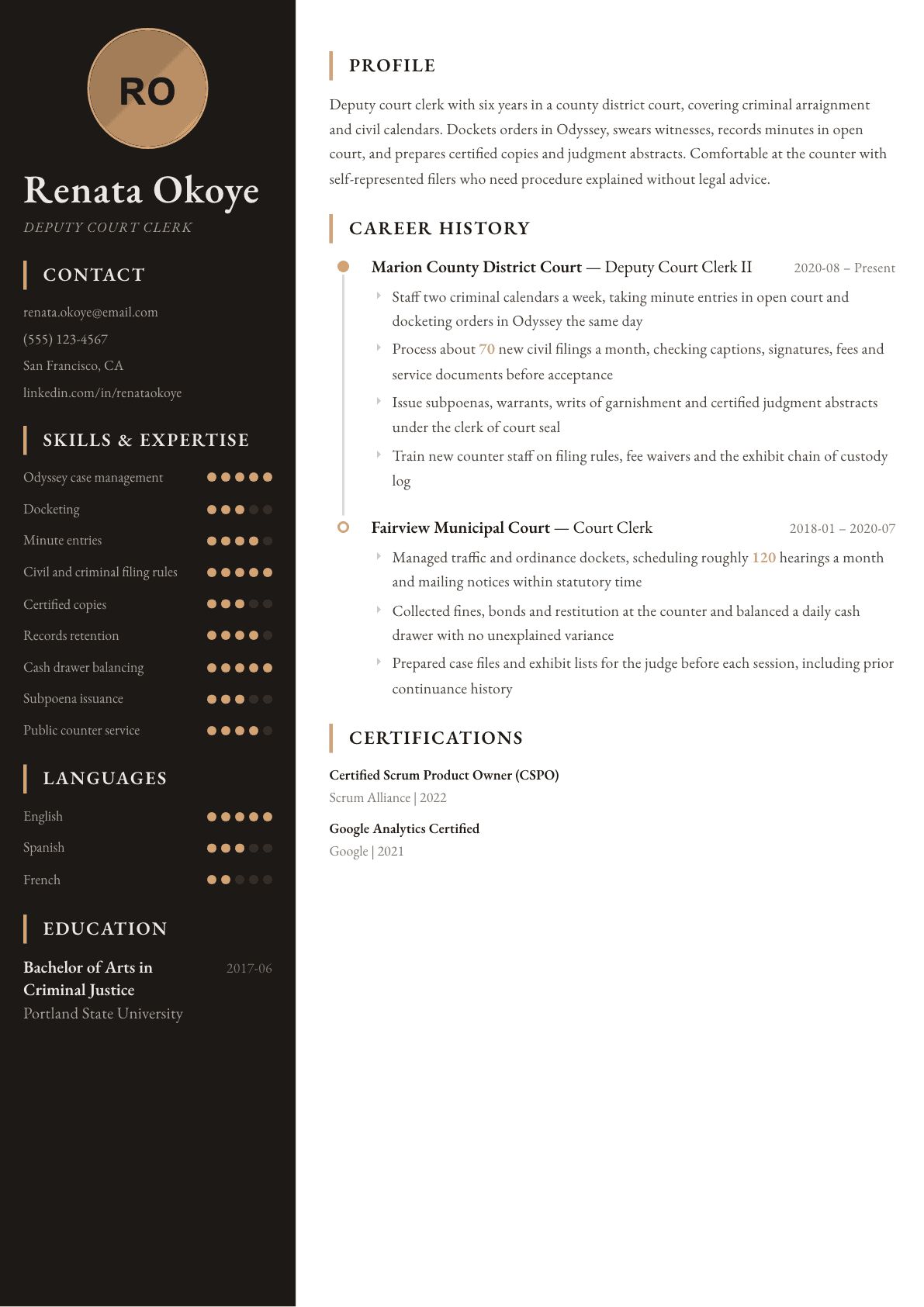
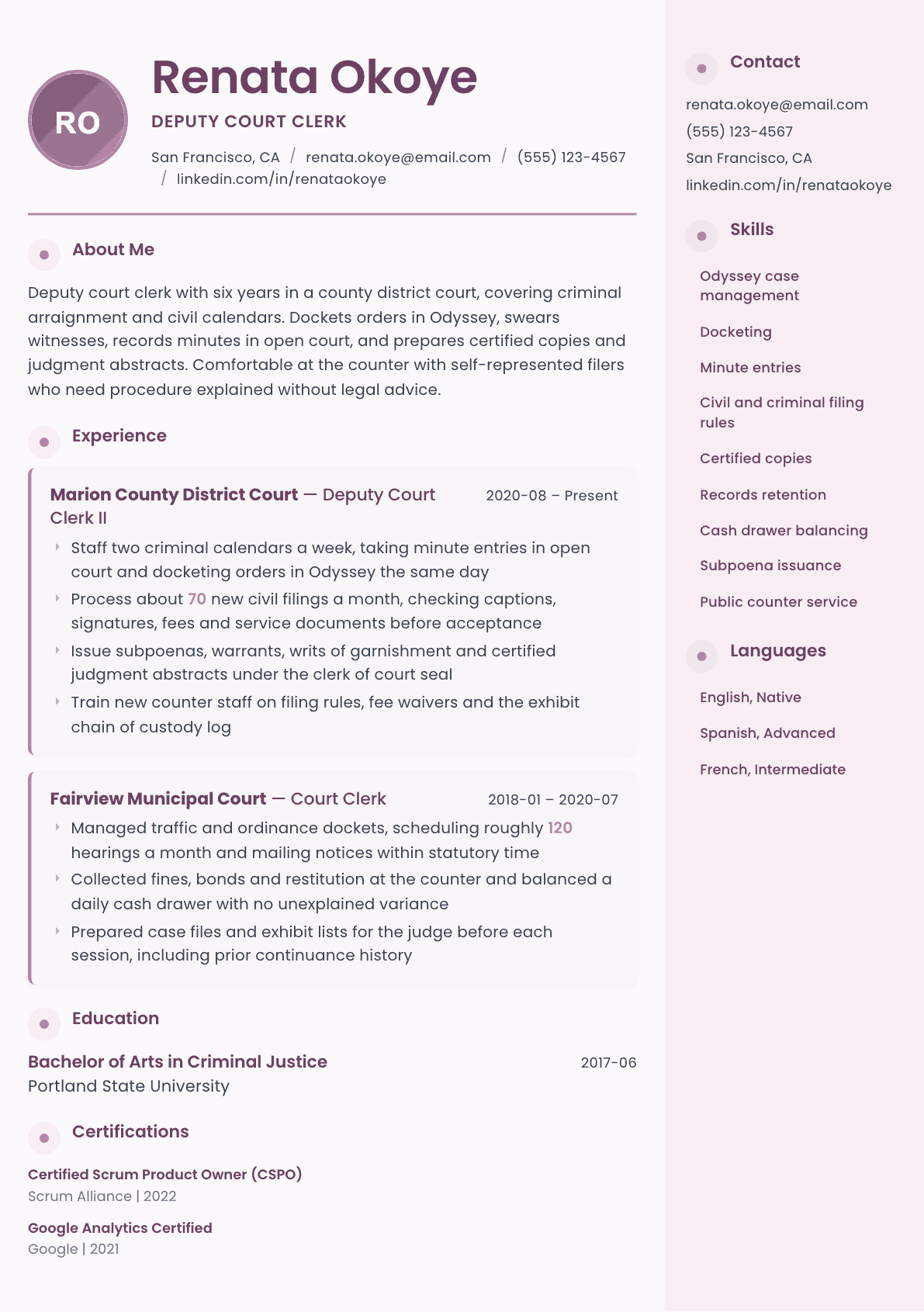
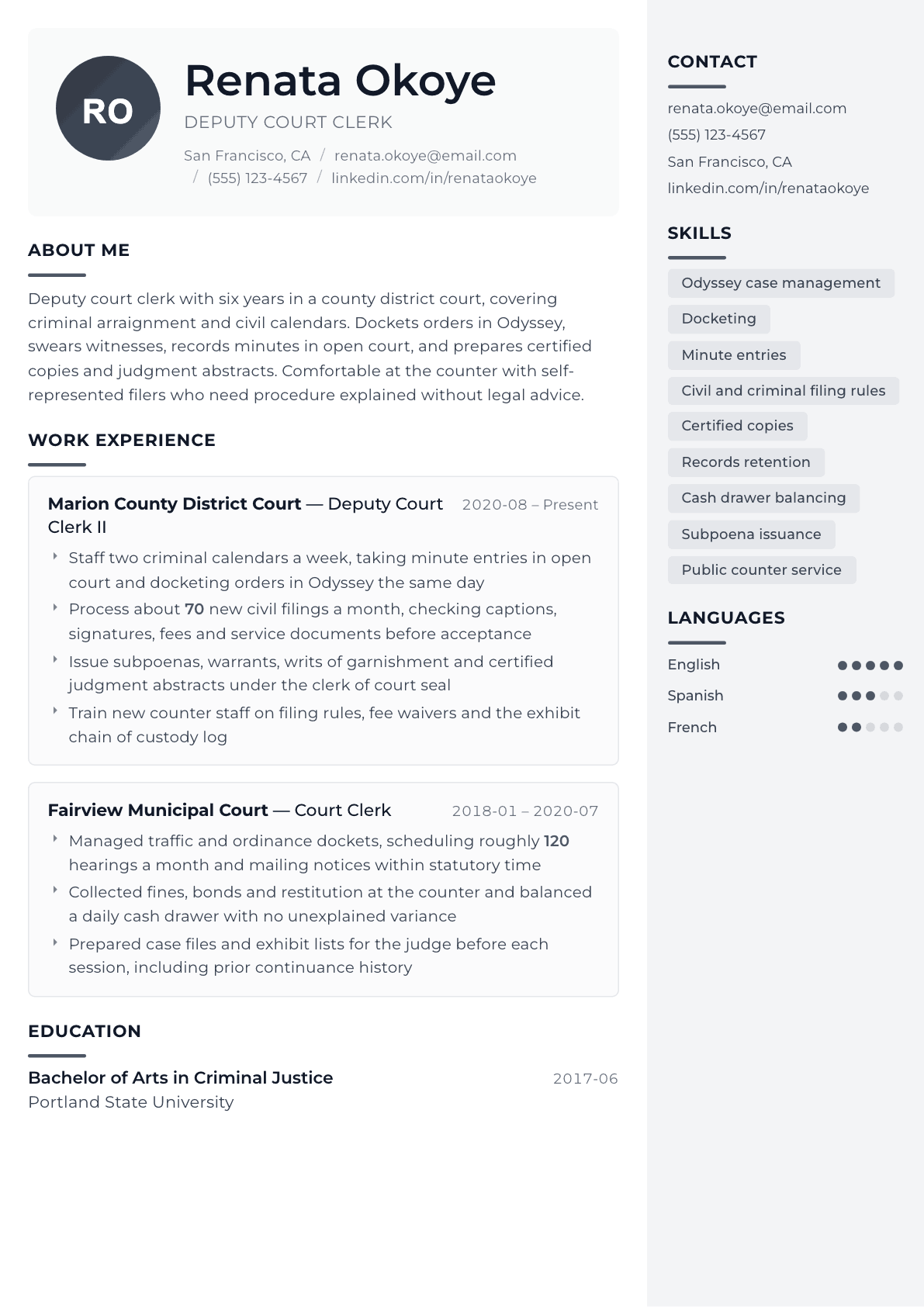
Example Court Clerk summary
Deputy court clerk with six years supporting criminal and civil calendars in a county district court. Dockets orders in Odyssey the same day, records minutes in open court, and processes about 70 new civil filings a month against local rules. Trains counter staff on fee waivers and exhibit custody, and holds an active notary commission. Bachelor degree in criminal justice.
Skills to list on a Court Clerk resume
- Docketing and minute entries
- Case management systems
- Odyssey
- Civil filing procedure
- Criminal calendar support
- Certified copies and seals
- Subpoenas and writs
- Records retention schedules
- Fee collection and receipting
- Exhibit custody logs
- Notary public duties
- Jury administration support
- Public counter service
- Redaction of confidential data
What actually gets this resume read
- Name the case management system by product, such as Odyssey, JIS, eCourts or CourtView, because clerk postings screen on it.
- State the court level and case types you covered: municipal traffic, district criminal, family, probate or civil.
- Show courtroom duties separately from counter duties, since many clerk roles are one or the other, not both.
- Include filing volume and hearing volume so a supervisor can judge whether you can carry their calendar.
- Say plainly that you explain procedure without giving legal advice, a boundary every clerk supervisor watches for.
- List notary commission, records retention training and any oath administration authority you hold in its own section.
How to write a court clerk resume
A court clerk resume goes through a county or municipal personnel office before a court administrator ever sees it, and public sector screens are mechanical. Minimum qualifications are checked line by line, so if the posting asks for two years of records or courtroom experience and your dates are vague, the file is scored out before anyone reads a word of your prose. Precision on the page is itself an audition for the job.
The second reader is the clerk of court or a supervising deputy who needs to know two things: which case management system you have docketed in, and whether you can stand at a public counter and explain procedure to a self-represented filer without drifting into legal advice. Those are the two competencies that decide the interview list.
This guide sets out the section order a court personnel screen expects, how to describe docketing, minute entries and filing review in language that matches a job specification, summary examples at three stages, before and after bullets, and the questions clerks ask when they apply across court levels.
Format: written for a minimum qualification screen first
Use reverse chronological order with month and year on every position, because public personnel offices compute qualifying months from those dates and an incomplete date can be scored as zero. If the posting names a required number of years of clerical, records or legal support experience, make sure the arithmetic on your page reaches it without the reader doing mental work.
One page works for under five years; two pages is normal once you have worked more than one court level. Keep the layout plain. Many jurisdictions also require a separate online application, and a resume that reads in the same order as that form, with matching employer names and dates, avoids the inconsistency flag that stalls a file in review.
- Header: name, city and state, phone, email, and any active notary commission.
- Section order: summary, case management systems, court experience, education, certifications and training.
- For each job give the court level and case types: municipal traffic, district criminal, civil, family, probate.
Summary: court level, case types, system, counter or courtroom
Say what kind of court you worked in, which calendars you covered, and which case management system you docketed in. Odyssey, JIS, eCourts and CourtView are not interchangeable, and a supervisor filling a criminal calendar seat wants to see criminal calendar words in the first two lines rather than a general claim about administrative support.
Add whether your work was courtroom, counter, or both. Many clerk positions are one or the other, and a candidate who has taken minute entries in open court is competing for a different seat than one who has processed filings at a window. Naming both when you have done both is a genuine advantage, so do not let it hide in a bullet on page two.
Experience: docketing, filings, courtroom duty, money handled
Anchor every position in volume and case type. New civil filings processed per month, hearings calendared, and criminal calendars staffed per week are the numbers a supervisor uses to judge whether you can carry the docket she needs covered. Then show the documents you issued under seal: subpoenas, warrants, writs of garnishment, certified copies and judgment abstracts.
Courtroom bullets should show what happens in session. Taking minute entries as the judge rules, swearing witnesses, marking and tracking exhibits through a chain of custody log, and docketing the resulting orders the same day are concrete and specific to the role. Counter bullets should show filing review: captions, signatures, service documents, fee calculation and fee waiver applications, and the rejection reasons you gave in writing.
If you handled money, say so plainly and say how it balanced. Fines, bonds and restitution collected at the counter with a daily cash drawer balanced and no unexplained variance is a bondable-position signal that many court postings quietly require, and it is easy to omit by accident.
- State the system by product name and what you did in it, not just used case management software.
- Separate courtroom duties from counter duties under each employer with a short label.
- Include records retention, sealing and redaction work, since confidentiality handling is scored in the interview.
The legal advice boundary and other trust signals
Every clerk supervisor watches for one line: that you can explain procedure and forms to the public without giving legal advice. Put it in your own words inside a bullet, tied to real counter traffic, because a candidate who volunteers that boundary has clearly been trained and clearly been tested by a frustrated filer at a window.
The other trust signals are records retention schedules, redaction of confidential identifiers before a file goes public, sealed case handling, and jury administration support. List the ones you have actually done. A notary commission belongs in the header and again in the certifications block, since clerks are often the ones administering oaths and certifying copies.
Education, training and the vocabulary the screen matches
A degree in criminal justice, paralegal studies, public administration or a related field helps but is rarely mandatory. What does help is naming court specific training you completed: local rules training, records retention training, courtroom technology, and any state judicial branch education program you attended. List the provider so the reader can place it.
For keywords, work from the job specification rather than the recruitment advertisement, because the specification carries the language the scoring rubric uses. Expect docketing, minute entries, case initiation, service of process, calendaring, certified copies, records retention, fee collection and public counter service. Use each once in a bullet where the work happened and once in your systems and skills block.
Court Clerk resume summary examples
First court role
Criminal justice graduate with two years of records and front counter work in a city department, now seeking a deputy court clerk position. Trained on public records retention, comfortable handling fee collection and a balanced cash drawer, and familiar with case file organization and confidential document handling.
Six years in
Deputy court clerk with six years in a county district court covering criminal arraignment and civil calendars. Dockets orders in Odyssey the same day, records minutes in open court, and processes about 70 new civil filings a month against local rules. Active notary commission and exhibit custody training.
Lead or supervising clerk
Senior deputy clerk with twelve years across municipal and district courts, currently leading a counter team of five and owning the civil filing review standard. Runs jury summons administration, certifies judgment abstracts and writs, and delivers new clerk training on local rules, fee waivers and records retention.
Work experience bullets: before and after
Before: Entered case information into the court computer system.
After: Docketed orders, judgments and continuances in Odyssey the same day they were entered, keeping the criminal calendar record current for two weekly sessions.
The document types, the system and the same-day standard show a docketing discipline rather than data entry.
Before: Helped people at the front counter.
After: Reviewed about 70 new civil filings a month at the public counter for caption, signature, fee and proof of service, explaining rejection reasons and procedure without giving legal advice.
It gives filing volume, the review criteria and the ethical boundary every clerk supervisor screens for.
Before: Worked in the courtroom during hearings.
After: Staffed two criminal calendars a week, swore witnesses, marked exhibits into the chain of custody log and took minute entries as the judge ruled from the bench.
Real courtroom verbs replace a location, so the reader can picture you in session instead of near it.
Before: Collected fees and fines.
After: Collected fines, bonds and restitution at the counter and balanced a daily cash drawer to the receipting system with no unexplained variance across three years.
Naming the instruments and the balancing result answers the bondable position question before it is asked.
Before: Issued court documents as needed.
After: Issued subpoenas, bench warrants, writs of garnishment and certified judgment abstracts under the clerk of court seal, verifying the underlying docket entry before each issuance.
Listing the instruments and the verification step shows you understand what a seal actually certifies.
Hard skills
- Docketing and minute entries
- Odyssey case management
- Civil filing review and case initiation
- Criminal calendar support
- Certified copies and seal issuance
- Subpoenas, warrants and writs
- Records retention schedules
- Redaction of confidential identifiers
- Fee collection and receipting
- Exhibit chain of custody logs
- Jury summons administration
- Notary public duties
- Calendaring and hearing notices
- Public counter service
Soft skills
- Composure with distressed filers
- Procedural explanation without advice
- Discretion with sealed matters
- Accuracy under calendar pressure
- Clear written notice drafting
- Working alongside judges and bailiffs
Certifications worth listing
- Certified Court Manager (CCM) (National Center for State Courts)
- Certified Court Executive (CCE) (National Center for State Courts)
- Notary Public Commission (State commissioning authority)
- Certified Public Manager (National Certified Public Manager Consortium)
Mistakes that cost court clerk candidates the interview
- Omitting the court level and case types, which leaves a supervisor unable to tell traffic arraignment work from a felony calendar.
- Writing used the case management system instead of naming Odyssey, JIS, eCourts or CourtView by product.
- Leaving off month and year dates, which public personnel screens convert to zero qualifying experience.
- Never addressing the legal advice boundary, the one line clerk supervisors look for in counter experience.
- Hiding cash handling and drawer balancing, which many court positions treat as a bondability requirement.
- Using courtroom terms loosely, for example calling a minute entry a transcript, which signals you have not sat in session.
Court Clerk resume questions
Do I need legal experience to become a court clerk?
No. Many deputy clerks come from records, front counter or municipal administrative work. What transfers is high volume document review, cash handling, confidentiality and public service under pressure. Name those directly and add any court observation or local rules training you have completed.
Should I list the case management system if I only used one court system?
Yes, and name it exactly. Courts hire on transferable docketing logic, so a clerk who is fluent in one platform is credible on another. Say which modules you worked in, such as case initiation, docketing or receipting, so the reader can gauge depth rather than exposure.
How do I write a court clerk resume for a promotion to lead clerk?
Add the supervisory evidence a court administrator scores: training you delivered, procedures you wrote, quality review of other clerks work, coverage you arranged, and any calendar you owned end to end. Keep your production numbers as well, because leads still carry a docket.
Does a notary commission matter for a court clerk position?
It helps in most jurisdictions because clerks certify copies and administer oaths. List the commission in your header and again under certifications with the commissioning state. If your court grants oath administration authority by statute rather than commission, describe it in that wording instead.
How much detail about confidential cases can I put on a resume?
Describe the category of work, never the matter. Handled sealed juvenile files under the retention schedule and redacted confidential identifiers before public release is appropriate. Naming a party, a case number or a judge in a specific matter is a confidentiality failure the interview panel will notice immediately.
Related resume examples
- Legal Secretary Resume example
- Paralegal Resume example
- Judicial Clerk Resume example
- Municipal Clerk Resume example
- Legal Administrative Assistant Resume example
- Records Clerk Resume example