Court Reporter Resume Examples: the lines they read
Write a Court Reporter Resume That Proves Speed and Accuracy
By Mustafa Tarabya, founder of CVBooster · Published · Updated
Court reporter resume example with realtime, deposition and transcript keywords, plus a writing guide for stenographic reporting work.
Sample resumes for a court reporter
The same court reporter content laid out in three CVBooster templates, so you can see what the finished document looks like before you write a word.
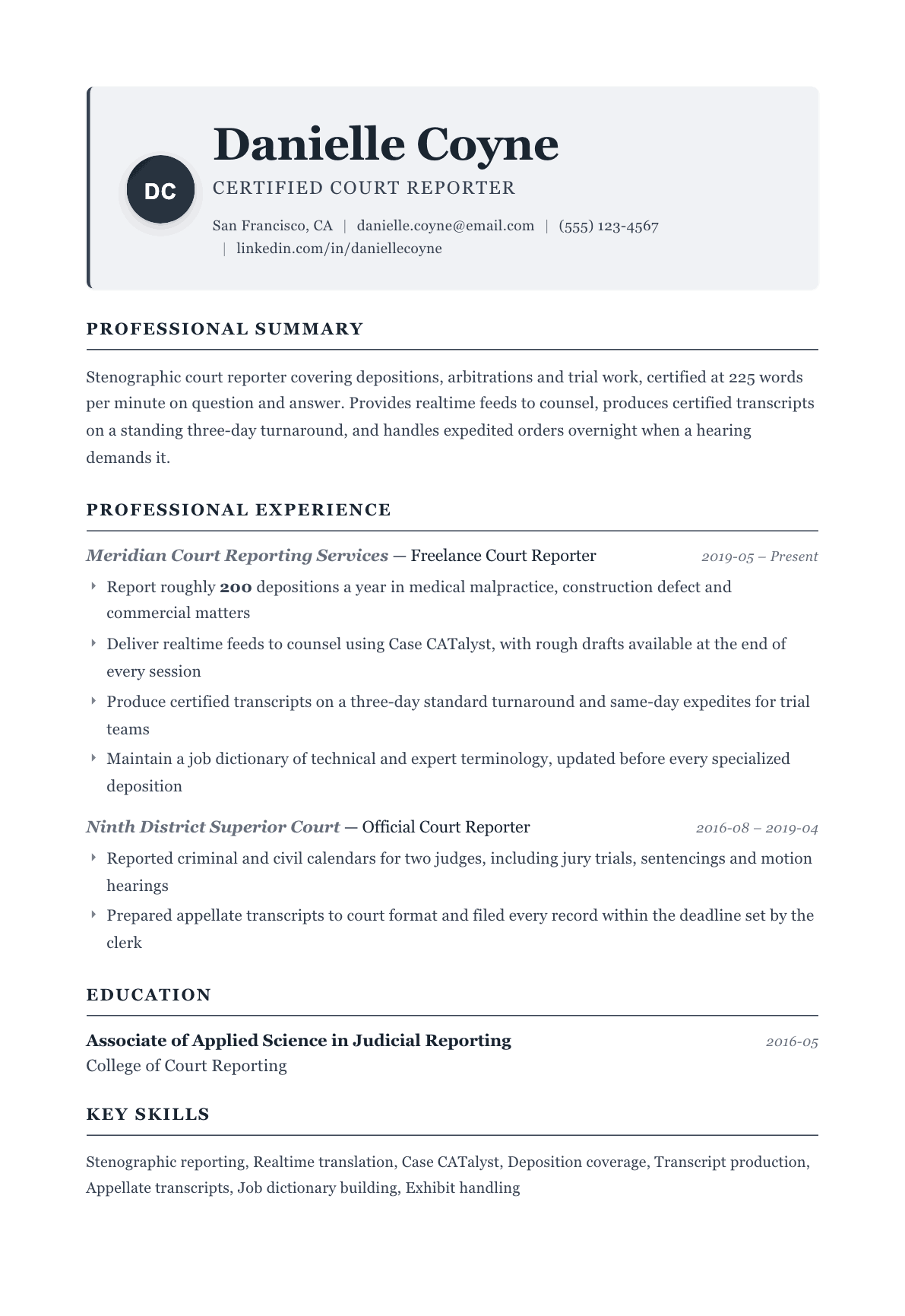
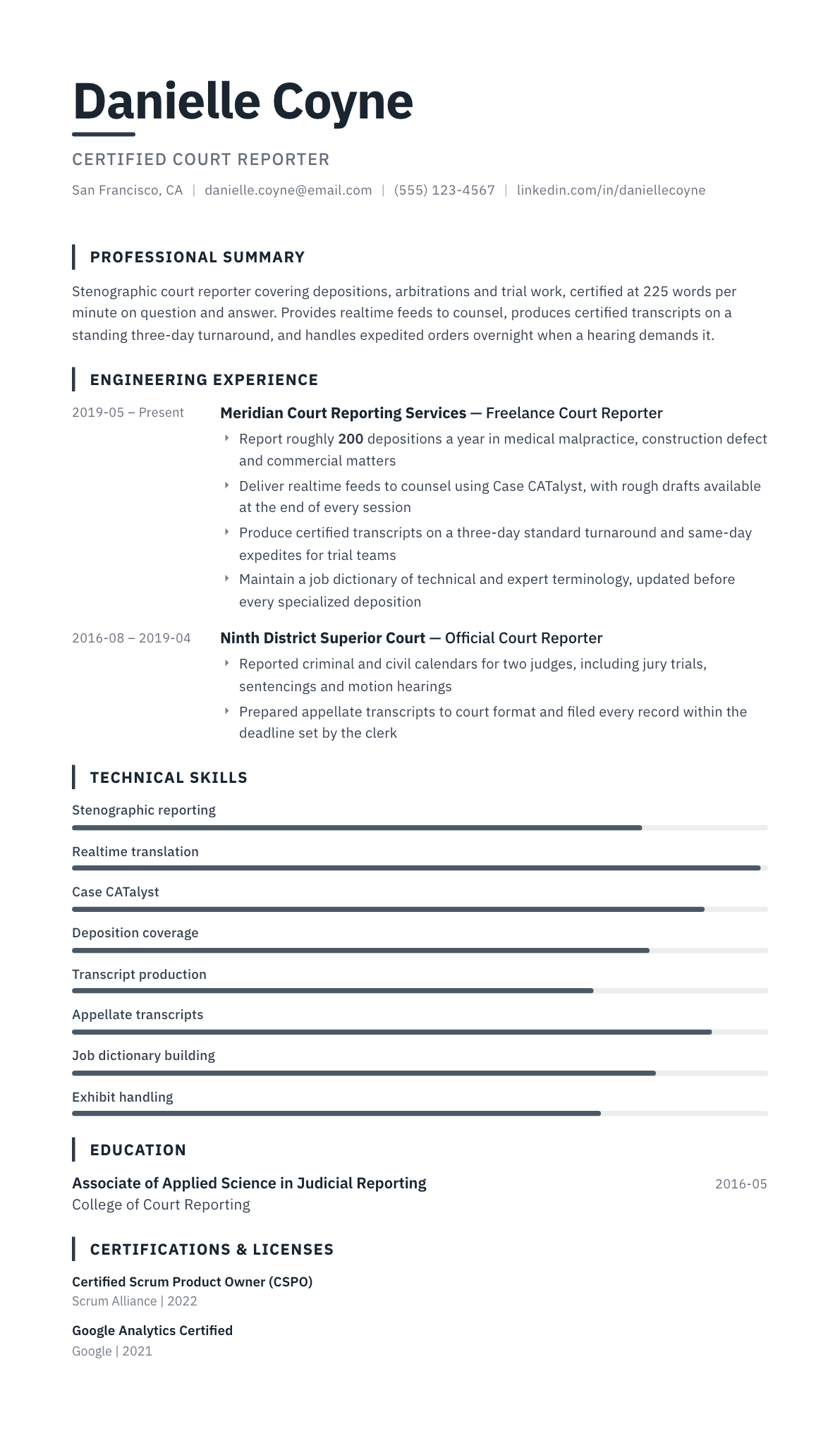
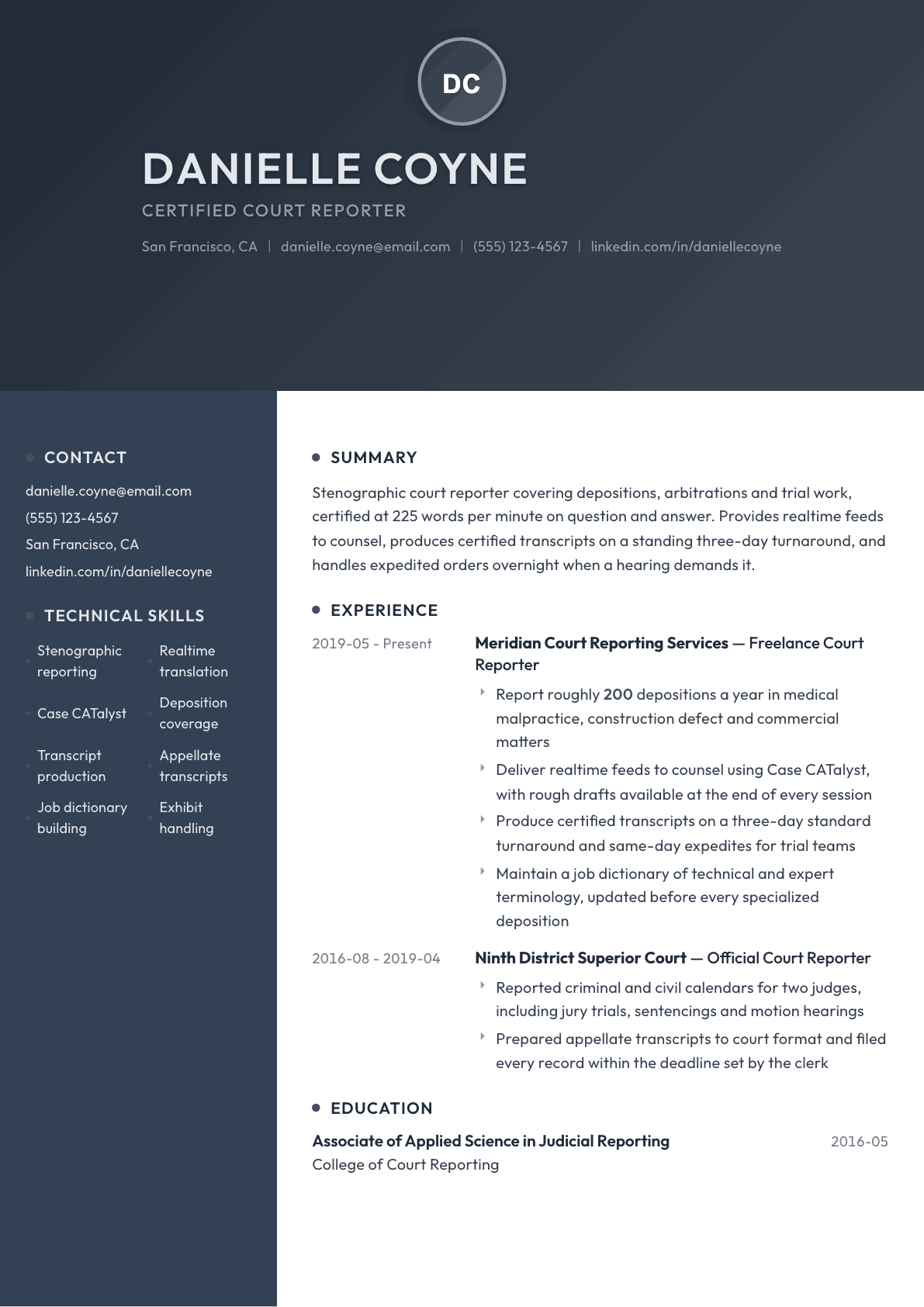
Example Court Reporter summary
Certified court reporter with nine years across official and freelance work, covering depositions, hearings and jury trials. Certified at 225 words per minute on question and answer, provides realtime feeds to counsel, and delivers certified transcripts on a three-day standard with same-day expedites available. Builds job dictionaries ahead of technical and expert testimony.
Skills to list on a Court Reporter resume
- Stenographic reporting
- Realtime reporting
- Deposition coverage
- Trial and hearing coverage
- Certified transcript production
- Appellate transcript preparation
- Computer-aided transcription software
- Job dictionary management
- Exhibit marking and handling
- Read-back and playback
- Confidentiality handling
- Scheduling and calendar management
- Audio synchronization
- Proofreading and scoping
What actually gets this resume read
- Put your certification and certified speed near the top, because agencies and courts screen on those two facts alone.
- Say whether you are official, freelance or both, since the calendars, deadlines and expectations differ sharply.
- List your writing software and whether you provide realtime, as realtime capability changes the rate you can command.
- Name the case types you have covered, because a firm booking a technical expert deposition wants a proven reporter.
- State your standard turnaround and whether you take expedites, since scheduling desks decide on availability and speed.
- Include state licensure or registration if your state requires it, because an agency cannot book you without it.
How to write a court reporter resume
Court reporter hiring runs on two facts that fit in one line: your certification and your certified speed. A scheduling manager at an agency, or a court administrator filling an official position, checks those first, then availability, then whether you write realtime. If those answers are not visible in the top third of the page, the rest of your resume is rarely read.
After that, the reader is buying reliability. Transcripts delivered when promised. A clean record when three attorneys talk over each other. A job dictionary prepared before a technical deposition so expert terminology does not translate as nonsense. A resume that names case types, turnaround standards and software shows all of that without a single adjective.
This guide covers how to put certification and speed where they are seen, how to describe official and freelance work differently, three example summaries, bullet rewrites that replace vague reporting language with the specifics agencies book on, and the questions reporters ask when moving between courts, agencies and independent work.
Format: certification, speed and software in the header block
Put your certification abbreviations after your name and your certified speed in the line below, along with any state registration or license your state requires. This is the block a scheduling desk reads. Everything else on the page supports it.
Use reverse chronological order for positions, and add a separate line for the agencies you cover if you freelance for several. One page is normal in this field even for experienced reporters, because the qualifying facts are compact and the work history is usually continuous.
- Header: name, certifications, certified speed, state registration, city, phone, email.
- Then a short capability line: realtime, rough drafts, expedites, remote platforms.
- Then experience, software, case types covered, education and continuing education.
Summary: setting, case types and turnaround
Say whether you are an official reporter, a freelance reporter or both, because the two lives differ. Officials carry a court calendar, prepare appellate transcripts and work to the deadlines a clerk sets. Freelancers cover depositions and arbitrations booked through agencies, manage their own scheduling and live on turnaround reputation.
Then name the case types you are comfortable in: medical malpractice, construction defect, patent, commercial, criminal, workers compensation. Then your standard turnaround and whether you accept expedites and dailies. An agency reads that combination as availability and skill in one sentence.
Experience: volume, realtime and the difficult jobs
Give annual volume of depositions or the calendar you covered, then the situations that separate reporters. Multi-party depositions with several attorneys appearing remotely. Interpreted testimony where the record must reflect both the question and the interpretation. Expert witnesses with dense technical vocabulary. Jury trials with sidebars and readbacks.
Realtime deserves its own bullets if you provide it, because it commands different rates and not every reporter offers it. Describe what counsel receives during the proceeding and what happens at the end of the session: rough draft, realtime feed, connection method for remote participants.
Then delivery. State your standard turnaround, whether you offer same-day or overnight expedites, and how you manage proofreading and scoping. Naming your scopist arrangement is a professional detail that reassures anyone booking you for a heavy week.
Software, dictionary work and remote proceedings
Name your writing software and any transcript delivery or exhibit platform you use. Then describe job dictionary preparation, which is the invisible craft of this profession: pulling names, terms and case-specific vocabulary before the job so the translation is clean on the first pass. A reporter who describes that habit sounds like a reporter with clean transcripts.
Remote proceedings are now a routine part of the calendar. Say which platforms you have worked in, how you handle exhibits and stipulations remotely, and what you do when audio quality drops, because that last question is what agencies worry about with a reporter they have not booked before.
Continuing education, ethics and the words to avoid
List continuing education relevant to certification maintenance and any specialty training such as realtime writing or captioning. If you hold notary authority where it matters for administering the oath, include it, because agencies check.
Avoid describing yourself as fast and accurate. Certified speed and a stated turnaround already prove both. Avoid naming specific cases or parties, since confidentiality is part of your professional standing and a reader will notice immediately if you treat it loosely.
Court Reporter resume summary examples
Newly certified
Newly certified court reporter writing at 225 words per minute on question and answer, trained on Case CATalyst with realtime setup completed. Completed 60 hours of internship covering depositions and motion hearings, and delivers rough drafts at the end of each session. Available for freelance deposition coverage.
Five years, freelance
Freelance court reporter covering roughly 200 depositions a year in medical malpractice, construction defect and commercial matters. Provides realtime feeds to counsel, delivers certified transcripts on a three-day standard, and accepts same-day expedites. Builds a job dictionary before every expert or technical deposition.
Official reporter
Official court reporter with twelve years reporting criminal and civil calendars for two judges, including jury trials, sentencings and evidentiary hearings. Prepares appellate transcripts to court format and files every record within the clerk deadline. Certified realtime reporter and mentor to two reporters in their first year.
Work experience bullets: before and after
Before: Reported depositions for law firms.
After: Reported roughly 200 depositions a year across medical malpractice, construction defect and commercial matters, including multi-party sessions with counsel appearing remotely.
Volume, case types and the multi-party detail tell a scheduling desk exactly what you can be booked for.
Before: Provided realtime services.
After: Delivered realtime feeds to counsel through Case CATalyst with rough drafts available at the end of every session, and set up remote connections for attorneys attending from other states.
Naming the software and what counsel actually receives turns a service claim into a described capability.
Before: Produced accurate transcripts on time.
After: Produced certified transcripts on a three-day standard turnaround and same-day expedites for trial teams, working with a regular scopist and proofreader during heavy calendar weeks.
A stated standard plus the support arrangement shows how reliability is achieved rather than promised.
Before: Prepared for technical depositions.
After: Built a job dictionary before every expert deposition, loading medical, engineering and product terminology from the notice and exhibits so the first-pass translation needed minimal correction.
Describing the preparation habit demonstrates the craft that produces clean transcripts on difficult jobs.
Before: Handled trial work for the court.
After: Reported jury trials, sentencings and motion hearings for two judges, managing sidebars and readbacks in open court and preparing appellate transcripts to the format the clerk requires.
Naming the proceeding types and the appellate format shows official court experience rather than general trial exposure.
Hard skills
- Stenographic writing
- Realtime translation
- Computer-aided transcription software
- Job dictionary preparation
- Deposition coverage
- Jury trial and hearing coverage
- Appellate transcript preparation
- Read-back and playback
- Exhibit marking and handling
- Remote proceeding platforms
- Scoping and proofreading coordination
- Transcript formatting standards
- Oath administration
- Calendar and scheduling management
Soft skills
- Concentration over long sessions
- Confidentiality
- Composure in contentious proceedings
- Courtroom presence
- Reliability on deadlines
- Professional interruption when the record is at risk
Certifications worth listing
- Registered Professional Reporter (RPR) (National Court Reporters Association)
- Registered Merit Reporter (RMR) (National Court Reporters Association)
- Certified Realtime Reporter (CRR) (National Court Reporters Association)
- Registered Diplomate Reporter (RDR) (National Court Reporters Association)
- Certified Verbatim Reporter (CVR) (National Verbatim Reporters Association)
Mistakes that cost court reporter candidates the interview
- Burying certification and certified speed below the experience section where a scheduling desk will not look.
- Failing to say whether you are official, freelance or both, which changes what the reader expects entirely.
- Leaving realtime capability off the page when it is one of the few things that changes your rate.
- Naming cases or parties you have reported, which reads as a confidentiality problem to any legal reader.
- Claiming fast and accurate rather than stating a certified speed and a turnaround standard.
- Omitting the state registration or license where your state requires one, since an agency cannot book you without it.
- Leaving out remote proceeding experience, which is now part of most calendars rather than an exception.
Court Reporter resume questions
What belongs at the very top of a court reporter resume?
Certification abbreviations after your name, your certified speed on the next line, and your state registration where one is required. Agencies and courts screen on those three facts, and everything else on the page is read only after they check out.
How do I present freelance work across several agencies?
Group it as one continuous freelance practice with the date range, then list the agencies you cover underneath. That reads as a stable career rather than a series of short jobs, and it shows the breadth of work you can be booked for.
Should I list my transcript turnaround on the resume?
Yes. Turnaround is the reputation currency of this profession. State your standard delivery, whether you take expedites and dailies, and whether you work with a scopist during heavy weeks so the commitment is credible.
How do I move from freelance deposition work to an official court position?
Emphasize trial and hearing coverage, readbacks, appellate transcript preparation and any experience with court formatting rules. Court administrators want evidence you can hold a calendar and meet clerk deadlines, not only that you can cover a deposition well.
Is digital or voice reporting experience worth including?
Include it if you hold a credential in that method and the posting invites it, and name the method plainly. Some courts and agencies hire across methods and others do not, so being clear about what you write prevents a wasted interview on both sides.