CrossFit Coach Resume Examples: the lines they read
Create a CrossFit Coach Resume That Shows Real Floor Judgment
By Mustafa Tarabya, founder of CVBooster · Published · Updated
CrossFit coach resume example with class sizes, scaling decisions, barbell coaching detail, credential order and the keywords affiliate owners screen for.
Sample resumes for a crossfit coach
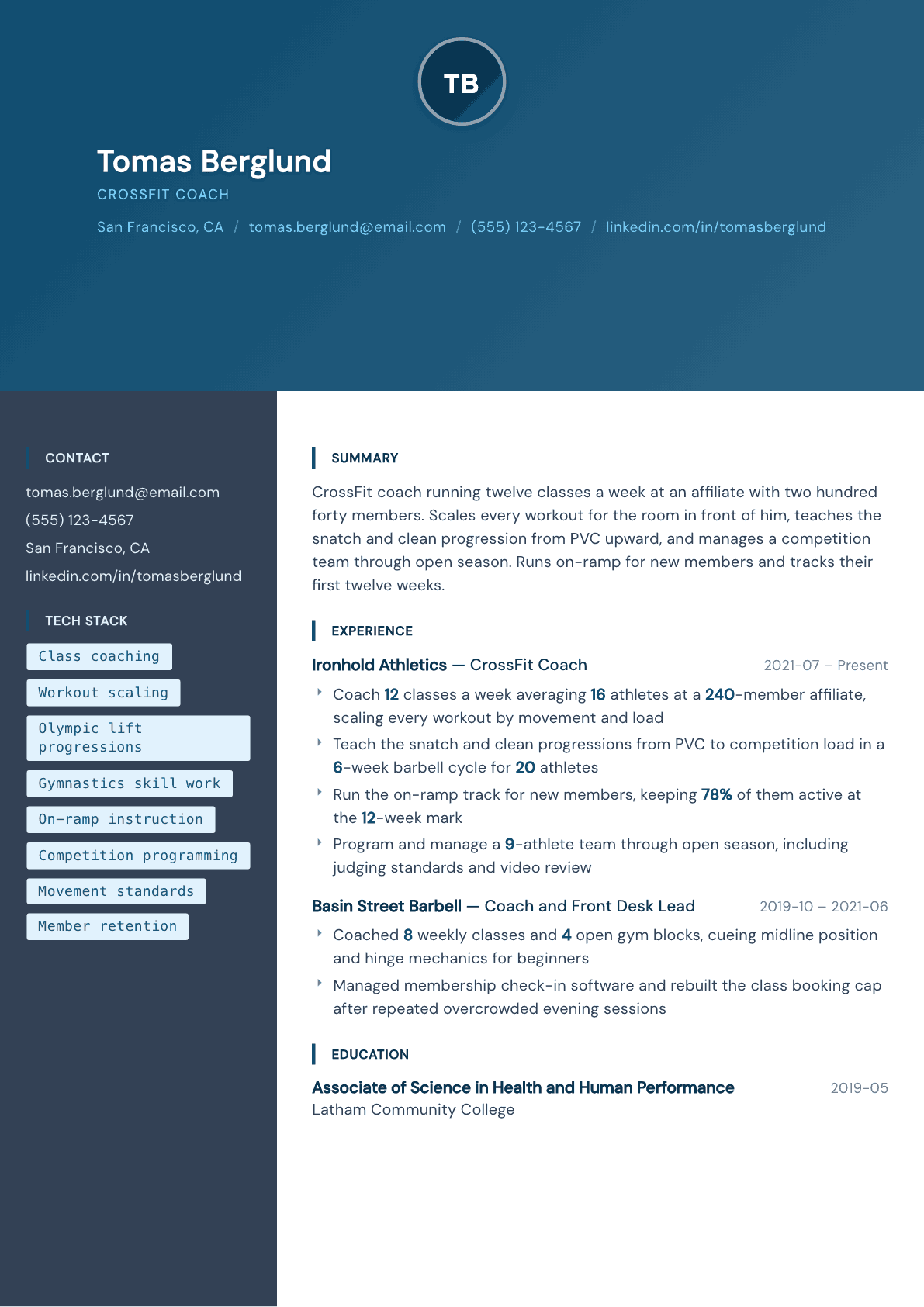
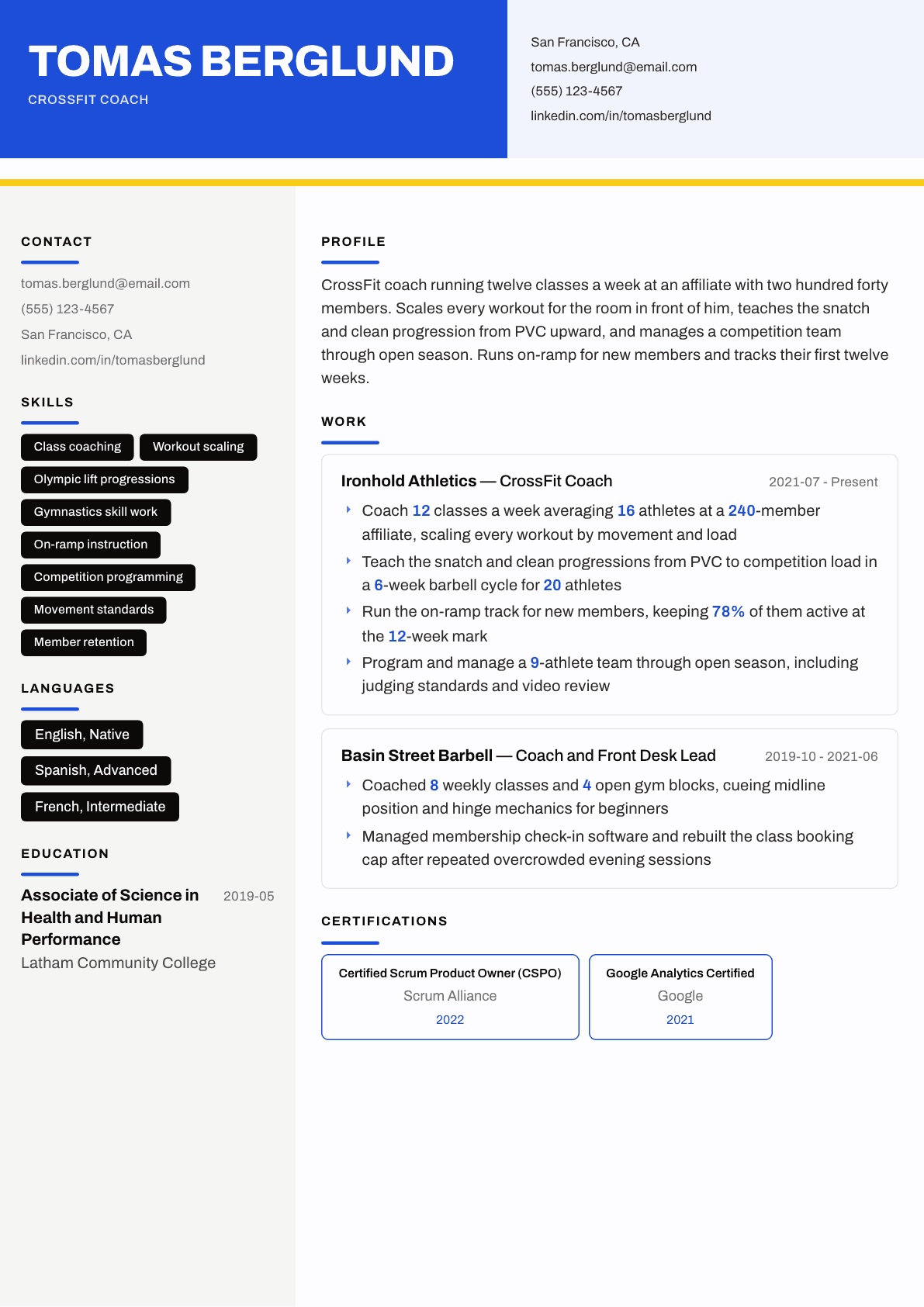
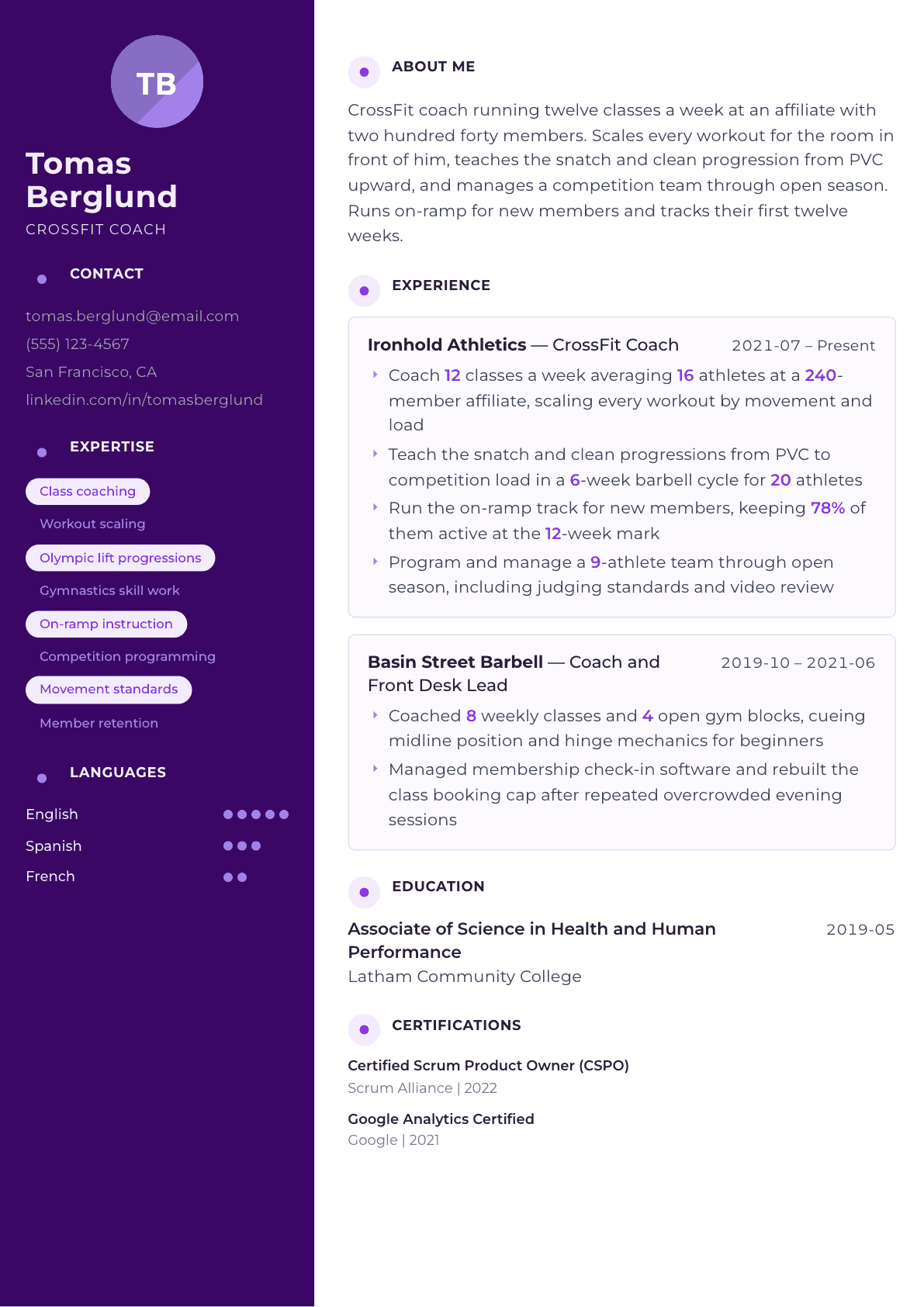
The same crossfit coach content laid out in three CVBooster templates, so you can see what the finished document looks like before you write a word.
Example CrossFit Coach summary
CrossFit coach with four years on an affiliate floor, running twelve classes a week for an average of sixteen athletes. Teaches snatch and clean progressions in six-week barbell cycles, scales by movement and load rather than by cutting reps, and keeps most on-ramp members active past twelve weeks. Managed a nine-athlete team through open season. Seeking a head coach role.
Skills to list on a CrossFit Coach resume
- CrossFit class coaching
- Workout scaling
- Snatch progression
- Clean and jerk coaching
- Gymnastics skill progressions
- Midline and hinge mechanics
- On-ramp and foundations
- Competition team management
- Movement standards and judging
- Barbell cycling
- Member retention
- Class booking systems
- Injury-aware substitution
- Whiteboard briefing
What actually gets this resume read
- Put your CrossFit credential level and issuing body in the header area, because affiliate owners filter on level first.
- Show scaling as a coaching decision: what you changed, for whom, and what the athlete did instead of the prescribed movement.
- Give class counts and average class size, because coaching sixteen athletes at once is a different job from coaching four.
- Describe your Olympic lifting teaching progression, since the snatch and clean are where affiliates judge coaching depth.
- Include on-ramp or foundations work and how many of those members were still training three months later.
- Add any weightlifting, gymnastics or nutrition credentials separately, because they let an owner slot you into specialty programs.
How to write a crossfit coach resume
An affiliate owner hiring a CrossFit coach is filling specific hours on a whiteboard, usually the ones nobody wants: five in the morning, the packed six in the evening, the Saturday partner workout. She reads applications with one question running underneath everything: can this person keep sixteen athletes safe and coached at the same time, in the same hour, at four different ability levels.
That is why credential level matters but never carries the application on its own. Plenty of coaches hold a level one credential. Far fewer can show what they did when a new member with no overhead position walked into a workout with heavy snatches, or how they got an on-ramp group to still be training three months later.
This guide covers where the credential goes, how to write scaling as a coaching decision rather than a formality, how to describe teaching the Olympic lifts, and the questions coaches ask when they want to move from covering classes to running a floor.
Format: credential level, class load, then coaching detail
One page. Put your CrossFit credential level with the issuing organization at the top, then any weightlifting, gymnastics or nutrition credentials underneath. Affiliate owners filter on level before they read prose, and a coach with a second-level credential is a different hire from a coach without one.
Give each affiliate its size. Member count, class cap and how many classes you personally coach a week. Coaching a class of six in a garage gym and coaching sixteen in a room with three racks and a rig are different jobs, and the reader should not have to guess which one you have done.
- Header: name, city, credential level with issuing organization, and current cardiopulmonary resuscitation status.
- Affiliate line for each job: member count, average class size, classes coached per week, specialty tracks you ran.
- List additional credentials separately so an owner can slot you into weightlifting, gymnastics or nutrition programs.
Scaling: the bullet that proves you coach
Every coach writes that they scale workouts. Almost nobody writes what scaling actually looked like. The bullet that gets read is the one that names the decision: a member without a stable overhead position moves to a front rack carry, someone six weeks post-injury does a tempo variation, a new athlete keeps the stimulus but loses the barbell load entirely.
Write scaling as preserving the intent of the session rather than cutting the workload. That distinction is the difference between a coach who understands a training day and one who is reading a whiteboard aloud. Say when you scale in advance during the brief and when you scale mid-workout after watching a rep degrade.
Teaching the barbell and the gymnastics progressions
Olympic lifting is where affiliate owners test coaching depth. Describe your progression: the positions you teach in order, what you use before a loaded barbell, how many sessions before an athlete cycles moderate weight, and how you correct the two or three faults you see most. That paragraph tells a reader more than any personal lifting number.
Gymnastics deserves the same treatment. Kipping progressions, the strict work you insist on before someone earns a kip, ring and bar scaling for athletes without a pull-up, and how you keep a class moving while three people are on progressions and thirteen are not. Class management is the hidden skill inside all of it.
- Name your barbell cycle length and how many athletes went through it.
- Say what you require before an athlete kips or goes overhead with load.
- Describe how you keep an entire class working while individuals are on different progressions.
On-ramp, retention and the business of the affiliate
On-ramp or foundations work is the most commercially valuable thing a coach does, because it decides whether a new member is still paying in three months. Give the structure, the group size and the share of those members still training at the twelve-week mark. An owner reads that as revenue retention, not just coaching.
Add the rest of the floor duties honestly: class booking caps, whiteboard briefing, equipment maintenance, cleaning standards, running the intramural or in-house competition, coaching a team through open season including judging standards and video review. Affiliates are small businesses and coaches who carry operations get hired first.
Keywords affiliate postings use
The recurring vocabulary is narrow: class coaching, scaling, on-ramp or foundations, movement standards, barbell cycling, gymnastics progressions, athlete retention, whiteboard brief, and the credential level itself. Place each inside a bullet where the work is visible.
Include the gym management and booking software you have used for check-in, class caps and membership holds. Owners who already run that system will value it, and it separates you from the coaching-only applicants.
CrossFit Coach resume summary examples
First year coaching
CrossFit coach in the first year on an affiliate floor, coaching six classes a week and covering open gym blocks. Cues midline position and hinge mechanics for beginners, scales by movement rather than by cutting rounds, and holds current cardiopulmonary resuscitation training. Seeking more class hours and on-ramp responsibility.
Four years on the floor
CrossFit coach running 12 classes a week averaging 16 athletes at a 240-member affiliate. Teaches snatch and clean progressions in six-week barbell cycles, runs the on-ramp track with 78% of new members still training at 12 weeks, and manages a nine-athlete team through open season.
Head coach
Head coach of an affiliate with a coaching staff of five, owning programming, coach development and the on-ramp curriculum. Runs monthly coach evaluations on the floor, rebuilt the class structure around a fixed brief and warm-up format, and coaches the competition team year round.
Work experience bullets: before and after
Before: Coached CrossFit classes and scaled workouts for members.
After: Coached 12 classes a week averaging 16 athletes at a 240-member affiliate, scaling each session by movement substitution and load so every athlete kept the intended stimulus.
Class volume, class size and a description of what scaling preserved make the coaching load concrete.
Before: Taught Olympic lifting to members.
After: Taught snatch and clean progressions from PVC through competition load in a six-week barbell cycle for 20 athletes, correcting early arm bend and an unfinished second pull.
The progression, the cycle length and two named faults show teaching depth instead of exposure to the lifts.
Before: Ran the beginner program for new members.
After: Ran the on-ramp track for every new member, covering squat, hinge, press and metabolic pacing across four sessions, and kept 78% of that group training at the 12-week mark.
A named curriculum plus a retention figure turns onboarding into a business result an owner can price.
Before: Helped with the gym competition team.
After: Programmed and managed a nine-athlete team through open season, running weekly video review against movement standards and assigning judging practice before every submitted score.
It names the roster size and two specific coaching activities instead of implying involvement.
Before: Kept the gym organized and equipment in good shape.
After: Maintained barbells, rig attachments and rower chains on a monthly check, and rebuilt the class booking cap after repeated overcrowded evening sessions left athletes without a rack.
Equipment care plus a booking fix shows the operational judgment affiliates rely on coaches to supply.
Hard skills
- Class coaching for large groups
- Workout scaling and substitution
- Snatch progression
- Clean and jerk coaching
- Gymnastics progressions
- Midline and hinge mechanics
- On-ramp and foundations delivery
- Barbell cycling
- Competition team programming
- Movement standards and judging
- Whiteboard briefing
- Equipment maintenance
- Gym management software
- Member retention tracking
Soft skills
- Command of a loud room
- Fast fault correction
- Beginner-friendly language
- Community building
- Composure during injuries
- Coaching other coaches
Certifications worth listing
- CrossFit Level 1 Trainer (CrossFit, LLC)
- CrossFit Level 2 Trainer (CrossFit, Inc.)
- USA Weightlifting Level 1 Coach (USA Weightlifting)
- Certified Personal Trainer (NASM-CPT) (National Academy of Sports Medicine)
- Adult CPR and AED (American Heart Association)
Mistakes that cost crossfit coach candidates the interview
- Leading with your own competition results, which an owner reads as an athlete resume rather than a coaching one.
- Writing that you scale workouts without a single example of what you changed and for whom.
- Omitting class size, so a reader cannot tell whether you have managed a full evening room or a handful of athletes.
- Skipping on-ramp and retention numbers, which are the results an affiliate owner cares about most.
- Listing every credential in one block so the reader cannot see your primary coaching level at a glance.
- Ignoring the operations work, when equipment, booking caps and cleaning are part of every coaching shift.
CrossFit Coach resume questions
Does a CrossFit coach need a second-level credential to get hired?
Not always, but it widens the field considerably and is often required for head coach or programming roles. List the level you hold with the issuing organization, and add any weightlifting or gymnastics credentials that let an owner staff specialty sessions.
Should I put my own workout scores on a coaching resume?
Keep them to a single short line at most. Owners hire on class management, scaling judgment and retention, so personal performance rarely earns space unless a competition record is directly relevant to a team coaching role.
How do I show coaching quality when I only cover a few classes a week?
Detail the coaching itself: class size, how you brief a session, the progressions you teach, the scaling decisions you made and any beginners you took from onboarding to a full class. Depth of description substitutes well for volume of hours.
What belongs in a CrossFit coach summary?
Credential level with the issuing body, classes per week, average class size, affiliate size, and one thing you own such as on-ramp, the barbell cycle or the competition team. That is enough for an owner to see where you fit.
How should I describe working with injured or returning athletes?
Describe adaptation inside your scope: keeping the session intent while avoiding the aggravating range, working with whatever a clinician has cleared, and sending an athlete reporting new pain back for assessment rather than coaching through it.
Related resume examples
- Personal Trainer Resume example
- Fitness Instructor Resume example
- Strength and Conditioning Coach Resume example
- Fitness Coach Resume example
- Athletic Coach Resume example
- Head Coach Resume example