Strength and Conditioning Coach Resume Examples: free
Build a Strength and Conditioning Coach Resume Athletic Directors Respect
By Mustafa Tarabya, founder of CVBooster · Published · Updated
Strength and conditioning coach resume example with roster size, periodization detail, testing batteries, credential placement and keywords for college and pro roles.
Sample resumes for a strength and conditioning coach
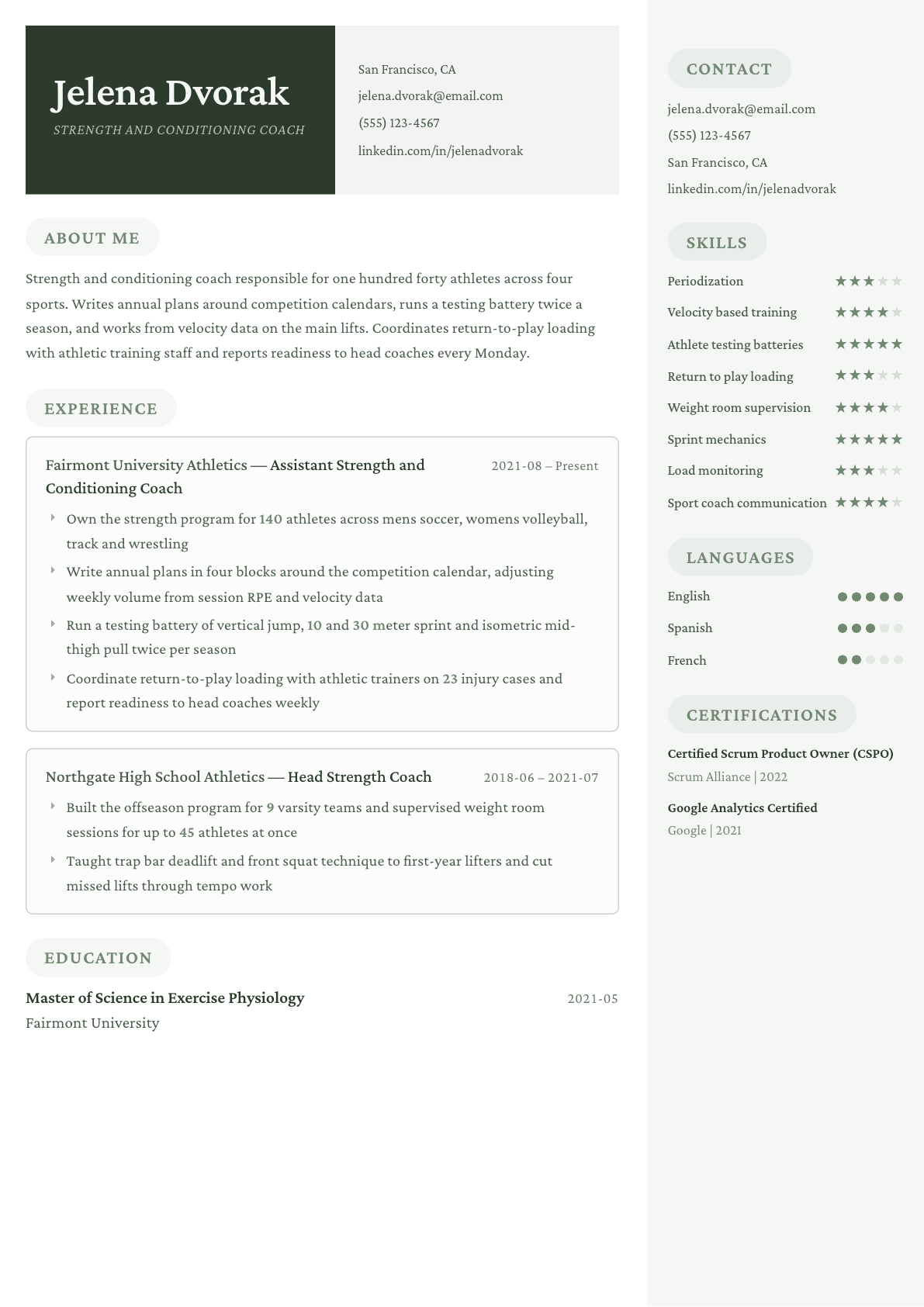
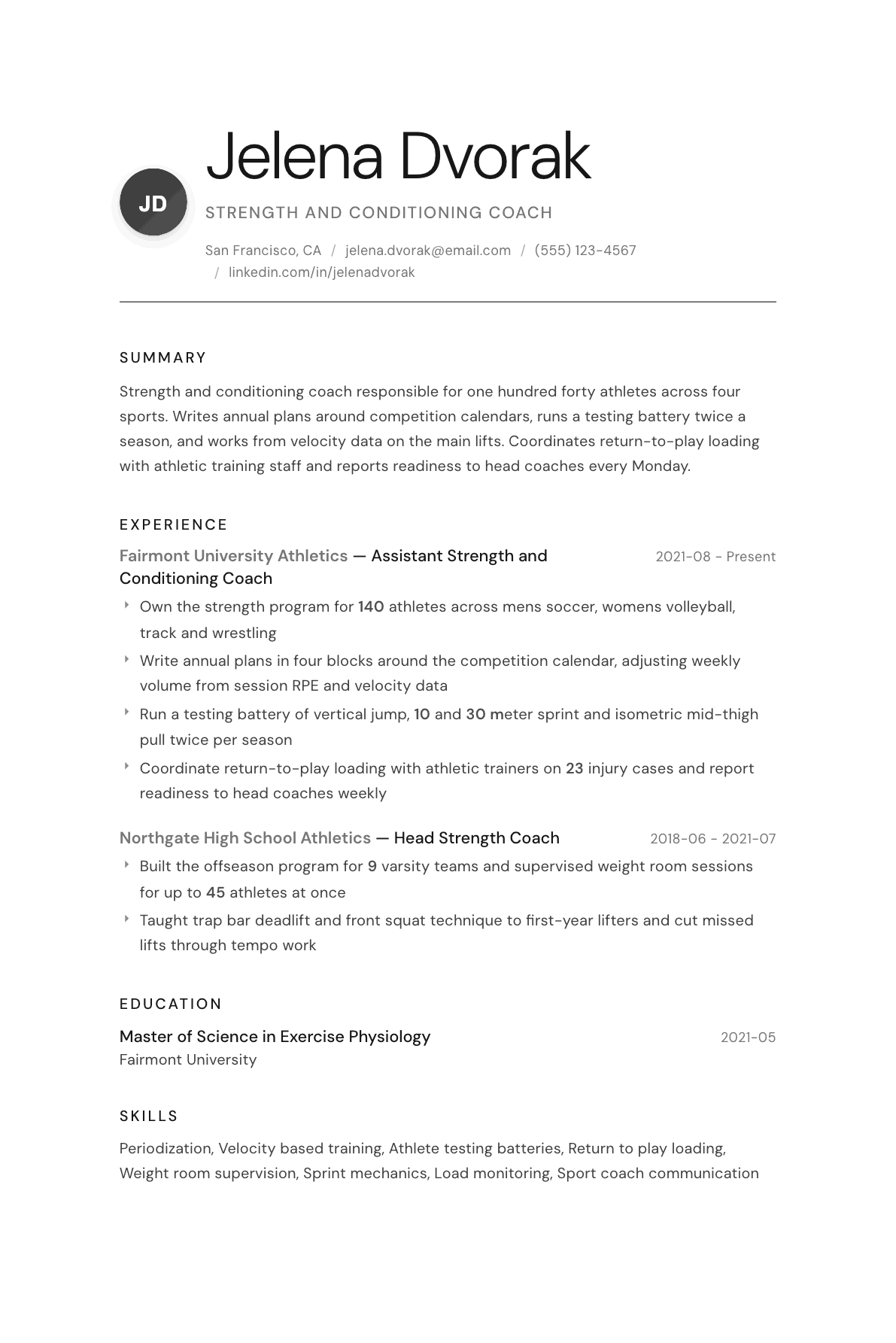
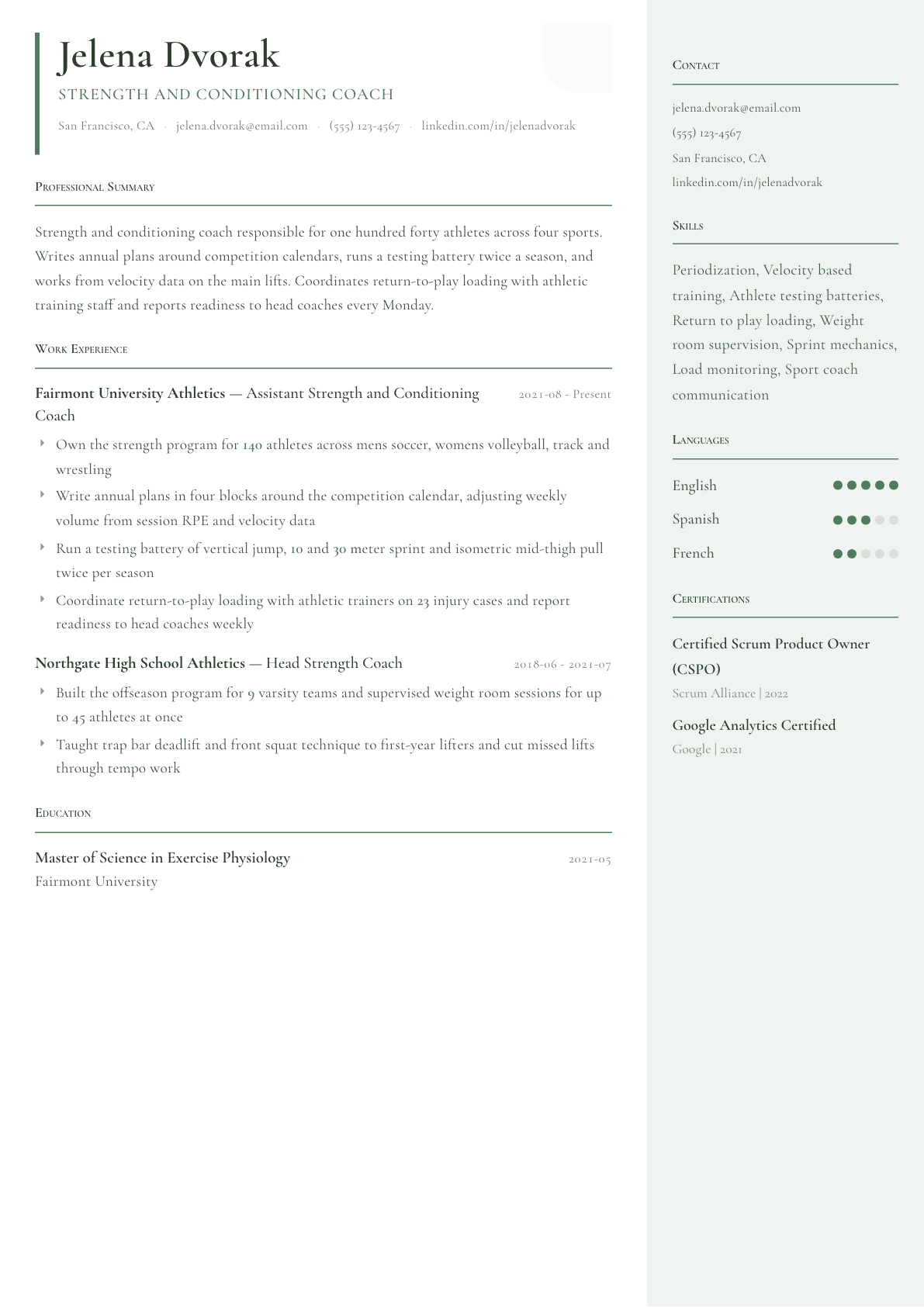
The same strength and conditioning coach content laid out in three CVBooster templates, so you can see what the finished document looks like before you write a word.
Example Strength and Conditioning Coach summary
Strength and conditioning coach with a graduate degree in exercise physiology and responsibility for one hundred forty athletes across four sports. Builds four-block annual plans around competition calendars, adjusts volume from session RPE and bar velocity, runs jump and sprint testing twice a season, and coordinates return-to-play loading with athletic training staff. Seeking a head strength coach position.
Skills to list on a Strength and Conditioning Coach resume
- Periodization
- Block programming
- Velocity based training
- Force plate testing
- Sprint mechanics
- Change of direction training
- Olympic lift derivatives
- Return to play progression
- Session RPE monitoring
- Weight room supervision
- Athlete monitoring software
- Testing batteries
- Team communication
- Youth lifting technique
What actually gets this resume read
- Lead with your certification and the issuing body, because collegiate and professional postings screen on it before anything else.
- Give roster size and the sports you owned, since coaching one hundred forty athletes differs from coaching a single team.
- Describe periodization in your own structure: blocks, competition calendar anchors and how weekly volume moved.
- Name your testing battery and the equipment behind it, because directors want to know what data you actually collect.
- Show the working relationship with athletic training staff on return to play, which is where liability and trust sit.
- Include weight room supervision ratios, because safely running forty athletes at once is a hiring criterion by itself.
How to write a strength and conditioning coach resume
Strength and conditioning hiring is credential-gated at the first cut. A director of sports performance sorting applications for a collegiate assistant role checks the certification and the issuing body, then looks for evidence that you have carried a real athlete load across a real competition calendar. Coaches without the credential rarely make it past that screen no matter how good the coaching is.
The second cut is different. Once the credential is confirmed, the reader wants to know how you think about a training year. What the blocks are, what happens the week of a conference match, how in-season volume is protected, what data you collect and what you do when the data says an athlete is not recovering. That is where most applications go flat, because they list exercises instead of showing a plan.
This guide walks through the sections a performance director expects, how to present roster responsibility, testing and monitoring, how to write about return to play without stepping into the medical staff lane, and the questions coaches ask when they move from high school weight rooms toward college jobs.
Format: credential, roster scope, then the training year
One page for an assistant, two once you have several institutions and a graduate degree. Reverse-chronological, single column, and the certification block goes directly beneath the summary with the full name of the issuing organization. Search committees in collegiate athletics verify this line first and often reject on it alone.
Directly under each job title, give the scope: number of athletes, number of teams and which sports. A strength and conditioning coach responsible for one hundred forty athletes across four sports and one responsible for a single team have different jobs, and scope is the fastest way to make that clear.
- Header: name, city, certification with the issuing organization written out, and current emergency care credentials.
- Section order: summary, certifications, performance experience, testing and technology, education, presentations or internships, skills.
- Add graduate assistantships and internships as full entries, because search committees read them as real experience in this field.
Write the training year, not a list of exercises
Describe the plan the way you would explain it to a sport coach. How many blocks in the annual plan, what each block is for, where the competition calendar forces a change, how in-season sessions are trimmed to preserve availability rather than to chase adaptation. That structure is the intellectual content of the job.
Then say how the plan reacts. Session rating of perceived exertion, bar velocity on the main lifts, jump testing between blocks, sleep and soreness reports from athlete monitoring software. The important part is not the tool, it is the decision rule: what number moves you to cut volume, and who you tell when it happens.
Testing batteries and technology
Give the battery by name and the equipment behind it: countermovement jump on a force plate or contact mat, timed sprints at set distances with electronic gates, isometric mid-thigh pull, change of direction tests, and how often the battery runs across a season. Directors want to know what data will exist after you have been there a year.
Then say what the data changed. A return-to-play threshold set from limb symmetry, a sprint group split by acceleration profile, a decision to hold an athlete out of a jump session. Testing that never changed a program is a hobby, and experienced readers can tell the difference at a glance.
- Name the athlete monitoring platform and what you actually reported out of it each week.
- State the testing cadence per season, since one battery a year tells a very different story from three.
- Say who received your reports: head coaches, the sports medicine staff, the performance director.
Return to play and the sports medicine relationship
This section wins interviews when it is written carefully. Describe collaboration: athletic trainers or physical therapists clear the athlete, you own the loading progression back to full training, and both sides share criteria and communicate at fixed points. Never write anything that implies you diagnose or treat.
Give the volume too. The number of cases you carried in a season and the criteria you used to advance an athlete between stages tell a director you have done this often enough to be trusted with it on day one.
Keywords in collegiate and professional postings
The vocabulary repeats: periodization, annual plan, athlete monitoring, load management, velocity based training, force plate testing, speed and agility development, return to participation, weight room supervision and sport coach collaboration. Use each where the work is shown.
Include the safety and supervision language too, because it is a hiring requirement: emergency action plan familiarity, supervision ratios in the weight room, and current cardiopulmonary resuscitation and automated external defibrillator certification. Those lines are checked before an offer is made.
Strength and Conditioning Coach resume summary examples
Graduate assistant
Graduate assistant strength and conditioning coach completing a masters in exercise physiology while running lifts for two teams and 46 athletes. Coaches trap bar deadlift and front squat technique to first-year lifters, collects jump and sprint data each block, and holds current emergency care certification.
Assistant coach, four sports
Assistant strength and conditioning coach responsible for 140 athletes across four sports. Writes four-block annual plans around the competition calendar, adjusts weekly volume from session rating of perceived exertion and bar velocity, and coordinates return-to-play loading with athletic trainers on 23 cases a year.
Director of performance
Director of sports performance leading a staff of four coaches and two interns across an entire athletics department. Owns the testing battery, the monitoring platform and the weight room schedule, and reports readiness and availability trends to head coaches and the sports medicine group every week.
Work experience bullets: before and after
Before: Designed strength programs for student athletes.
After: Owned the strength program for 140 athletes across four sports, writing four-block annual plans anchored to each competition calendar and trimming in-season volume to protect availability.
Roster scope plus the structure of the training year shows planning ability rather than exercise selection.
Before: Used technology to monitor athletes.
After: Tracked session rating of perceived exertion and bar velocity on main lifts, then cut weekly volume for any athlete whose velocity dropped across two consecutive sessions.
A decision rule turns monitoring from a purchased tool into a coaching practice.
Before: Performed athlete testing twice a year.
After: Ran a testing battery of countermovement jump, timed 10 and 30 meter sprints and isometric mid-thigh pull twice per season, and used limb symmetry results to set return-to-training thresholds.
Naming the tests and one downstream use proves the data changed something.
Before: Worked with the athletic trainers on injured athletes.
After: Coordinated return-to-play loading with athletic trainers on 23 injury cases across a season, taking ownership of the progression once the athlete was cleared and sharing advancement criteria at each stage.
It shows collaboration and a clear professional boundary, which is what a director is checking for.
Before: Supervised the weight room.
After: Supervised weight room sessions of up to 45 athletes with a written spotting and loading standard, and ran the emergency action plan walkthrough with staff before every season.
Supervision becomes credible when the ratio and the safety standards behind it are stated.
Hard skills
- Annual plan and periodization
- Block programming
- Velocity based training
- Force plate and jump testing
- Timed sprint testing
- Speed and change of direction development
- Olympic lift derivatives
- Return to participation progressions
- Session RPE and load monitoring
- Athlete monitoring platforms
- Weight room supervision standards
- Emergency action planning
- Youth and first-year lifter technique
- Sport coach reporting
Soft skills
- Communication with sport coaches
- Standing your ground on load
- Teaching under time pressure
- Cross-department collaboration
- Athlete trust
- Written reporting
Certifications worth listing
- Certified Strength and Conditioning Specialist (CSCS) (National Strength and Conditioning Association)
- Registered Strength and Conditioning Coach (RSCC) (National Strength and Conditioning Association)
- Strength and Conditioning Coach Certified (SCCC) (Collegiate Strength and Conditioning Coaches Association)
- USA Weightlifting Level 1 Coach (USA Weightlifting)
- Basic Life Support for Healthcare Providers (American Heart Association)
Mistakes that cost strength and conditioning coach candidates the interview
- Leaving the certification acronym without the issuing organization, which is the first line a search committee verifies.
- Listing exercises and set schemes instead of describing the training year and the decisions inside it.
- Failing to give roster size and sports, so nobody can judge the scale of what you have managed.
- Writing about injured athletes in language that sounds like treatment rather than post-clearance loading.
- Collecting testing data with no example of a program change that came out of it.
- Dropping graduate assistantships and internships, which committees in this field count as real experience.
Strength and Conditioning Coach resume questions
Which certification do collegiate strength and conditioning jobs require?
Most collegiate postings name a specific accredited credential and will not consider applications without it. Write yours with the issuing organization spelled out, add the expiration status, and list any second credential underneath rather than replacing the primary one.
How do I show experience when most of mine is an internship?
Treat the internship as a full job entry with the teams you covered, the athlete count, the sessions you ran alone and the data you collected. Search committees in this field expect internships and read them closely when they carry real scope.
Should I include athlete performance results?
Include group-level results such as testing improvements across a squad, training availability across a season, or reduced missed sessions. Avoid claiming credit for wins, because a hiring committee knows a strength coach is one input among many.
How much technology detail belongs on the resume?
Name the platforms and testing equipment you actually operate, then show one decision each of them drove. A list of tools with no decision attached reads as familiarity, while a single decision rule proves you used the system in practice.
What separates a high school strength coach resume from a college one?
Scope and structure. College applications emphasize multi-sport rosters, formal testing batteries, monitoring platforms and sports medicine collaboration. High school entries should still show those elements where they exist, since that is what makes the jump believable.
Related resume examples
- Athletic Trainer Resume example
- Sports Coach Resume example
- CrossFit Coach Resume example
- Exercise Physiologist Resume example
- Horse Trainer Resume example
- Boxing Coach Resume example