CT Technologist Resume Examples: the lines they read
Build a CT Technologist Resume Around Protocols and Dose
By Mustafa Tarabya, founder of CVBooster · Published · Updated
CT technologist resume example with scanner models, contrast protocols, dose reduction wording and computed tomography keywords.
Sample resumes for a ct technologist
The same ct technologist content laid out in three CVBooster templates, so you can see what the finished document looks like before you write a word.
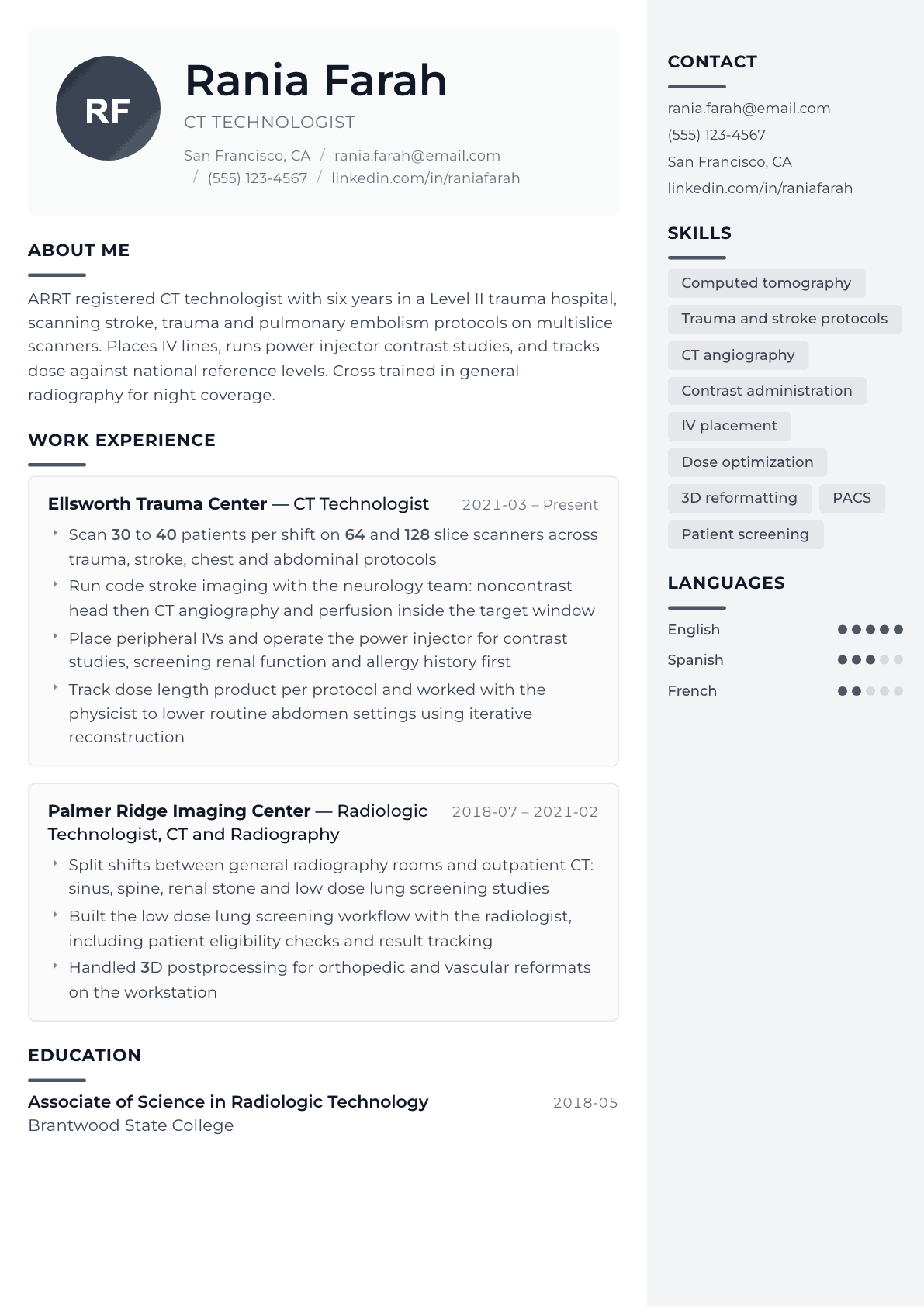
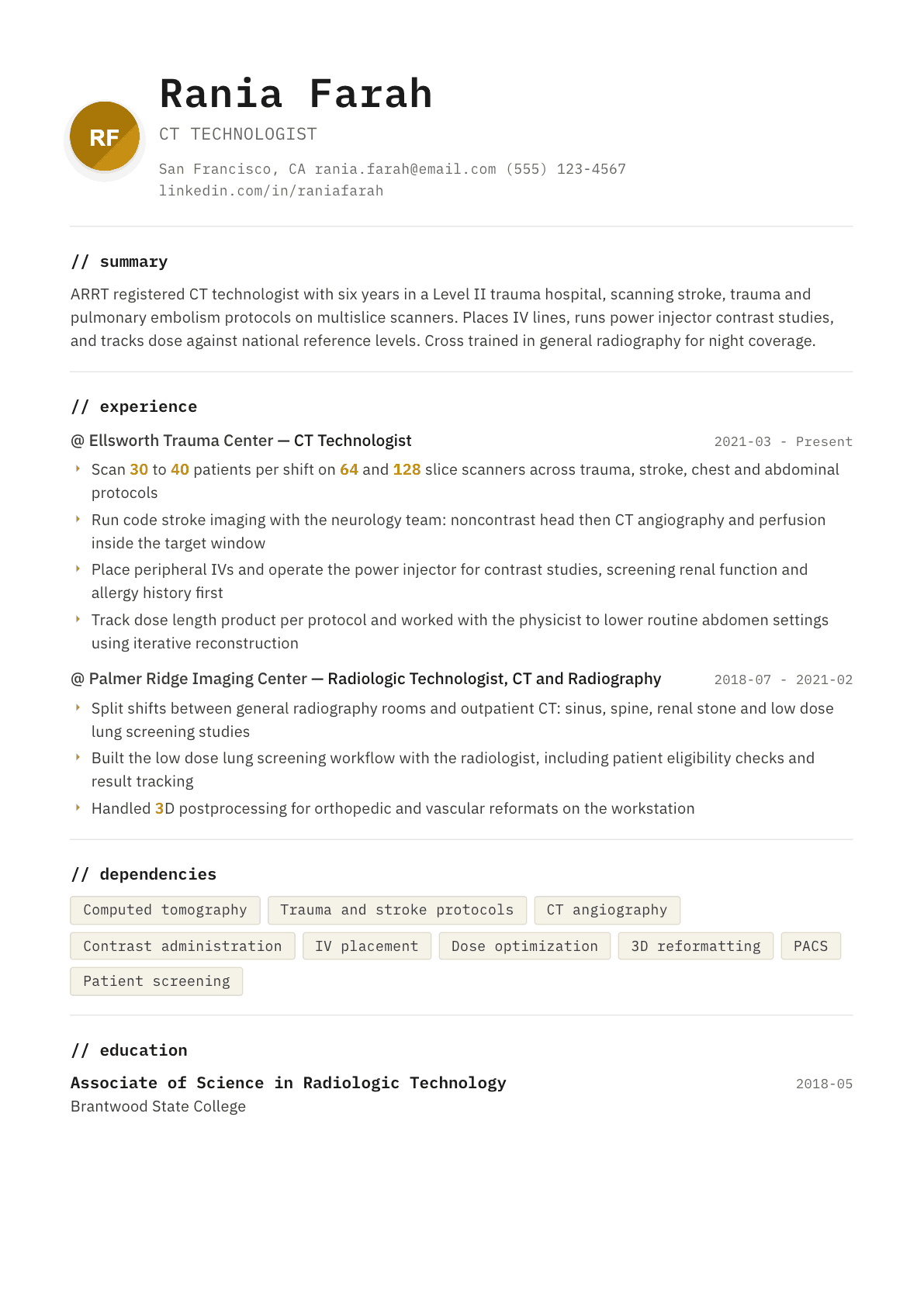
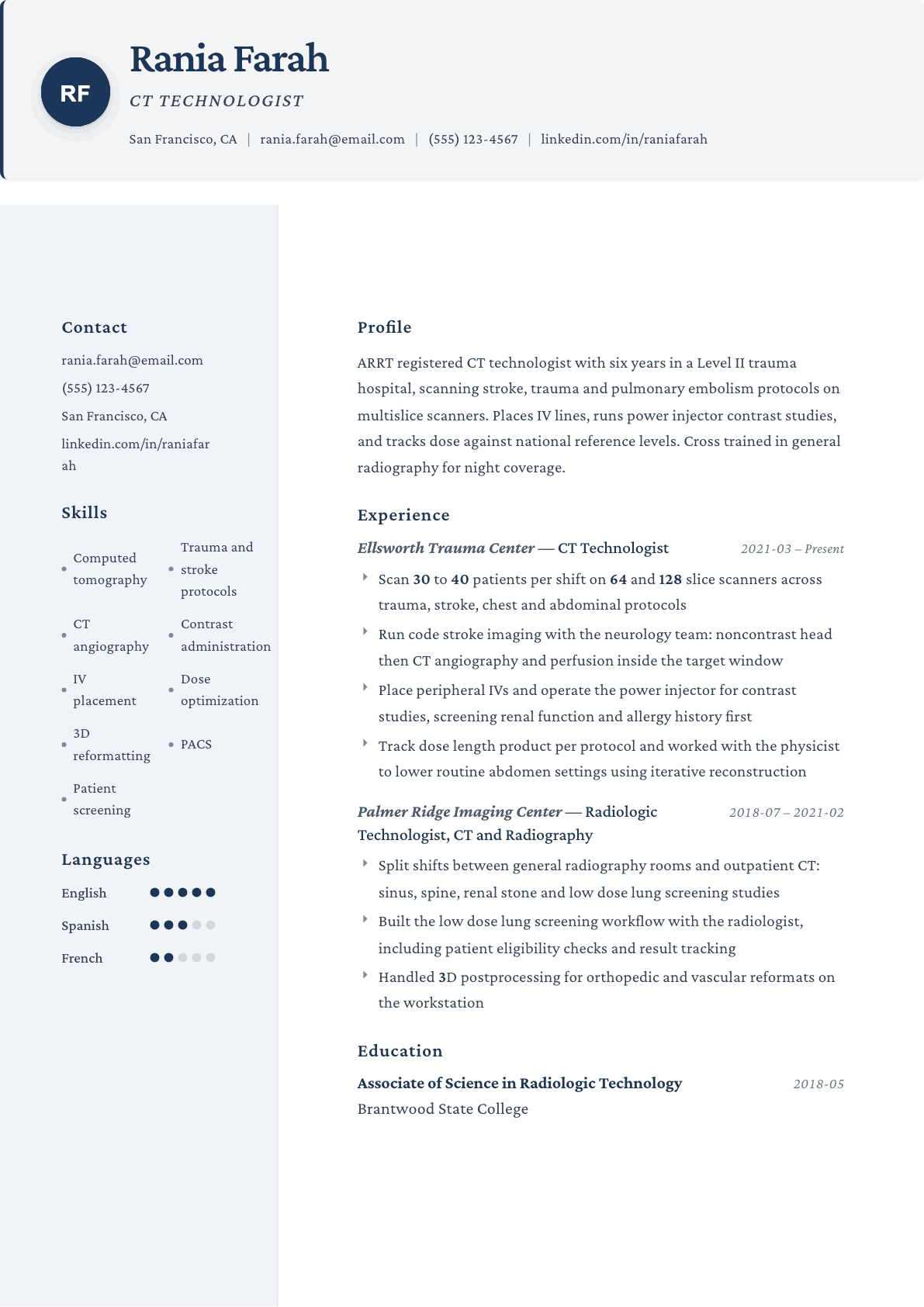
Example CT Technologist summary
ARRT registered CT technologist with six years at a Level II trauma center, scanning up to forty patients per shift across trauma, stroke, angiography and abdominal protocols. Places peripheral IVs, runs power injector contrast studies and screens renal and allergy history. Worked with the medical physicist to lower routine abdomen dose using iterative reconstruction. Seeking a hospital position with lead technologist responsibility.
Skills to list on a CT Technologist resume
- Computed tomography scanning
- Trauma imaging protocols
- Stroke and perfusion protocols
- CT angiography
- Low dose lung screening
- Contrast administration
- Power injector operation
- IV placement
- Contrast reaction response
- Dose optimization and tracking
- Iterative reconstruction
- 3D reformatting and postprocessing
- Radiation safety
- PACS and study routing
- Patient screening and history
What actually gets this resume read
- Name the scanner slice count and manufacturer, because a department wants to know you can walk up to their console.
- List protocol families you run unsupervised: trauma, stroke, angiography, perfusion, renal stone, low dose lung screening.
- Say plainly whether you place your own IVs and run the power injector, since that decides staffing in many centers.
- Put ARRT computed tomography certification on the resume separately from your primary radiography registration.
- Show dose awareness with specifics: dose length product tracking, iterative reconstruction, and protocol review with a physicist.
- Note trauma level and call coverage, because a Level II night shift is a different job from an outpatient day list.
How to write a ct technologist resume
Computed tomography is the modality where speed and dose pull against each other every shift. A CT technologist resume is read by a manager weighing both: can this person get a code stroke through the scanner inside the window, and will the routine abdomen studies come back at a sensible dose length product.
The third question is contrast. Departments vary enormously on whether the technologist places the IV line, screens renal function, operates the power injector and manages a contrast reaction. Where you sit on that spectrum changes which postings you can answer, so it belongs near the top of the page.
This guide covers the scanner and protocol line, how to write dose and contrast bullets with real substance, how to present the CT credential alongside your primary registration, and how to write the resume while you are still cross training into the modality.
Format: registration, scanner, protocols
One page under eight years, single column. The header carries your name with credentials, your primary registration, your computed tomography credential status and your state license. Underneath, one line naming the scanners you have operated by manufacturer and slice count.
Slice count matters more than candidates expect. A department running a wide detector scanner for cardiac and perfusion work needs someone who has handled those acquisitions, and a candidate whose experience stops at a sixteen slice machine is a longer training project.
- Header: name with credentials, contact details, registration and license status, BLS.
- Scanner line: manufacturer, slice count and any dedicated cardiac or interventional system.
- Section order: summary, credentials, imaging experience, protocol and contrast skills, education.
Protocols: what you run unsupervised
List protocol families explicitly and say which you run without a lead technologist in the room. Trauma whole body, code stroke noncontrast head with angiography and perfusion, pulmonary embolism, aortic dissection, renal stone, enterography, low dose lung screening, biopsy guidance and cardiac calcium scoring are each a separate capability with separate timing pressures.
Stroke work deserves its own bullet because it is timed and coordinated. Describe the handoff with neurology, how you preload the protocol, and what your role is between the noncontrast head and the angiography series. A manager staffing a stroke center reads that paragraph closely.
Trauma is the same. Say the trauma level of the facility, whether you scan from the resuscitation bay, and how the scanner is prepared before a activation arrives. Those details separate someone who has worked trauma from someone who has covered a scanner near an emergency department.
Contrast and IV practice
State plainly whether you place peripheral IV lines yourself, what gauge and sites you routinely use, and how you screen before a contrast study: renal function, allergy history, metformin considerations and prior reaction documentation. That single paragraph decides whether you fit half the postings you are reading.
Add the power injector work: split bolus and multiphase protocols, bolus tracking and timing bolus techniques, injection rate selection by access, and extravasation recognition and management. If you have run a contrast reaction and know the department policy, say so, because reaction response is what a lead technologist is asked about at interview.
- Name the injector system and any bolus tracking package you use routinely.
- Include oral contrast preparation, timing and patient instruction if your department uses it.
- Mention post-processing: multiplanar reformats, maximum intensity projections and vessel analysis.
Dose: the section that reads as maturity
Write about dose in the department vocabulary. Dose length product and volume computed tomography dose index tracking by protocol, comparison against national diagnostic reference levels, iterative or model based reconstruction settings, automatic tube current modulation, tube potential selection for contrast studies, and pediatric protocol adjustment by body size.
The strongest bullet in this area names a protocol you helped change and the result. Working with a medical physicist to lower routine abdomen settings after switching reconstruction methods is a concrete, checkable piece of work and it is exactly what a lead posting wants to see.
Keywords computed tomography postings repeat
These job descriptions reuse a compact set of phrases: computed tomography, trauma protocols, stroke imaging, angiography, contrast administration, power injector, dose optimization, image reconstruction, patient screening and PACS. Mirror the true ones once and prove two or three inside your bullets.
Where a posting names a scanner manufacturer, echo the exact name. It is one of the few hard filters an imaging recruiter applies before a human reads the file.
CT Technologist resume summary examples
Cross training in
Registered radiologic technologist with three years in general radiography, now 40 clinical computed tomography procedures into the postprimary pathway across head, chest, abdomen and renal stone protocols. Places peripheral IV lines and assists with power injector studies. Seeking a hospital position with a defined computed tomography rotation.
Five years in
CT technologist with five years at a Level II trauma hospital, scanning 30 to 40 patients per shift on 64 and 128 slice systems across trauma, stroke, pulmonary embolism and abdominal protocols. Places own IV access, runs bolus tracking studies and tracks dose length product by protocol. Cross trained in general radiography.
Lead CT technologist
Lead computed tomography technologist with eleven years across trauma and outpatient imaging, now supervising six technologists on two scanners. Owns the protocol library, runs quarterly dose reviews with the medical physicist, and built the low dose lung screening workflow from eligibility checks through result tracking.
Work experience bullets: before and after
Before: Performed CT scans on patients each shift.
After: Scanned 30 to 40 patients per shift on 64 and 128 slice systems across trauma, stroke, chest, abdominal and renal stone protocols.
Slice counts, throughput and protocol families let a manager judge both pace and capability in one line.
Before: Helped with stroke patients from the emergency department.
After: Ran code stroke imaging with the neurology team: preloaded protocol, noncontrast head, then angiography and perfusion series inside the treatment window.
The sequence, the coordination and the timing constraint show the actual workflow rather than proximity to it.
Before: Gave contrast for scans.
After: Placed peripheral IV access and operated the power injector for bolus tracked angiography, screening renal function, allergy history and prior reactions before every contrast study.
Access placement, injector technique and screening define the scope of practice a department is hiring for.
Before: Kept radiation dose as low as possible.
After: Tracked dose length product by protocol against reference levels and worked with the medical physicist to lower routine abdomen settings after moving to iterative reconstruction.
A tracked metric, a comparison standard and a specific change turn a slogan into documented practice.
Before: Did 3D work on the computer for the radiologists.
After: Produced multiplanar reformats, maximum intensity projections and vessel centerline analyses on the workstation for orthopedic and vascular reads.
The named post-processing outputs and the services they serve show workstation skill rather than button pressing.
Hard skills
- Computed tomography acquisition
- Trauma whole body protocols
- Stroke and perfusion imaging
- CT angiography and bolus tracking
- Pulmonary embolism protocols
- Low dose lung screening
- Biopsy and drainage guidance
- Peripheral IV placement
- Power injector operation
- Contrast reaction recognition
- Dose tracking and reference level comparison
- Iterative reconstruction settings
- Multiplanar and 3D post-processing
- PACS and radiology information systems
Soft skills
- Working inside timed clinical pathways
- Coordination with trauma and neurology teams
- Fast, clear breath hold instruction
- Judgment on when to rescan
- Overnight solo coverage discipline
- Training technologists on new protocols
Certifications worth listing
- Computed Tomography postprimary certification, R.T.(CT) (American Registry of Radiologic Technologists)
- Registered Technologist in Radiography, R.T.(R) (American Registry of Radiologic Technologists)
- Nuclear Medicine Technology Certification with computed tomography (Nuclear Medicine Technology Certification Board)
- Basic Life Support (BLS) (American Heart Association)
Mistakes that cost ct technologist candidates the interview
- Omitting slice count and manufacturer, which is the first thing a department checks when it runs a wide detector scanner.
- Never stating whether you place your own IV access, when that single fact rules you in or out of many postings.
- Writing dose reduction as a phrase without the tracked metric, the reconstruction method or the physicist review behind it.
- Listing stroke and trauma among general protocols instead of describing the timed workflow you actually run.
- Leaving post-processing off the page, when reformats and vessel analysis are daily work in most departments.
- Blending your general radiography and computed tomography years so a manager cannot tell how much scanner time you have.
- Forgetting the contrast reaction question, which comes up in every serious computed tomography interview.
CT Technologist resume questions
How do I write a CT technologist resume while still cross training?
Put the pathway progress on the page: the number of clinical procedures logged, the protocol categories covered, and the exam date you have booked. Departments hire partway through the pathway regularly because it fills a coverage gap sooner than a fully credentialed outside hire would.
Should I keep my general radiography experience on the resume?
Yes, and keep it in its own section rather than mixed into your scanner work. Many hospitals need overnight staff who can cover both, so radiography competence adds value, but blending the two makes your actual scanner hours impossible to judge.
How do I show dose awareness without inventing numbers?
Describe the practices instead of quoting figures. Tracking dose length product per protocol, comparing against published reference levels, using tube current modulation, and reviewing protocol settings with a medical physicist are all real work you can name without fabricating a result.
What contrast details belong on the resume?
Whether you place your own IV access, the screening you perform before a study, the injector techniques you use including bolus tracking and split bolus, and your role in recognizing and managing extravasation or a contrast reaction under department policy.
Does trauma level matter on a CT technologist resume?
It does, because a designated trauma center scans activations day and night with the whole team waiting. Naming the level tells a manager what pressure you have worked under, which is not obvious from a scan count or a protocol list alone.