MRI Technologist Resume Examples: the lines they read
Write an MRI Technologist Resume That Shows Scanner Fluency
By Mustafa Tarabya, founder of CVBooster · Published · Updated
MRI technologist resume example with scanner platforms, safety zone screening, protocol wording and ARRT credential keywords.
Sample resumes for a mri technologist
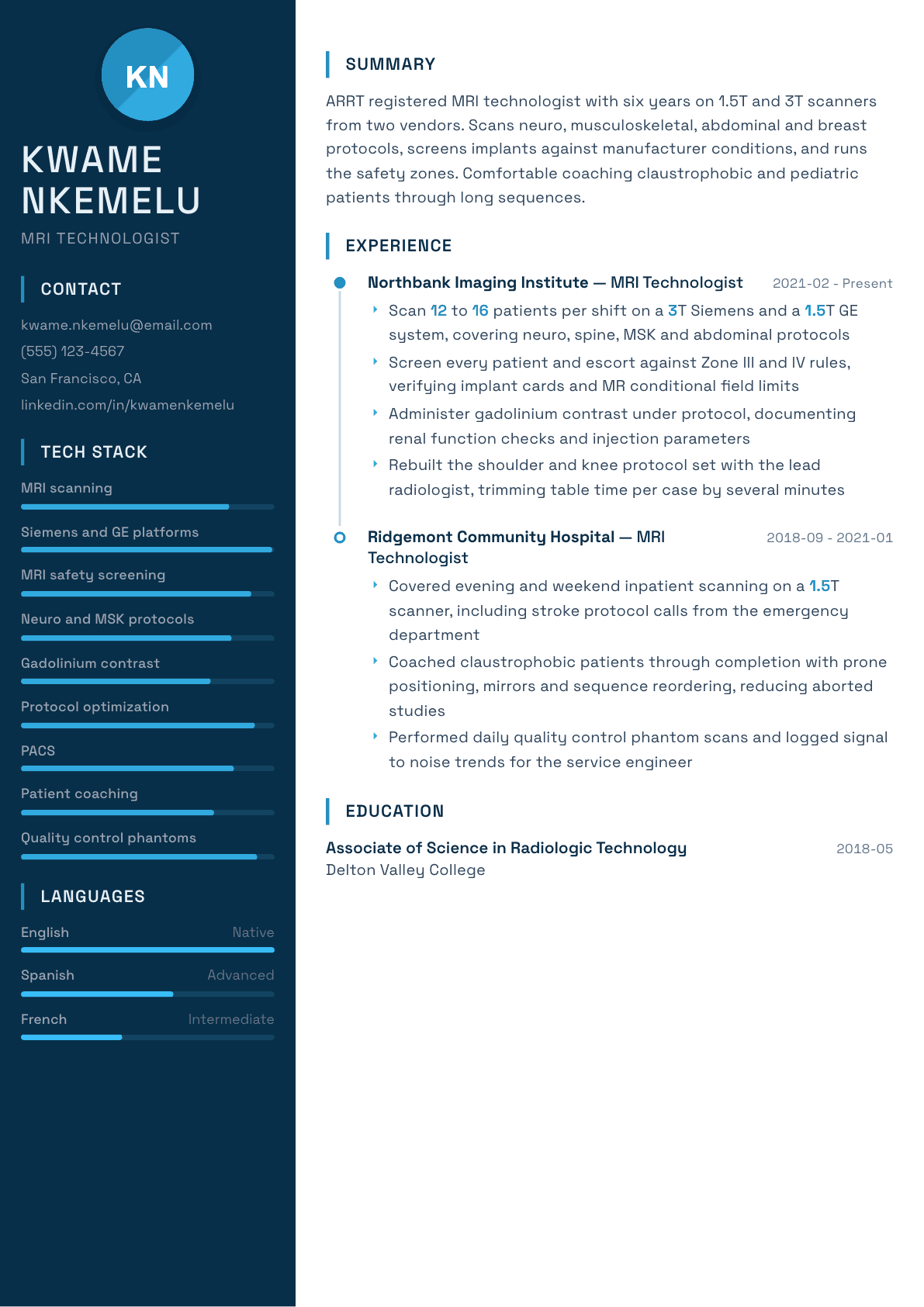
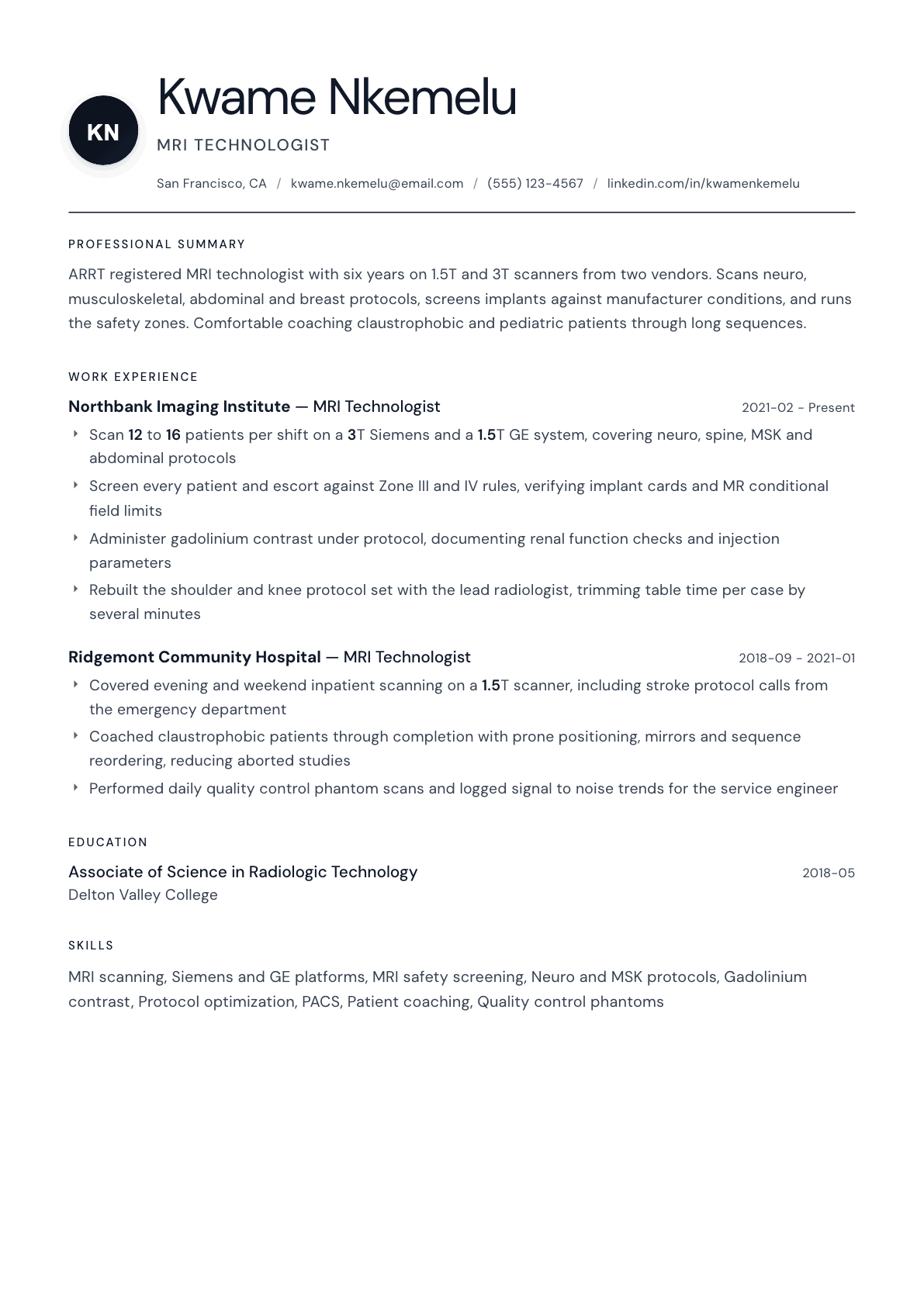
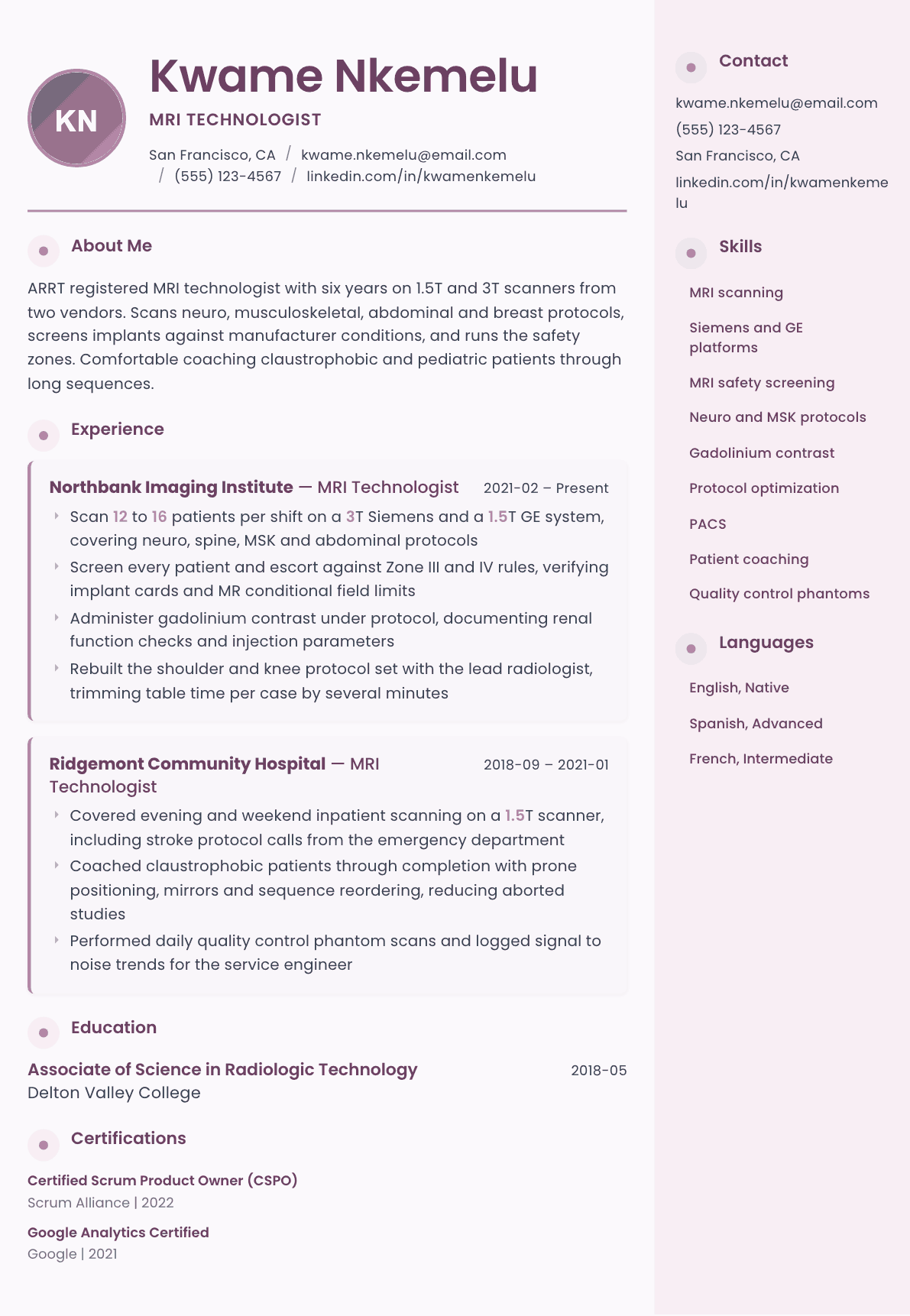
The same mri technologist content laid out in three CVBooster templates, so you can see what the finished document looks like before you write a word.
Example MRI Technologist summary
ARRT registered MRI technologist with six years across 1.5T and 3T scanners from two vendors, covering neuro, spine, musculoskeletal and abdominal protocols. Runs zone screening and implant verification for the department and administers gadolinium under protocol. Rebuilt shoulder and knee sequences with the lead radiologist to cut table time. Seeking an outpatient imaging center role with a research protocol component.
Skills to list on a MRI Technologist resume
- MRI scanning
- Field strength protocol selection
- Neurological imaging protocols
- Musculoskeletal imaging protocols
- Abdominal and pelvic imaging
- MRI safety zone control
- Implant and device screening
- Gadolinium contrast administration
- IV access
- Coil selection and positioning
- Artifact recognition
- Protocol optimization
- Quality control phantom testing
- PACS and study routing
- Patient coaching and sedation support
What actually gets this resume read
- Name the field strength and vendor of every scanner you have run, because departments hire for their exact platform.
- List the protocol families you scan independently: neuro, spine, musculoskeletal, abdominal, cardiac, breast, prostate.
- Show MRI safety in its own bullet: zone control, implant screening against conditional labeling and ferromagnetic checks.
- State ARRT registration in radiography plus the MR postprimary pathway, and whether you hold ARMRIT instead.
- Include patient throughput per shift and how you keep claustrophobic and pediatric studies from being aborted.
- Mention contrast work, renal screening and any IV certification, since many postings require the technologist to inject.
How to write a mri technologist resume
An MRI technologist resume is read by someone who owns a magnet that is never turned off. Before anything else, she wants evidence that you take safety screening seriously, because the failure mode in this modality is not a repeated exposure. It is a ferromagnetic object entering the scan room.
After safety comes platform and protocol. A department running a three tesla scanner from one vendor and a one and a half tesla scanner from another needs to know which consoles you have sat at, which protocol families you scan without a lead technologist beside you, and whether you inject your own contrast.
This guide covers the credential header, how to write the scanner and protocol line for each job, safety bullets that actually mean something, and the questions MRI technologists ask when they update the file after a few years at one site.
Format: credentials, platforms, protocols, in that order
One page for under eight years of imaging work, two after that. Single column, plain headings. The top third of the page carries your registration, your state license where your state requires one, and a platform line naming every scanner field strength and vendor you have operated.
That platform line does more work than any paragraph. A manager scanning fifty applications is looking for her own vendor, and a candidate who lists field strengths and manufacturers plainly gets pulled out of the stack in seconds.
- Header: name with credentials, contact details, registration status, state license, BLS.
- Platform line: every scanner field strength and manufacturer you have run, plus software generation if you know it.
- Section order: summary, credentials, imaging experience, protocol and safety skills, education.
Safety: the section that separates candidates
Give MRI safety its own bullets rather than a single word in a skills list. Describe the screening process you run: the written screening form, the verbal reconfirmation, implant card verification against manufacturer conditional labeling, field strength and gradient limits for conditional devices, and ferromagnetic detection at the door.
Describe your zone practice too. Who you escort, how you control Zone III and Zone IV access, how you handle a patient arriving from the emergency department on a stretcher, and how contractors or cleaning staff are managed. A department that has had a near miss reads this section first.
If you have held the MR safety officer or MR safety expert role, or have trained staff on screening, put it on the page. Those responsibilities are rarer than the certification itself and they are what a lead posting is looking for.
Protocols, coils and image quality
List the protocol families you scan independently: brain and stroke, spine, internal auditory canal, orbits, musculoskeletal joints, abdominal and liver, pelvis and prostate, breast, cardiac and vascular angiography. Say which ones you run without a lead technologist present, because that is what determines whether you can take an evening shift alone.
Coil selection and positioning is a craft detail worth writing about, especially for shoulder, wrist, temporomandibular joint and small field of view work. So is artifact recognition: motion, wrap, chemical shift, susceptibility from hardware, and how you adapt sequence parameters or positioning rather than simply repeating the scan.
If you have optimized protocols with a radiologist or an applications specialist, describe what you changed and what it did to table time or image quality. That single bullet is often the difference between a staff and a lead application.
- Name contrast agents and whether you place your own IV lines and screen renal function.
- Include sedation and anesthesia support cases if your department scans them.
- Mention research or clinical trial scanning if you have done it, including protocol adherence documentation.
Throughput, patients and quality control
Give patients per shift rather than an annual figure. Then describe how you protect it: prone positioning and mirrors for claustrophobic patients, sequence reordering so the diagnostic series happens first, coaching pediatric patients through short holds, and communication with nursing for sedated cases. Aborted studies are a real cost and a technologist who prevents them is worth naming as such.
Daily quality control deserves a line. Phantom scans, signal to noise trending, coil checks, cryogen level monitoring where you are responsible for logging it, and the working relationship with the service engineer all show that you look after the scanner rather than only operating it.
Keywords MRI postings repeat
Magnetic resonance job descriptions reuse a narrow set of terms: MRI safety screening, zone control, conditional implants, gadolinium administration, coil positioning, protocol optimization, artifact reduction, patient screening, PACS and image quality. Use the true ones once in your summary or skills and prove at least two inside your bullets.
MRI Technologist resume summary examples
New to magnetic resonance
Registered radiologic technologist completing the magnetic resonance postprimary pathway, with 900 clinical hours on a 1.5T scanner covering brain, spine and musculoskeletal protocols. Trained in zone control, implant screening and contrast administration under supervision. Seeking a staff position with a structured protocol training plan.
Five years in
MRI technologist with five years across 1.5T and 3T scanners from two vendors, scanning 12 to 16 patients per shift through neuro, spine, musculoskeletal and abdominal protocols. Runs screening and zone control independently, places IV lines and administers gadolinium. Known for finishing claustrophobic studies other technologists have aborted.
Lead MRI technologist
Lead MRI technologist with twelve years and four running a three-scanner outpatient center. Owns the safety screening policy, trains staff on conditional implant verification, and rebuilt the musculoskeletal and prostate protocol sets with the reading radiologists. Coordinates service visits, phantom quality control and applications training for new software releases.
Work experience bullets: before and after
Before: Screened patients before their MRI scans.
After: Screened every patient and escort against Zone III and Zone IV rules, verifying implant cards and confirming conditional field strength and gradient limits before entry.
The zones, the implant cards and the conditional limits describe the real screening process instead of naming it.
Before: Scanned patients on a 3T machine.
After: Scanned 12 to 16 patients per shift on a 3T and a 1.5T system from different vendors, covering brain, spine, musculoskeletal and abdominal protocols independently.
Two field strengths, two vendors, a throughput figure and the protocol list answer everything a manager needs to know.
Before: Helped nervous patients get through their exam.
After: Completed claustrophobic studies using prone positioning, mirrors and sequence reordering so the diagnostic series ran first, reducing aborted exams on the evening list.
Named techniques and the outcome show a repeatable method rather than a pleasant manner.
Before: Gave contrast to patients as needed.
After: Placed peripheral IV lines and administered gadolinium per protocol, documenting renal function screening, injection rate and any reaction on every contrast case.
IV placement, screening and documentation define the scope of your contrast practice, which varies between departments.
Before: Worked with the radiologist to improve protocols.
After: Rebuilt the shoulder and knee protocol sets with the lead radiologist, trimming several minutes of table time per case without losing diagnostic sequences.
The specific protocols and the effect on table time make the collaboration measurable.
Hard skills
- MRI scanning across field strengths
- Neurological and stroke protocols
- Spine imaging protocols
- Musculoskeletal joint imaging
- Abdominal and pelvic imaging
- MR angiography
- MRI safety zone control
- Conditional implant screening
- Gadolinium contrast administration
- Peripheral IV placement
- Coil selection and positioning
- Artifact recognition and correction
- Protocol optimization
- Phantom quality control testing
Soft skills
- Coaching claustrophobic patients
- Verbal screening discipline
- Working with sedation and nursing teams
- Patience across long sequences
- Training staff on safety rules
- Escalating equipment concerns early
Certifications worth listing
- Magnetic Resonance Imaging postprimary certification, R.T.(MR) (American Registry of Radiologic Technologists)
- MR Safety Officer (MRSO) (American Board of Magnetic Resonance Safety)
- Basic Life Support (BLS) (American Heart Association)
Mistakes that cost mri technologist candidates the interview
- Writing MRI experience without naming field strengths and vendors, when platform familiarity is the first thing a manager filters on.
- Reducing safety to one word in a skills list instead of describing the screening and zone control you personally run.
- Listing protocols you have observed alongside protocols you run alone, with no way for a reader to tell them apart.
- Leaving out whether you place your own IV lines, which changes the staffing model in many outpatient centers.
- Giving an annual scan count instead of patients per shift, which is the number that maps to a schedule.
- Ignoring artifact handling and image quality, the two subjects a lead technologist interview always reaches.
- Forgetting to mention aborted study prevention, which is a real cost center and a genuine differentiator.
MRI Technologist resume questions
Do I need radiography registration before working in MRI?
Most departments hire technologists who hold a primary registration and then complete the magnetic resonance postprimary pathway, but a direct magnetic resonance credential exists and some employers accept it. List whichever route you took with the issuing body so a recruiter can match it against the posting.
How should I describe scanner experience on the resume?
Give field strength, manufacturer and, where you know it, the software generation, for every scanner you have operated. A department buying a new system also wants to know if you have been through an applications training and upgrade cycle, so mention that if you have.
What belongs in the MRI safety part of the resume?
The screening process you run, implant verification against conditional labeling, zone access control, ferromagnetic detection, and how you handle emergency department arrivals and outside staff. If you hold a safety officer role or have trained others on screening, that belongs there too.
How do I show protocol skill without listing every sequence?
List protocol families rather than individual sequences, and say which you run without a lead technologist present. Then use one bullet to describe a protocol you helped rebuild with a radiologist, naming the exam and what changed in table time or image quality.
Is it worth mentioning claustrophobic and pediatric patients?
Yes, because aborted studies cost the department a slot and a repeat visit. Describe the specific techniques you use, such as prone positioning, mirrors, sequence reordering and short breath hold coaching, so the claim reads as method rather than temperament.