Ultrasound Technician Resume Examples: read this first
Ultrasound Technician Resume: Examples for Ultrasound Techs
By Mustafa Tarabya, founder of CVBooster · Published · Updated
Ultrasound resume examples for ultrasound techs: new graduate, hospital and vascular samples with exam types, ARDMS credential wording and scan volume.
Sample resumes for a ultrasound technician
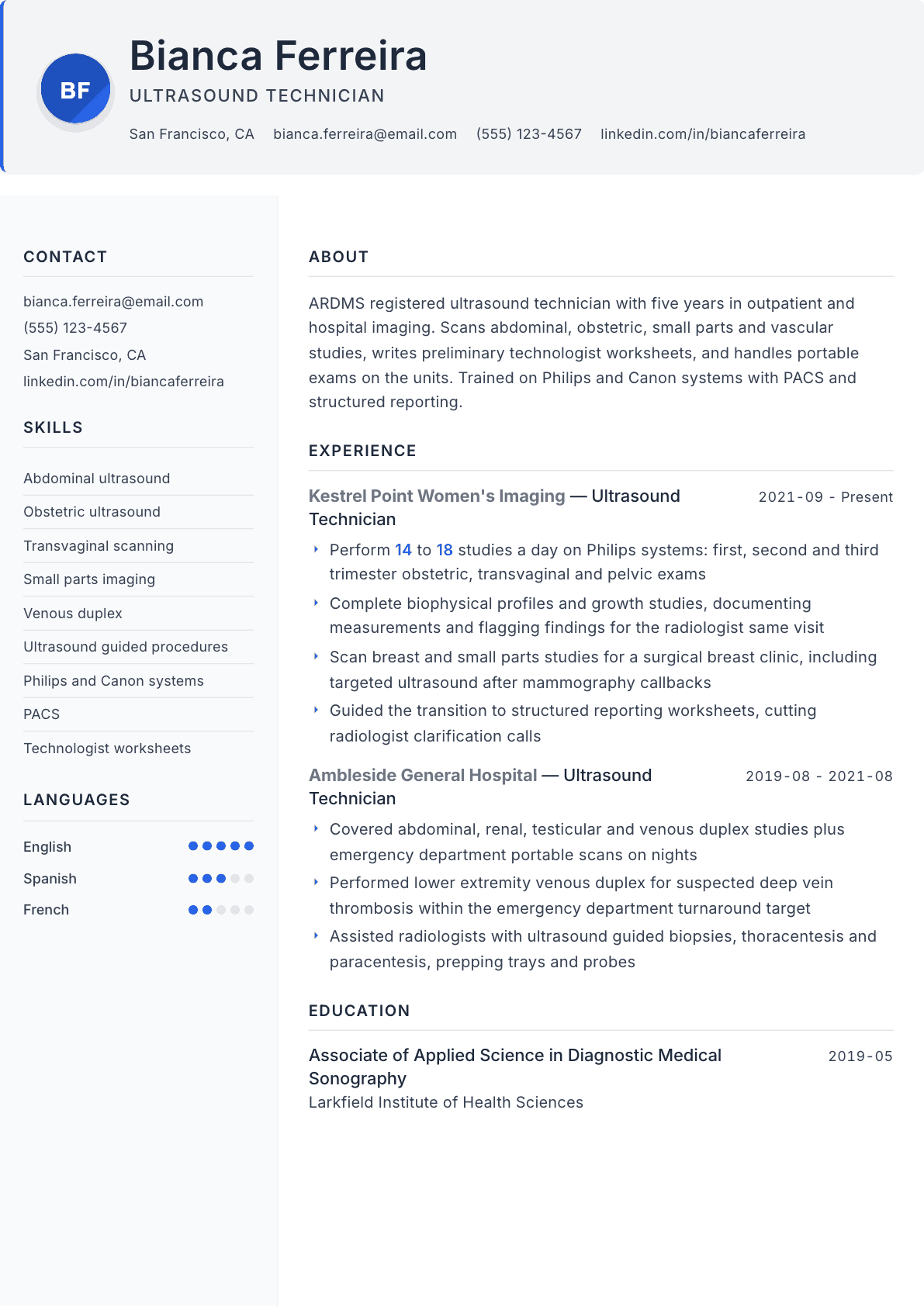
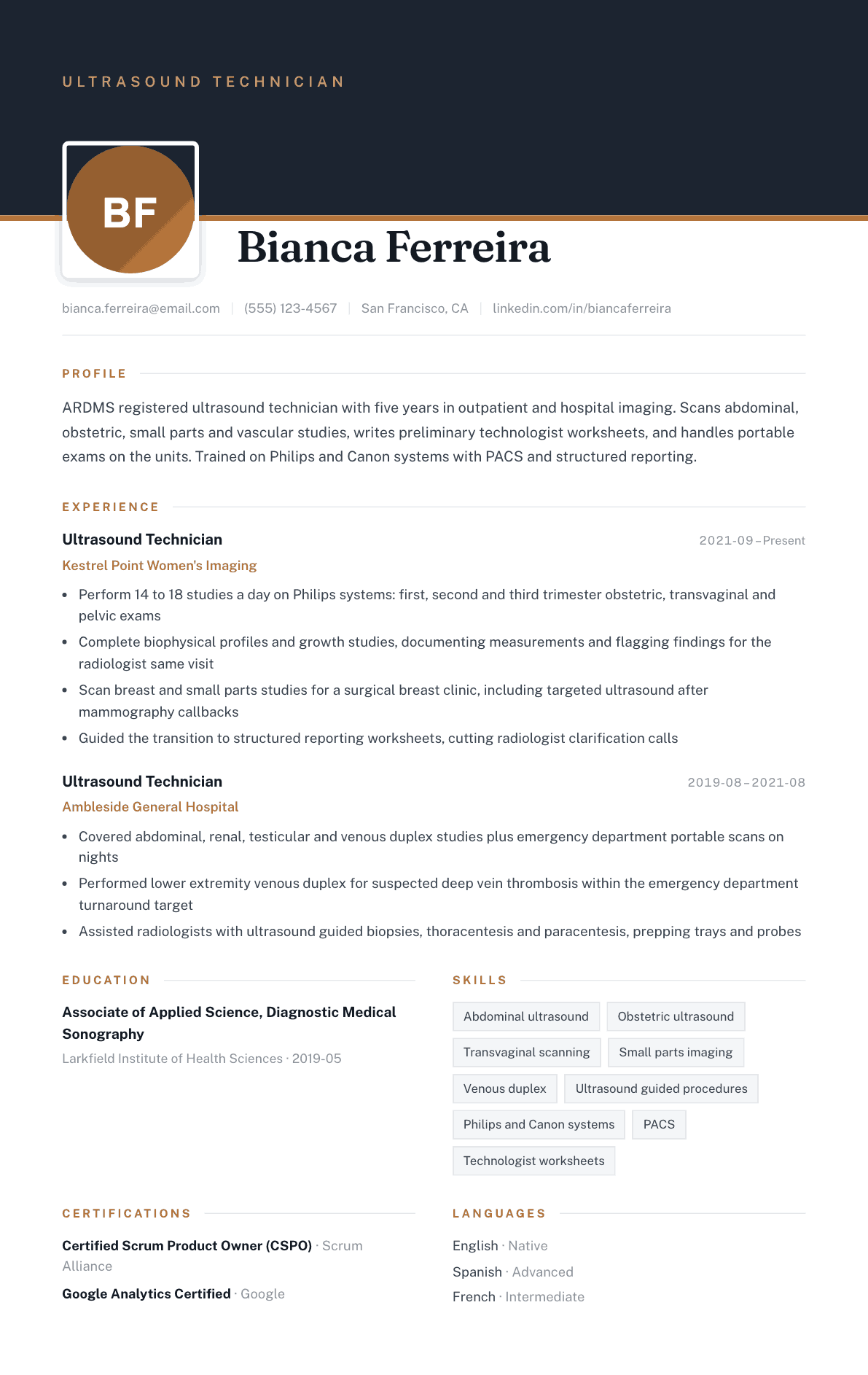
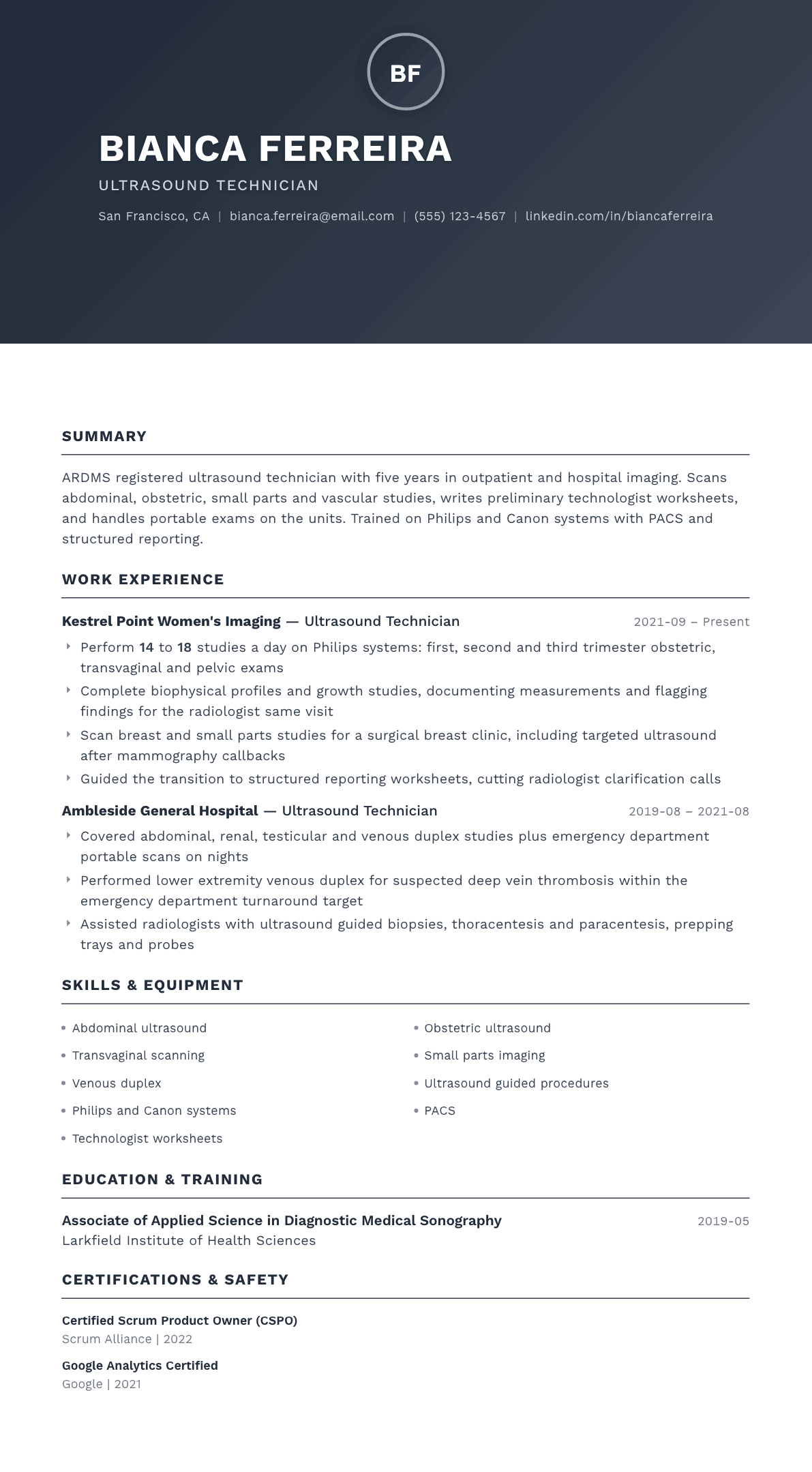
The same ultrasound technician content laid out in three CVBooster templates, so you can see what the finished document looks like before you write a word.
Example Ultrasound Technician summary
ARDMS registered ultrasound technician with five years across outpatient women's imaging and hospital general sonography. Scans obstetric, gynecologic, abdominal, small parts and venous duplex studies, and assists radiologists with ultrasound guided biopsies and drainage. Writes preliminary worksheets that hold up under review and covers portable emergency department calls. Seeking a hospital position with a vascular specialty track.
Skills to list on a Ultrasound Technician resume
- Abdominal ultrasound
- Obstetric and gynecologic ultrasound
- Transvaginal scanning
- Small parts and thyroid imaging
- Breast ultrasound
- Venous and arterial duplex
- Doppler and color flow
- Ultrasound guided procedure support
- Portable and bedside scanning
- Technologist preliminary worksheets
- Image optimization and gain settings
- Probe selection and care
- PACS and structured reporting
- Patient positioning and comfort
- Equipment quality assurance
What actually gets this resume read
- List exam categories separately: abdominal, obstetric, gynecologic, small parts, vascular, and procedural guidance work.
- Put every ARDMS specialty you hold on its own line, because each one unlocks a different set of postings.
- Give studies per day and whether you cover portable and emergency department scans, which decide the schedule you fit.
- Name the ultrasound vendor and the reporting system, since departments prefer someone who already knows the keyboard.
- Show the preliminary worksheet work you do for radiologists, because that judgment separates strong technicians from new ones.
- Mention ergonomic and scanning technique habits if you have them, since repetitive strain injuries drive turnover in this job.
How to write a ultrasound technician resume
Ultrasound is the one imaging modality where the operator makes the diagnosis possible or impossible. There is no retrospective reconstruction: if the image was never captured, the radiologist has nothing to read. That is why an ultrasound technician resume is judged on exam categories and on the quality of the preliminary work you hand over.
Hiring managers screen first on registry credentials, because accreditation of the department depends on staffing registered technicians in each specialty. Then they screen on exam mix, then on whether you can cover portables, procedures and call.
This guide covers three ultrasound resume examples for ultrasound techs at different stages, how to organize the resume by exam category, what belongs in a technologist worksheet bullet, how to present multiple registries so each one is found, and how to write the file when you are moving from an outpatient office into a hospital department. Hospitals often post the same job as ultrasound technologist, and an ultrasound technologist resume follows the same rules: use the title from the posting and keep the registry credentials exact.
Format: registries first, exam categories second
One page for under eight years, single column, reverse chronological. The header carries your name, your registry credentials written out in the abbreviations the certifying board uses, and your state license where your state issues one.
Immediately below, list the exam categories you perform. Abdominal, obstetric and gynecologic, small parts, vascular, breast, musculoskeletal and procedural guidance are the standard buckets, and a manager staffing a room reads that line before your work history.
- Header: name with registry abbreviations, contact details, license status, BLS.
- Category line: every exam family you scan independently, in the order the posting lists them.
- Section order: summary, registries, imaging experience, exam and equipment skills, education.
Summary: setting, exam mix, and coverage
Three lines. Give the settings you have worked, your years, the studies per day, and the exam families you scan without a second technician available. Then say what coverage you can take: portables on the inpatient units, emergency department scans, after hours call, or procedural assistance in interventional radiology.
Coverage is the part candidates underplay. Departments struggle to staff after hours studies for suspected torsion, ectopic pregnancy and deep vein thrombosis, and a technician who states plainly that she has carried that call is answering the manager's hardest problem.
Experience: exam categories, volume, and the worksheet
Under each job give the setting and the exam mix, then studies per day, then the bullets. An outpatient women's imaging office, a general hospital department and a vascular laboratory are three different jobs, and the resume should not blur them.
The preliminary worksheet is where an experienced technician shows judgment. Describe the measurements and observations you document for the radiologist, how you flag findings that need a same visit read, and any structured reporting system you have used. A technician whose worksheets hold up under review saves a radiologist call on every study.
Procedural work is the second differentiator. Ultrasound guided biopsy, thoracentesis, paracentesis, vascular access and drain placement all need a technician who can hold the probe steady and keep the needle in plane. Name the procedures and the specialties you support.
Avoid bullets that describe sonography in the abstract. Performed ultrasound examinations says only that you had the title.
- Name the ultrasound vendor and system family you have scanned on, plus the reporting software.
- Separate portable and emergency department work from scheduled room studies.
- Include probe cleaning and high level disinfection practice, which surveyors check every time.
Registries, education and accreditation
Write each registry credential on its own line with the certifying board, because a department needs a specific credential to keep a specific service accredited. A technician holding abdomen, obstetrics and vascular registries is three different hires, and merging them into one line hides that.
Name your program and whether it was accredited, since some employers require graduation from an accredited program. If you have been through a department accreditation survey, say which body and what you prepared, because that experience is rare and immediately useful.
Ultrasound resume examples for ultrasound techs: three samples
The three samples below follow the same order a lead sonographer reads in: name with credentials, registry line, a summary with setting and exam mix, then experience by exam family. They are invented, so keep the structure and replace every hospital, number and exam with your own. What changes from one stage to the next is the evidence: a new graduate proves clinical hours and supervised exams, an experienced tech proves volume, coverage and independent work, and a specialist proves the protocols and lab accreditation work that come with a second registry.
- New graduate ultrasound tech: Diagnostic medical sonography graduate of an accredited program, RDMS (AB) earned, OB/GYN exam scheduled. Clinical rotations at a community hospital and an outpatient imaging center; performed supervised abdominal, pelvic, obstetric and small parts exams and wrote preliminary worksheets checked by the supervising sonographer.
- General ultrasound technician, hospital: RDMS (AB, OB/GYN), five years. Scans about 12 to 15 patients a shift across abdomen, OB/GYN, small parts and venous duplex; covers emergency department and portable studies; takes call one weekend a month; precepts students from the local sonography program.
- Vascular ultrasound technologist: RDMS (AB) and RVT, nine years. Performs carotid, arterial and venous duplex studies in an accredited vascular lab, writes technical findings for the reading physician, maintains the lab's protocol binder and helped prepare the reaccreditation submission.
- Every sample keeps the registry line directly under the name, with the specialty letters in brackets, so a recruiter searching for one credential finds it in the first lines.
Keywords ultrasound postings repeat
Sonography job descriptions reuse a small set of phrases: diagnostic medical sonography, abdominal imaging, obstetric imaging, small parts, vascular duplex, Doppler, image optimization, technologist worksheet, patient positioning and probe disinfection. Use the true ones once in your summary or skills, and prove two of them inside your bullets.
Where a posting names a specific registry, echo that exact abbreviation. Recruiters search on those letters, and a spelled out credential without the abbreviation can miss the filter entirely.
Ultrasound Technician resume summary examples
New graduate
Diagnostic medical sonography graduate with 1,200 clinical hours across a hospital department and an outpatient office, scanning abdominal, obstetric, gynecologic, small parts and venous studies. Registry exams in abdomen and obstetrics passed. Trained on Philips systems and PACS. Seeking a general sonography position with weekend rotation.
Five years in
Ultrasound technician with five years across outpatient women's imaging and a general hospital department, performing 14 to 18 studies a day. Covers obstetric, gynecologic, abdominal, small parts and venous duplex exams, plus portable emergency department scans. Writes preliminary worksheets that radiologists rarely need to question.
Senior technician
Senior ultrasound technician with ten years and three registry credentials, scanning abdominal, obstetric and vascular studies in a hospital department. Assists interventional radiology with biopsies and drainage, carries after hours call, and rewrote the probe disinfection procedure ahead of the last accreditation survey.
Work experience bullets: before and after
Before: Performed ultrasound exams on patients daily.
After: Performed 14 to 18 studies a day covering first, second and third trimester obstetric, transvaginal, pelvic and abdominal exams on Philips systems.
Daily volume and the specific exam families tell a manager exactly which room you can staff tomorrow.
Before: Checked for blood clots in patients' legs.
After: Performed lower extremity venous duplex studies for suspected deep vein thrombosis from the emergency department, meeting the department turnaround target on overnight calls.
The named study, the referral source and the turnaround expectation describe real vascular coverage.
Before: Helped doctors with ultrasound-guided procedures.
After: Assisted radiologists with ultrasound-guided liver biopsies, thoracentesis and paracentesis, prepping trays, selecting probes and holding the needle in plane throughout.
Naming the procedures and your part in them shows procedural competence rather than presence in the room.
Before: Wrote notes for the radiologist after each scan.
After: Documented measurements and findings on structured technologist worksheets, flagging suspected ectopic pregnancy and torsion cases for a same-visit radiologist read.
The worksheet content and the escalation examples prove judgment, which is what separates experienced scanners.
Before: Kept the ultrasound equipment clean.
After: Built a probe cleaning and high level disinfection log with tracked cycle times, which passed two accreditation surveys without a finding.
A log, a tracked measure and a survey result turn routine cleaning into demonstrated compliance work.
Hard skills
- Abdominal ultrasound
- Obstetric and gynecologic ultrasound
- Transvaginal scanning
- Small parts and thyroid imaging
- Breast ultrasound
- Venous and arterial duplex
- Doppler and color flow imaging
- Ultrasound guided procedure support
- Portable and bedside scanning
- Technologist preliminary worksheets
- Image optimization and gain control
- Probe selection and high level disinfection
- PACS and structured reporting
- Equipment quality assurance
Soft skills
- Explaining findings limits without diagnosing
- Steady hand during guided procedures
- Patient positioning for comfort and access
- Composure during difficult obstetric findings
- Communication with referring clinicians
- Ergonomic scanning discipline
Certifications worth listing
- Registered Diagnostic Medical Sonographer (RDMS) (American Registry for Diagnostic Medical Sonography)
- Registered Vascular Technologist (RVT) (American Registry for Diagnostic Medical Sonography)
- Sonography certification, S (American Registry of Radiologic Technologists)
- Registered Musculoskeletal Sonographer (RMSKS) (American Registry for Diagnostic Medical Sonography)
- Basic Life Support (BLS) (American Heart Association)
Mistakes that cost ultrasound technician candidates the interview
- Listing sonography experience as one block without breaking out the exam categories a department needs staffed.
- Spelling out registry credentials without the abbreviations recruiters actually search on.
- Leaving out call and portable coverage, which is where most hospital ultrasound staffing pain sits.
- Never mentioning the preliminary worksheet, when that documentation is the clearest evidence of scanning judgment.
- Skipping probe disinfection practice, which every accreditation survey examines and every manager worries about.
- Claiming procedural experience without naming the procedures or the specialty that requested them.
- Giving an annual exam total instead of studies per day, which is the figure that maps to a schedule.
Ultrasound Technician resume questions
Is ultrasound technician the same job as diagnostic medical sonographer?
Employers use both titles for the same work, with sonographer more common in hospitals and technician more common in outpatient offices. Use the title from the posting in your summary and keep the formal registry wording in your credentials section so either search term finds you.
How many registry credentials should I hold?
One gets you hired and a second widens the postings you can answer considerably. Abdomen paired with obstetrics and gynecology suits general departments, while a vascular credential opens hospital vascular laboratories and after hours coverage roles that pay differently.
What should a preliminary worksheet bullet actually say?
Say what you document, how you structure it, and how you escalate. Naming the findings you flag for a same visit read, such as suspected ectopic pregnancy or testicular torsion, shows a radiologist that you know which images cannot wait until the end of the list.
Is an ultrasound technologist resume different from an ultrasound tech resume?
No. Technician, tech, technologist and sonographer describe the same work, and employers use them interchangeably. Match the posting's title in your header, then lead with registries such as RDMS or RVT, your exam categories and the coverage you can take. The ultrasound tech resume samples on this page work under any of those titles.
What should an entry level ultrasound tech resume include?
Put your sonography program and its accreditation, the registry exams passed or scheduled, and your clinical sites at the top. Then list the exam families you performed under supervision, your worksheet practice and any patient care work such as CNA or phlebotomy. Hiring managers know new graduates need mentoring and look for clean clinical evidence.