Support Engineer Resume Examples: the lines they read
Solve Complex Problems with a Support Engineer Resume
By Mustafa Tarabya, founder of CVBooster · Published · Updated
Create a support engineer resume that highlights your deep technical troubleshooting, coding ability, and escalation management in SaaS or infrastructure environments.
Sample resumes for a support engineer
The same support engineer content laid out in three CVBooster templates, so you can see what the finished document looks like before you write a word.
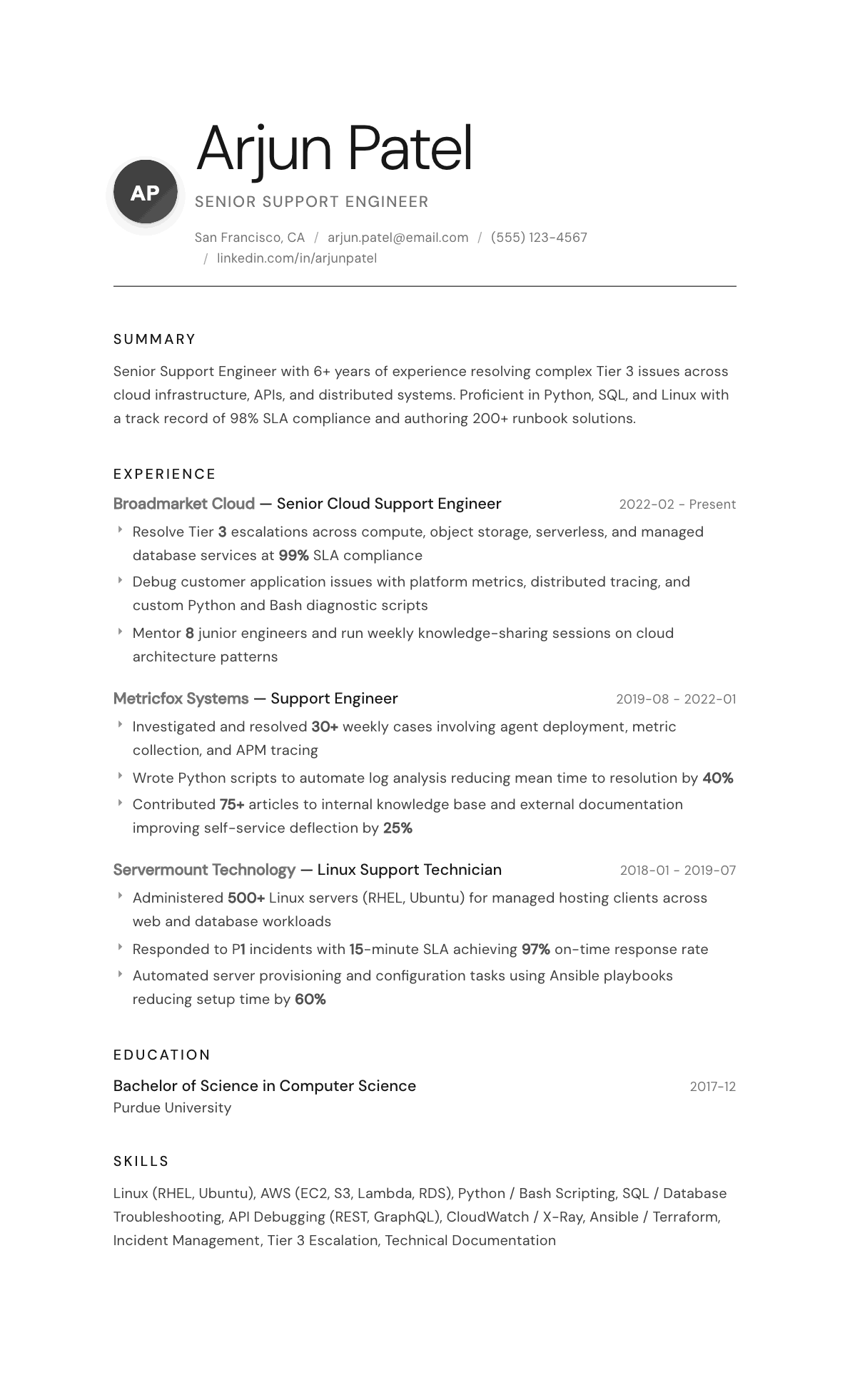
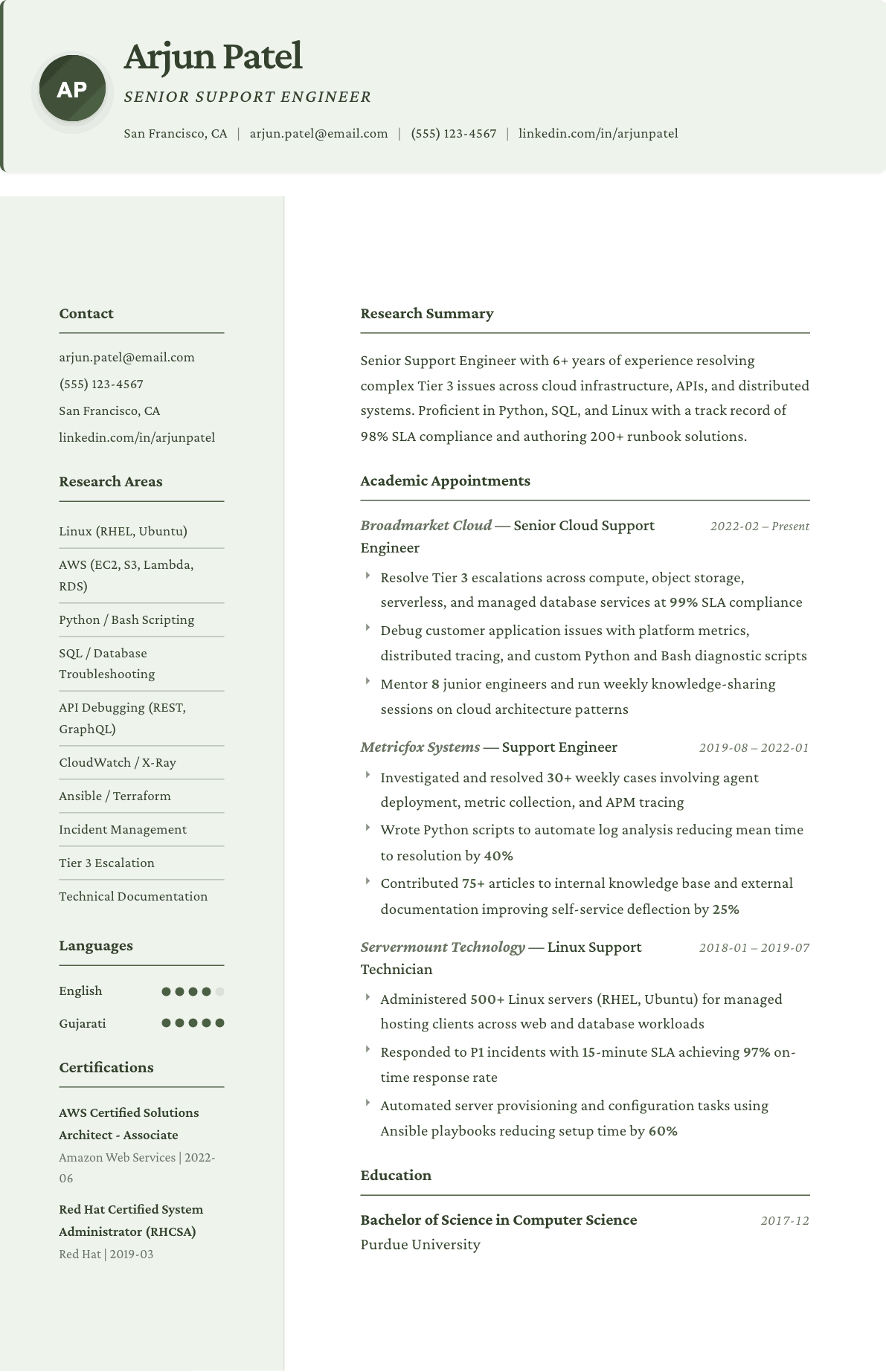
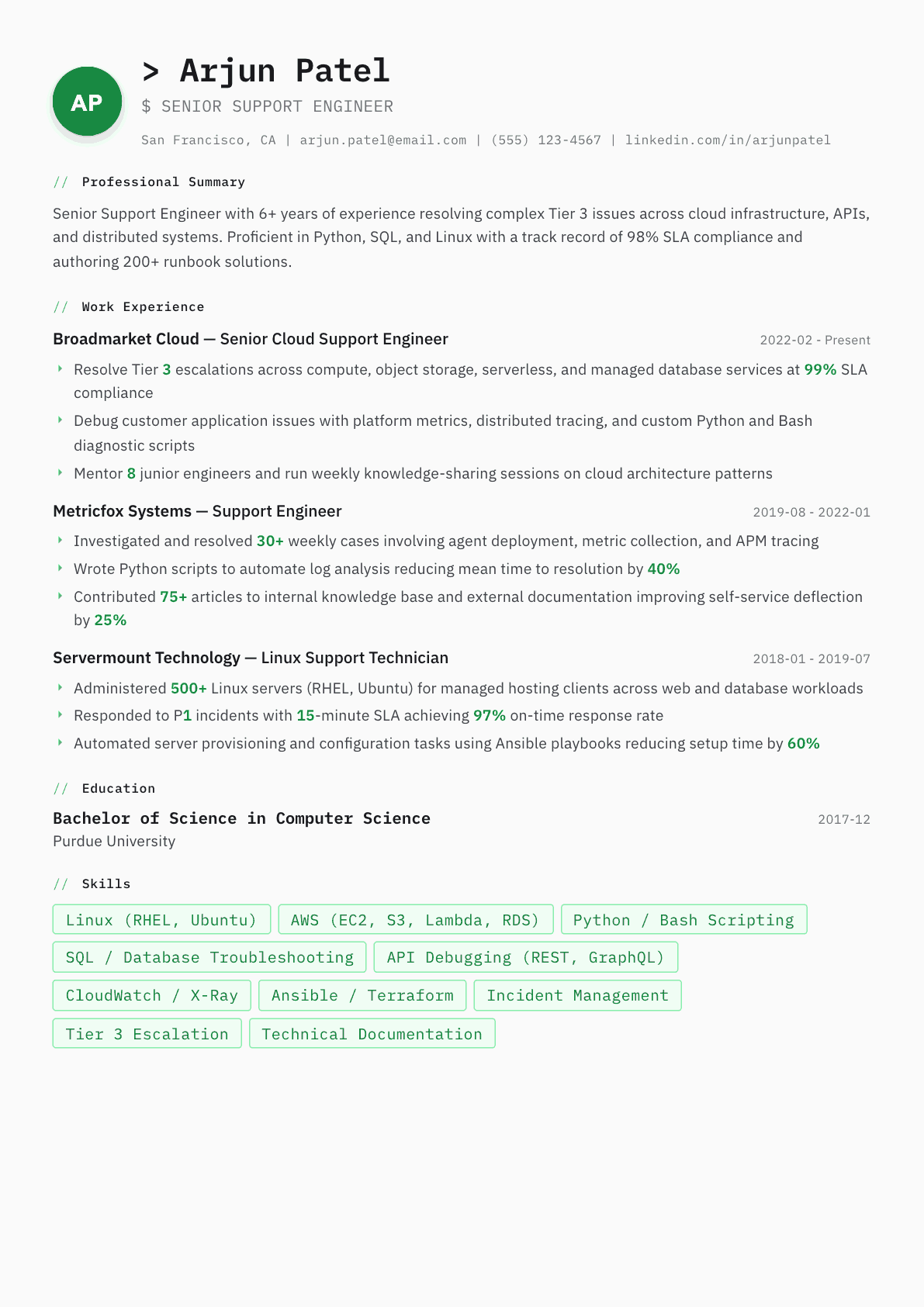
Example Support Engineer summary
Support Engineer with 6 years of Tier 3 cloud infrastructure support experience across AWS, Linux, and distributed systems. Maintains 99% SLA compliance with 40% MTTR reduction through Python automation and 200+ runbook contributions.
Skills to list on a Support Engineer resume
- Linux Administration
- AWS / GCP / Azure
- Python / Bash Scripting
- SQL & Database Support
- API Troubleshooting
- Log Analysis & Monitoring
- Ansible / Terraform
- Incident Response
- Root Cause Analysis
- Technical Writing
- Tier 3 Support
- SLA Management
What actually gets this resume read
- Emphasize the complexity of issues you resolve, from Tier 3 escalations to root cause analysis and cross-service debugging.
- Include scripting and automation skills (Python, Bash, PowerShell) that differentiate you from basic support.
- Quantify your SLA compliance, MTTR improvements, and knowledge base contributions.
- List cloud platforms, APIs, and infrastructure tools to demonstrate technical depth.
- Highlight mentorship or knowledge-sharing activities that show leadership potential.
How to write a support engineer resume
A support engineer resume is read by an engineering manager, not a service desk lead, and that changes what counts. She is not scoring you on tickets closed per hour. She wants evidence that you can take a vague customer report, reproduce it, read the logs and the code path, decide whether it is a defect or a configuration problem, and write something engineering can act on without a second round of questions.
Everything else follows from that. The resume needs the stack you debugged, the tools you read data in, the scripts you wrote, the escalation path you owned, and the cases where your investigation ended in a code fix or a root cause document. Volume metrics still belong on the page, but they support the technical narrative instead of carrying it.
This guide covers the layout, how to write debugging work so an engineer believes it, how to handle the boundary between support and engineering on your resume, and the questions people ask when they are moving from a service desk toward this role or from this role toward a software engineering one.
Format: one page under six years, technical stack visible immediately
Reverse chronological, one page until roughly six years in, then two. Put a compact technical section under the summary covering languages, operating systems, cloud platforms, observability tools and databases. An engineering manager scans that block before anything else, and if the platform she runs is missing she stops.
Keep formatting plain and avoid skill rating bars. Engineers read them as noise, and a claimed proficiency level invites a question in the interview that no rating can survive.
- Header: name, city and state or remote with time zone, phone, email, and a code or writing link if you have one worth showing.
- Order: summary, technical skills, experience, certifications, education.
- Every job needs the product surface you supported and the escalation tier you worked.
Summary: the tier, the stack, and what your escalations produced
Three lines naming the tier, the technology you supported, the scripting or query languages you use, and one outcome that shows depth. The strongest outcomes for this role are the ones a support metric cannot express: bugs you isolated, root cause documents you wrote, automation that removed a recurring investigation.
If you are moving up from a service desk, say what you already do that is not service desk work. Reading application logs, writing queries against a production database replica, scripting a diagnostic, and filing reproducible bug reports are the four signals that separate the two roles, and naming them is more convincing than the title change you are asking for.
Experience: reproduce, isolate, escalate, prevent
Structure each job around that sequence. Start with the surface you covered and its scale, then write bullets that show the investigation rather than the ticket. Which logs you read, which traces you followed, what you eliminated, and how you proved where the fault was. A bullet that names the observability tool and the finding beats five bullets about resolving customer issues.
The escalation bullet matters most. Support engineers earn their reputation on the quality of what they hand to engineering: reproduction steps, affected versions and account identifiers, the log excerpt, the expected and actual behavior, and a hypothesis. Say that explicitly, because engineering managers have all been on the receiving end of the alternative.
Then prevention. Runbooks written, knowledge base articles published, diagnostic scripts automated, alerting or documentation gaps closed, and product feedback that turned into a fix or a better error message. This is the difference between an engineer who reduces the queue and one who empties the same queue every week.
Add the operational reality when you have it: on-call rotations, severity one incident response, service level compliance under time pressure, and postmortem participation. Those tell a manager you can carry the pager.
- Product surface and scale: services supported, customer count or account tier, case volume per week.
- Debugging bullets naming the tools: log platform, tracing, metrics dashboards, database queries.
- Escalation quality: bug reports filed, acceptance without rework, root cause documents authored.
- Automation: scripts written and the investigation time they removed.
- On-call and incident work with the severity levels and response targets.
Technical skills: specific enough to be interviewed on
List only what you can be questioned about. Group by category: languages and scripting, operating systems, cloud services by name, containers and orchestration, databases and query experience, networking, observability, and the ticketing and issue trackers you worked in. Naming individual cloud services rather than the platform alone signals real hands on time.
Certifications carry genuine weight in this role because the products are large and the credentials are hard. A cloud associate level certification, a Linux administration credential or a container orchestration certification all shorten the trust gap with an engineering manager who has never met you.
Where support ends and engineering begins
Be exact about the code you have written. Diagnostic scripts, log parsers, internal tools and test harnesses are all legitimate and worth naming. Contributing a patch to the product is a bigger claim and should be stated only if it happened, with the kind of change it was.
If your goal is a software engineering role next, weight the resume toward the automation and the code, and keep a short public repository or internal tool description ready. If your goal is a senior or escalation engineer role, weight it toward incident work, mentoring and root cause ownership instead.
Support Engineer resume summary examples
Moving up from the service desk
Service desk analyst with three years supporting enterprise users, now handling application escalations: reading server logs, writing SQL queries against reporting replicas and filing reproducible bug reports. Comfortable on Linux and Python, targeting a Tier 2 support engineer role in a software company.
Three years in product support
Support engineer investigating 30 weekly cases on agent deployment, metric collection and application tracing. Writes Python log analysis scripts that cut mean time to resolution by 40%, and contributed 75 knowledge base and documentation articles that lifted self-service deflection by 25%.
Senior, Tier 3 escalations
Senior support engineer with six years resolving Tier 3 escalations across compute, storage, serverless and managed database services at 99% service level compliance. Debugs customer workloads with tracing and custom diagnostic scripts, and mentors eight junior engineers on architecture patterns.
Work experience bullets: before and after
Before: Resolved escalated technical issues for customers.
After: Resolved Tier 3 escalations across compute, object storage, serverless and managed database services at 99% service level compliance, owning each case from reproduction to root cause.
Naming the services and the ownership span shows the depth of the queue rather than the fact that it was escalated.
Before: Used monitoring tools to troubleshoot problems.
After: Debugged customer application faults using metric dashboards, distributed traces and custom Python and Bash diagnostic scripts, isolating a throttling defect that affected requests only above a specific payload size.
A concrete finding proves the tools were used for investigation rather than listed as familiarity.
Before: Wrote scripts to make my job easier.
After: Wrote Python scripts that parsed and correlated multi-service log bundles automatically, cutting mean time to resolution by 40% on the highest volume case category.
The specific automation and the metric it moved make the script an engineering contribution instead of a personal shortcut.
Before: Created documentation for the support team.
After: Authored 75 knowledge base and public documentation articles covering the top recurring failure modes, raising self-service deflection by 25% and removing repeat cases from the queue.
Count plus deflection shows the writing changed inbound volume rather than filling a wiki.
Before: Managed Linux servers for hosting customers.
After: Administered 500 Linux servers across web and database workloads for managed hosting clients, responding to severity one incidents against a 15 minute target at a 97% on-time rate.
Fleet size, workload types and an incident response record establish operational scale under real pressure.
Hard skills
- Linux administration (RHEL, Ubuntu)
- AWS compute, storage and managed database services
- Python and Bash scripting
- SQL and database query troubleshooting
- REST and GraphQL API debugging
- Log analysis and search platforms
- Distributed tracing and metrics dashboards
- Containers and Kubernetes troubleshooting
- Networking, DNS and TLS diagnostics
- Incident response and severity handling
- Root cause analysis and postmortem writing
- Jira issue filing and reproduction cases
- Runbook and knowledge base authoring
- Configuration management with Ansible
Soft skills
- Explaining a failure to a non-technical customer
- Written precision in bug reports
- Persistence on an unreproducible case
- Judgment on when to escalate
- Mentoring junior engineers
- Calm during a severity one call
Certifications worth listing
- AWS Certified Solutions Architect, Associate (Amazon Web Services)
- AWS Certified SysOps Administrator, Associate (Amazon Web Services)
- Red Hat Certified System Administrator (RHCSA) (Red Hat)
- Certified Kubernetes Administrator (CKA) (Cloud Native Computing Foundation)
- Microsoft Certified: Azure Administrator Associate (Microsoft)
Mistakes that cost support engineer candidates the interview
- Writing the resume like a service desk resume. Ticket counts without any evidence of debugging read as volume work to an engineering manager.
- Listing technologies with proficiency bars or star ratings, which engineers discount and interviewers immediately test.
- Describing escalations without saying what you handed over, when the quality of the handover is the whole reputation of the role.
- Omitting the scripting language, which is the fastest signal that you can automate an investigation rather than repeat it.
- Claiming product code contributions that were actually internal tooling. Name the tooling honestly, it is still strong evidence.
- Leaving out on-call and incident experience, which is often the hardest requirement for the hiring team to fill.
Support Engineer resume questions
What is the difference between a support engineer and a help desk analyst resume?
A help desk resume proves queue throughput on internal end user issues. A support engineer resume proves technical investigation on a product: reading logs and traces, querying databases, writing scripts and producing bug reports engineering can act on without rework.
How much coding should a support engineer resume show?
Enough to prove you automate rather than repeat. Diagnostic scripts, log parsers and internal tools are the expected level, and naming the language plus the time saved is more persuasive than listing several languages you have only read.
Do cloud certifications matter for support engineering jobs?
They matter more here than in most support roles because the platforms are large and the credentials are non-trivial. An associate level cloud or Linux administration certification gives a hiring manager a baseline she can trust before the technical interview.
Should I include ticket volume on a support engineer resume?
Include it once per job as context for the technical bullets, ideally as weekly case volume with the complexity noted. Leading with it, or repeating it in several bullets, pushes the resume back toward a service desk profile.
How do I use a support engineer role to move into software engineering?
Weight the resume toward the code: the tools you built, the automation you delivered internally, the test harnesses and the languages. Add a repository or a documented internal project, and keep the case metrics to a single supporting line per job.
Related resume examples
- Technical Support Specialist Resume example
- Help Desk Analyst Resume example
- Live Chat Agent Resume example
- Customer Support Specialist Resume example
- Technical Support Representative Resume example
- Help Desk Technician Resume example