Technical Support Representative Resume Examples: free
Technical Support Representative Resume That Proves You Can Fix Things
By Mustafa Tarabya, founder of CVBooster · Published · Updated
Technical support representative resume example with ticketing tools, resolution metrics, troubleshooting bullets, keywords and a writing guide.
Sample resumes for a technical support representative
The same technical support representative content laid out in three CVBooster templates, so you can see what the finished document looks like before you write a word.
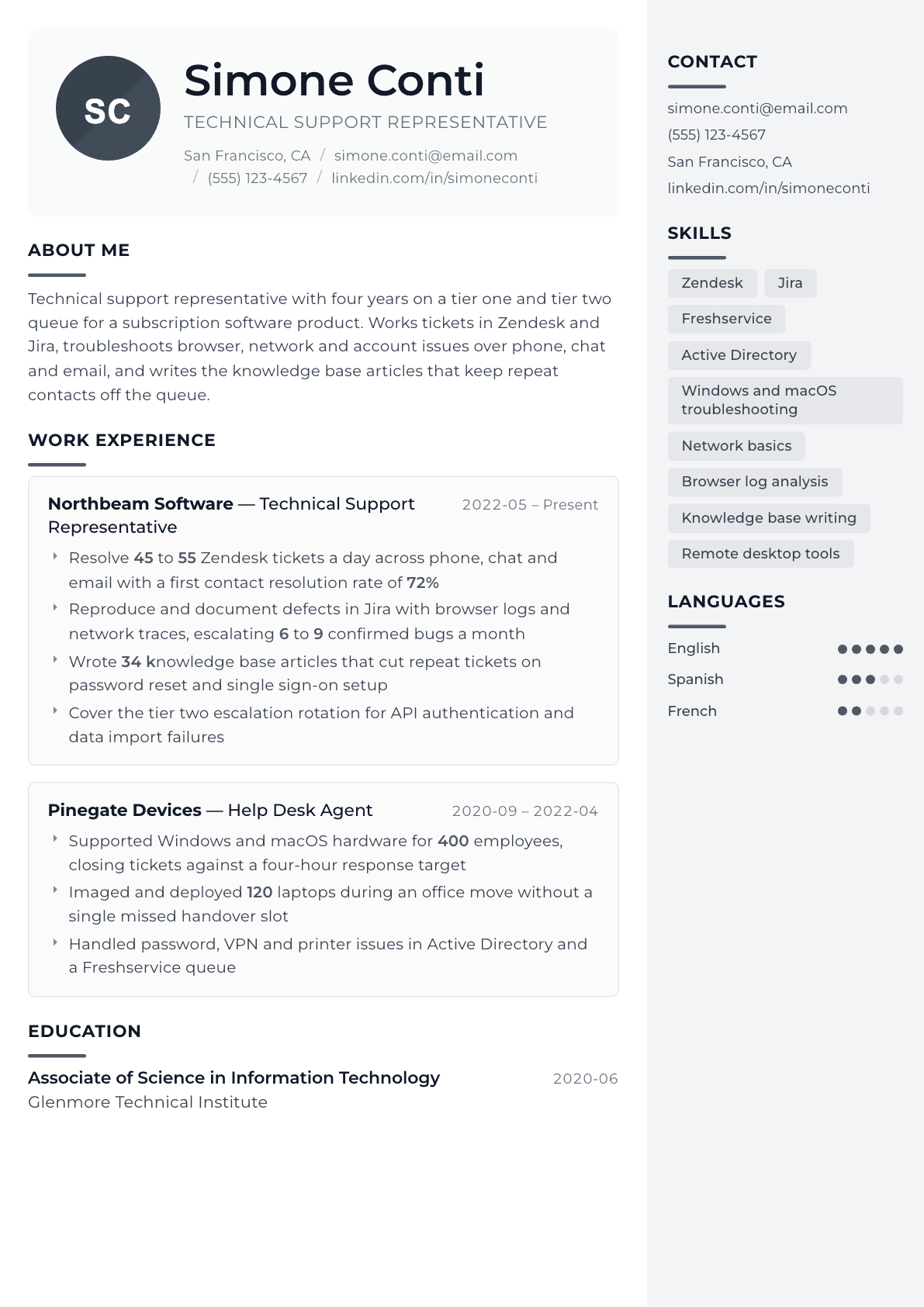
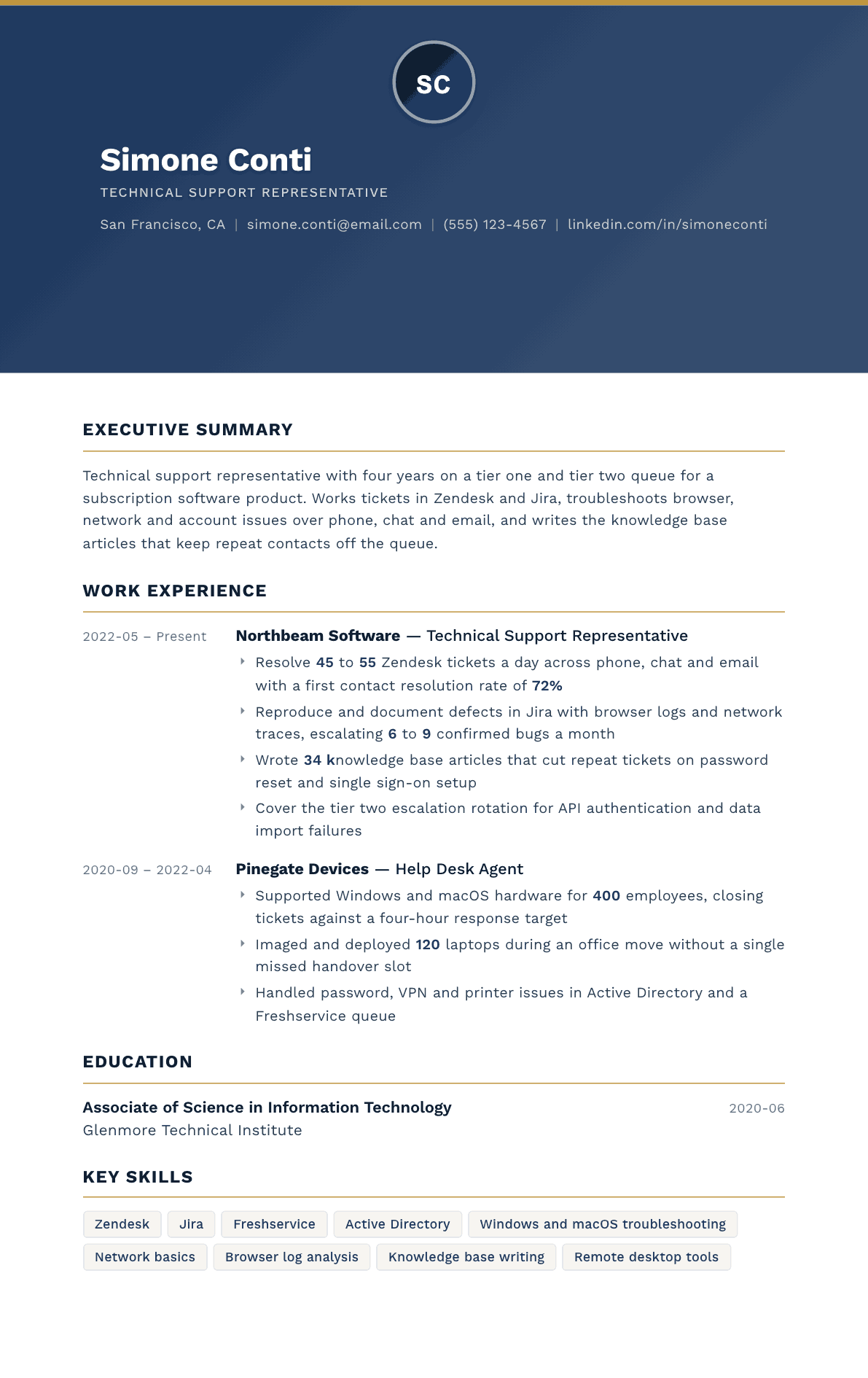
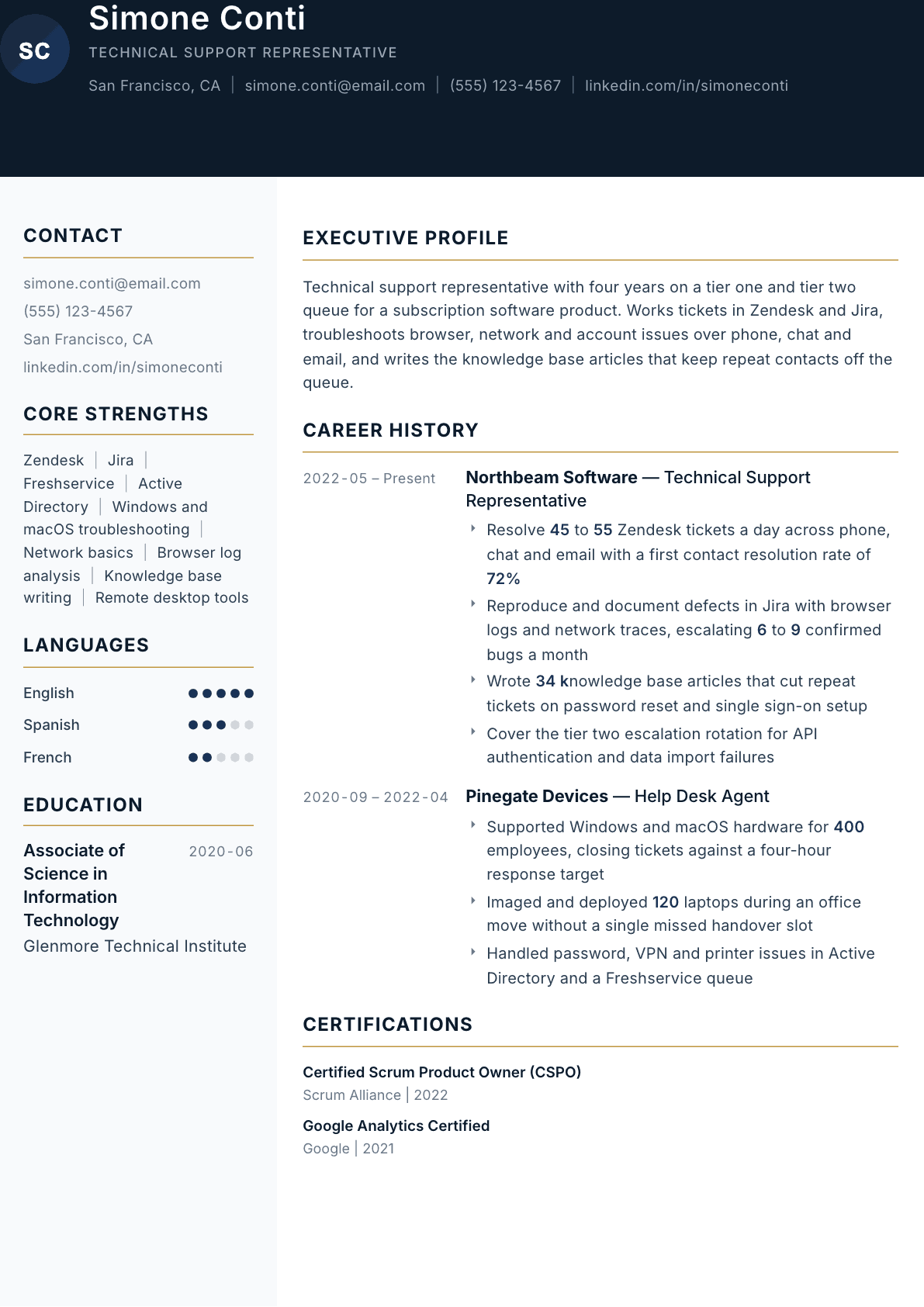
Example Technical Support Representative summary
Technical support representative with four years on tier one and tier two queues for a subscription software product, resolving 45 to 55 tickets a day in Zendesk at a 72% first contact resolution rate. Reproduces defects with browser and network logs, files clean Jira escalations, and has written more than 30 knowledge base articles that removed repeat contacts on login and import failures.
Skills to list on a Technical Support Representative resume
- Ticket triage
- Zendesk
- Jira
- Freshservice
- ServiceNow
- First contact resolution
- Windows troubleshooting
- macOS troubleshooting
- Active Directory
- VPN and network basics
- Browser developer tools
- API and log reading
- Knowledge base authoring
- Remote desktop support
- Escalation management
- Customer communication
What actually gets this resume read
- Give the ticket volume you carry per day alongside your first contact resolution rate, because both numbers set your tier on the queue.
- Name the ticketing platform and the escalation tracker separately, since Zendesk plus Jira reads very differently from a single inbox.
- Describe what you troubleshoot, not that you troubleshoot: browser consoles, VPN clients, API keys, DNS records or printer drivers.
- Show the writing side of the job by counting the knowledge base articles or macros you produced and what they removed from the queue.
- List the operating systems and platforms you support by version family, because a Windows-only shop screens differently to a mixed fleet.
- Include any certification you actually hold and leave the ones you are studying for in a clearly labeled in-progress line.
How to write a technical support representative resume
A technical support representative resume is screened by someone who runs a queue and knows exactly what it costs when a hire cannot troubleshoot independently. That reader is looking for two things in the first ten seconds: the ticketing platform you worked in, and the tier you carried. Everything else on the page either supports those or gets skimmed.
The second filter is evidence that you actually diagnose rather than route. Anyone can escalate. A support lead wants to see that you reproduced the problem, read the browser console or the server response, isolated the cause, and either fixed it or handed engineering a defect report they did not have to rewrite. The resumes that stall are the ones where every bullet ends at "escalated to the appropriate team".
This guide covers the sections in the order a support manager reads them, with example summaries for a first support role, a four-year representative and a tier two or team lead, before-and-after bullets from real ticket work, and the questions support agents ask when they sit down to write.
Format: one page, tools strip under the header
Reverse chronological, one page for under six years, single column. Support hiring moves fast and the screener is usually pattern matching against a tool stack, so a compact tools strip directly beneath your contact line does most of the screening work: ticketing platform, defect tracker, remote access tool, directory service, and the operating systems you support.
Skip graphics and skill rating bars. A five-dot rating tells a support lead nothing about whether you can read a HAR file, and it costs the space that a real diagnostic bullet needed.
- Header: name, city and state or "remote", phone, email, and time zone if you are applying across regions.
- Sections in this order: summary, tools and platforms, experience, certifications, education.
- Career changers from retail or hospitality lead with volume, resolution rate and any self-taught technical work.
Summary: product type, tier, volume, resolution rate
Three lines. Say what you supported, because a subscription software queue, a hardware fleet and a telecom line are three different jobs. Then the tier or tiers you carried, the ticketing platform, the daily ticket volume and the first contact resolution rate. Those numbers place you against the team the manager already runs.
If you are moving into support from a service desk, a lab role or self-taught study, name the move and lead with the closest evidence: home lab work, a certification in progress, a support-adjacent job where you handled password resets and device setup for colleagues.
Experience: what broke, what you did, what the queue looked like after
Head each job with the employer, the product or fleet you supported, the user population and the channels. A line such as "Tier one and tier two support, subscription analytics product, phone, chat and email, about 4,000 active accounts" gives the reader scale before the bullets begin.
Then three to five bullets. Lead with ticket volume and resolution rate, because those set your tier. Then a diagnostic bullet that names the actual technology: browser developer tools, network traces, authentication tokens, single sign-on configuration, data import validation, VPN clients, printer drivers or directory permissions. Then an escalation quality bullet, then a deflection bullet covering knowledge base articles, macros or automations that removed repeat contacts.
Do not write "troubleshoot issues". Write which issues. The verb is identical across every support resume in the stack, so only the object of the sentence carries information.
Metrics: the four numbers a support manager checks
Support is one of the most measured jobs in an organization, so a resume with no numbers reads as if you never saw a dashboard. Give tickets handled per day, first contact resolution rate, response and resolution performance against the target you were held to, and customer satisfaction scoring with the response base where you have it.
Then add the number almost nobody includes: what you removed from the queue. Knowledge base articles written, macros built, a workflow automated, or a recurring defect you pushed to a permanent fix. That is the difference between an agent who absorbs the queue and one who shrinks it, and it is the fastest route to a tier two or lead title.
- Tickets per day and the channel split across phone, chat and email.
- First contact resolution and the target the team worked to.
- Response and resolution performance against the service target.
- Satisfaction scoring, with the number of responses behind it.
- Deflection work: articles, macros, automations, permanent fixes.
Tools, platforms and certifications: exact names only
Name the ticketing platform and the defect tracker separately, because a queue that runs on a help desk tool plus an engineering tracker is a different operating environment from a shared inbox. Then the rest of the stack: remote support tools, directory and identity services, endpoint management, and the log or monitoring surface you were given access to.
For certifications, list only what you hold, with the issuing body, and keep anything in progress on a clearly labeled line with the exam date. A hardware and operating system credential plus a networking credential is the standard pairing that gets an entry resume read. A service management foundation credential helps for structured enterprise desks.
Technical Support Representative resume summary examples
First support role
Information technology graduate with a home lab, a hardware and operating systems certification, and eight months of campus help desk work resetting accounts, imaging laptops and clearing printer and network faults. Comfortable in a ticket queue, writing clean reproduction steps, and studying for a networking certification.
Four years in
Technical support representative with four years on tier one and tier two queues for a subscription software product, resolving 45 to 55 tickets a day at a 72% first contact resolution rate. Reproduces defects with browser and network logs, files clean engineering escalations, and has written more than 30 knowledge base articles that removed repeat login and import contacts.
Tier two or team lead
Senior support representative with seven years across hardware and software queues, owning the tier two escalation rotation for authentication, data import and integration failures. Mentors five agents, runs weekly ticket trend reviews with engineering, and rebuilt the macro library that cut average handling time on the top three contact drivers.
Work experience bullets: before and after
Before: Answered customer support tickets by phone and email.
After: Resolved 45 to 55 tickets a day across phone, chat and email in Zendesk, holding a 72% first contact resolution rate against a team target of 65%.
Volume, channel mix and resolution against a target place you on a queue the manager can already picture.
Before: Troubleshot technical issues for users.
After: Diagnosed single sign-on and application programming interface authentication failures using browser developer tools, request headers and server response codes, isolating cause before escalation.
Naming the failure class and the diagnostic surface proves real troubleshooting instead of a routing step.
Before: Escalated bugs to the engineering team.
After: Filed 6 to 9 confirmed defects a month in Jira with reproduction steps, environment details, network traces and screenshots, so engineering could reproduce without a follow-up request.
A monthly count and the contents of the report show escalation quality, which is what tier two hiring screens on.
Before: Wrote help articles for customers.
After: Wrote 34 knowledge base articles on password reset, single sign-on setup and data import errors, reducing repeat contacts on those three drivers over the following two quarters.
Article count tied to named contact drivers and a result shows queue deflection rather than documentation busywork.
Before: Supported Windows and Mac computers in the office.
After: Supported a mixed Windows and macOS fleet for 400 employees against a four-hour response target, imaging and deploying 120 laptops during an office move with no missed handover slot.
Fleet size, response target and a project outcome turn generic desktop support into a workload with edges.
Hard skills
- Ticket triage and queue management
- Zendesk
- Jira
- Freshservice
- ServiceNow
- Windows troubleshooting
- macOS troubleshooting
- Active Directory and identity management
- VPN and network fundamentals
- Browser developer tools and log reading
- Application programming interface basics
- Remote desktop support tools
- Knowledge base authoring
- Escalation and defect reporting
Soft skills
- Explaining a fix without jargon
- Patience with a frustrated caller
- Reproduction discipline
- Written clarity in ticket notes
- Ownership through to closure
- Knowing when to escalate
Certifications worth listing
- CompTIA A+ (CompTIA)
- CompTIA Network+ (CompTIA)
- ITIL 4 Foundation (PeopleCert)
- Google IT Support Professional Certificate (Google)
- HDI Support Center Analyst (HDI)
- Microsoft 365 Certified: Endpoint Administrator Associate (Microsoft)
Mistakes that cost technical support representative candidates the interview
- Writing "troubleshoot technical issues" with no object, so every bullet reads the same and none of them prove diagnostic ability.
- Leaving out ticket volume and first contact resolution, which are the two numbers that decide the tier you are offered.
- Naming a ticketing tool but never the defect tracker, which hides whether you have worked alongside engineering.
- Listing certifications you are studying for as though you already hold them, which unravels in the credential check.
- Ending every escalation bullet at the handoff, leaving no evidence that you found a cause before passing it on.
- Using skill rating bars instead of naming the operating systems, directory services and log surfaces you actually work in.
Technical Support Representative resume questions
How do I get a technical support job with no support experience?
Lead with proof of diagnosis rather than job titles: a hardware and operating systems certification, a home lab, devices you rebuilt, or informal support you gave colleagues. Then show you can handle volume by citing throughput from any high-contact job you have held.
Should I list every tool I have touched?
No. List the ones you could be dropped into tomorrow, and keep familiarity separate from fluency. A short honest stack beats a long list, because the interviewer will pick one item from it and ask you to walk through a real ticket you solved in it.
What is the difference between a tier one and a tier two resume?
Tier one is measured on volume, resolution rate and script adherence. Tier two is measured on the hard cases: reproduction, log analysis, integration and authentication failures, and defect quality. Write to the tier you are applying for and lead with the matching bullets.
Do knowledge base articles belong on a support resume?
Yes, and they are underused. Article and macro counts tied to the contact drivers they removed show you shrink the queue instead of just working it. That is the clearest evidence for a promotion to a senior or content-owning support role.
How long should a technical support resume be?
One page for under six years. Two pages is reasonable once you have lead responsibilities, multiple product lines and a real certification list. Never let a second page exist just to hold an objective statement and a row of software logos.
Related resume examples
- Technical Support Specialist Resume example
- Help Desk Analyst Resume example
- IT Support Specialist Resume example
- Help Desk Technician Resume example
- Customer Support Specialist Resume example
- Remote Customer Service Representative Resume example