Data Protection Officer Resume Examples: free ATS score
Write a Data Protection Officer Resume With Real Independence
By Mustafa Tarabya, founder of CVBooster · Published · Updated
Data protection officer resume example with GDPR, DPIA and data subject request keywords, plus a writing guide for the DPO role.
Sample resumes for a data protection officer
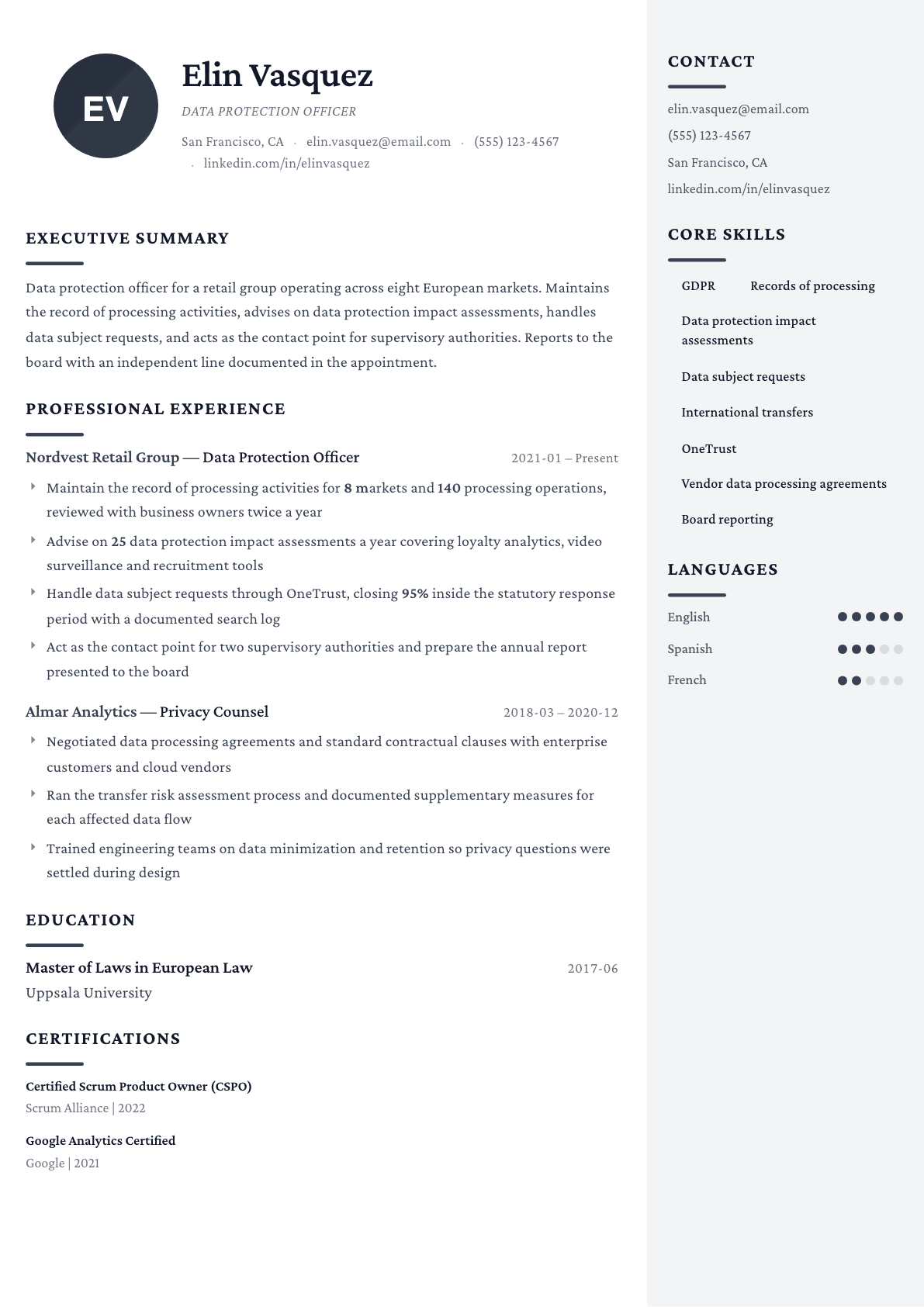
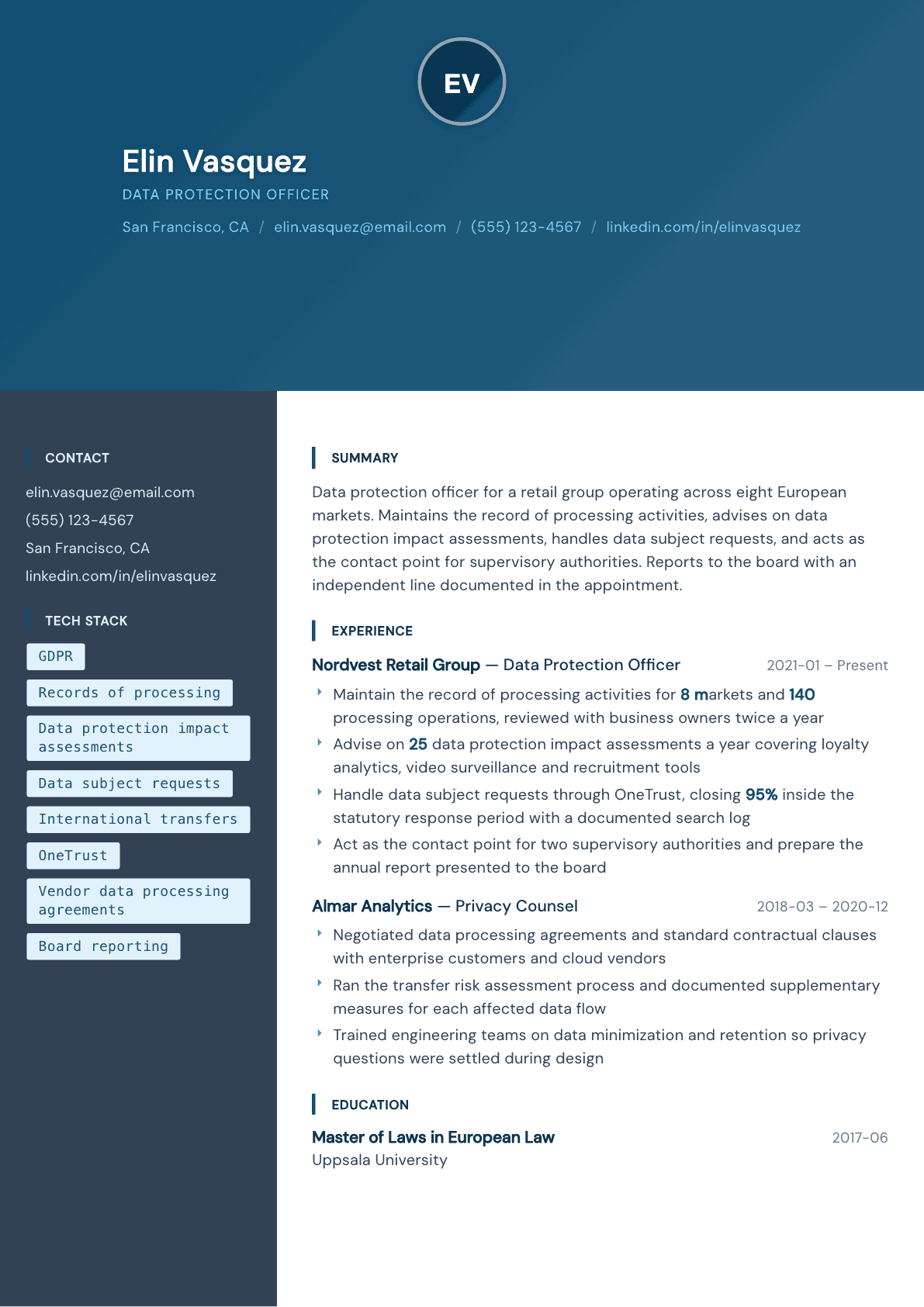
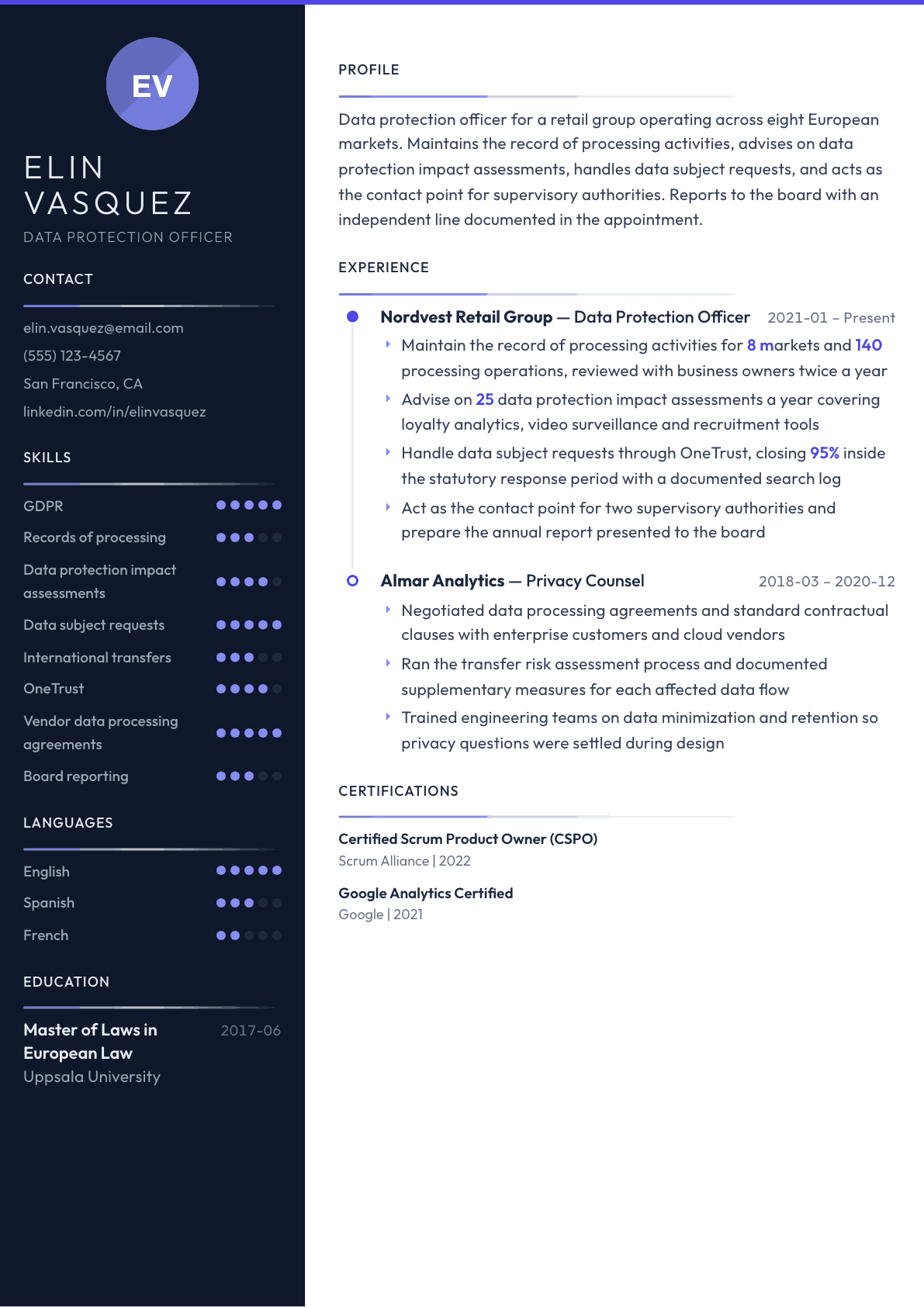
The same data protection officer content laid out in three CVBooster templates, so you can see what the finished document looks like before you write a word.
Example Data Protection Officer summary
Data protection officer covering a multi-market retail group, responsible for the record of processing, impact assessments, data subject requests and supervisory authority contact. Advises product and marketing teams before launch rather than after, keeps transfer documentation defensible, and reports independently to the board. Qualified in law with a privacy certification and hands-on platform experience.
Skills to list on a Data Protection Officer resume
- GDPR advisory
- Records of processing activities
- Data protection impact assessments
- Data subject request handling
- International data transfers
- Standard contractual clauses
- Data processing agreements
- Privacy by design
- Retention schedules
- Breach notification
- Supervisory authority liaison
- Privacy training
- Vendor assessments
- Privacy management platforms
What actually gets this resume read
- Say who you report to and how independence is documented, because that reporting line is a defining feature of the role.
- List the markets and entities you cover, since a group DPO and a single-entity DPO are different jobs on paper.
- Give the request and assessment volumes, as those two numbers describe your week better than any adjective.
- Name your privacy management platform and the record structure you maintain, because tooling experience shortens onboarding.
- Show supervisory authority contact, since handling a regulator directly is the experience most candidates cannot claim.
- Keep the engineering side visible, because a DPO who can talk to product teams gets invited before decisions are locked.
How to write a data protection officer resume
The data protection officer role is unusual because independence is part of the job description. A DPO advises, monitors and acts as the contact point for the supervisory authority, and cannot be instructed on how to reach a conclusion. A resume that reads like a compliance manager job with a different title misses the thing that defines the position.
The reader is often a general counsel, a chief compliance officer or a board secretary appointing a statutory role. She is checking three things: that you understand the obligations attached to the appointment, that you have operated the core machinery of a privacy program, and that you can survive contact with a regulator without escalating a routine question into an incident.
This guide covers the sections that matter for a data protection officer application, how to express scope across entities and markets, summaries for privacy specialist, appointed DPO and group DPO levels, bullets built from records, assessments and requests, and the questions candidates ask when they take on the role formally for the first time.
Format: the appointment and the scope come first
Say in the first two lines whether you have been formally appointed, for which entities, and to whom you report. An appointed DPO for a group of eight entities and a privacy manager who supports a DPO are different candidates, and conflating them wastes the reader time and yours.
Reverse chronological, single column, two pages once you have both advisory and program-building experience. Keep an explicit block for the privacy management platform, the record structure you maintain, and the assessment methodology you use, because those three details predict how fast you can take over an existing program.
- Header: name, privacy certifications, city and country, phone, email.
- Order: summary, experience with an entity and market scope line, program artifacts, systems, education, certifications.
- State any legal qualification separately from the DPO appointment, since the two are often confused.
Summary: entities, markets, reporting line, independence
Give the group shape: how many entities, which markets, and what kind of processing sits at the center of the business. A retail group with loyalty analytics, a health provider with clinical records and an employer with a large workforce all produce different daily work.
Then the reporting line and the independence arrangement. Reporting to the board, with the appointment documented and no instruction on outcomes, is a fact worth stating plainly. Candidates who leave it out force the interviewer to ask, and the answer often reveals a role that was compliance in a DPO costume.
Experience: the record, the assessments, the requests, the regulator
The record of processing activities is the backbone. Say how many processing operations it covers, how you keep it current, and who confirms each entry. A record that is reviewed with business owners on a schedule is a living control. A spreadsheet updated once is not, and experienced readers can tell the difference from a single sentence.
Data protection impact assessments come next. Give the annual number and, more importantly, the kinds of processing they covered and what changed as a result. An assessment that ends with a mitigation the business actually implemented is the strongest evidence a DPO resume can carry.
Then rights requests: volume, how you search, how you meet the response period and what your refusal reasoning looks like. Then transfers, vendor agreements and the assessment behind them. Then the supervisory authority contact, described factually, with no characterization of any outcome.
Advising product and engineering before decisions harden
The difference between a respected DPO and an ignored one is when the questions arrive. Show that you are consulted at design time: privacy requirements written into product specifications, retention decided before a data set is built, default settings agreed with engineering, and training that gives teams enough vocabulary to spot the issue themselves.
Give one example where early involvement removed a problem that would otherwise have surfaced at launch. That single case will do more than a paragraph asserting that you partner closely with the business.
Credentials, keywords and honest limits
List privacy certifications with their issuing body, and any information security qualification separately. If you hold a law degree, state it as a qualification rather than implying you provide legal advice in a jurisdiction where you are not admitted.
Postings for this role reuse a tight vocabulary: record of processing, impact assessment, data subject rights, international transfers, processor agreements, privacy by design, breach notification, retention schedule and supervisory authority. Match the wording once, then support it with a bullet that proves it.
Data Protection Officer resume summary examples
Privacy specialist, not yet appointed
Privacy specialist supporting an appointed data protection officer at a software company. Maintains the record of processing for 40 operations, prepares impact assessment drafts, and handles data subject requests within the statutory response period. Certified in privacy program management and comfortable working directly with engineering teams.
Appointed DPO, single entity
Appointed data protection officer for a payments company, reporting to the board with a documented independent line. Maintains the record of processing, advises on 15 impact assessments a year, negotiates processor agreements, handles rights requests and acts as the contact point for the national supervisory authority.
Group DPO
Group data protection officer covering 8 markets and 140 processing operations for a retail group. Runs a network of local privacy coordinators, advises on loyalty analytics and workforce monitoring, owns the transfer assessment framework, and presents an annual report to the board on program maturity and open risks.
Work experience bullets: before and after
Before: Maintained GDPR documentation for the company.
After: Maintained the record of processing activities across 8 markets and 140 processing operations, reviewed with each business owner twice a year and reconciled against the vendor inventory.
Scope, cadence and reconciliation show a living record instead of a document created once for an audit.
Before: Carried out data protection impact assessments.
After: Advised on 25 impact assessments a year covering loyalty analytics, video surveillance and recruitment tools, and secured retention and access changes on the assessments that raised the highest residual risk.
Naming the processing types and the mitigations adopted proves the assessments influenced real decisions.
Before: Handled data subject requests.
After: Handled rights requests through the privacy platform, closing the large majority inside the statutory period with a documented search log covering every system in scope.
The search log and the response discipline are what a reader needs to trust the process would hold up.
Before: Worked with vendors on data protection terms.
After: Negotiated processor agreements and standard contractual clauses with cloud vendors and enterprise customers, and ran transfer risk assessments documenting the supplementary measures for each affected data flow.
The specific instruments and the assessment step show command of the hardest part of vendor privacy work.
Before: Trained staff on data protection.
After: Trained engineering and marketing teams on data minimization and retention so privacy questions were settled during design reviews rather than raised in the week before launch.
Tying training to when questions arrive demonstrates the shift in behavior the training was meant to produce.
Hard skills
- Data protection advisory
- Records of processing activities
- Data protection impact assessments
- Data subject rights handling
- International transfer assessments
- Standard contractual clauses
- Processor and controller agreements
- Privacy by design reviews
- Retention and deletion schedules
- Personal data breach notification
- Supervisory authority liaison
- Privacy management platforms
- Vendor and processor assessments
- Privacy training and awareness
Soft skills
- Independent judgment
- Regulator-facing communication
- Explaining obligations to engineers
- Negotiating with commercial teams
- Documentation discipline
- Working across languages and markets
Certifications worth listing
- Certified Information Privacy Professional, Europe (CIPP/E) (International Association of Privacy Professionals)
- Certified Information Privacy Manager (CIPM) (International Association of Privacy Professionals)
- Certified Information Privacy Technologist (CIPT) (International Association of Privacy Professionals)
Mistakes that cost data protection officer candidates the interview
- Leaving out whether you were formally appointed, which is the first question an appointing organization has.
- Saying nothing about the reporting line or independence, the features that define this statutory role.
- Treating the record of processing as paperwork rather than showing the review cycle that keeps it true.
- Listing impact assessments as a count with no mention of what changed in the processing afterward.
- Characterizing the outcome of a supervisory authority interaction, which is confidential and reads as indiscreet.
- Implying legal authority in a jurisdiction where you are not admitted, which unsettles the counsel reading the page.
- Ignoring the engineering relationship, which is where a data protection officer either gains influence or loses it.
Data Protection Officer resume questions
Does a data protection officer need to be a lawyer?
No. The requirement is expert knowledge of data protection law and practice, proportionate to the processing involved. Many effective officers come from information security, audit or compliance. A legal qualification helps with interpretation questions but does not substitute for program experience.
How do I show independence on my resume?
State the reporting line, say that the appointment is documented, and describe a moment where your advice went against a commercial preference and was recorded anyway. That combination communicates independence better than the word itself ever does.
Can I serve as an external data protection officer and show that on a resume?
Yes. Present it as a portfolio: how many client organizations, their sectors and sizes, and what each engagement covered. Say how you handle conflicts between clients and how availability is guaranteed, because appointing bodies ask about both.
What if my experience is with a privacy program rather than a formal appointment?
Say so plainly and lead with the machinery you have run: records, assessments, rights requests, vendor terms and training. Most appointing organizations care more about whether you can operate the program than about the label on your previous business card.
How much technical depth should a data protection officer show?
Enough to hold a conversation with engineers about data flows, storage, logging and deletion. You do not need to configure systems, but a candidate who cannot follow a data flow diagram will struggle to challenge a design, and interviewers test for exactly that.