Privacy Officer Resume Examples: the lines they read
Create a Privacy Officer Resume That Shows Program Ownership
By Mustafa Tarabya, founder of CVBooster · Published · Updated
Privacy officer resume example with breach response, training and program keywords, plus a writing guide for healthcare and corporate privacy roles.
Sample resumes for a privacy officer
The same privacy officer content laid out in three CVBooster templates, so you can see what the finished document looks like before you write a word.
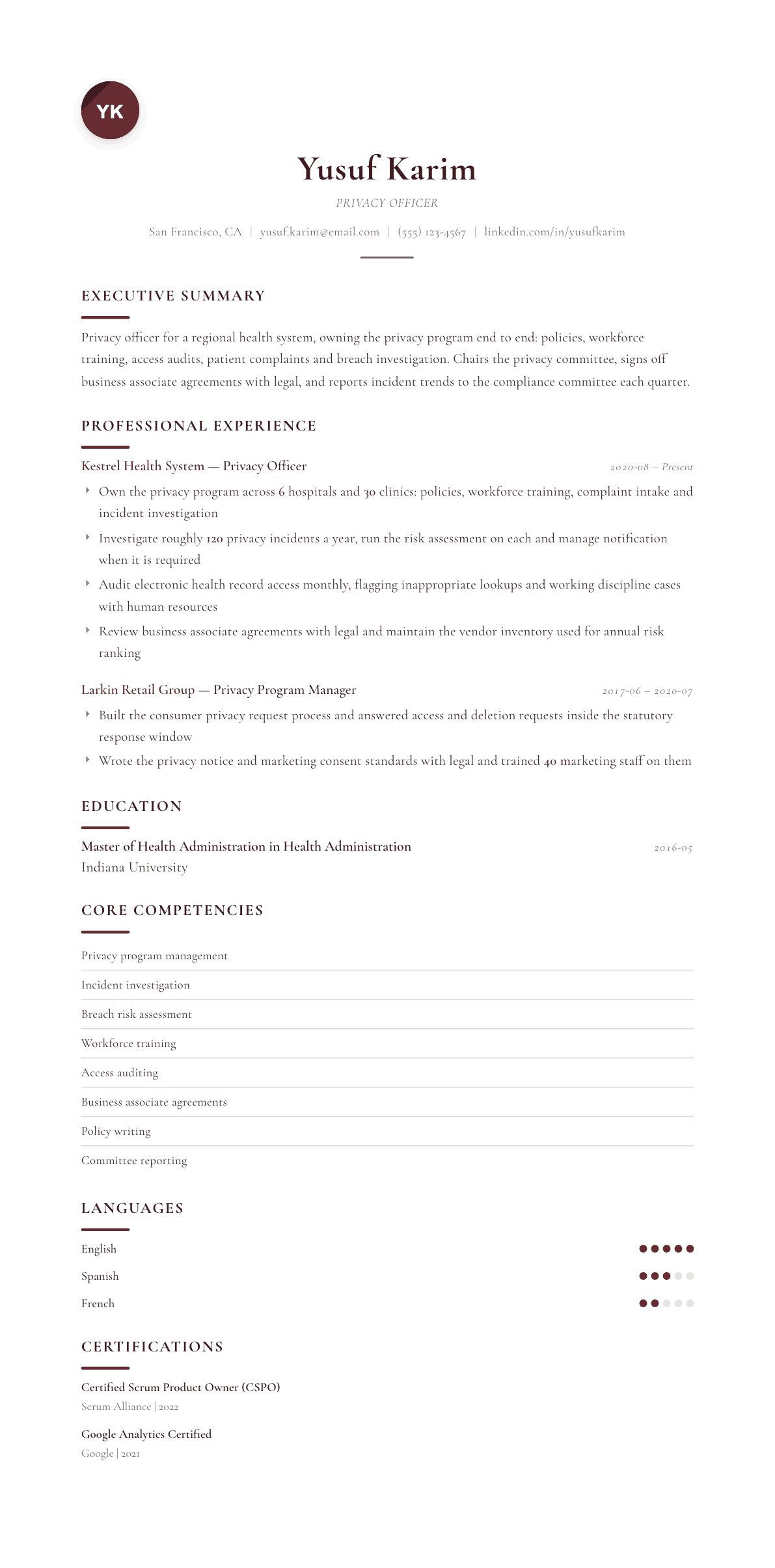
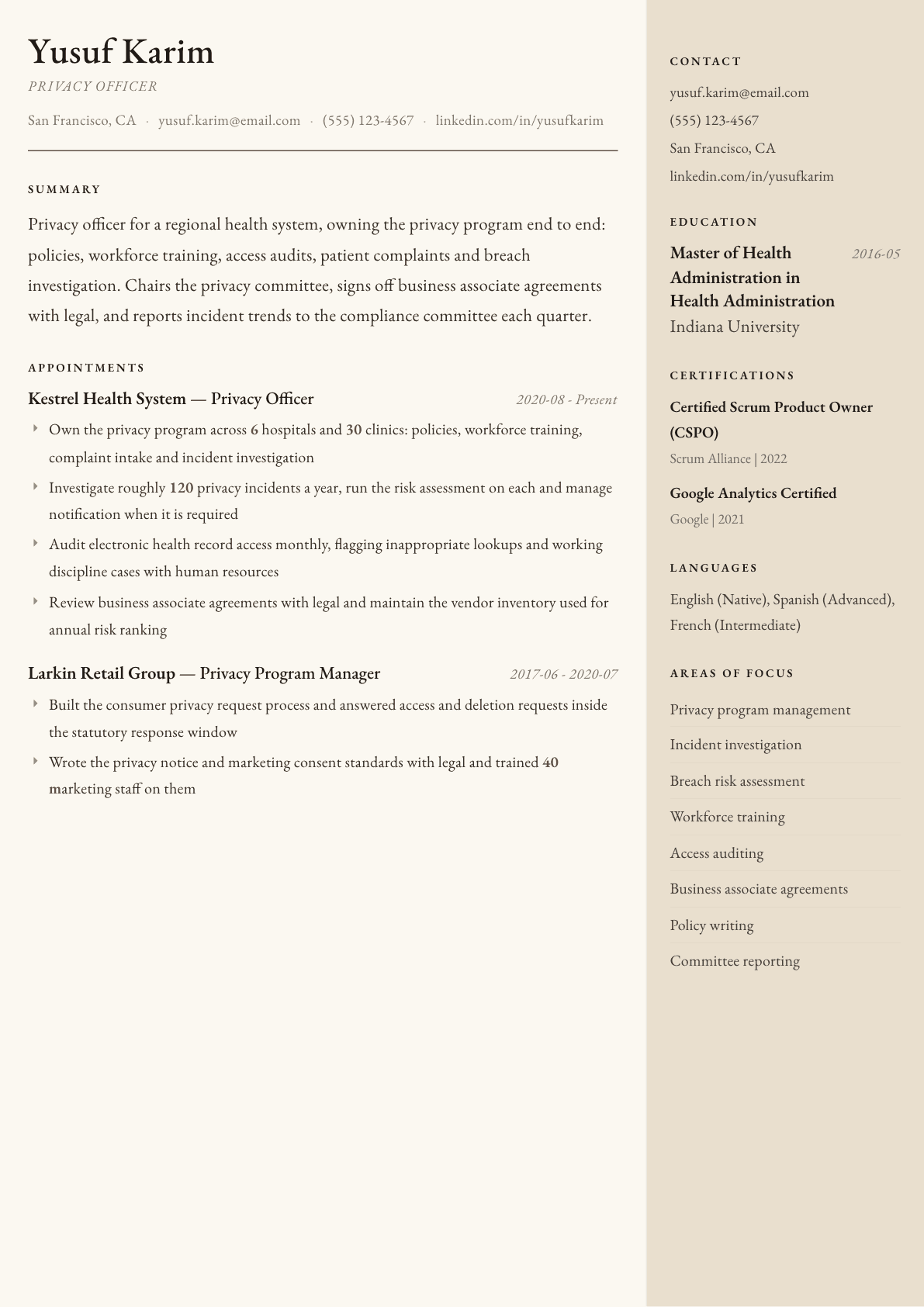
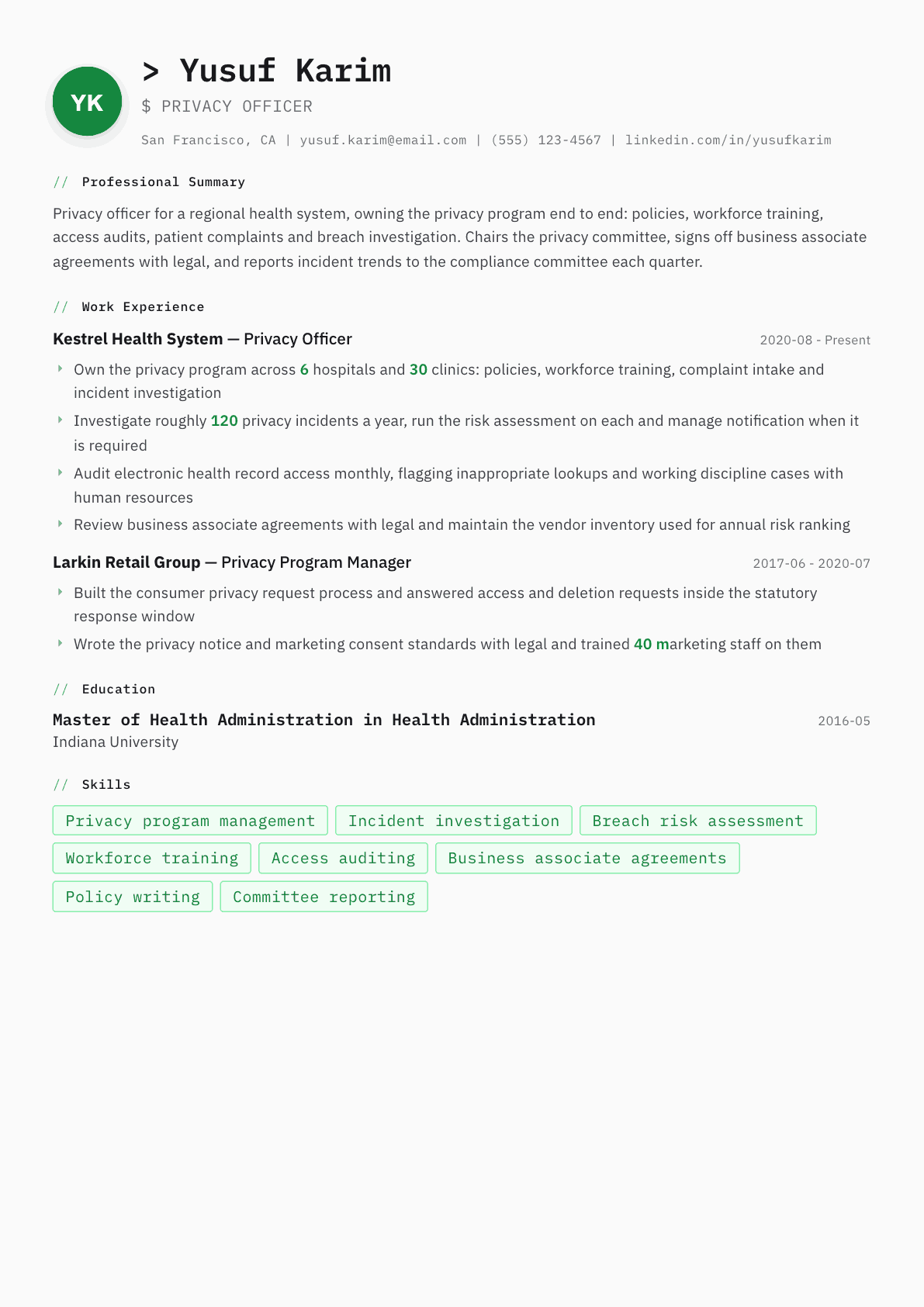
Example Privacy Officer summary
Privacy officer with eight years running privacy programs in healthcare and retail, covering policy, training, access auditing, complaints and breach investigation. Investigates incidents, documents the risk assessment behind every notification decision, and reports trends to the compliance committee. Holds a recognized privacy credential and works closely with legal and security leadership.
Skills to list on a Privacy Officer resume
- Privacy program management
- HIPAA privacy rule
- Incident investigation
- Breach risk assessment
- Notification management
- Workforce privacy training
- Access audits
- Business associate agreements
- Policy and procedure development
- Consumer rights requests
- Vendor risk review
- Privacy impact assessments
- Committee and board reporting
- Complaint handling
What actually gets this resume read
- State the scope you cover: sites, staff headcount and records, because a privacy officer is hired against the size of the footprint.
- Separate incident work from program work, since the first shows judgment under pressure and the second shows structure.
- Give the incident volume and what happened after, as investigation without documented resolution reads as unfinished.
- List the privacy credential you hold with its issuing body, because these are the credentials the posting names directly.
- Show committee and board reporting, since a privacy officer who cannot brief leadership will stall in the role.
- Include training reach and completion, because workforce education is the control regulators inspect first.
How to write a privacy officer resume
A privacy officer is hired to own a program, not to hold an opinion about privacy. So the person reading your resume, usually a chief compliance officer or a general counsel, is checking whether you have run the whole cycle: written the policies, trained the workforce, audited access, investigated incidents, decided on notification and reported the result to a committee that asked hard questions.
The gap on most privacy resumes is the investigation half. Plenty of candidates can describe a policy refresh. Far fewer can describe the morning a nurse looked up a neighbor record, or the day a mailing went to the wrong list, and what happened in the eight hours after that. Judgment under those conditions is what the role is really about, and it belongs on the page.
This guide covers how to structure a privacy officer resume, how to size your program scope so the reader can compare it to hers, summaries at three levels, bullet rewrites drawn from real incident and audit work, and the questions people ask when moving between healthcare privacy and consumer privacy.
Format: scope in the header, credential right behind it
Under your name, give the credential you hold and the sector you work in. Then in the summary, size the program: number of sites, workforce headcount, record volume or customer base. Privacy officer roles are scoped by footprint, and a reader cannot place you without one of those numbers.
Reverse chronological order. Keep a separate section for the privacy program elements you have owned, because postings are frequently written as a list of program components and a matching list is the easiest thing for a screener to check.
- Header: name, privacy credential, city and state, phone, email.
- Order: summary, experience, program elements owned, systems, education, certifications.
- Keep committee and board reporting visible near the top of the most recent role.
Summary: program ownership, incident load, reporting line
Three facts. What you own, meaning the program components under your name rather than the ones you contribute to. How many incidents you handle in a year, since that number describes your operational reality better than any adjective. Who you report to, because a privacy officer sitting under compliance and one sitting under the chief information officer face different pressures.
Name the regulatory environment plainly: health information privacy, consumer privacy law, education records, financial privacy. Do not stack every acronym you have heard of. A short accurate list beats a long list you cannot defend.
Experience: incidents, audits, agreements, training
Incident work first. Describe intake, investigation, the risk assessment behind the notification decision, the notification itself where required, and the corrective action. Say who else was in the room: legal, security, human resources, communications. A privacy officer who works alone on a serious incident is a warning sign, and showing the coordination proves you know it.
Then proactive controls. Access auditing of clinical or customer systems, with the cadence and what you do with a hit. Vendor agreements and the inventory behind them. Privacy impact assessments on new systems and marketing programs. Retention and disposal schedules that someone actually follows.
Then workforce training, with reach and completion. Training is the control that fails quietly, so a bullet showing you drove a full population to completion carries weight with anyone who has tried it.
Working with security, legal and the business
Privacy sits between three functions that all want to own the decision. Show that you can hold your own: reviewing a vendor with security, agreeing a notification position with legal, and telling a business owner that a planned use of data does not work as designed. Describe one case where you changed a business plan rather than only documented one.
Committee work is the other half of that credibility. Name the forum you present to, what you report and how often. Trend reporting on incident categories is far more persuasive than a statement that you keep leadership informed.
Keywords and what to avoid claiming
Postings repeat privacy program management, breach investigation, risk assessment, notification, workforce training, access audit, business associate agreement, privacy impact assessment, complaint handling and vendor risk. Use the exact wording once in the skills block and once in a bullet.
Avoid presenting yourself as a legal authority if you are not admitted to practice. Privacy officers advise on program requirements and escalate legal interpretation, and blurring that boundary makes a general counsel uneasy.
Privacy Officer resume summary examples
Privacy analyst stepping up
Privacy analyst with two years in a hospital compliance office, handling patient complaints, running monthly access audits and drafting incident summaries for the privacy officer. Maintains the business associate inventory and delivers new hire privacy training. Working toward a healthcare privacy certification.
Single-site privacy officer
Privacy officer for a 300-bed hospital and its outpatient clinics, owning policy, training, access auditing and incident investigation. Handles roughly 60 privacy incidents a year, documents the risk assessment behind every notification decision, and reports trends to the compliance committee each quarter.
System privacy officer
System privacy officer covering 6 hospitals and 30 clinics with a team of three. Owns the privacy program end to end, chairs the privacy committee, reviews business associate agreements with legal, and presents incident trends and remediation status to the board compliance committee twice a year.
Work experience bullets: before and after
Before: Investigated privacy incidents and breaches.
After: Investigated roughly 120 privacy incidents a year, completed a documented risk assessment on each, and managed notification with legal and communications on the small number that required it.
The volume and the assessment step show a defensible process rather than a description of the job title.
Before: Conducted audits of system access.
After: Audited electronic health record access monthly against high-risk triggers, referred confirmed inappropriate lookups to human resources, and used the pattern to retarget the next training cycle.
The trigger method and the loop back into training prove the audit changed behavior rather than filling a file.
Before: Managed business associate agreements.
After: Reviewed business associate agreements with legal and maintained a vendor inventory of 220 entries used to rank annual risk reviews and to scope incident notification obligations.
The inventory and its two downstream uses turn contract administration into program infrastructure.
Before: Provided privacy training to employees.
After: Delivered privacy training to a workforce of 4,000 across onboarding and annual refresh, and built a short targeted module for the departments generating the most incidents.
Reach plus targeting shows a training program driven by evidence instead of a compliance calendar.
Before: Advised the business on privacy questions.
After: Reviewed a planned patient outreach campaign, identified the consent gap in the source data set, and worked with marketing to redesign it around a compliant audience before launch.
A single concrete case shows the judgment that a general statement about advising cannot demonstrate.
Hard skills
- Privacy program management
- Health information privacy requirements
- Incident intake and investigation
- Breach risk assessment
- Notification management
- Access and audit log review
- Privacy impact assessments
- Business associate agreements
- Vendor privacy risk reviews
- Policy and procedure development
- Workforce privacy training
- Complaint handling
- Retention and disposal schedules
- Committee and board reporting
Soft skills
- Investigative questioning
- Discretion with sensitive facts
- Holding a position with senior stakeholders
- Clear written findings
- Calm during an incident
- Partnering with security and legal
Certifications worth listing
- Certified in Healthcare Privacy Compliance (CHPC) (Compliance Certification Board)
- Certified Information Privacy Professional, United States (CIPP/US) (International Association of Privacy Professionals)
- Certified Information Privacy Manager (CIPM) (International Association of Privacy Professionals)
- Certified in Healthcare Compliance (CHC) (Compliance Certification Board)
Mistakes that cost privacy officer candidates the interview
- Listing program components without the scope, so the reader cannot tell a single clinic from a health system.
- Describing policy work in detail and incident work in one line, when incidents are what the role is judged on.
- Omitting the risk assessment step, which is the part of a notification decision that has to be documented.
- Writing about training without reach or completion, which makes the strongest visible control look weak.
- Presenting yourself as giving legal advice when you are not admitted to practice.
- Leaving committee reporting off the page, which caps you at analyst level in the reader mind.
Privacy Officer resume questions
Do I need a law degree to be a privacy officer?
No. Many privacy officers come from compliance, health information management, nursing or information security. A privacy certification and demonstrated program ownership matter more. Where legal interpretation is needed, the expectation is that you work with counsel rather than substitute for one.
How do I move from healthcare privacy to corporate privacy?
Lead with the parts that transfer whole: incident investigation, risk assessment, training, vendor review and committee reporting. Then show you have studied the consumer privacy landscape through a certification, and reframe patient rights work as individual rights request handling.
Should I put incident numbers on a privacy resume?
Yes, at the annual level. Volume tells a hiring manager what pace you are used to and it never identifies a matter. Avoid describing any single incident in a way that could be recognized, and never characterize a regulator interaction you were part of.
What if my organization has no formal privacy program yet?
That is a strong story if you tell it as building. Describe what existed when you arrived, the components you stood up in order, and what evidence now exists that did not before. Builders are valued highly by companies at the same stage.
How do privacy and security roles differ on a resume?
Security resumes center on controls, systems and threats. Privacy resumes center on data use, individual rights, notification decisions and workforce behavior. If you have done both, keep them in separate bullet groups so a reader hiring for one is not distracted by the other.