Supply Chain Director Resume Examples: read this first
Write a Supply Chain Director Resume Executives Take Seriously
By Mustafa Tarabya, founder of CVBooster · Published · Updated
Supply chain director resume examples, network and cost metrics worth listing, ATS keywords, and a full writing guide for senior operations leaders.
Sample resumes for a supply chain director
The same supply chain director content laid out in three CVBooster templates, so you can see what the finished document looks like before you write a word.
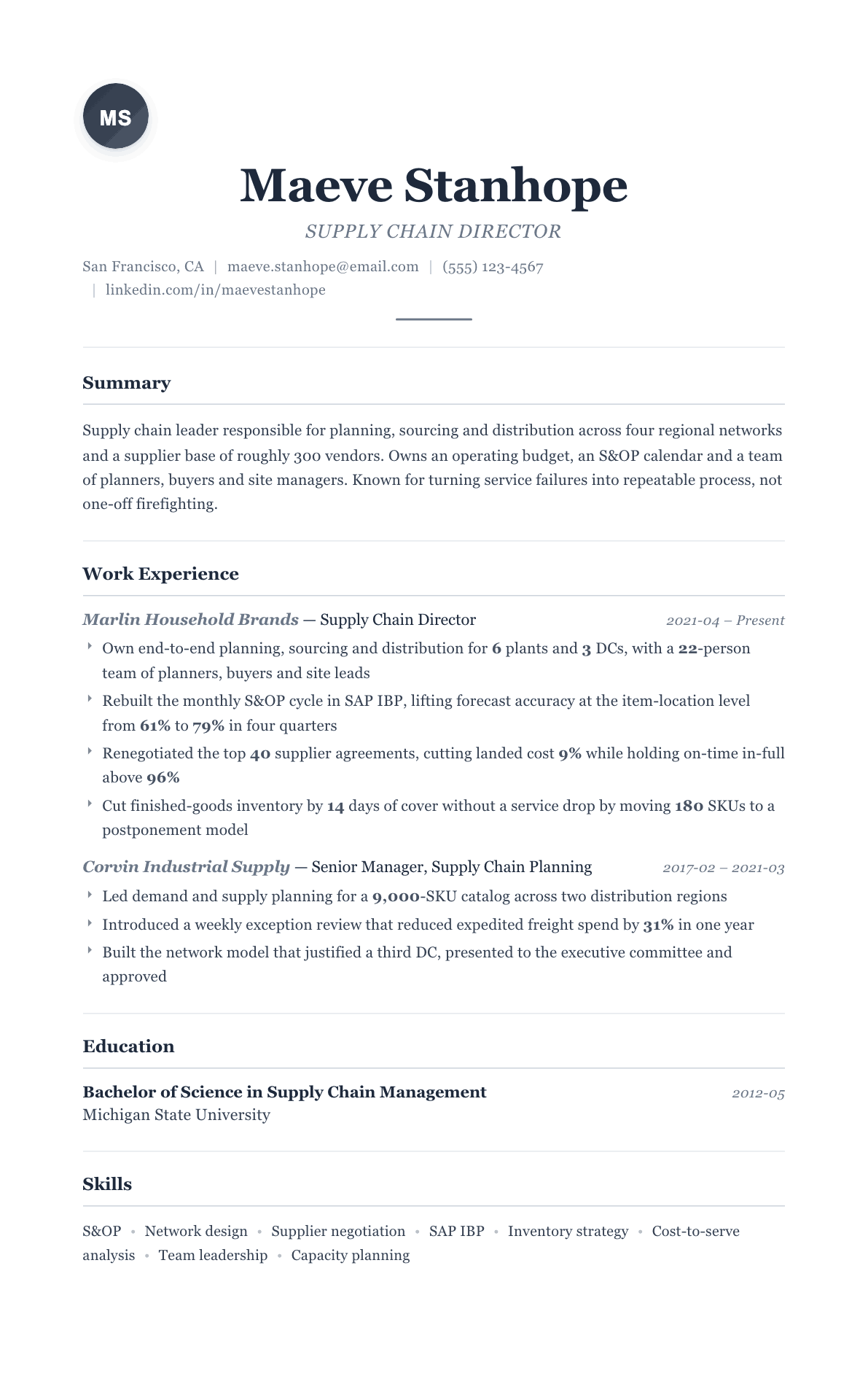
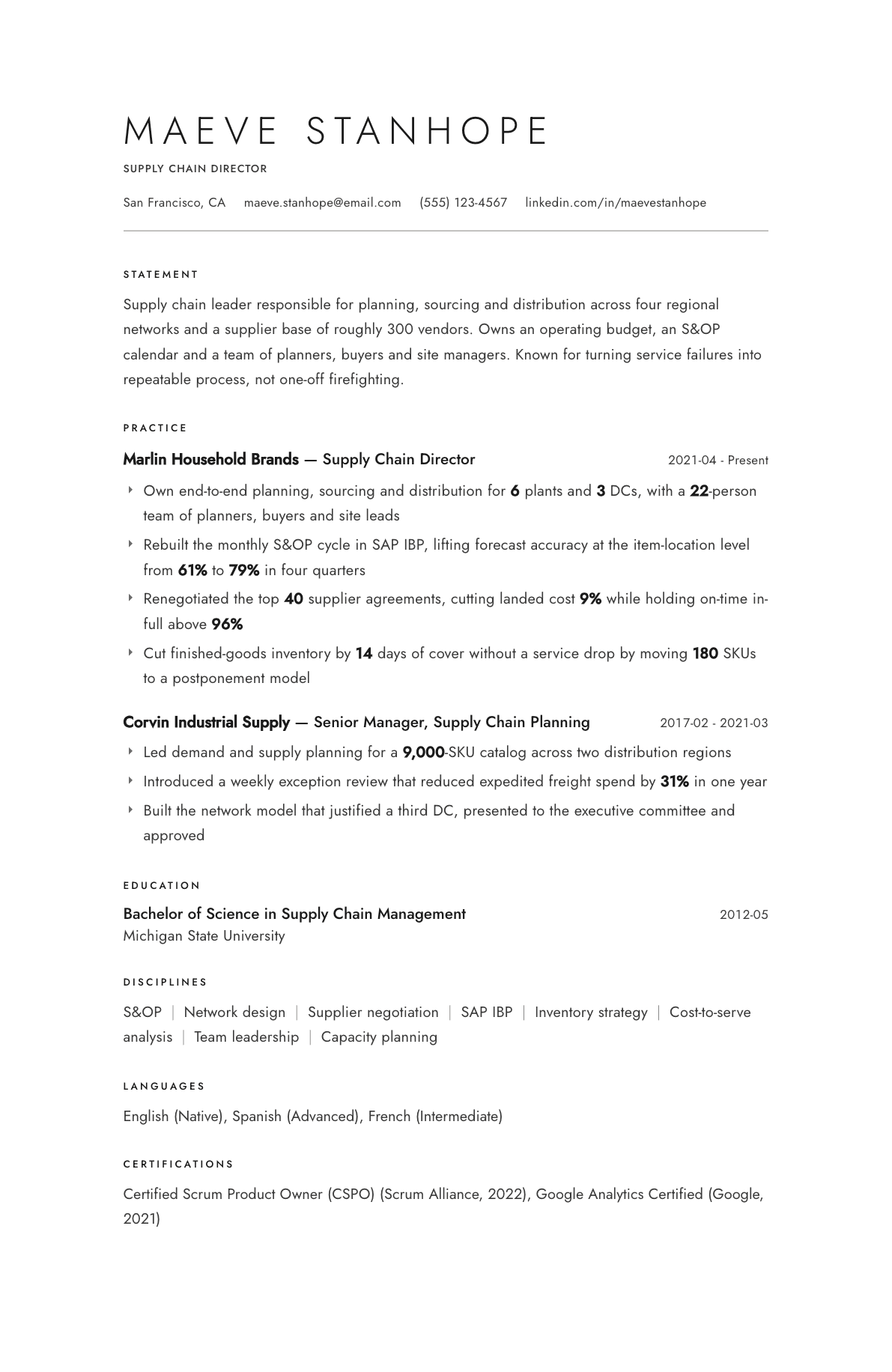
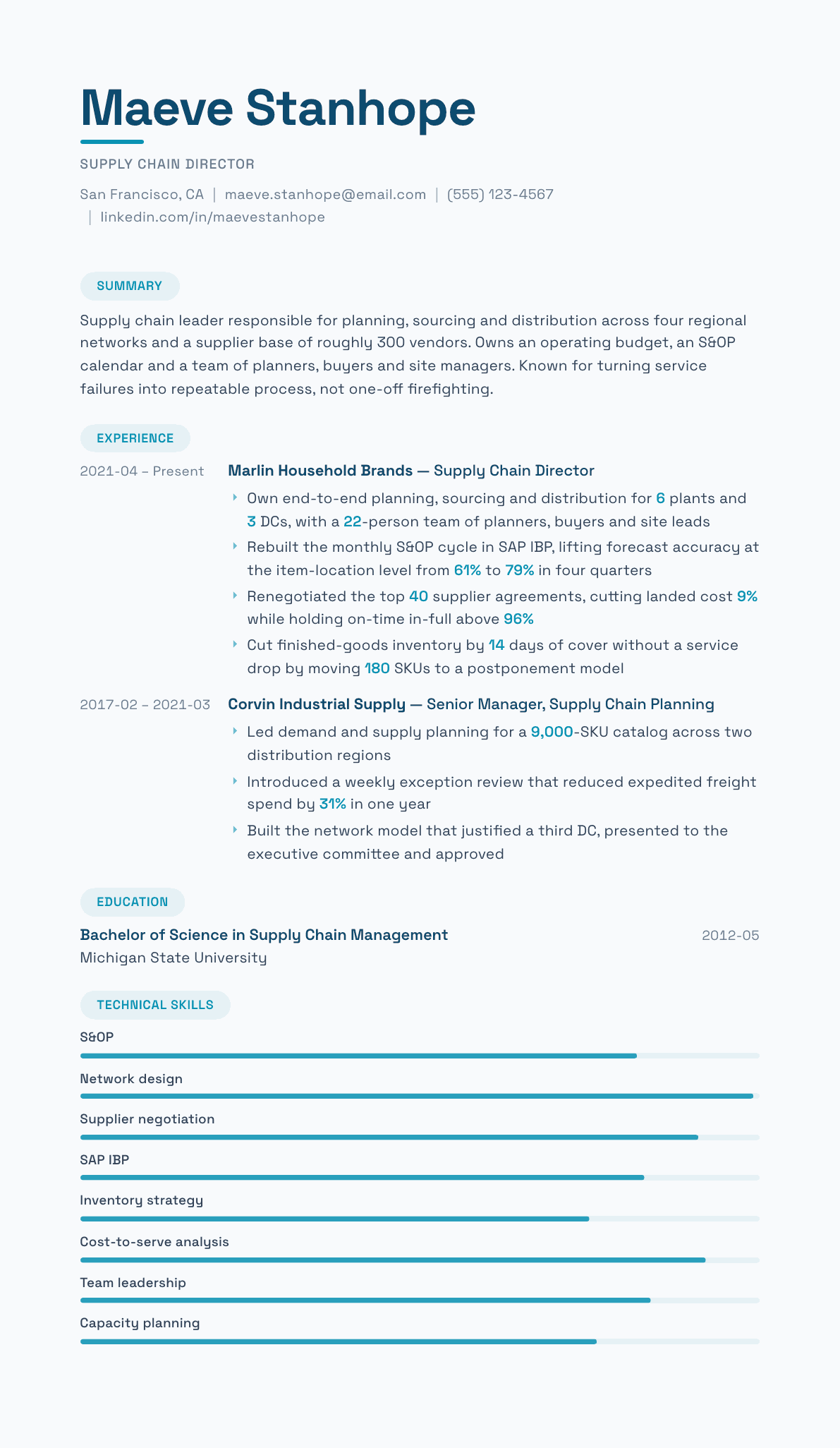
Example Supply Chain Director summary
Supply chain director with responsibility for planning, procurement and distribution across six manufacturing sites and three distribution centers. Rebuilt an S&OP cycle that raised forecast accuracy at item level, renegotiated a top-40 supplier portfolio for a 9% landed-cost reduction, and released two weeks of inventory cover without touching service. Looking for a network-wide leadership role in consumer manufacturing.
Skills to list on a Supply Chain Director resume
- Sales and operations planning
- Network design
- Strategic sourcing
- Supplier relationship management
- Inventory optimization
- Demand planning
- Capacity planning
- Cost to serve
- SAP IBP
- Kinaxis RapidResponse
- Contract negotiation
- Distribution strategy
- Budget ownership
- Risk and continuity planning
- Continuous improvement
- Executive reporting
What actually gets this resume read
- Open with scope: sites, SKUs, spend under management, headcount and the regions your network covers.
- Give every job an operating metric a CFO recognizes, such as on-time in-full, days of inventory or cost to serve.
- Name the planning system you ran, because SAP IBP, Kinaxis and Oracle Planning are searched as literal terms.
- Show the S&OP or IBP cadence you owned and who sat in the room, since that proves executive-level influence.
- Separate what you led from what your team executed so the reader can size your actual span of control.
- Put network redesigns, plant transitions and supplier consolidations near the top; they are the projects boards fund.
- Keep the resume to two pages and move older plant or planner roles into a short earlier-career block.
How to write a supply chain director resume
A supply chain director resume is screened by people who already know the job. The talent partner checks scope first: how many sites, how much spend, how many people, which functions actually reported to you. The chief operating officer or general manager who interviews you is reading for something narrower, which is whether you have carried a service commitment and a cost target at the same time and can say what you traded away to hold both.
That is why generic leadership language sinks these resumes. Phrases about driving excellence and building high performing teams are on every file in the stack. What separates the shortlist is a candidate who names the planning horizon they owned, the service measure their board saw, and the specific structural change they made to the network rather than the meetings they attended.
This guide covers the section order a director-level file should follow, how to state scope so a reader can size it in one line, three summary examples from a first-time director to a multi-region leader, before-and-after bullets, and the questions supply chain leaders ask when they sit down to rewrite.
Format: two pages, scope line first in every role
Reverse chronological, two pages, and no columns. Start each job with a one-line scope statement in plain text before the bullets: functions owned, sites, headcount, supplier count and the geography. A reader who has to hunt for scope across four bullets will simply move to the next resume.
Roles older than about a decade belong in a compact earlier-career block with title, employer and dates only. The planner job you held before your first management seat proves the foundation but does not need bullets competing with your current scope.
- Header: name, city and state, phone, email, and a one-line positioning statement such as end-to-end supply chain leader, consumer manufacturing.
- Section order: summary, core scope or leadership highlights, professional experience, education, certifications.
- Keep a short selected projects block only if network redesigns or system implementations do not fit inside the job bullets.
Summary: functions owned, network size, and the outcome you are known for
Four lines at most. Name the functions under you, whether that is planning, sourcing, logistics, customer service or all four, then the physical network, then one outcome that a finance leader would recognize. A director summary that never states which functions reported to you forces the reader to guess your seniority, and the guess is usually low.
If you are stepping up from a senior manager title, say so directly and anchor it in scope rather than in ambition. Naming a multi-site remit and a budget you already carried is more persuasive than a sentence about being ready for the next level.
Experience: run the network, not the meeting calendar
Under the scope line, write four to six bullets per recent role. The strongest ones describe a structural decision and its effect: a network node added or closed, a planning process rebuilt, a supplier portfolio consolidated, an inventory policy changed by segment. Each of those is a decision only someone at your level could make, which is exactly what the reader is testing for.
Pair a service measure with a cost measure inside the same job. On-time in-full next to landed cost, or days of inventory next to case fill, shows you managed a trade-off rather than optimizing one number while quietly damaging another. Directors who present only savings invite a question about what broke.
Include the people dimension once per role: the structure you built, the leaders you developed, the roles you added or removed. Distribution and planning teams are hard to staff, and a director who can retain planners is worth interviewing on that basis alone.
- Lead each recent role with the largest structural change you made, not with routine responsibilities.
- Attach the forum where a result was reported, such as the executive S&OP or the quarterly business review.
- Name the system landscape once per role so keyword matching finds it without repetition.
Systems, certifications and education
List the planning and execution systems by product name in a compact block: the advanced planning tool, the ERP, the warehouse and transportation systems, and the reporting layer. Recruiters filter on these strings, and a director who cannot name the tools reads as removed from the work.
Certifications carry real weight at this level in operations. The APICS credentials issued through the Association for Supply Chain Management are the recognized standard, and a Lean Six Sigma belt is common in manufacturing environments. Put a graduate degree above certifications if you hold one, otherwise keep education to a single line.
Keywords the screen is built from
Director postings recycle a narrow vocabulary: end-to-end supply chain, sales and operations planning, network design, strategic sourcing, inventory optimization, cost to serve, supplier performance, capacity planning and business continuity. Mirror each once in the summary or the systems block, then prove it inside a bullet. Repeating a phrase six times does not raise the match score in any modern parser and it reads badly to the human who opens the file next.
Supply Chain Director resume summary examples
First director seat
Supply chain leader stepping into a director remit after five years as a senior planning manager, with responsibility for demand and supply planning across two plants and a shared distribution center. Rebuilt the S&OP calendar, improved item-level forecast accuracy by 14 points, and cut expedited freight spend by a third.
Single business unit
Supply chain director owning planning, procurement and distribution for a consumer manufacturer with six plants, three distribution centers and roughly 300 suppliers. Holds on-time in-full above 96% while releasing two weeks of inventory cover, and leads a 22-person team of planners, buyers and site managers through a monthly executive planning cycle.
Multi-region leader
End-to-end supply chain director across North America and Europe, accountable for four regional networks, twelve sites and an operating budget covering planning, logistics and customer service. Delivered a network redesign that removed 9% of landed cost, and built the leadership bench that now runs three of the four regions.
Work experience bullets: before and after
Before: Responsible for supply chain operations across multiple sites.
After: Owned planning, sourcing and distribution for 6 plants and 3 distribution centers, a 22-person salaried team and a supplier base of roughly 300 vendors.
Functions, sites, headcount and supplier count let a reader size the role instantly instead of guessing at the word multiple.
Before: Improved the forecasting process for the business.
After: Rebuilt the monthly S&OP cycle in SAP IBP with a published assumption log, lifting item-location forecast accuracy from 61% to 79% over four quarters.
The system, the mechanism and a measured movement turn a process claim into evidence a peer can interrogate.
Before: Reduced costs through supplier negotiations.
After: Renegotiated the top 40 supplier agreements around indexed pricing and volume tiers, cutting landed cost 9% while on-time in-full stayed above 96%.
Holding service constant alongside the saving answers the question every operations interviewer asks next.
Before: Managed inventory levels to support the business.
After: Segmented 180 slow-moving SKUs into a postponement model and reset safety stock by demand variability, releasing 14 days of cover with no change in case fill.
The policy change is named, so the result reads as a deliberate design decision rather than a lucky quarter.
Before: Built and led a strong supply chain team.
After: Restructured planning into demand, supply and materials pods, promoted three planners into manager roles, and held voluntary turnover in the function under 8%.
A named structure, internal promotions and a retention figure make leadership visible instead of asserted.
Hard skills
- Sales and operations planning
- Integrated business planning
- Network design and modeling
- Strategic sourcing
- Inventory segmentation and policy
- Cost to serve analysis
- Capacity and constraint planning
- Supplier performance management
- SAP IBP and S/4HANA
- Kinaxis RapidResponse
- Distribution and transportation strategy
- Business continuity planning
Soft skills
- Executive communication
- Cross-functional influence
- Talent development
- Negotiation
- Decision making under incomplete data
- Change leadership
Certifications worth listing
- Certified Supply Chain Professional (CSCP) (Association for Supply Chain Management)
- Certified in Planning and Inventory Management (CPIM) (Association for Supply Chain Management)
- Certified in Logistics, Transportation and Distribution (CLTD) (Association for Supply Chain Management)
- SCPro Certification (Council of Supply Chain Management Professionals)
- Project Management Professional (PMP) (Project Management Institute)
Mistakes that cost supply chain director candidates the interview
- Writing responsibilities instead of decisions, so the file reads like a job description rather than a record of what changed under you.
- Omitting scope, which leaves a reader unable to tell a single-site remit from a four-region one and defaulting to the smaller assumption.
- Quoting savings with no service measure beside them, which invites the suspicion that inventory or fill rate paid for the number.
- Filling the summary with leadership adjectives that would fit a marketing director just as well as an operations one.
- Hiding the system landscape, so an automated screen never matches the planning tool named in the posting.
- Running to three pages by keeping full bullets on roles from early in the career instead of compressing them into one block.
- Claiming a transformation without naming the structural change, the sequence or who else had to agree to it.
Supply Chain Director resume questions
How long should a supply chain director resume be?
Two pages. Senior operations leaders have more material than fits on one, but three pages signals an inability to prioritize. Compress anything older than roughly ten years into a single earlier-career block with titles, employers and dates only.
Should I include a budget figure on the resume?
Describe the budget in structure rather than absolute currency: the cost lines you owned, whether it covered labor, freight and third-party logistics, and how many cost centers rolled up to you. That communicates scope without inviting comparison against a different industry.
Do certifications still matter at director level?
They matter less than results but still filter files in manufacturing and distribution. A CSCP or CPIM from the Association for Supply Chain Management signals depth in planning fundamentals, and a Lean Six Sigma belt fits plant-heavy environments. List them under education rather than at the top.
How do I show S&OP ownership without sounding generic?
Name the cadence, the horizon and the attendees. Saying you chaired a monthly executive planning review covering an eighteen-month horizon with the commercial, finance and manufacturing leads tells a reader far more than the phrase led the S&OP process ever will.
What if my experience is in one industry and I am targeting another?
Translate the constraint rather than the product. A pharmaceutical planner moving to food should lead with regulated environments, shelf life management and batch traceability, since those transfer directly, and then name the categories where the demand pattern differs so the reader sees you know the gap.
Related resume examples
- Supply Chain Manager Resume example
- Logistics Manager Resume example
- Demand Planner Resume example
- Distribution Manager Resume example
- Supply Chain Specialist Resume example
- Warehouse Manager Resume example