Supply Chain Specialist Resume Examples: free ATS score
A Supply Chain Specialist Resume That Shows Network Impact
By Mustafa Tarabya, founder of CVBooster · Published · Updated
A supply chain specialist resume covering planning systems, supplier programs and cost savings, with a sample resume and a section by section guide.
Sample resumes for a supply chain specialist
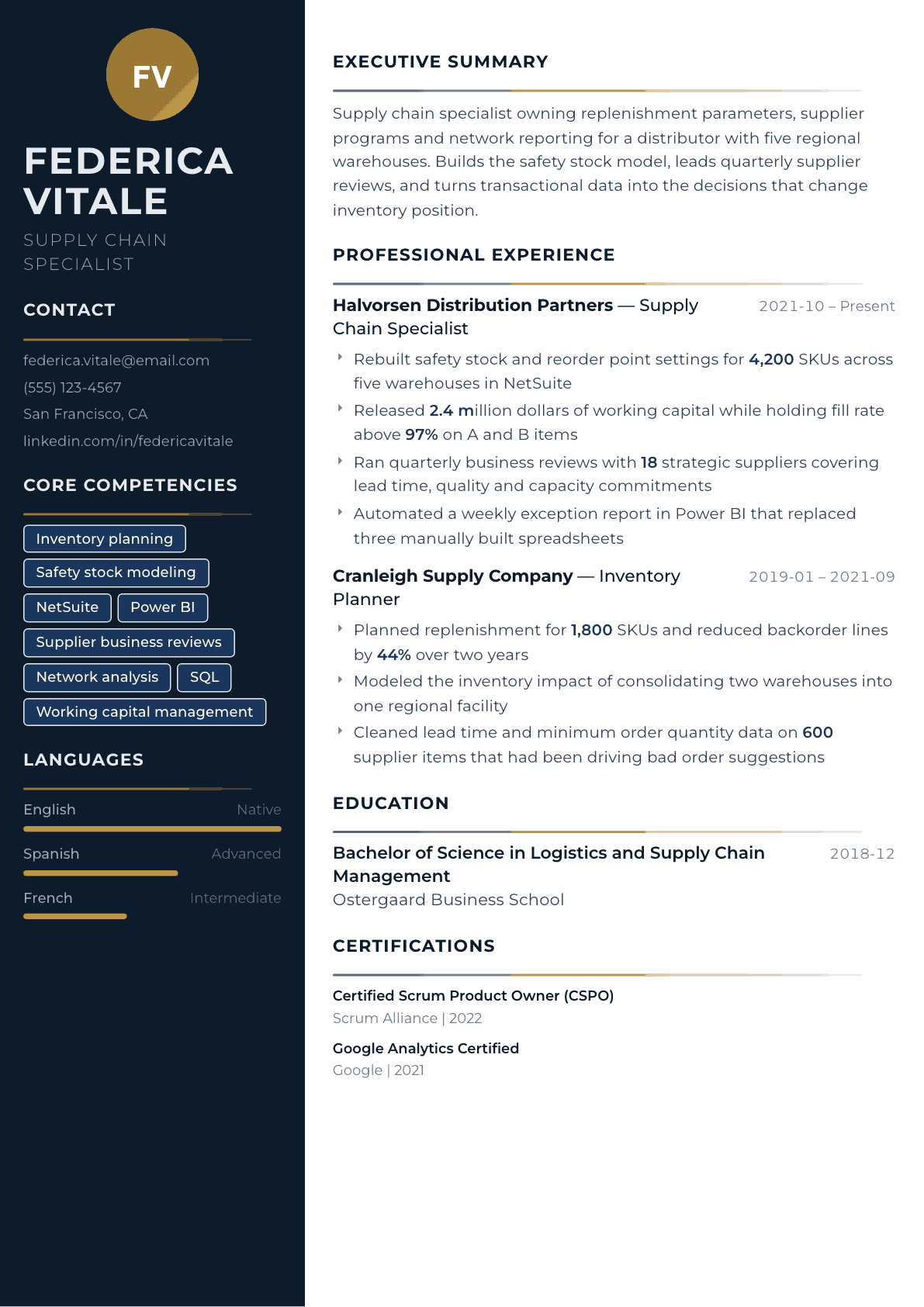
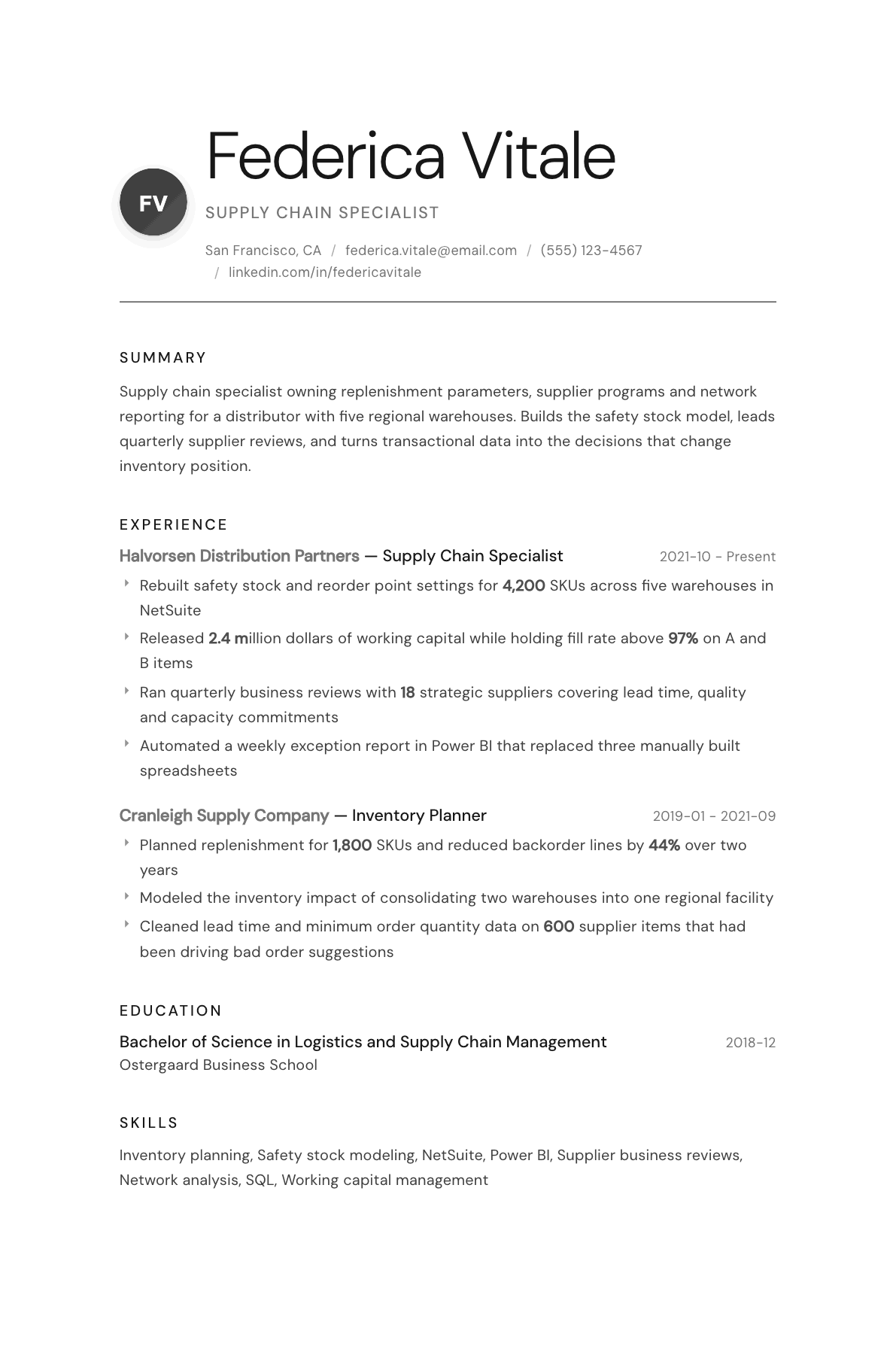
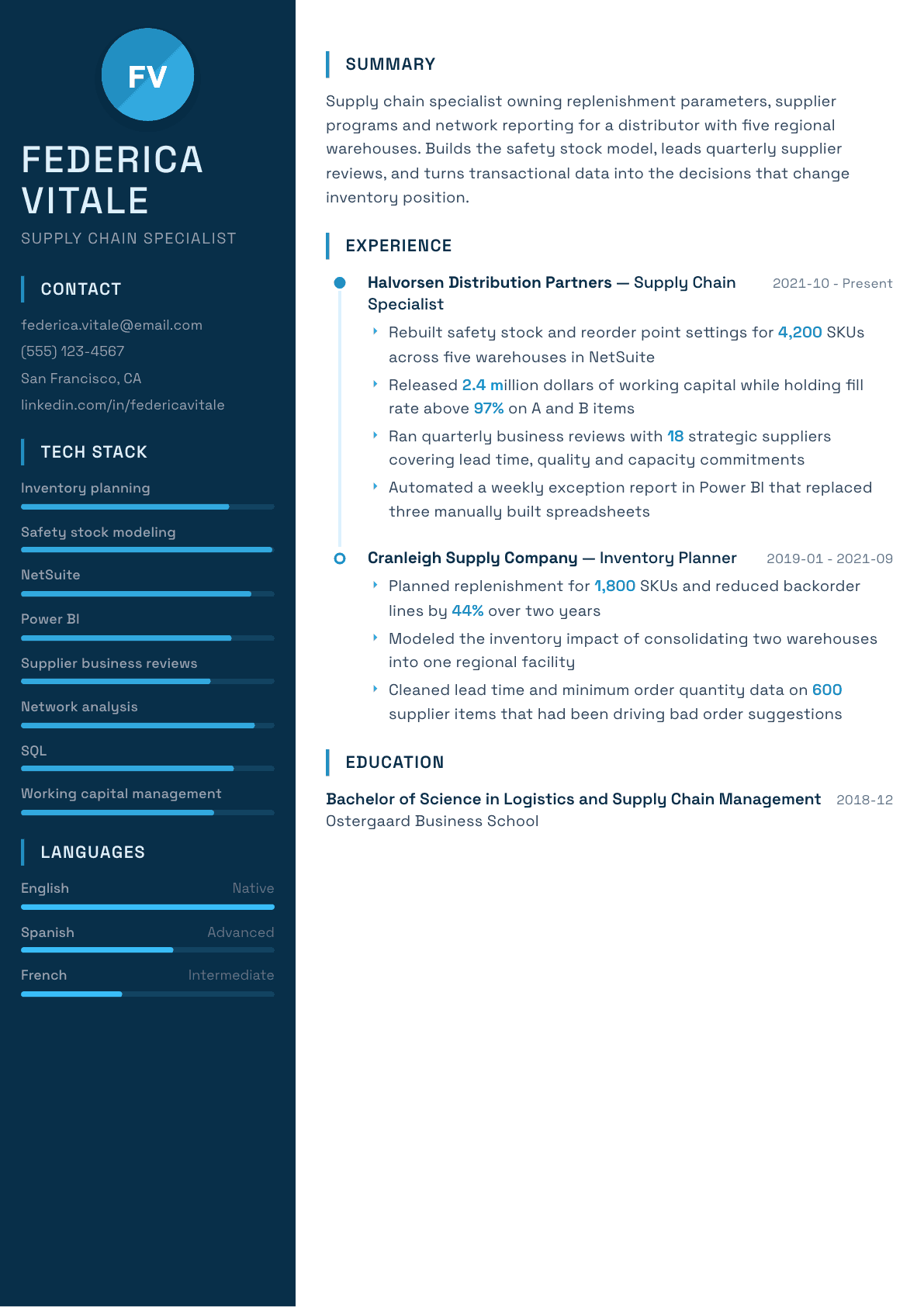
The same supply chain specialist content laid out in three CVBooster templates, so you can see what the finished document looks like before you write a word.
Example Supply Chain Specialist summary
Supply chain specialist with six years owning replenishment parameters, supplier programs and network reporting for multi-warehouse distributors. Builds safety stock models, leads quarterly supplier reviews, and automates reporting in Power BI and SQL. Released significant working capital by resetting reorder points for 4,200 SKUs while holding fill rate above 97%. Seeking a planning role with sourcing responsibility.
Skills to list on a Supply Chain Specialist resume
- Inventory optimization
- Safety stock and reorder points
- Demand planning
- Supplier relationship management
- ERP planning systems
- NetSuite
- SAP
- Power BI
- SQL
- Excel modeling
- Network and scenario analysis
- Cost savings tracking
- S&OP support
- Working capital analysis
What actually gets this resume read
- Separate what you analyzed from what you decided, because a specialist role is judged on the decisions you owned.
- Anchor each achievement to a supply chain metric such as fill rate, days of supply, backorder lines or turns.
- Name your planning system and your reporting stack, since employers screen for both the ERP and the analytics tool.
- Describe supplier work in terms of the program you ran, not the meetings you attended, and give supplier counts.
- Add scenario or network work if you have it, such as a warehouse consolidation or a sourcing change model.
- Keep the certification section honest and current, listing only credentials you actually hold with the issuing body.
How to write a supply chain specialist resume
A supply chain specialist resume has to prove that you change the numbers rather than report them. The hiring manager is looking for parameter ownership, supplier program work, scenario analysis and a reporting stack, because a specialist sits between the people who transact and the people who set strategy, and the value is in the decisions made at that seam.
The most common weakness is a page of analysis with no consequence. Building models, pulling reports and supporting the team says nothing about what changed as a result. Inventory came down, fill rate held, a supplier committed to a shorter lead time, a warehouse consolidation was modeled and then approved. Those are the sentences that earn interviews.
What follows is the section order a supply chain manager reads, summaries for an inventory planner, a working specialist and a senior one, five rewritten bullets that convert analysis into outcome, and the questions specialists ask when they are aiming at planning or sourcing leadership.
Format: one page early, two once you own programs
Reverse chronological. One page until you own several programs across multiple sites, then two. Each job opens with the network you supported: number of warehouses or plants, active item count, supplier count, and the channels served. Scale first, method second, result third, in every job.
Keep a compact systems line high on the page listing your planning system and your analysis tools together. Employers screen for both, and a specialist who can query the data as well as run the planning engine is a scarcer hire than either alone.
- Summary: network size, item count, what you own, and one financial or service outcome.
- Experience with network profile first, then the decisions you owned.
- A systems line pairing the ERP or planning tool with the analytics stack.
- Certifications with the issuing association, since planning credentials carry weight here.
Summary: parameters, programs, and a result with two sides
Say what you own. Replenishment parameters, supplier programs, network reporting, or a category. Ownership language is what distinguishes this title from an analyst title, so avoid supported and assisted in the opening line unless it is genuinely accurate.
Then give a result with two sides to it, because that is how supply chain performance is judged. Inventory reduced while fill rate held, lead time shortened without a cost increase, or backorder lines cut while working capital stayed flat. A single sided number invites the question of what it cost elsewhere.
Experience: parameters, suppliers, scenarios, reporting
Parameter work is the core. Safety stock methodology, reorder points, order quantities, service level targets by item class, and how often you review them. Say how many items you set parameters for and what happened to inventory and service afterward. This is the highest leverage thing a specialist does and it is regularly left off the page.
Supplier programs come next. Quarterly business reviews, lead time and capacity commitments, quality and delivery corrective actions, dual sourcing work, and contract compliance follow up. Give the number of suppliers in your program and what the reviews actually changed, since attending a review is not the same as running one.
Then scenario work and reporting. Warehouse consolidation models, sourcing change analysis, transportation mode tradeoffs and demand scenario testing. Finish with the reporting you automated: what it replaced, who reads it, and what decision it drives. Automating a report that removed manual spreadsheet assembly is a real result and belongs in a bullet.
Analytics, sales and operations planning, and the finance link
Name your analysis stack precisely: the query language, the dashboard tool, the modeling you do in spreadsheets, and any statistical forecasting you have run. Specialists who can build their own data pull are trusted with bigger questions than those waiting on a reporting team.
Then show the connection to money and to the planning cycle. Working capital impact, cost savings tracked to a finance-agreed baseline, obsolescence exposure, and your role in the sales and operations planning cycle. A specialist who can speak to both service and capital is being read as a future planning manager.
- Planning system and module, plus the analytics tools you use directly.
- Your role in the planning cycle, including which meetings you prepare.
- Financial measures you affected and how they were validated.
- Scenario or network analysis you ran, with the decision it informed.
Keywords that surface a specialist resume
Employers search for inventory optimization, safety stock, reorder point, service level, fill rate, days of supply, inventory turns, demand planning, supplier relationship management, sales and operations planning, network analysis, working capital and the planning system name. Use the ones you own inside results, not in a list.
Watch the title language on postings. The same work is advertised as supply chain specialist, inventory analyst, planning specialist and materials specialist, so mirror the posting title in your summary to clear both the parser and the recruiter skim.
Supply Chain Specialist resume summary examples
Inventory planner
Inventory planner responsible for replenishment on 1,800 items at a regional distribution center. Reduced backorder lines by 44% over two years, cleaned lead time and order quantity data on 600 supplier items, and modeled the inventory effect of merging two warehouses into one facility.
Four years as a specialist
Supply chain specialist owning replenishment parameters and supplier programs for a distributor with five regional warehouses. Rebuilt safety stock and reorder points on 4,200 items in NetSuite, released working capital while holding fill rate above 97%, and automated weekly exception reporting in Power BI.
Senior specialist
Senior supply chain specialist leading inventory strategy across nine sites and three channels. Sets service level policy by item class, runs quarterly reviews with strategic suppliers, prepares the demand and supply review for the monthly planning cycle, and models sourcing and network changes for leadership.
Work experience bullets: before and after
Before: Managed inventory levels across the warehouse network.
After: Rebuilt safety stock and reorder point settings for 4,200 items across five warehouses in NetSuite, segmenting service level targets by item class.
Item count, network size and the segmentation method turn a vague responsibility into a defined project.
Before: Reduced inventory for the company.
After: Released 2.4 million dollars of working capital through parameter resets while holding fill rate above 97% on A and B items.
Pairing the capital release with a service constraint proves the reduction did not simply move the problem.
Before: Attended supplier meetings each quarter.
After: Ran quarterly business reviews with 18 strategic suppliers covering lead time, capacity and quality commitments, and tracked corrective actions to closure between reviews.
Running the review and closing the actions is a different job from sitting in the meeting.
Before: Built reports for the supply chain team.
After: Automated a weekly exception report in Power BI that replaced three manually assembled spreadsheets and became the input to the Monday supply review.
Naming what was replaced and where the output lands shows the reporting changed how the team works.
Before: Analyzed a proposed warehouse change.
After: Modeled the inventory, service and freight effect of consolidating two warehouses into one regional facility, and presented the tradeoffs that shaped the final decision.
Stating the dimensions modeled and the decision it informed proves analysis with consequence.
Hard skills
- Inventory optimization
- Safety stock and reorder point modeling
- Service level segmentation
- Demand planning support
- Sales and operations planning input
- Supplier program management
- NetSuite planning
- SAP planning modules
- Power BI dashboards
- SQL data extraction
- Advanced Excel modeling
- Network and scenario analysis
Soft skills
- Turning analysis into a recommendation
- Presenting tradeoffs to leadership
- Supplier relationship building
- Structured problem framing
- Working across finance and operations
- Skeptical review of data quality
Certifications worth listing
- Certified in Planning and Inventory Management (CPIM) (Association for Supply Chain Management)
- Supply Chain Operations Reference Professional (SCOR-P) (Association for Supply Chain Management)
- Certified Professional in Supply Management (CPSM) (Institute for Supply Management)
- Certified Six Sigma Green Belt (CSSGB) (American Society for Quality)
Mistakes that cost supply chain specialist candidates the interview
- Describing analysis with no decision or outcome attached to any of it.
- Giving an inventory reduction without the service measure that protects it from looking reckless.
- Using supported and assisted throughout, which reads as an analyst applying for a specialist seat.
- Leaving out parameter ownership, which is the most valuable work this role performs.
- Listing tools without saying what you built in them or who used the output.
- Omitting supplier program work, so the page looks purely internal and desk bound.
- Filling the resume with acronyms a recruiter outside the field cannot parse on a first read.
Supply Chain Specialist resume questions
How is a supply chain specialist different from an analyst?
An analyst produces the analysis, a specialist owns a piece of the system: parameters, a supplier program, a category or a planning process. If you have owned any of those, lead with the ownership rather than with the reporting you also do.
What inventory results are safe to claim on a resume?
Claim what you can trace to a change you made and defend in an interview. Parameter resets, order policy changes, obsolete stock disposition and supplier lead time reductions all have a clear line to inventory, so pair each with the service measure alongside it.
Do I need SQL for a supply chain specialist role?
It is not universally required, but it separates candidates quickly. Being able to pull your own data means you can answer a question the same day instead of queuing a request, and hiring managers notice that in the interview as well as on the page.
Should I list the sales and operations planning cycle on my resume?
Yes, if you contributed to it. Say which review you prepared, what you brought to it, and what decisions came out. Planning cycle experience is one of the clearest signals that you work at a network level rather than an order level.
How do I present cost savings credibly?
Say how the saving was calculated and who agreed the baseline, usually finance or the category owner. A savings figure with a validation source behind it survives scrutiny, while a large unexplained number makes an experienced reader discount the whole page.
Related resume examples
- Supply Chain Analyst Resume example
- Procurement Specialist Resume example
- Supply Planner Resume example
- Logistics Specialist Resume example
- Procurement Analyst Resume example
- Supply Chain Director Resume example