Dental Office Manager Resume Examples: read this first
Build a Dental Office Manager Resume Owners Trust
By Mustafa Tarabya, founder of CVBooster · Published · Updated
Dental office manager resume examples with production, collections and scheduling keywords, plus a guide to writing the business side of a practice.
Sample resumes for a dental office manager
The same dental office manager content laid out in three CVBooster templates, so you can see what the finished document looks like before you write a word.
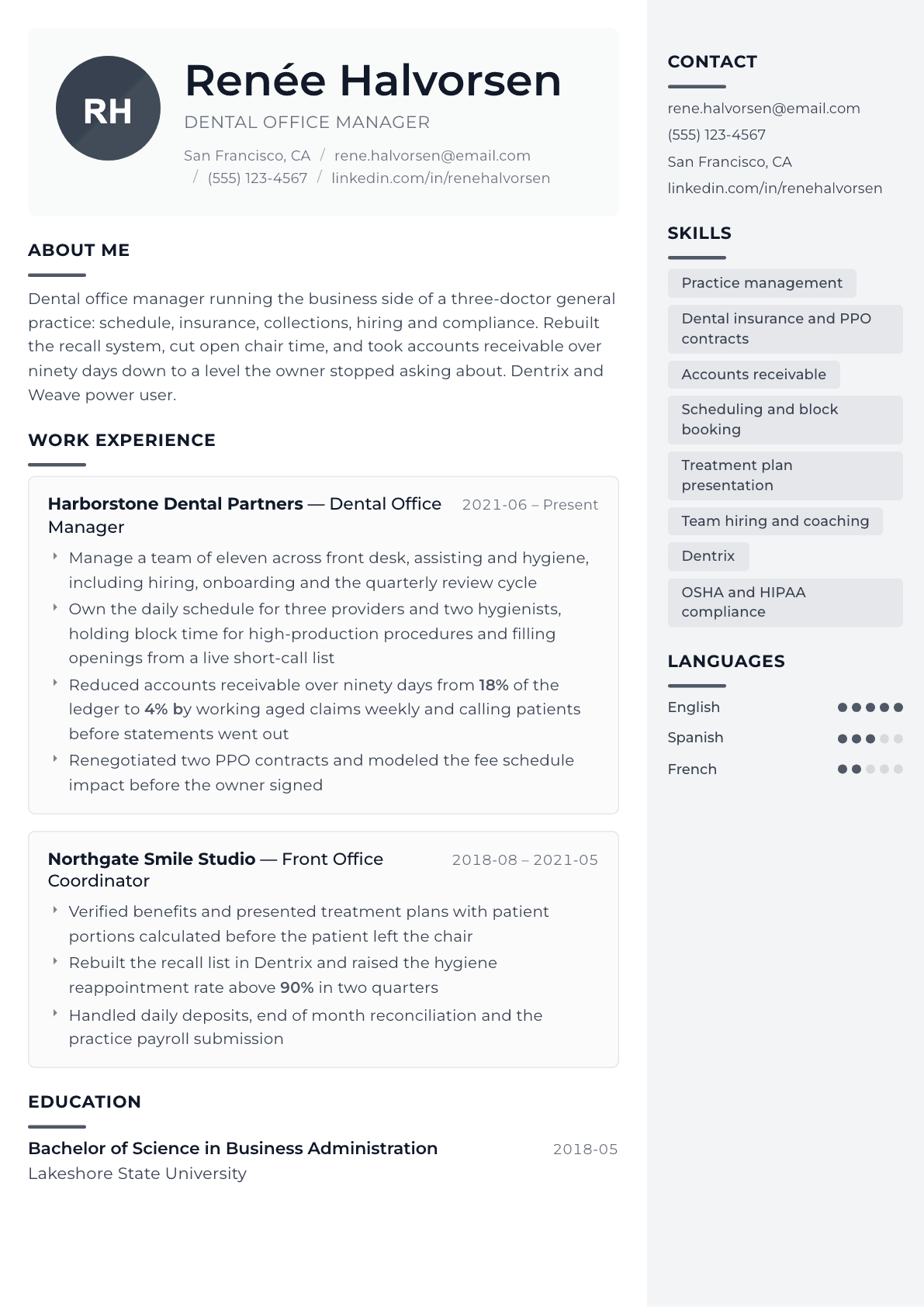
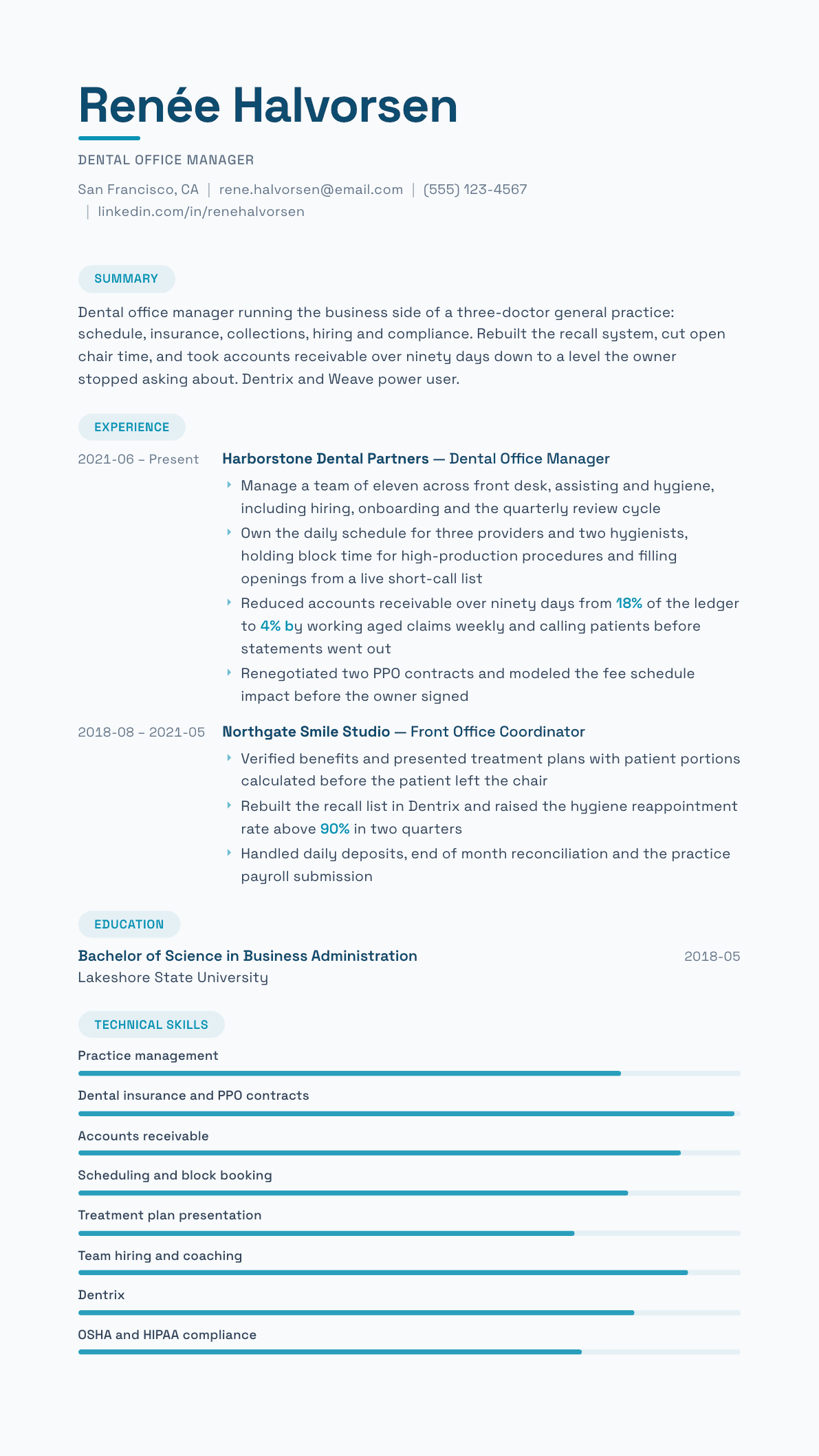
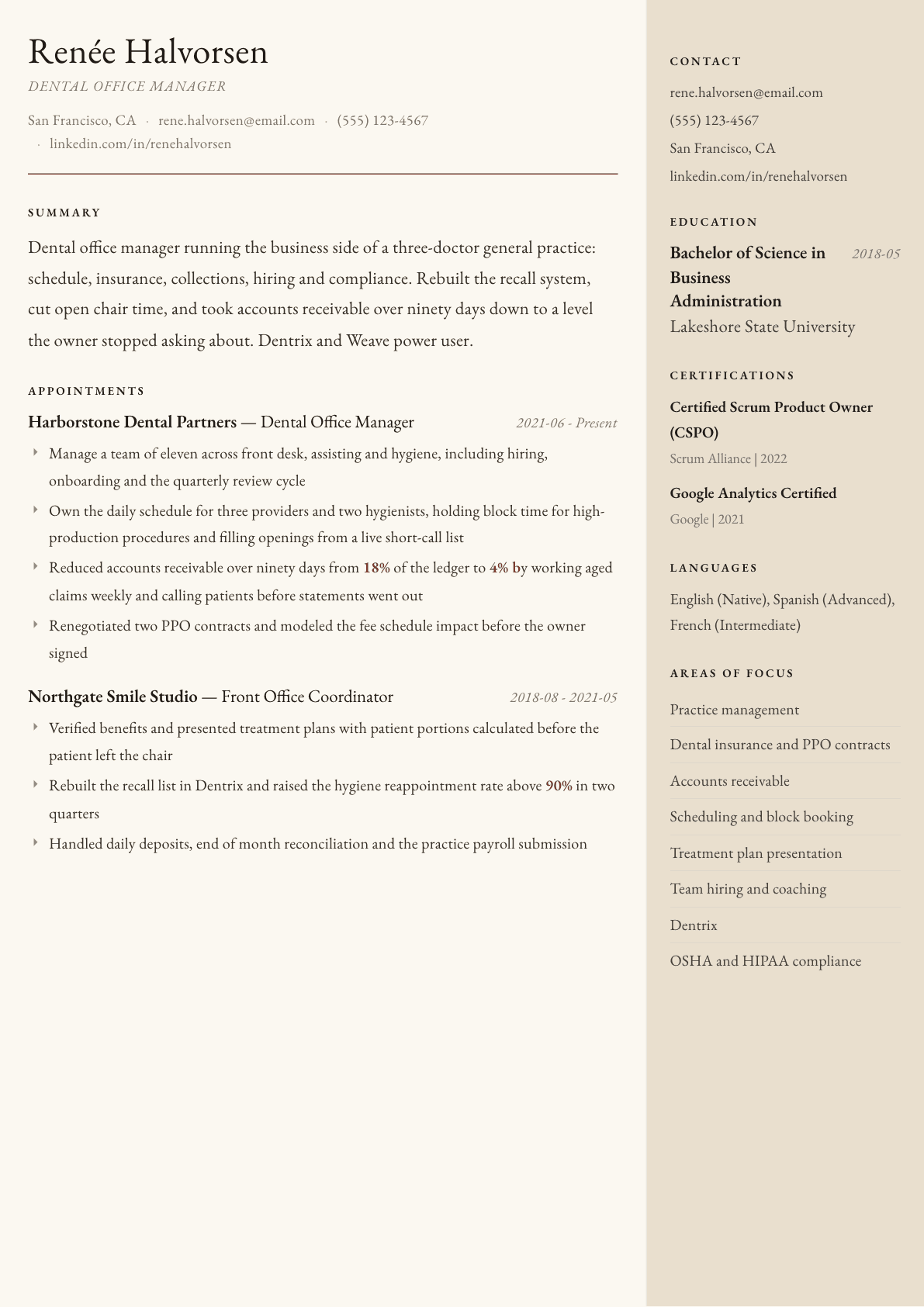
Example Dental Office Manager summary
Dental office manager with seven years running the front office of a two-location group practice. Owns scheduling, insurance, collections, staffing and compliance, and reports weekly on production, case acceptance and hygiene reappointment. Raised collections against production above 98% while cutting front desk turnover. Fluent in Dentrix, Open Dental and the reporting behind both.
Skills to list on a Dental Office Manager resume
- Practice management
- Dental insurance verification
- PPO fee schedule negotiation
- Claims and appeals
- Accounts receivable management
- Treatment plan presentation
- Case acceptance coaching
- Block scheduling
- Hygiene recall systems
- Staff hiring and onboarding
- Payroll administration
- OSHA compliance
- HIPAA compliance
- Dentrix
- Open Dental
- Practice reporting and KPIs
What actually gets this resume read
- Open with the practice profile: number of providers, operatories, staff size and whether it is fee for service or PPO heavy.
- Give production and collection results as ratios or percentages rather than raw dollars, which vary too much between practices.
- Show that you own the schedule, not just fill it: block scheduling, short-call lists and provider capacity planning.
- Name the systems you administer, including the practice management platform, imaging bridge and patient messaging tool.
- Cover the compliance side, since owners want an OSHA binder, HIPAA training and a sterilization audit trail that survives inspection.
- Include hiring and retention outcomes, because turnover at the front desk is the problem most owners are trying to solve.
How to write a dental office manager resume
A dental office manager resume is read by the owner dentist, usually late in the evening after the last patient has left. He is not looking for a warm personality. He is looking for someone who will keep the schedule full, get the insurance money collected, stop the front desk turnover, and make the compliance binder a problem he never has to think about again.
That means this resume has to look like a business resume that happens to sit inside a dental practice. Production and collections, accounts receivable aging, case acceptance, hygiene reappointment, staff retention: those are the numbers a practice owner already tracks, so those are the numbers your bullets should speak in.
The sections below cover how to profile each practice you have run, which metrics translate across offices and which do not, three summaries from front office coordinator to multi-location manager, before and after bullets, and the questions managers ask when they finally sit down to rewrite this document.
Format: one page under eight years, two pages after
Use reverse-chronological order and a clean single column. Avoid heavy graphics and skills bars; an owner scanning on a phone between operatories wants text he can read, and many group practices push resumes through an applicant tracking system that mangles columns.
Put a short practice profile line under each employer instead of building a separate summary of qualifications. The profile carries more information per inch than any headline.
- Header: name, city and state, phone, email.
- Order: summary, core management areas, experience with practice profiles, education, certifications and software.
- Two pages is acceptable once you have run more than one location.
Summary: practice size, scope, and the number you moved
Name the number of providers, hygienists and support staff you manage, whether the practice is fee for service or PPO heavy, and the specific areas you own end to end. Then close with one result. "Took accounts receivable over ninety days from a fifth of the ledger to single digits" is a sentence that gets a call back.
If you are moving from a single office to a group, say so, and point at the parts of the job that scale: standard operating procedures, onboarding, reporting and credentialing across locations.
Experience: run the practice, do not describe the front desk
Every job entry needs the practice profile first: providers, operatories, staff headcount, specialty mix and the practice management platform. Then four or five bullets that split cleanly into the four areas an owner cares about: schedule and production, insurance and collections, people, and compliance.
For schedule and production, show that you shape the day rather than fill it. Block scheduling for high-production procedures, a live short-call list, provider capacity planning and same-day emergency slots are the practices that separate a manager from a receptionist with a title.
For insurance and collections, be concrete about the work: benefit verification before the visit, treatment plan presentation with the patient portion calculated, claim submission with attachments, appeals on denials, and a weekly aging review. Say what happened to the aging buckets.
For people, give hiring, onboarding, cross-training and retention. Front desk turnover is the wound most owners are trying to close, and a manager who names her onboarding structure and her retention record is answering the real question.
Metrics: use ratios, not raw dollars
Production and collection figures do not travel between practices, because a specialty office and a small rural general practice live on different scales. Ratios do. Collections against production, accounts receivable over ninety days as a share of the ledger, hygiene reappointment rate, case acceptance rate, open chair hours per week and new patient count per month are all comparable and all understood.
Where you have to reference a dollar amount, describe the direction and the mechanism instead: which claims you worked, which contracts you renegotiated, which recall gap you closed.
Compliance and systems: the part that protects the owner
Give compliance its own space. OSHA training records, the hazard communication and bloodborne pathogen program, sterilization monitoring logs, HIPAA training and the notice of privacy practices, radiation safety records, and state board requirements. An owner who has been through an inspection will read this block twice.
Then list systems by name: the practice management platform, the imaging bridge, the patient communication tool, payroll and the merchant processor. Software fluency is a screening keyword in every group practice posting.
Dental Office Manager resume summary examples
Front office coordinator moving up
Front office coordinator with three years in a two-doctor general practice, running verification, treatment plan presentation and daily deposits. Rebuilt the hygiene recall list in Dentrix and lifted reappointment above 90%. Ready to take on scheduling ownership, claims follow-up and staff training as an office manager.
Single practice manager
Dental office manager for a three-doctor, six-operatory practice with a team of eleven. Owns schedule design, insurance and collections, hiring and OSHA compliance. Cut accounts receivable over ninety days to 4% of the ledger and holds collections against production above 98% through monthly aging reviews.
Multi-location manager
Regional practice manager overseeing three locations, nine providers and a support team of thirty. Standardized scheduling templates, onboarding and insurance workflows across sites, led provider credentialing, and renegotiated PPO participation after modeling the fee schedule impact for each office.
Work experience bullets: before and after
Before: Managed the front desk and scheduled patients.
After: Designed the daily schedule for three doctors and two hygienists, protecting block time for crown and implant cases and filling openings from a live short-call list.
It replaces a job title with the scheduling method that actually drives daily production.
Before: Handled insurance claims and billing.
After: Worked aged claims weekly and drove accounts receivable over ninety days from 18% of the ledger to 4% within three quarters.
A ratio and a timeframe let an owner compare your result to his own aging report.
Before: Responsible for hiring and training staff.
After: Hired and onboarded seven team members through a structured two-week orientation, and kept front desk turnover to one departure in three years.
Retention is the outcome the owner is buying, so name it rather than the activity.
Before: Made sure the office was compliant.
After: Maintained the OSHA and HIPAA program end to end: annual training records, bloodborne pathogen plan, sterilization monitoring logs and updated notice of privacy practices.
Listing the actual documents proves the binder exists rather than claiming a state of compliance.
Before: Presented treatment plans to patients.
After: Presented treatment with the patient portion calculated before the patient left the chair, and moved case acceptance on multi-visit restorative plans above 70%.
The timing detail and the acceptance figure show a method, not a conversation.
Hard skills
- Practice management and daily operations
- Dental insurance verification and PPO contracts
- Claims submission and appeals
- Accounts receivable aging management
- Block scheduling and provider capacity planning
- Treatment plan presentation and case acceptance
- Hygiene recall systems
- Payroll and timekeeping administration
- Provider credentialing
- OSHA and HIPAA program administration
- Dentrix and Open Dental reporting
- Practice KPI dashboards
Soft skills
- Owner communication
- Difficult patient de-escalation
- Team coaching and accountability
- Hiring judgment
- Calm handling of money conversations
Certifications worth listing
- Certified Dental Practice Management Administrator (CDPMA) (Dental Assisting National Board)
- Fellowship, American Association of Dental Office Management (American Association of Dental Office Management)
- Certified Dental Assistant (CDA) (Dental Assisting National Board)
- Basic Life Support (BLS) (American Heart Association)
Mistakes that cost dental office manager candidates the interview
- Writing the resume as a front desk job description when the role being hired is the business manager of a small company.
- Quoting raw production dollars from a practice whose scale the reader cannot picture, instead of using ratios.
- Omitting the practice profile, so the owner cannot tell whether you have run one operatory or ten.
- Ignoring compliance entirely, which is the risk an owner most wants a manager to absorb.
- Listing software as a bare word without saying what you built inside it, such as reports, templates or recall lists.
- Claiming leadership without a single retention, hiring or training outcome to support it.
Dental Office Manager resume questions
What metrics should a dental office manager put on a resume?
Collections against production, accounts receivable over ninety days as a share of the ledger, hygiene reappointment rate, case acceptance, new patient count per month and staff turnover. Ratios travel between practices; raw revenue figures do not.
Do I need clinical dental experience to be an office manager?
It is not required, but it helps you schedule realistically and talk to patients about treatment. If you have chairside or hygiene background, keep it as a short earlier entry so the owner sees you understand appointment length and procedure flow.
How do I show insurance experience without listing every payer?
Describe the workflow instead: benefit verification before the visit, claim submission with narratives and attachments, denial appeals, and a weekly aging review. Then name the plan types you handle, such as PPO, capitation and fee for service.
Should I include a certification for practice management?
Include it only if you actually hold it, with the issuing body named. A management credential helps in group practice hiring, but a strong record of collections, scheduling and retention outweighs any certificate on this resume.
How do I move from a single office to a group practice role?
Emphasize the parts of your work that repeat across sites: written standard operating procedures, onboarding structure, insurance workflow, credentialing and reporting. Group hiring managers want a manager who can standardize, not one who improvises in one building.