Dermatologist Resume Examples: free ATS score and gap list
Build a Dermatologist Resume That Highlights Your Specialty
By Mustafa Tarabya, founder of CVBooster · Published · Updated
Create an impressive dermatologist resume with physician-level templates, clinical examples, and tips for dermatology positions.
Sample resumes for a dermatologist
The same dermatologist content laid out in three CVBooster templates, so you can see what the finished document looks like before you write a word.
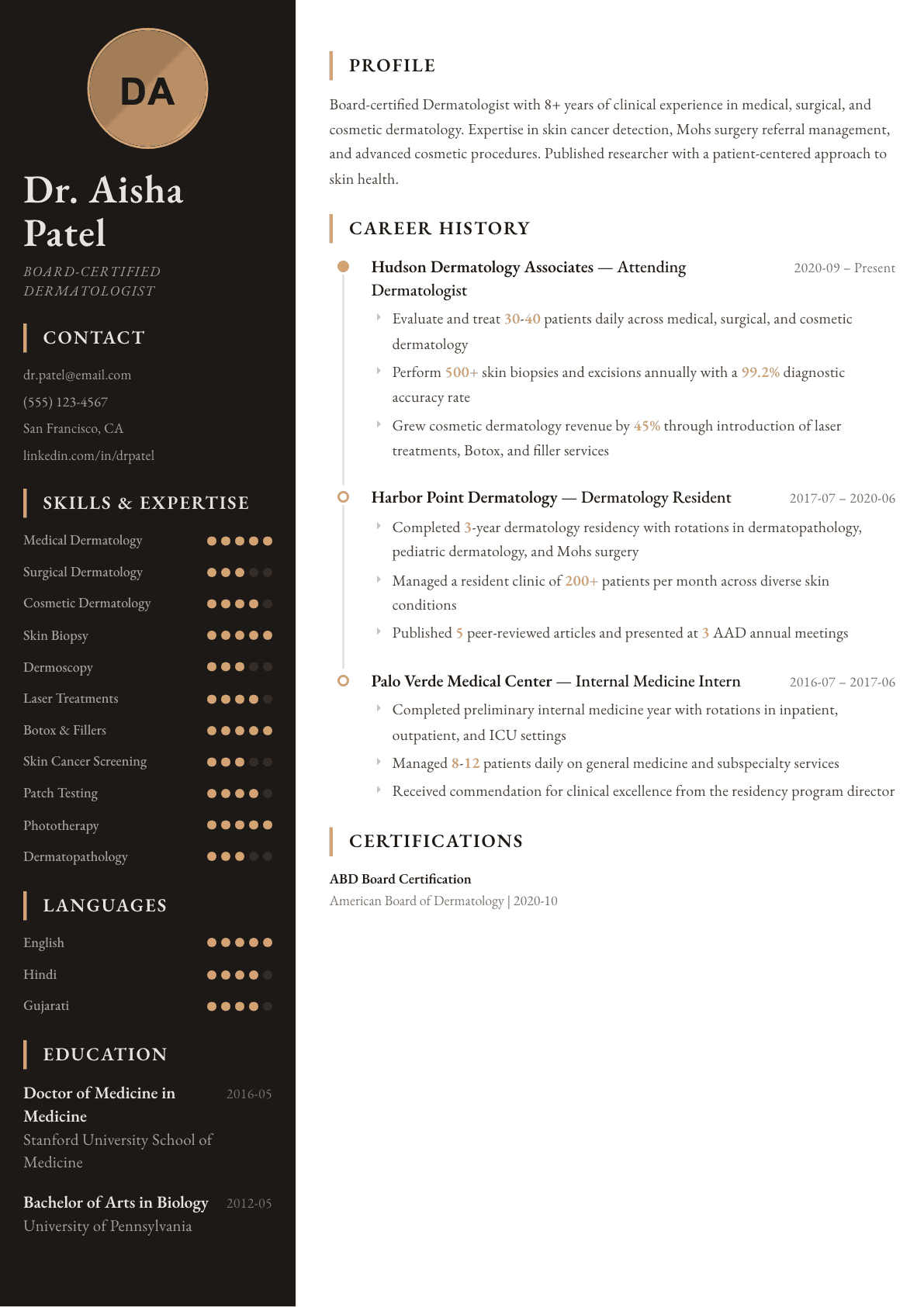
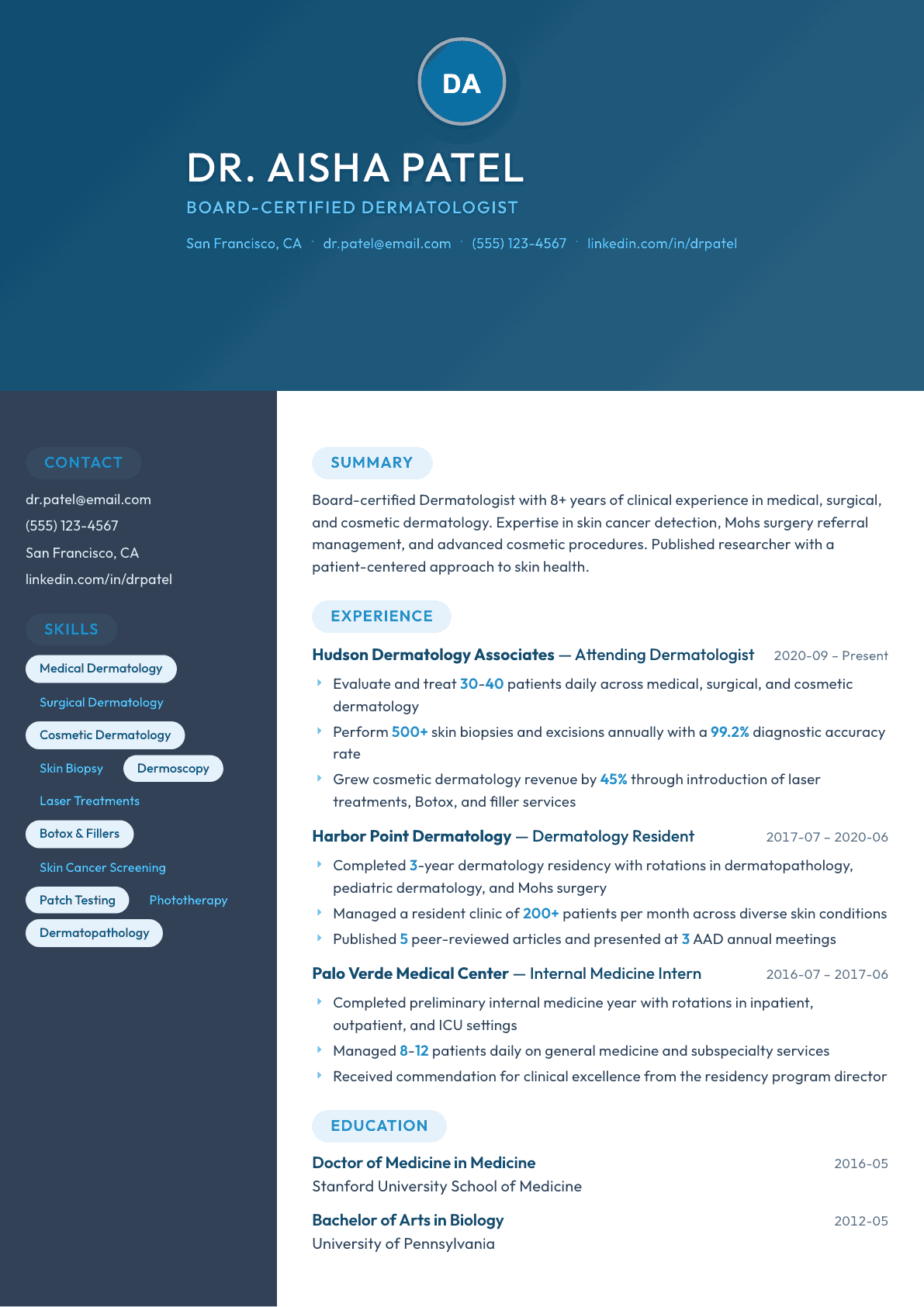
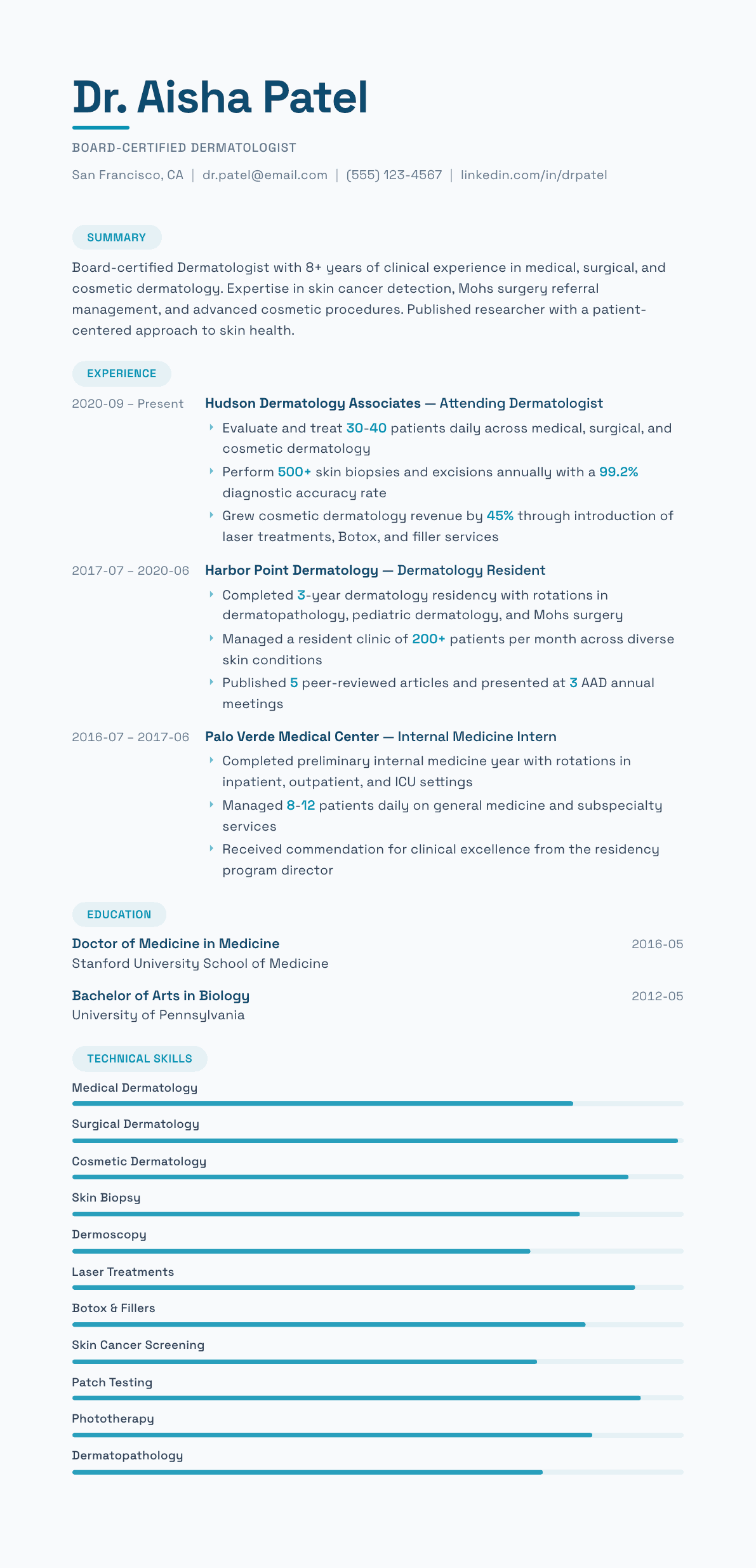
Example Dermatologist summary
ABD board-certified Dermatologist with 8 years of clinical experience in medical, surgical, and cosmetic dermatology. Perform 500+ biopsies annually with 99.2% diagnostic accuracy and grew cosmetic revenue by 45%. Seeking a partnership-track position at a multi-physician dermatology practice.
Skills to list on a Dermatologist resume
- Medical Dermatology
- Surgical Dermatology
- Cosmetic Dermatology
- Skin Biopsy
- Dermoscopy
- Mohs Surgery
- Laser Treatments
- Botox & Fillers
- Skin Cancer Detection
- Phototherapy
- Patch Testing
- Dermatopathology
- Pediatric Dermatology
- Acne Management
What actually gets this resume read
- Display ABD board certification and subspecialty qualifications prominently.
- Quantify patient volumes, biopsy counts, and diagnostic accuracy rates.
- Specify medical, surgical, and cosmetic dermatology experience separately.
- Highlight any Mohs surgery, laser, or cosmetic procedure training.
- Include publications and AAD or society presentations for academic roles.
- Show revenue growth or practice development achievements for private practice.
How to write a dermatologist resume
Dermatology hiring runs on a narrow set of facts, and the person reading your file, whether a practice managing partner, an academic division chief or a recruiter for a private equity backed group, checks them in the same order every time: board certification status with the American Board of Dermatology, state license and DEA, residency program and graduation year, fellowship if any, and the split of your practice between medical, surgical and cosmetic dermatology.
That practice split is the decision point. A group hiring for a general medical dermatology column wants biopsy and excision volume, teledermatology comfort and the ability to run a high volume clinic. A cosmetic focused practice wants injector experience and device training. A Mohs practice wants fellowship credentials and case numbers. One resume cannot serve all three, and the version that tries reads as unfocused.
This guide covers how to structure a dermatologist resume or curriculum vitae for each of those settings, three summaries spanning a graduating resident, an attending several years in and a practice leader, and the rewrites that turn duty statements into evidence a hiring committee can act on.
Format: resume for private practice, curriculum vitae for academics
For a private or group practice position, send a two page resume: credentials, practice profile, clinical experience, procedures and devices, training, and a short line for research or teaching. For an academic appointment send a full curriculum vitae with publications, presentations, grants, teaching and committee service in the standard order, because promotion committees read it the way they read a promotion packet.
Either way, the first block after your name should be credentials and licensure: board certification and certifying board, state licenses, DEA, and hospital privileges if you hold them. Dermatology positions are frequently credentialed by a payer before a start date is set, so the reader is checking feasibility as much as fit.
- Header: name with MD or DO, city and state, phone, email.
- Order for practice roles: summary, certification and licensure, clinical experience, procedures and devices, residency and fellowship, education, selected research.
- Recent residency graduates lead with training and give case and procedure volumes from residency clinics.
Summary: subspecialty focus, patient volume, and case mix
Three sentences. Name the mix of medical, surgical and cosmetic dermatology in your current practice, the patients seen per clinic day, and one focused strength such as complex medical dermatology, pediatric dermatology, dermatopathology sign out or laser and injectable work. A managing partner is trying to work out which schedule template you would fill.
If you are targeting a different mix than you currently run, say so directly and name the training that supports it. A dermatologist moving from an academic complex medical clinic toward a general practice column should point at the breadth of general referrals handled, not at the rare disease clinic that will not repeat in the new job.
Clinical experience: clinic volume, acuity and the surgical load
Head each position with the setting and scale: private group with a stated number of dermatologists and advanced practice providers, academic department, multispecialty group, Veterans Affairs or safety net clinic. Then give patients seen per clinic day and the split across general medical, surgical and cosmetic sessions.
Surgical volume needs its own bullets. Shave and punch biopsies, excisions of benign and malignant lesions, repairs by complexity including flaps and grafts, cryotherapy, electrodesiccation and curettage, and whether you perform Mohs micrographic surgery or refer it. Give annual counts, since dermatology groups model revenue and coverage on procedure volume.
Medical dermatology bullets should show acuity and continuity: biologic therapy management for psoriasis and atopic dermatitis, connective tissue disease, hidradenitis, immunobullous disease, drug eruptions, inpatient consultation, contact dermatitis and patch testing, and pediatric patients if you see them.
Procedures, devices and the cosmetic side
Give devices and cosmetic procedures their own block, because the equipment a practice already owns decides how quickly a new hire becomes productive. Name the laser platforms and treatment types you have used: vascular and pigment lasers, resurfacing, hair removal, intense pulsed light, radiofrequency microneedling, and body contouring devices.
For injectables, name the product families you have used and roughly how many treatment sessions you perform in a typical month, plus complication management experience such as vascular occlusion protocol and hyaluronidase reversal. A cosmetic practice reads that as risk reduction, which is often the deciding factor.
Teledermatology and store and forward review deserve a line if you have done it at volume, since many groups now staff a virtual column and want a physician who has already worked without touching the skin.
Training, research and the keywords a screener uses
List the dermatology residency with the institution and completion, any fellowship in Mohs surgery, dermatopathology, pediatric dermatology or complex medical dermatology, and the preliminary or transitional year. For academic files, follow with publications, funded projects, teaching roles and society service.
Mirror the vocabulary the posting uses so a screener and any parsing software both find it: board certified, general dermatology, skin cancer screening, total body skin examination, Mohs, dermoscopy, biologics, phototherapy, patch testing, cosmetic dermatology and the electronic health record the group runs, commonly Epic, ModMed or Nextech.
Dermatologist resume summary examples
Graduating resident
Dermatology resident completing training in June and board eligible, with 3,400 continuity clinic visits, 480 biopsies and 210 excisions including intermediate repairs during residency. Experienced with dermoscopy, patch testing and biologic initiation, seeking a general medical dermatology position in a group practice.
Six years attending
Board certified dermatologist with six years in a nine physician group, seeing 34 patients per clinic day across a 70% medical and 30% surgical split. Performs 600 biopsies and 280 excisions annually, manages biologics for psoriasis and hidradenitis, and supervises two physician assistants.
Practice leader
Board certified dermatologist and site medical director with fourteen years of practice, leading four dermatologists and five advanced practice providers across two clinics. Built the cosmetic service from two devices to a full laser suite and set the credentialing and quality review process for the group.
Work experience bullets: before and after
Before: Diagnosed and treated a wide range of skin conditions.
After: Saw 34 patients per clinic day across acne, psoriasis, atopic dermatitis, hidradenitis, immunobullous disease and skin cancer screening, with dermoscopy used on every pigmented lesion evaluation.
The volume and the named condition list show the acuity and pace a group is hiring for, which a wide range hides.
Before: Performed skin biopsies and minor surgical procedures.
After: Performed about 600 biopsies and 280 excisions per year, including intermediate and complex repairs and 40 flap or graft closures, with margin clearance confirmed before repair.
Annual counts and repair complexity are how a practice models surgical capacity and coverage.
Before: Provided cosmetic dermatology services.
After: Ran a weekly cosmetic session of 14 to 18 patients covering neuromodulator and filler injection, vascular laser, fractional resurfacing and radiofrequency microneedling, with a written vascular occlusion protocol in place.
Session volume, device names and a complication protocol let a cosmetic practice judge both productivity and risk.
Before: Involved in resident and student teaching.
After: Precepted dermatology residents in a weekly continuity clinic and led the monthly dermoscopy conference for residents and rotating internal medicine trainees.
Named teaching settings and a recurring conference are verifiable, while involved in teaching is not.
Before: Helped improve clinic efficiency.
After: Redesigned the skin cancer screening template to a 15 minute slot with pre visit intake, adding four appointments per physician day without extending clinic hours.
The specific scheduling change and its capacity result show operational judgment a partner can evaluate.
Hard skills
- General medical dermatology
- Total body skin examination
- Dermoscopy
- Shave and punch biopsy
- Excision with intermediate and complex repair
- Cryotherapy and electrodesiccation
- Skin cancer diagnosis and management
- Biologic therapy management
- Phototherapy
- Patch testing
- Laser and light based treatment
- Neuromodulator and dermal filler injection
- Teledermatology review
- Dermatopathology correlation
Soft skills
- Difficult diagnosis communication
- Cosmetic consultation and expectation setting
- Advanced practice provider supervision
- Referral network relationships
- Clinic throughput discipline
Certifications worth listing
- Board Certification in Dermatology (American Board of Dermatology)
- Board Certification in Dermatology (American Osteopathic Board of Dermatology)
- Micrographic Dermatologic Surgery subspecialty certification (American Board of Dermatology)
- Dermatopathology subspecialty certification (American Board of Dermatology)
- Pediatric Dermatology subspecialty certification (American Board of Dermatology)
- DEA Registration (United States Drug Enforcement Administration)
- Basic Life Support (BLS) for Healthcare Providers (American Heart Association)
Mistakes that cost dermatologist candidates the interview
- Sending an academic curriculum vitae with forty publications to a private group that wanted two pages and a procedure volume.
- Leaving board certification status ambiguous, when board eligible and board certified are treated as different hires by credentialing and by payers.
- Omitting the medical, surgical and cosmetic split, which is the first thing a managing partner uses to match you to a schedule template.
- Giving no annual biopsy or excision counts, so the group cannot model your surgical contribution or coverage.
- Listing laser and injectable experience without naming platforms or product families, which reads as exposure rather than competence.
- Ignoring the electronic health record and practice management systems you have used, when a mismatch costs real clinic time in the first month.
- Using one identical file for academic, general practice and cosmetic applications instead of reordering the evidence for each.
Dermatologist resume questions
Do dermatologists need a curriculum vitae or a resume?
Both, kept in parallel. Academic departments, fellowships and hospital appointments expect a full curriculum vitae with publications and teaching. Private and group practices expect a two page resume led by practice profile, clinic volume and procedure counts, with research reduced to a single line.
How do I show surgical volume on a dermatology resume?
Give annual counts by procedure type: biopsies, benign and malignant excisions, repairs split by complexity, and destructions. Add whether you perform Mohs micrographic surgery yourself or refer it, since that single fact changes how a practice plans its surgical coverage.
Should a board eligible dermatologist say so?
Yes, and state the exam timing. Write board eligible with the expected certification date rather than implying certification, because credentialing departments verify status directly and any ambiguity discovered later damages the offer far more than the honest line would have.
How much cosmetic detail belongs on the resume?
As much as the target job needs. For a cosmetic focused practice, dedicate a block to devices, product families, monthly session volume and complication management. For a medical dermatology position, compress it to two lines so it does not crowd out the medical and surgical evidence.
What should a graduating dermatology resident put on a first resume?
Lead with residency, then give clinic visit totals, biopsy and excision counts, repair types, and rotations such as dermatopathology, pediatric dermatology and Mohs. Add dermoscopy and patch testing experience, plus any research, and keep the whole file to two pages.