Perioperative Nurse Resume Examples: what gets the call
Craft a Perioperative Nurse Resume That Names Your Service Lines
By Mustafa Tarabya, founder of CVBooster · Published · Updated
Perioperative nurse resume examples with circulating and scrub keywords, service line bullets, and a guide to writing case volume and count practice.
Sample resumes for a perioperative nurse
The same perioperative nurse content laid out in three CVBooster templates, so you can see what the finished document looks like before you write a word.
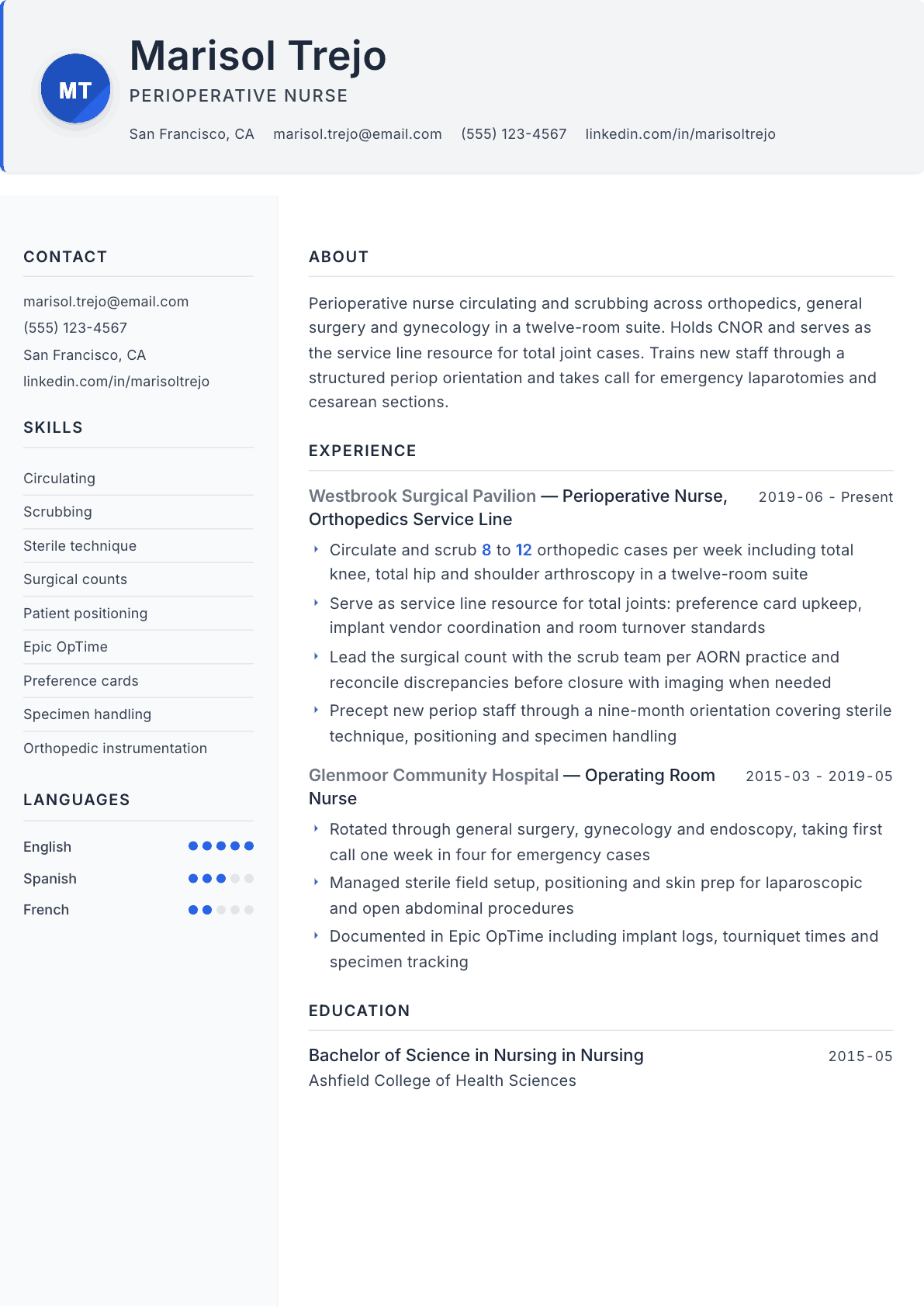
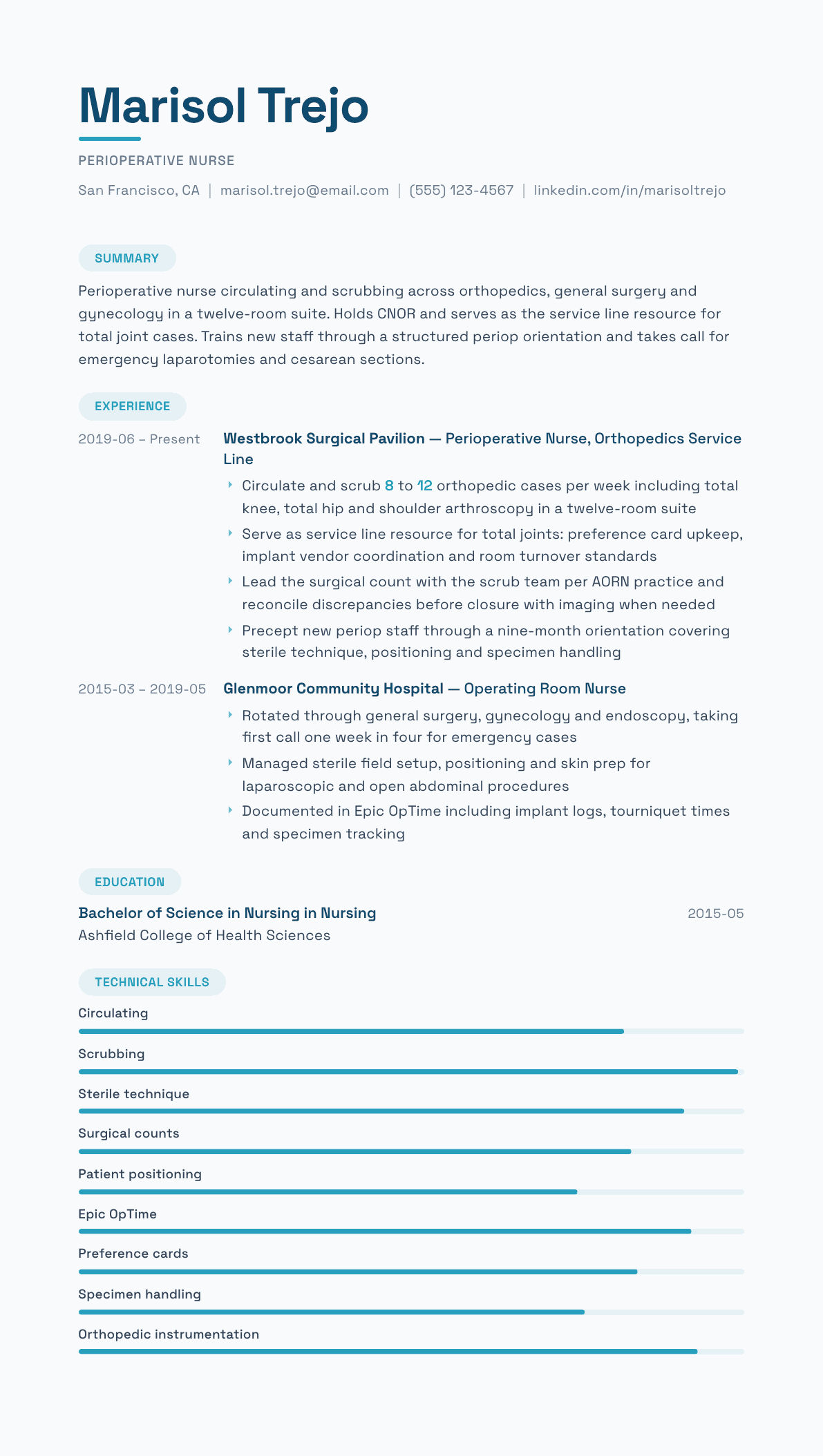
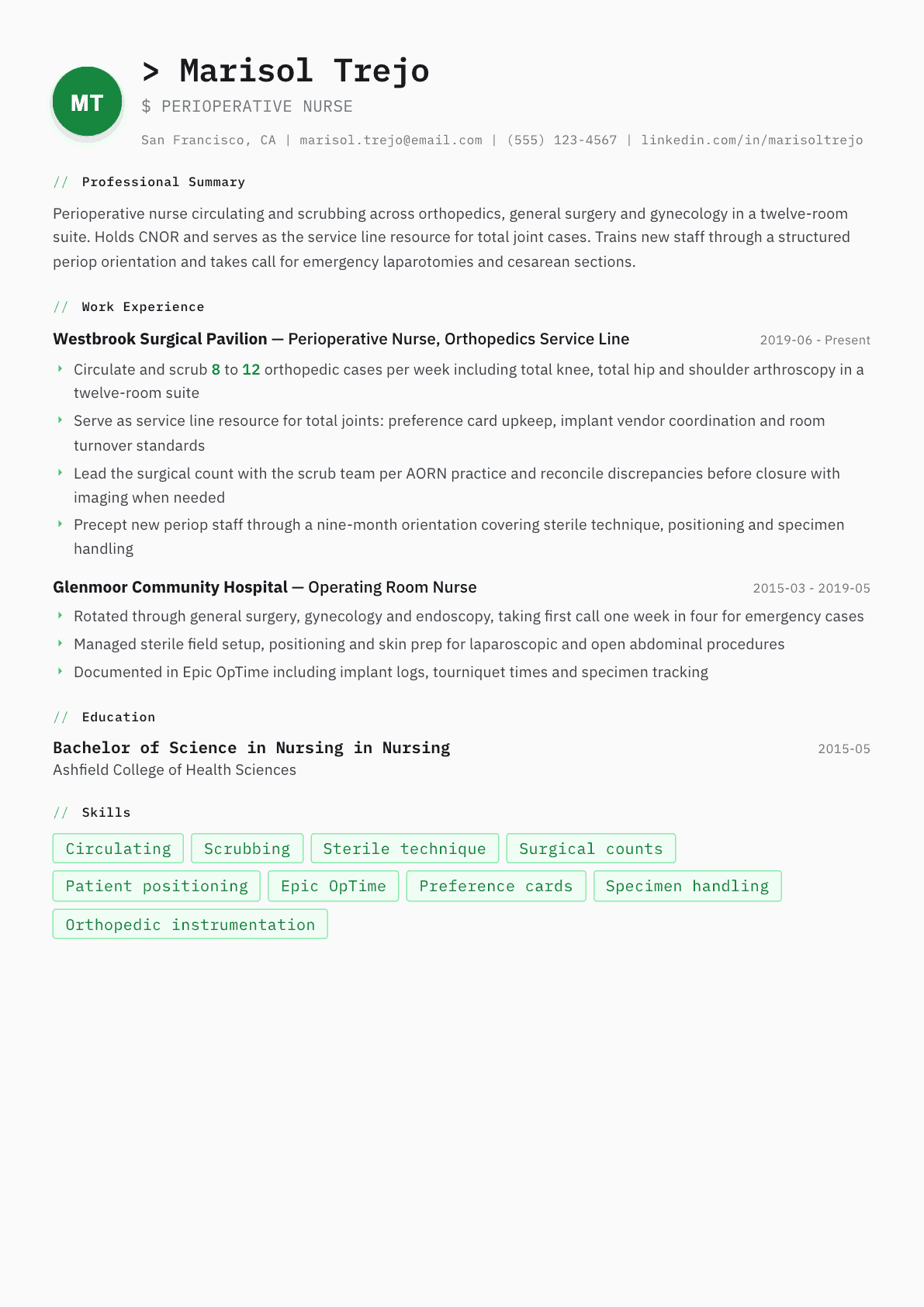
Example Perioperative Nurse summary
Perioperative nurse with nine years in the operating room, circulating and scrubbing orthopedic, general surgery and gynecologic cases in a twelve-room suite. CNOR certified and the total joint service line resource, responsible for preference cards, implant coordination and periop orientation. Takes emergency call one week in four. Seeking a charge or service line coordinator role in a high volume surgical center.
Skills to list on a Perioperative Nurse resume
- Circulating nurse duties
- Scrub nurse duties
- Sterile technique
- Surgical counts
- Patient positioning
- Skin preparation
- Preference card management
- Instrument and tray handling
- Specimen handling
- Epic OpTime
- Laparoscopic setup
- Orthopedic implants
- Room turnover
- Surgical time out
- Malignant hyperthermia response
What actually gets this resume read
- Name every service line you have covered and say whether you circulate, scrub, or do both in each one.
- Give the size of the suite in rooms and your weekly case volume; both tell a manager how quickly you can be productive.
- Say what your call commitment is, because call coverage is often the first question in a periop interview.
- List the instrumentation and implant systems you know by category rather than by brand claim, such as total joint or spine trays.
- Reference AORN practice when describing counts, positioning or sterile field management to signal current standards.
- Put CNOR near the top if you hold it, since many postings list it as preferred and screeners search for it directly.
How to write a perioperative nurse resume
An operating room manager reads a perioperative nurse resume with a schedule in front of her. She has rooms to staff, service lines with gaps, and a call roster that never covers itself. What she needs from your resume is which specialties you can walk into, whether you circulate, scrub or both, and how much call you will carry. Everything else is secondary.
This is why generic nursing language fails so badly in periop. The room does not care that you are detail oriented. It cares that you know the total joint trays, that your counts are clean, that you can position a prone spine case, and that you know what to do when the count does not reconcile at closure.
What follows is the section order periop managers read in, three summaries covering a new periop nurse, a service line resource and a charge nurse, before and after bullets built from real case work, and the questions asked most often when nurses write for the operating room.
Format: service lines before anything else
Reverse-chronological, one page under five years and two pages after. Put your name, credentials and CNOR in the header, then a short line listing every service line you have covered and the role you played in each. A manager who has to read three jobs to learn that you have never done cardiac will not read three jobs.
Keep the layout single column. Many hospital parsers scramble two-column resumes, and periop resumes are dense with short list items that scramble worst.
- Header: name, credentials, CNOR if held, city and state, license state.
- Order: summary, service lines and roles, certifications, operating room experience, other clinical experience, education.
- New periop nurses add a periop orientation section with the program length and the specialties rotated through.
Summary: suite size, specialties, call
Three lines. Name the number of rooms in the suite, the specialties you cover, whether you circulate, scrub or both, and your call commitment. Those four facts answer the manager questions that otherwise become the first ten minutes of a phone screen.
If you are moving from a hospital suite into an ambulatory surgery center or the reverse, name the difference and address it. Turnover expectations, case mix and staffing models differ enough that a manager will wonder whether you know what you are asking for.
Experience: cases, counts, positioning, turnover
Lead each job with the facility type, the number of rooms and the case mix, then write bullets around the work that carries risk. The surgical count and its reconciliation, sterile field setup and breaks in technique, positioning for prone, lithotomy or lateral cases, specimen handling and labeling, tourniquet and implant documentation, and the surgical time out.
Volume belongs in a bullet. Cases per week by specialty tells a manager how fast you will be productive on her board. So does room turnover time when you owned the standard, and so does first case on time start when your team tracked it.
Include the things that happen when a case goes wrong: converting laparoscopic to open, malignant hyperthermia response, massive transfusion in the room, or an unreconciled count that went to imaging. One such bullet does more for you than five that describe a routine setup.
Instruments, implants and preference cards
Describe instrumentation by category and complexity rather than by brand claims you cannot defend. Total joint trays, spine instrumentation, robotic docking and instrument exchange, laparoscopic towers, arthroscopy setups and microsurgery loupes each imply a specific skill set.
Preference card ownership is underrated on these resumes. A nurse who maintains cards, coordinates with vendors on implant availability, and cleans up picks that waste supply is solving a problem every periop manager has. Say so explicitly with the service line you owned.
Certifications, standards and keywords
CNOR belongs near the top when you hold it, with the certifying body named. Keep BLS and ACLS current and list any specialty course such as robotic surgery training or an RN first assistant credential, since those change what a manager can assign you to.
Reference the standards you practice under when describing counts, sterile technique and positioning. Postings for this role repeat a small vocabulary: circulating, scrubbing, sterile field, surgical counts, time out, positioning, specimen handling, preference cards, room turnover, call coverage and the service line names. Use their words, once in the summary and once inside a bullet.
Perioperative Nurse resume summary examples
Out of periop orientation
Registered nurse completing a nine-month perioperative orientation covering general surgery, gynecology and orthopedics, with sterile technique, positioning and specimen handling signed off. Two prior years on a surgical step-down unit. Seeking a circulating position in a hospital operating suite with structured preceptorship.
Service line resource
Perioperative nurse with six years circulating and scrubbing orthopedic and general surgery cases in a twelve-room suite. Service line resource for total joints, responsible for preference cards, implant vendor coordination and turnover standards. CNOR certified and taking first call one week in four.
Operating room charge nurse
Operating room charge nurse with twelve years across orthopedics, vascular and robotic general surgery, running board assignments and break relief for a fourteen-room suite. Leads periop orientation, chairs the sterile processing liaison meeting, and manages call roster coverage across three services.
Work experience bullets: before and after
Before: Assisted in surgeries in the operating room.
After: Circulated and scrubbed 8 to 12 orthopedic cases per week in a twelve-room suite, including total knee, total hip and shoulder arthroscopy.
Case types, weekly volume and suite size tell a manager exactly where you fit on the board.
Before: Performed surgical counts.
After: Led the surgical count with the scrub team at every count point and reconciled two discrepancies during the year using intraoperative imaging before closure.
Naming the count points and what happened when one failed shows the judgment the task actually requires.
Before: Kept the room stocked and ready.
After: Owned preference cards for the total joint service, working with implant vendors on tray availability and removing repeatedly unused picks from six surgeon cards.
Ownership of a specific card set solves a supply problem the manager already has on her list.
Before: Trained new nurses in the OR.
After: Precepted four new perioperative staff through a nine-month orientation covering sterile technique, positioning, specimen handling and independent circulating in two service lines.
The curriculum and duration prove structured teaching rather than informal shadowing.
Before: Handled emergency cases.
After: Took first call one week in four for emergency laparotomy and cesarean sections, opening the room and assembling the team inside the required response window.
Call frequency and response expectations answer the staffing question a periop manager asks first.
Hard skills
- Circulating nurse practice
- Scrub nurse practice
- Sterile technique and field setup
- Surgical counts and reconciliation
- Patient positioning for prone, lateral and lithotomy
- Surgical time out procedure
- Specimen handling and labeling
- Preference card management
- Orthopedic and spine instrumentation
- Robotic case setup and docking
- Epic OpTime documentation
- Malignant hyperthermia response
Soft skills
- Anticipating the surgeon
- Advocacy for the anesthetized patient
- Composure during conversion to open
- Team briefing and handoff
- Vendor and sterile processing coordination
- Precepting in a live room
Certifications worth listing
- CNOR (Perioperative Nursing Certification) (Competency and Credentialing Institute)
- CSSM (Certified Surgical Services Manager) (Competency and Credentialing Institute)
- CRNFA (Certified Registered Nurse First Assistant) (Competency and Credentialing Institute)
- Basic Life Support (BLS) (American Heart Association)
- Advanced Cardiovascular Life Support (ACLS) (American Heart Association)
Mistakes that cost perioperative nurse candidates the interview
- Leaving out the service lines, which forces the manager to guess whether you can cover the gap she is hiring for.
- Not saying whether you circulate, scrub or both, when the two roles need different training investments.
- Omitting call commitment, since call coverage is often the deciding factor between two similar candidates.
- Writing assisted with procedures instead of naming the case types and the weekly volume you carried.
- Skipping the count, positioning and specimen bullets that prove you practice to current perioperative standards.
- Burying CNOR at the bottom of the second page when postings routinely list it as preferred.
Perioperative Nurse resume questions
How do I write a perioperative nurse resume with no operating room experience?
Put the periop orientation program front and center with its length and the specialties you rotated through, then pull forward step-down, emergency or post-anesthesia experience. Managers hiring into orientation want evidence of sterile discipline and comfort with rapid changes, not case counts.
Should I list every surgeon and procedure I have worked with?
List procedures by service line and keep surgeons off entirely. A manager wants the case categories she can assign you to. A long procedure list reads as padding, while five service lines with weekly volumes reads as a staffing solution.
Does CNOR make a real difference on a resume?
It does when the posting names it as required or preferred, because recruiters filter on the term directly. It also signals that you have enough documented case hours to sit the exam, which itself tells a manager how much independent time you have logged.
How should I describe experience in an ambulatory surgery center?
Give the number of rooms, the case mix and the daily case count, because centers run higher volume and faster turnover than hospital suites. Then name any recovery or pre-admission testing duties, since small centers cross-train staff across phases of care.
What belongs in the skills section for an operating room role?
Clinical and equipment terms only: circulating, scrubbing, counts, positioning, sterile field, specimen handling, instrumentation categories and your documentation system. Move teamwork and composure into experience bullets where a specific case makes them believable.