Speech-Language Pathologist Resume Examples: free score
Sample Speech Language Pathologist Resume for Every Setting
By Mustafa Tarabya, founder of CVBooster · Published · Updated
Sample speech language pathologist resume with setting, caseload, assessments and outcomes, plus a full speech language pathology resume, top to bottom.
Sample resumes for a speech-language pathologist
The same speech-language pathologist content laid out in three CVBooster templates, so you can see what the finished document looks like before you write a word.
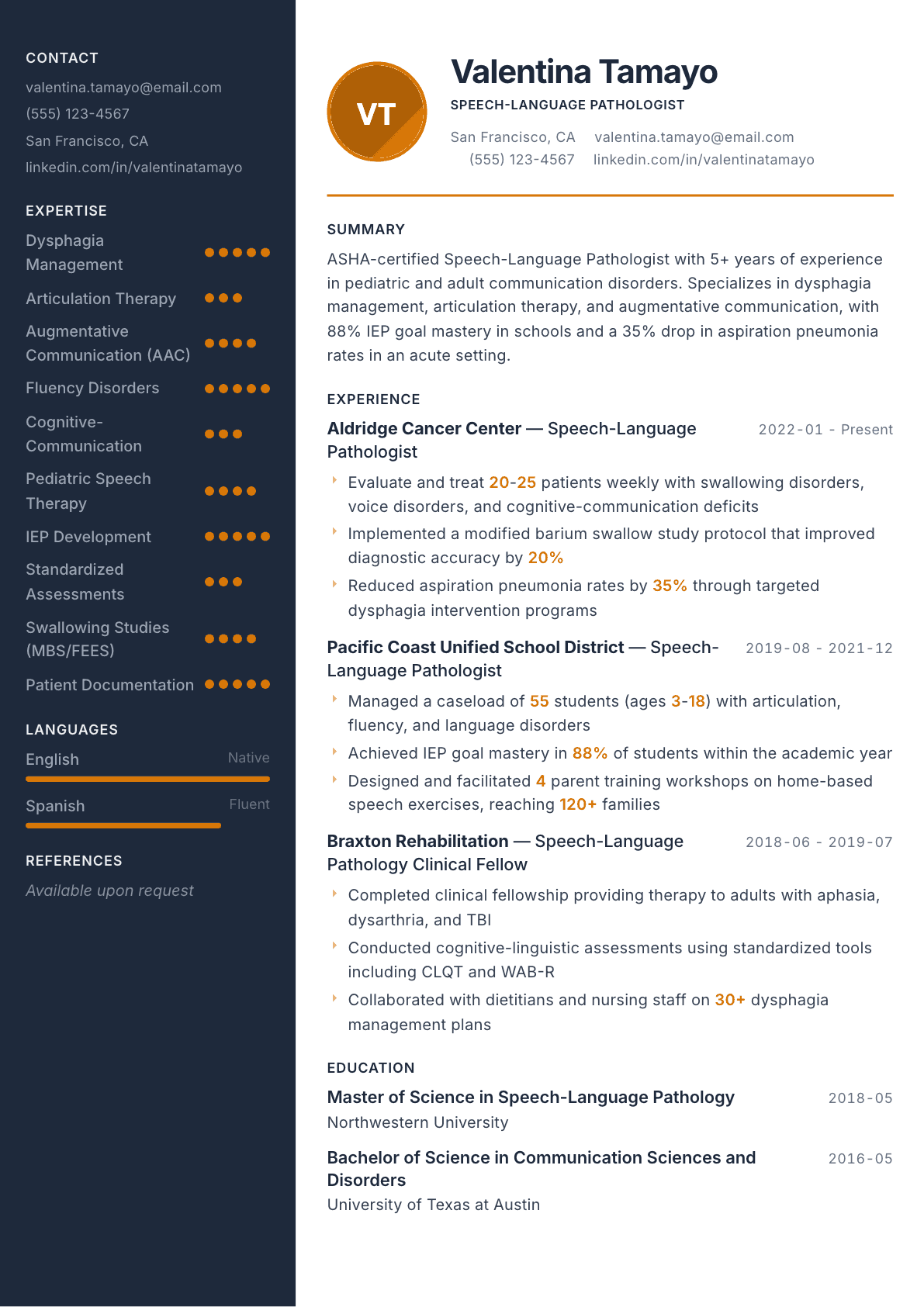
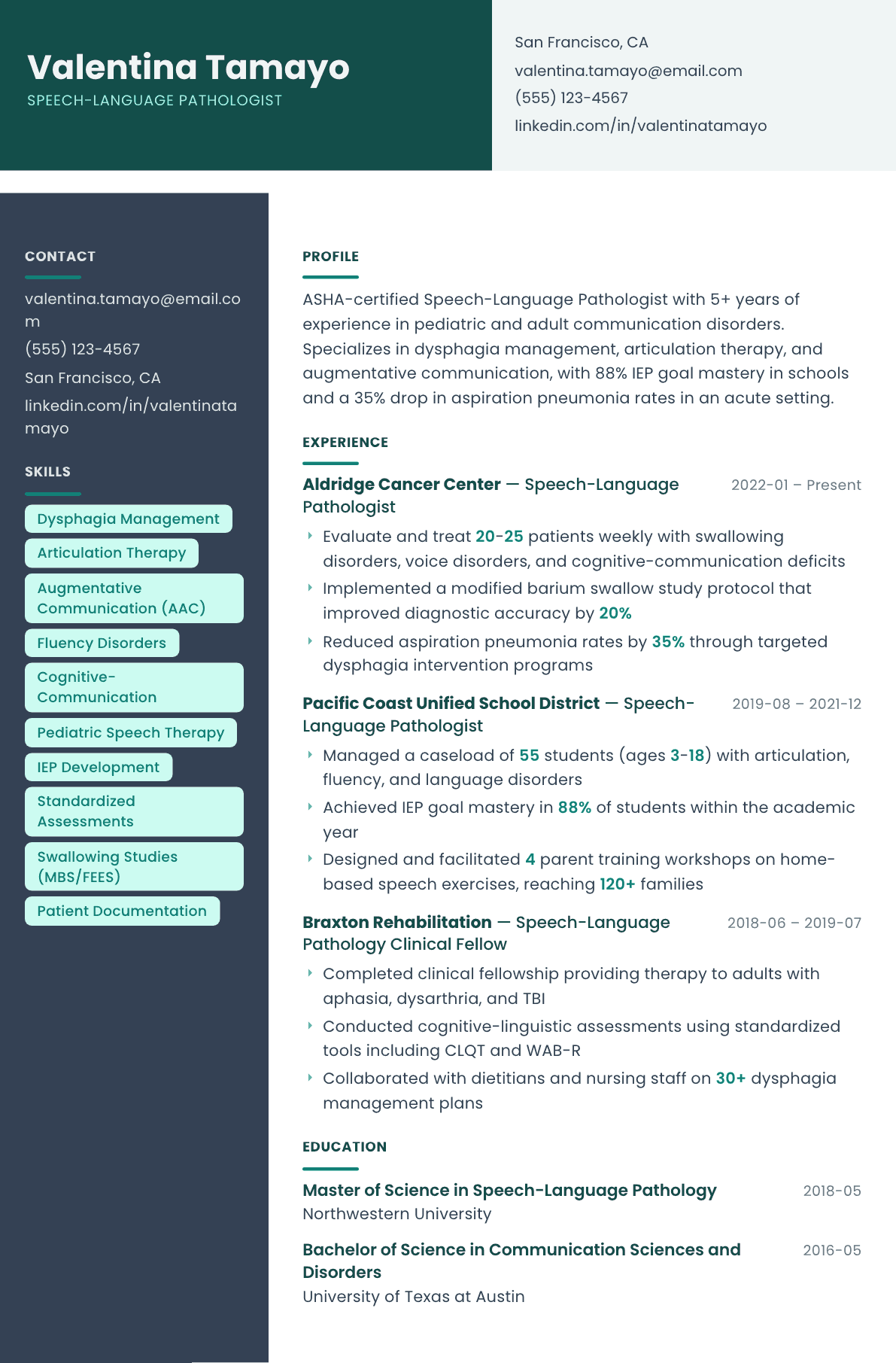
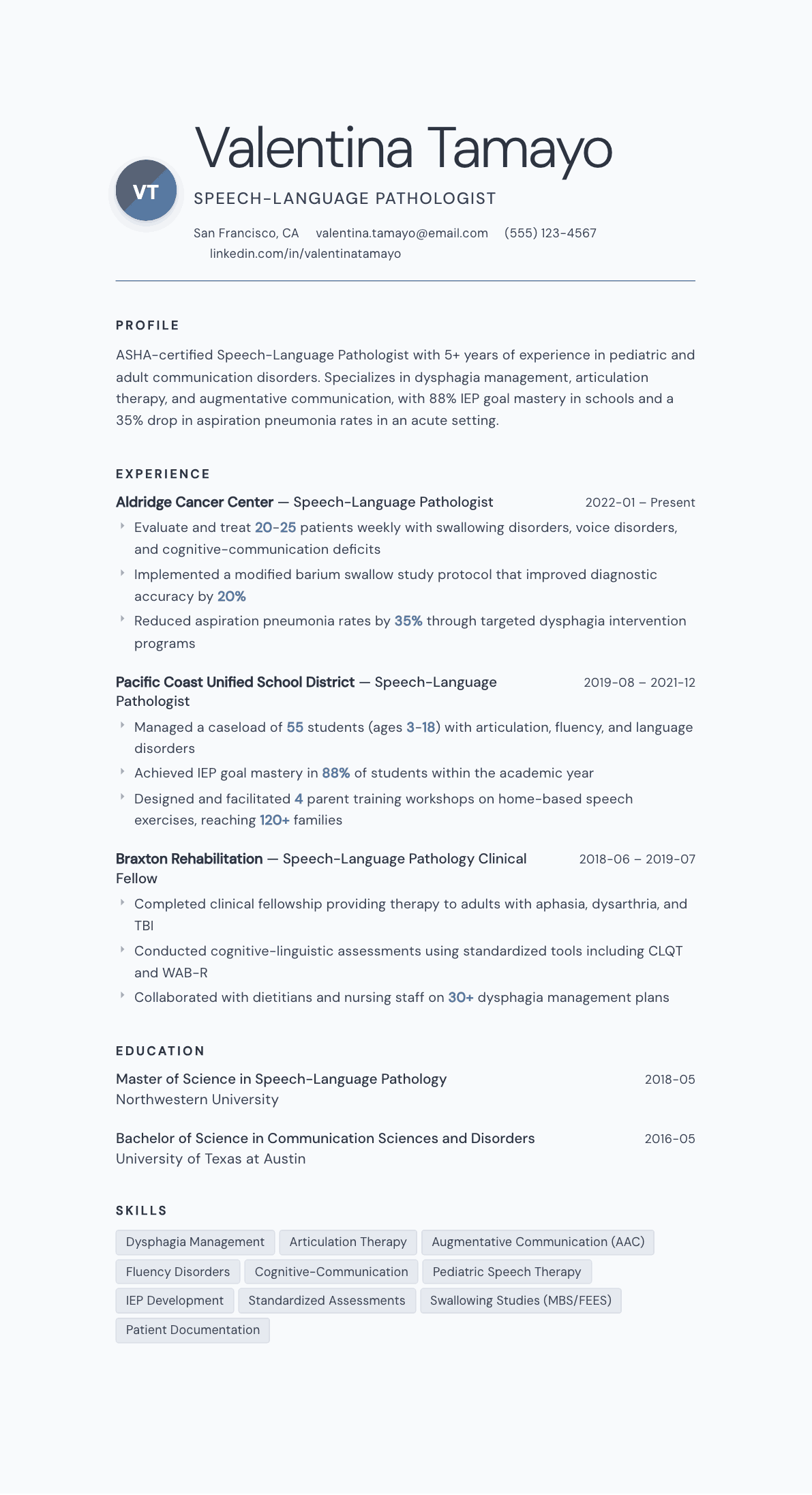
Example Speech-Language Pathologist summary
ASHA-certified Speech-Language Pathologist (CCC-SLP) with 5 years of experience treating communication and swallowing disorders across medical and school settings. Achieved 88% IEP goal attainment and reduced aspiration rates by 35% through evidence-based dysphagia protocols. Bilingual in English and Spanish.
Skills to list on a Speech-Language Pathologist resume
- Dysphagia Management
- Articulation Therapy
- Language Disorders
- Fluency Disorders
- Voice Disorders
- AAC Devices
- Cognitive-Communication
- Pediatric Speech Therapy
- IEP Development
- Standardized Assessments
- Swallowing Studies
- Patient Counseling
- Aphasia Treatment
- Early Intervention
What actually gets this resume read
- Display your CCC-SLP credential immediately after your name.
- Quantify caseload size, IEP goal attainment rates, and patient outcomes.
- Specify the populations and disorders you treat to match job descriptions.
- List standardized assessment tools you are proficient in (e.g., CLQT, PLS-5, CELF-5).
- Highlight bilingual skills, as bilingual SLPs are in high demand.
- Include continuing education in specialized areas like dysphagia or AAC.
How to write a speech-language pathologist resume
A Speech-Language Pathologist resume is read against a setting. School districts, skilled nursing facilities, acute hospitals, outpatient pediatric clinics and early intervention programs all hire SLPs, and they want almost nothing in common. The district wants caseload size, individualized education program writing and Medicaid billing. The hospital wants instrumental swallow studies, tracheostomy and ventilator patients, and same-day evaluation turnaround. A single generic resume reads as unqualified to both. Many postings, especially in private practice and schools, say speech therapist instead, and a speech therapist resume sample follows exactly the same rules.
The credential screen is quick: Certificate of Clinical Competence from the national association, state licensure, and for school work the state teaching or educational credential. Clinical fellows are screened separately, so say plainly whether you are in the fellowship year or past it.
This guide covers how to write for a named setting, three summaries from clinical fellow to lead, before-and-after bullets built on caseload and outcome data, a sample SLP resume laid out from header to skills, and the questions SLPs ask when moving between medical and educational work.
Format: pick the setting before you pick the words
Reverse chronological, one page for a fellow and two once you have several settings and instrumental competencies. Put the credentials after your name as the association writes them, then a licensure and certification block under the summary listing the state license, the certificate of clinical competence, and any state education credential.
Then decide the setting the resume is for and reorder everything to serve it. A medical resume leads with dysphagia, instrumental assessment and interdisciplinary rounds. A school resume leads with caseload size, age range, disorder mix and compliance with individualized education program timelines.
- Header: name, CCC-SLP, state license, city and state, phone, email.
- Order: summary, licensure and certification, clinical experience, assessments and competencies, education, skills.
- Clinical fellows list the fellowship site, the supervisor arrangement and the populations served.
Summary: population, caseload, disorders, the scarce competency
Name the population and age range, the setting, the caseload size and the disorder areas you treat. Then one scarce competency. Modified barium swallow study interpretation, fiberoptic endoscopic evaluation of swallowing, tracheostomy and speaking valve management, or augmentative and alternative communication device programming are the lines that get a callback, because most departments are short in exactly one of those.
If you are moving between settings, say it and name the bridge. A school Speech-Language Pathologist moving to outpatient pediatrics should point at the articulation, fluency and language caseload rather than the compliance paperwork.
Experience: caseload numbers and what you evaluated
Head each job with the setting, the population and the caseload. A line such as school-based SLP, 3 elementary sites, caseload of 55 students aged 3 to 18, does more than three sentences of description. In a medical setting use daily or weekly evaluation and treatment volumes plus the units you cover.
Then bullets naming the assessments and treatments. Standardized batteries you administer, instrumental studies you perform or interpret, therapy approaches you deliver by name, and the interdisciplinary work: dietitians on diet texture, nursing on aspiration precautions, teachers on classroom accommodations, otolaryngology on voice.
Avoid bullets that restate the profession. Provided speech therapy to patients could sit on any SLP resume ever written and tells a hiring manager nothing about your competencies.
Outcomes: the data this field can actually show
SLPs have unusually good outcome evidence available. Goal mastery rates against individualized education program goals, diet texture advancement, reduction in aspiration events on a unit, functional communication measure change scores, discharge to a less restrictive setting, and dismissal rates all belong in bullets when you have them.
Productivity is also read closely in medical and contract settings. If you have carried a demanding treatment target while keeping documentation current, say so plainly, because managers in skilled nursing and rehabilitation screen on it.
Assessments, tools and documentation systems
Give a compact competency block. Name the standardized assessments you administer, the instrumental procedures you are competent in, the augmentative communication platforms you program, and the documentation systems you chart in, whether an electronic health record or a school special education data system. That block carries most of the keyword weight for the applicant tracking system.
For school work, add the compliance vocabulary that district postings use: individualized education program development, present levels of performance, eligibility determination, response to intervention, and Medicaid billing documentation.
Sample speech language pathology resume, top to bottom
Here is the skeleton for a school-based SLP four years past the clinical fellowship who wants to move into outpatient pediatrics. Use this SLP resume example to check your order, then rebuild each line from your own caseload and assessments.
One page works for a clinical fellow. Two pages is normal once you have more than one setting, as long as the credential line and the setting you want sit in the top third.
- Header: Hannah Whitfield, M.S., CCC-SLP, state license, city and state, phone, email.
- Summary: Speech-Language Pathologist with four years in elementary schools, carrying a caseload of 52 students with articulation, language, fluency and AAC needs. Writes and leads IEP meetings, and wants to bring that caseload experience to an outpatient pediatric clinic.
- Licensure and certification: CCC-SLP, state license, state education credential, and any specialty training such as PROMPT or an AAC device certification.
- Experience: district or clinic, sites and dates, then caseload size and age range on the first line, followed by four bullets on assessments, treatment approaches, outcomes and collaboration.
- Education: graduate program, clinical placements by setting, and the undergraduate degree if it was in communication sciences.
Speech-Language Pathologist resume summary examples
Clinical fellow
Speech-Language Pathologist completing the clinical fellowship year in adult inpatient rehabilitation, treating aphasia, dysarthria, cognitive-communication deficits after brain injury and bedside swallow evaluation. Graduate placements covered pediatric outpatient, early intervention and a 12-week school rotation with a caseload of 30 students.
Five years in schools
Certified Speech-Language Pathologist with 5 years across 3 elementary sites, managing a caseload of 55 students aged 3 to 18 with articulation, fluency, language and social communication needs. Reached individualized education program goal mastery for 88% of students and ran 4 parent training workshops last year.
Lead medical SLP
Lead Speech-Language Pathologist with 11 years in acute care and inpatient rehabilitation, performing modified barium swallow studies and endoscopic swallow evaluations, and managing tracheostomy and ventilator-dependent patients. Supervises 5 clinicians and 2 clinical fellows and owns the dysphagia competency program.
Work experience bullets: before and after
Before: Provided speech therapy to students at three schools.
After: Carried a caseload of 55 students aged 3 to 18 across 3 elementary sites, treating articulation, fluency, receptive and expressive language and social communication needs.
Caseload size, age range, site count and disorder mix are what a district actually staffs against.
Before: Worked with patients who had swallowing problems.
After: Completed 20 to 25 dysphagia evaluations weekly, performed modified barium swallow studies with radiology, and set diet texture and compensatory strategies with the dietitian and nursing team.
Volume, the instrumental procedure and the interdisciplinary handoff prove medical competency rather than exposure.
Before: Wrote IEPs and attended meetings.
After: Wrote and defended 55 individualized education programs a year, held eligibility and reevaluation timelines without a compliance finding, and led the meetings for the district's speech-only caseload.
Volume plus a compliance record is the school-based evidence a special education director is looking for.
Before: Used AAC devices with nonverbal clients.
After: Evaluated and programmed high-tech augmentative communication systems for 12 nonspeaking students, trained classroom staff and families on device use, and wrote the funding justification reports.
Device programming, staff training and funding paperwork are three distinct skills that a vague AAC mention hides.
Before: Helped reduce aspiration pneumonia on the unit.
After: Built a bedside dysphagia screening pathway with nursing, retrained the unit on aspiration precautions, and cut pneumonia readmissions on the rehabilitation floor over 3 quarters.
Naming the pathway and the partner makes the outcome yours instead of the unit's.
Hard skills
- Dysphagia evaluation and treatment
- Modified barium swallow studies
- Endoscopic evaluation of swallowing
- Tracheostomy and speaking valve management
- Aphasia and apraxia therapy
- Cognitive-communication rehabilitation
- Articulation and phonology therapy
- Fluency treatment
- Augmentative and alternative communication
- Standardized assessment administration
- Individualized education program development
- Voice and resonance therapy
Soft skills
- Family and caregiver coaching
- Interdisciplinary collaboration
- Case management across sites
- Supervision of assistants and fellows
- Clear documentation habits
- Advocacy in team meetings
Certifications worth listing
- Certificate of Clinical Competence in Speech-Language Pathology (CCC-SLP) (American Speech-Language-Hearing Association)
- Board Certified Specialist in Swallowing and Swallowing Disorders (BCS-S) (American Board of Swallowing and Swallowing Disorders)
- Board Certified Specialist in Child Language (BCS-CL) (American Board of Child Language and Language Disorders)
- Board Certified Specialist in Fluency (BCS-F) (American Board of Fluency and Fluency Disorders)
- Lee Silverman Voice Treatment LOUD Certification (LSVT Global)
Mistakes that cost speech-language pathologist candidates the interview
- Writing one resume for both medical and school postings, when the two settings screen on entirely different competencies.
- Leaving the caseload number off a school resume, which is the first figure a special education director looks for.
- Saying dysphagia experience without naming whether you perform instrumental studies, interpret them, or only complete bedside evaluations.
- Listing every graduate practicum years after the fellowship ended instead of the paid clinical work that replaced it.
- Skipping the state license and certificate of clinical competence status, which stops the file at the credentialing step.
- Describing therapy generically when goal mastery, diet advancement and dismissal data are available and verifiable.
Speech-Language Pathologist resume questions
How should a clinical fellow present the fellowship year on a resume?
Name the site, the setting, the population and the supervision arrangement, and say clearly whether the fellowship is in progress or complete. List the graduate practicum placements underneath with hours and populations until you have paid clinical experience to replace them.
Do I need a different resume for school and medical SLP jobs?
Yes. Swap the summary, reorder the bullets, and change the competency block. A school version leads with caseload, individualized education program compliance and age range, while a medical version leads with instrumental swallow studies, tracheostomy patients and evaluation volume.
What numbers should go on an SLP resume?
Caseload size and age range, weekly evaluation and treatment volume, goal mastery rates, diet texture advancement, dismissal or discharge outcomes, and the number of clinicians or assistants you supervise. Choose the ones your target setting actually tracks.
Should I list the standardized assessments I administer?
Yes, in a compact competency block rather than inside prose. Hiring managers scan for the batteries their department uses and for instrumental competencies, and the applicant tracking system indexes those names as keywords.
Is a speech therapist resume different from a speech language pathologist resume?
No. Speech therapist is the everyday name for the same licensed role, so use whichever title the posting uses in your header and summary, and keep the credential line exact: the CCC-SLP from ASHA and your state license. The sample resume on this page works under either title, in schools or in medical settings.