Design Systems Lead Resume Examples: what gets the call
Build a Design Systems Lead Resume That Demonstrates Scale
By Mustafa Tarabya, founder of CVBooster · Published · Updated
Create a design systems lead resume highlighting your component library, design token, and cross-team governance expertise with modern templates.
Sample resumes for a design systems lead
The same design systems lead content laid out in three CVBooster templates, so you can see what the finished document looks like before you write a word.
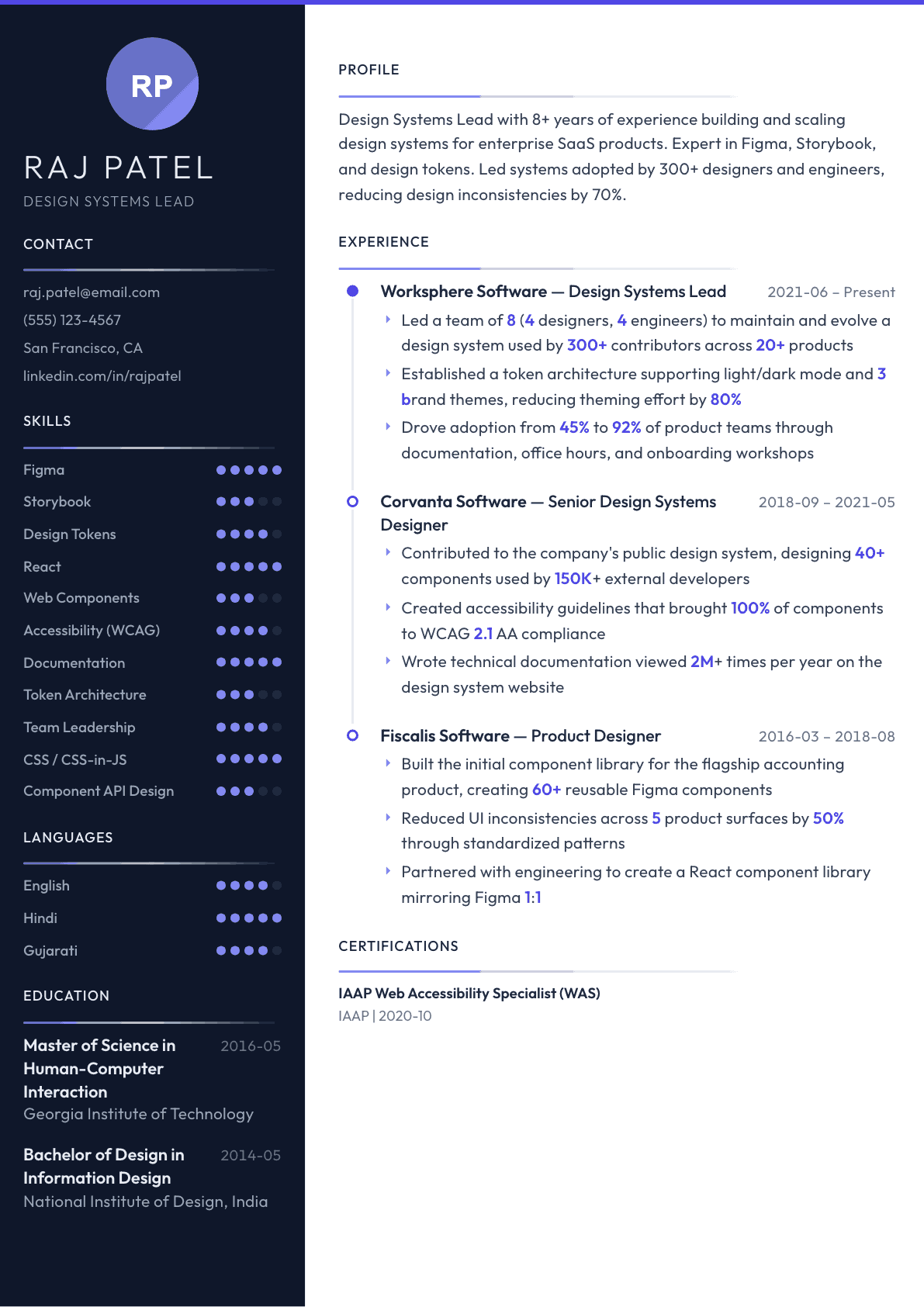
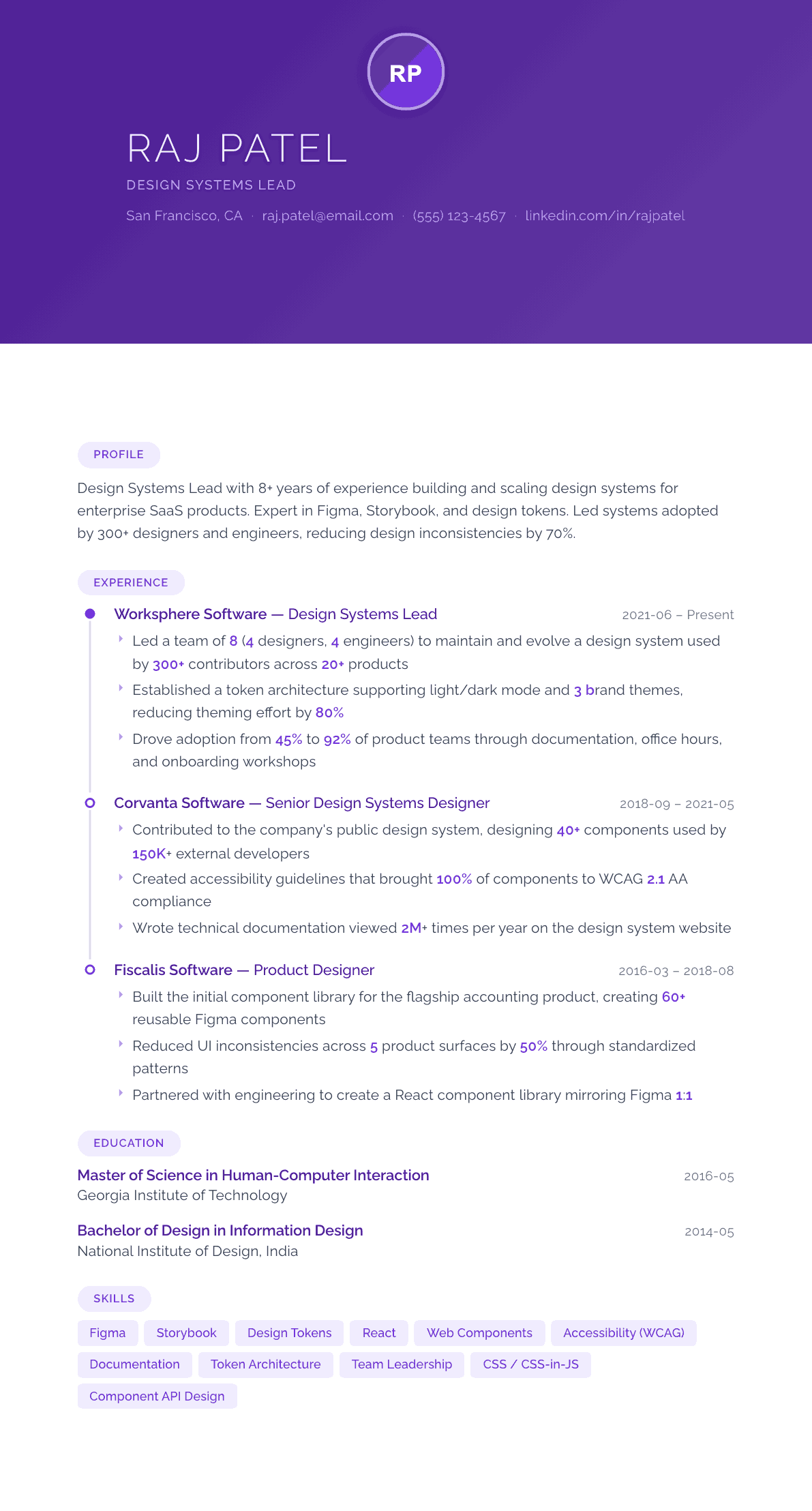
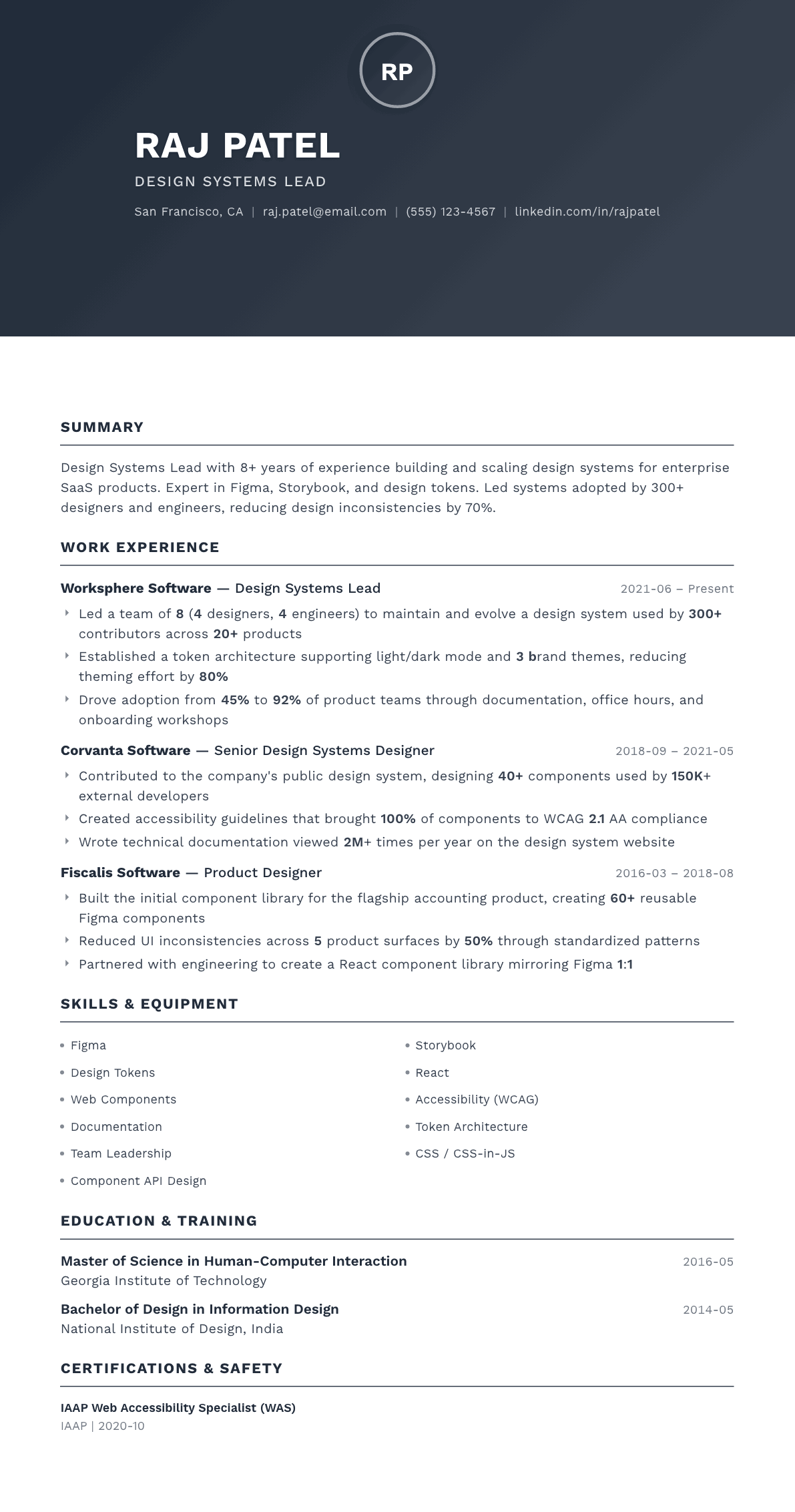
Example Design Systems Lead summary
Strategic Design Systems Lead with 8 years building scalable component libraries and token architectures for enterprise SaaS. Led systems adopted by 300+ contributors, reducing inconsistencies by 70% and theming effort by 80%. Fluent in Figma, Storybook, React, and WCAG accessibility standards.
Skills to list on a Design Systems Lead resume
- Design Systems
- Figma
- Storybook
- Design Tokens
- React
- CSS / CSS-in-JS
- Web Components
- Accessibility (WCAG)
- Documentation
- Component API Design
- Versioning & Release
- Team Leadership
- Cross-functional Collaboration
- Token Architecture
What actually gets this resume read
- Quantify system scale: number of components, tokens, consumers, products, and contributors.
- Highlight adoption metrics -- going from low to high adoption is the hardest and most valuable skill.
- Show both design and engineering fluency: Figma, Storybook, React, CSS, tokens, versioning.
- Mention governance processes you established: contribution models, release cycles, breaking change policies.
- Include accessibility achievements: WCAG compliance levels, audit pass rates.
- Link to any public design system documentation or conference talks.
How to write a design systems lead resume
A design systems lead is hired to solve an organizational problem with a design and engineering artifact. Anybody can build a component library. The job is getting product teams to use it, keeping it correct as the product changes, and making sure the thing does not quietly rot into a folder nobody trusts. Hiring managers read these resumes looking for adoption and governance evidence, and most candidates write about components instead.
The role sits between three groups who do not naturally agree: designers who want expressive freedom, engineers who want stability and a small bundle, and product managers who want their feature out this sprint. The lead has to hold a standard while staying useful to all three. Resumes that only show craft miss the half of the job that is negotiation, documentation and slow persuasion.
This guide covers the section order design and engineering hiring managers expect, how to write adoption and governance as evidence rather than as claims, how to show accessibility work credibly, three summaries from a first systems role through lead, before and after bullets, and the questions people in this role ask when they rewrite the page.
Format: one page under eight years, engineering fluency visible early
Reverse chronological, one column, text that a parser can read. Under your name put the title, city, email, portfolio link and any public documentation site, repository or conference talk. Public artifacts are unusually valuable in this role because they let a hiring manager evaluate your documentation voice directly, which is a large part of the job.
Order the page: header, summary naming the scale of systems you have run, experience, systems and technical skills, accessibility, education, and speaking or writing. Put at least one engineering signal in the top third, because the fastest way to be filtered out of this role is to read as a designer who has never opened a pull request.
- Under each role give the system scale: number of components, number of consuming products or teams, number of contributors, and the platforms supported.
- Say whether the system served web only, or web plus native, and whether it had to theme across brands or products.
- Name your reporting line: design organization, engineering organization, or a platform team, since it changes what the job actually was.
Scale and structure: the numbers that size the job
A system with 30 components serving one product and a system with 120 components serving eleven products across web and two native platforms are different jobs by an order of magnitude. Give the counts. Components, tokens, consuming teams, contributors, supported platforms and themes are the figures a hiring manager uses to calibrate everything else you claim.
Then describe how the system was structured, because the architecture is your design work. Token layers from primitive through semantic to component level, theming strategy, the split between design tool libraries and code packages, versioning and release approach, and how breaking changes were handled. Anyone who has run a system for two years has opinions here, and stating yours is what makes the resume read as a lead rather than a contributor.
Adoption and governance: the evidence that matters most
Adoption is the only real measure of a design system. Say how you measured it and what it did: coverage of components in production interfaces, the share of screens built from the library, detection of one off components, or a count of teams migrated. If you inherited a system nobody used and got it to real usage, that story is worth more page space than everything else on the resume.
Governance is how the system survives contact with product teams. Describe the contribution model, the review path for proposals, the release cadence, the deprecation policy, office hours or a support channel, and how you decided when something belonged in the system rather than in a product. Write these as processes you ran, with the frictions they caused and how you resolved them, because a hiring manager is trying to learn whether you can hold a line without becoming a blocker.
Support work belongs here too. Answering questions, unblocking teams, pairing with product designers and engineers, and writing the migration guide. It is unglamorous and it is a large part of the week, and naming it signals that you know what the job actually contains.
Accessibility: be specific or say nothing
Accessibility claims are cheap and easy to check. Say what you actually did: the conformance level you targeted, keyboard interaction patterns implemented for complex components such as menus, comboboxes and dialogs, focus management and focus visible treatment, screen reader testing on named readers, automated checks in the pipeline, and audits by an external partner or an internal specialist.
The strongest evidence is a hard component done right. A date picker, a data table with sorting and selection, or a modal stack built with correct roles, labeling and keyboard behavior demonstrates more than a general commitment to inclusive design ever will. Name the component and the pattern you followed.
Technical fluency and search terms
Name the design tool and its library features, the front end framework and language the components were written in, the documentation and component workshop tooling, the token pipeline and any transformation step from design source to code, the package registry and release automation, and the visual regression and unit testing you ran. You do not need to be the strongest engineer on the team, but you need to be credible in a code review conversation.
Hiring managers and recruiters search for design system, component library, design tokens, theming, accessibility conformance, contribution model, adoption, documentation, and the named tools. Put the two or three that describe your last system into the summary and repeat each once inside an experience bullet with the work behind it.
Design Systems Lead resume summary examples
First systems role
Product designer with 4 years who moved onto the design system team, owning 22 components across the design library and their documentation. Built the first token layer, ran weekly office hours for three product squads, and wrote the contribution guide the team still uses.
Design systems designer
Design systems designer with 7 years, maintaining a library of 60 components used by 5 product teams across web and one native platform. Owns semantic token architecture and theming, pairs with engineers on component behavior, and drove component coverage in production from a third to over 80%.
Design systems lead
Design systems lead with 12 years, running a team of 4 designers and 3 engineers on a system serving 11 products and roughly 200 contributors. Owns versioning, deprecation policy and accessibility conformance, and rebuilt the token pipeline to support three brand themes from one source.
Work experience bullets: before and after
Before: Built and maintained a component library.
After: Owned a library of 60 web components from design source through published package, running a two week release cadence with a documented deprecation window for every breaking change.
The pipeline, cadence and deprecation policy show the operational discipline that keeps a system trustworthy.
Before: Improved design system adoption across teams.
After: Raised production component coverage from a third of screens to over four fifths by migrating the two highest traffic products myself, publishing a migration guide and holding weekly office hours for the remaining teams.
Naming the mechanism, including doing the hard migrations personally, makes the adoption number credible.
Before: Made the design system accessible.
After: Rebuilt the menu, combobox and dialog components to the published authoring patterns, adding focus management and screen reader testing, and wired automated accessibility checks into the pull request pipeline.
Specific components, patterns and automation replace a claim that no hiring manager could evaluate.
Before: Worked with engineers on the component library.
After: Reviewed component pull requests alongside the engineering owner, catching interaction and token misuse before release, and paired on the props interface so designers and developers named the same things.
Sitting in code review and shaping the interface naming is the concrete form of cross discipline fluency.
Before: Created documentation for the design system.
After: Rewrote the documentation site around usage guidance rather than props tables, adding do and do not examples, accessibility notes and a decision log explaining why each pattern exists.
Documentation structure and a decision log show you understand that a system is taught, not just published.
Hard skills
- Component library architecture
- Design token systems and theming
- Design tool library management
- Front end component implementation
- Versioning and release management
- Deprecation and migration planning
- Accessibility conformance testing
- Documentation site authoring
- Visual regression testing
- Contribution model design
- Adoption measurement
- Cross platform system support
Soft skills
- Saying no to a one off without losing the team
- Writing clearly for two audiences
- Running office hours patiently
- Building consensus across disciplines
- Long horizon persistence
Certifications worth listing
- Certified Professional in Accessibility Core Competencies (CPACC) (International Association of Accessibility Professionals)
- Web Accessibility Specialist (WAS) (International Association of Accessibility Professionals)
Mistakes that cost design systems lead candidates the interview
- Writing about components and never about adoption, which is the only measure that tells a hiring manager the system worked.
- Leaving out scale numbers, so the reader cannot tell a one product library from an enterprise platform.
- Reading as a pure visual designer, which gets the resume filtered before anyone sees the systems work.
- Claiming accessibility without naming a conformance level, a component or a testing method.
- Ignoring governance entirely, when contribution, review and deprecation are the daily work of the role.
- Skipping the support and documentation half of the job, which is where most of the week actually goes.
Design Systems Lead resume questions
How do I move into a design systems lead role from product design?
Show the systems work already inside your product experience: shared patterns you standardized, a component you contributed upstream, documentation you wrote, or a token migration you drove. Then add engineering fluency evidence, since that is the credibility gap most product designers have to close.
How technical does a design systems lead need to be?
Enough to read a component implementation, discuss a props interface, review a pull request and understand a build and release pipeline. You do not need to be the strongest engineer on the team, but a lead who cannot hold that conversation ends up outside the decisions that matter.
What numbers belong on a design systems resume?
Component and token counts, consuming teams and products, contributors, supported platforms and themes, adoption or coverage, and release cadence. Pair the adoption figure with the specific action that moved it, because coverage numbers with no mechanism read as inherited rather than earned.
Should I include a portfolio for a design systems role?
Yes, but build it around architecture and adoption rather than screenshots. Show token layers, a component anatomy with its states, documentation pages you wrote, and a before and after of a product migrated onto the system. Public documentation or a talk works even better.
How do I write about a design system that failed to gain adoption?
Write it honestly and lead with what you learned. Say what you tried, where the resistance came from, and which change eventually moved things or would have. Hiring managers have all lived through a stalled rollout, and a candidate who can diagnose one is more useful than one who has only seen success.