Digital Designer Resume Examples: the lines they read
Craft a Digital Designer Resume for Web, App and Campaign Work
By Mustafa Tarabya, founder of CVBooster · Published · Updated
Digital designer resume example covering web, email and app design, plus keywords, tool lists and a complete writing guide.
Sample resumes for a digital designer
The same digital designer content laid out in three CVBooster templates, so you can see what the finished document looks like before you write a word.
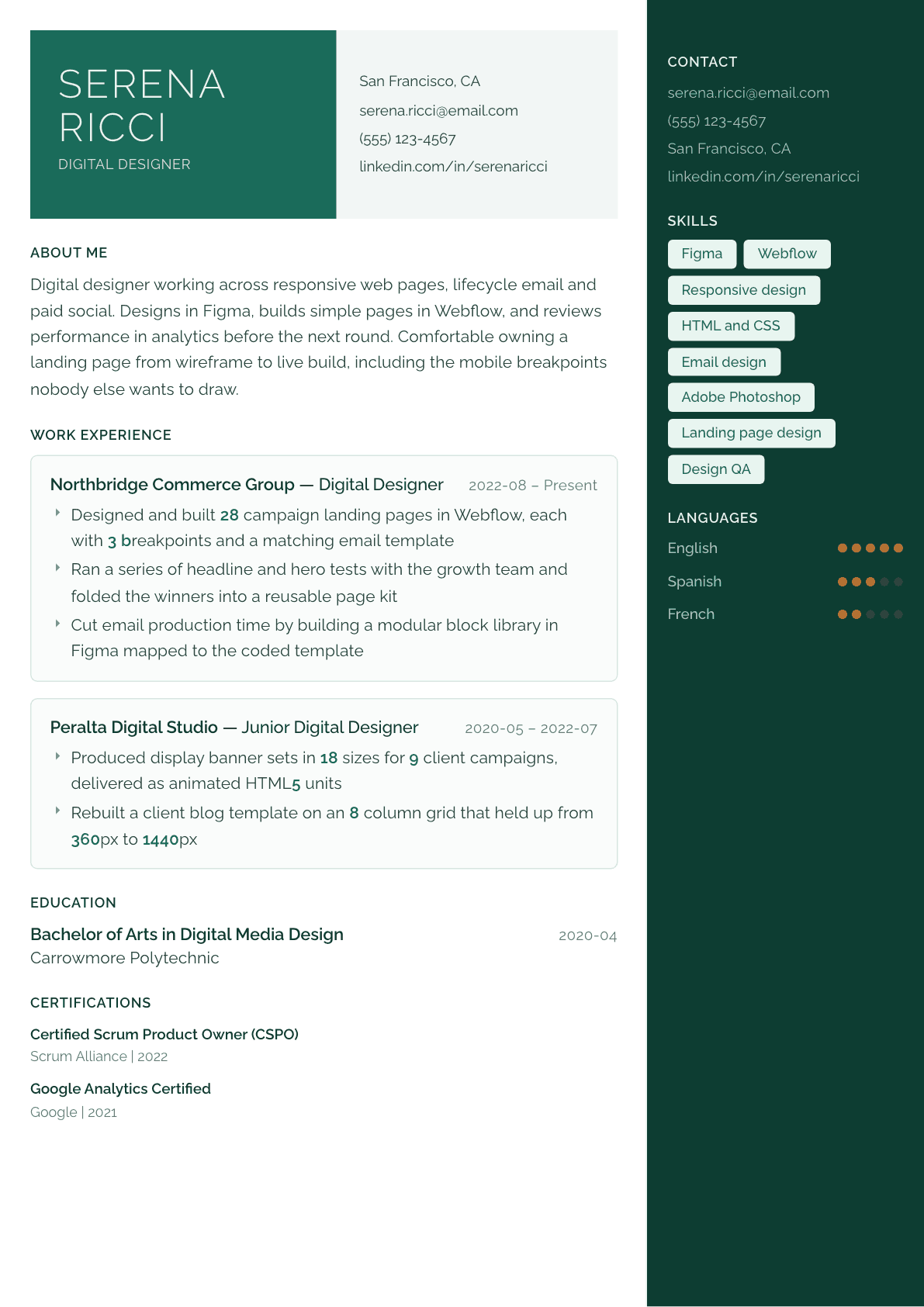
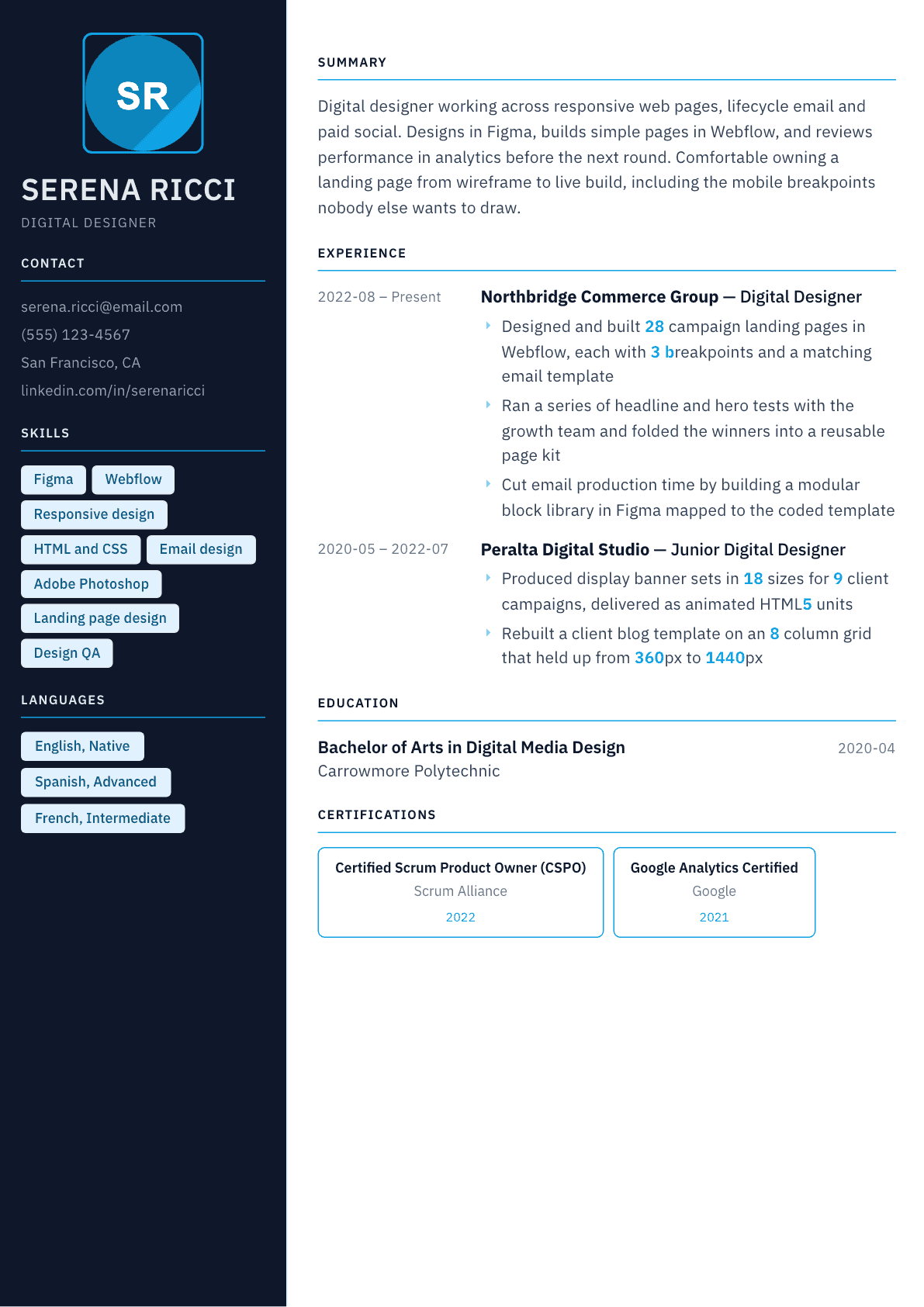
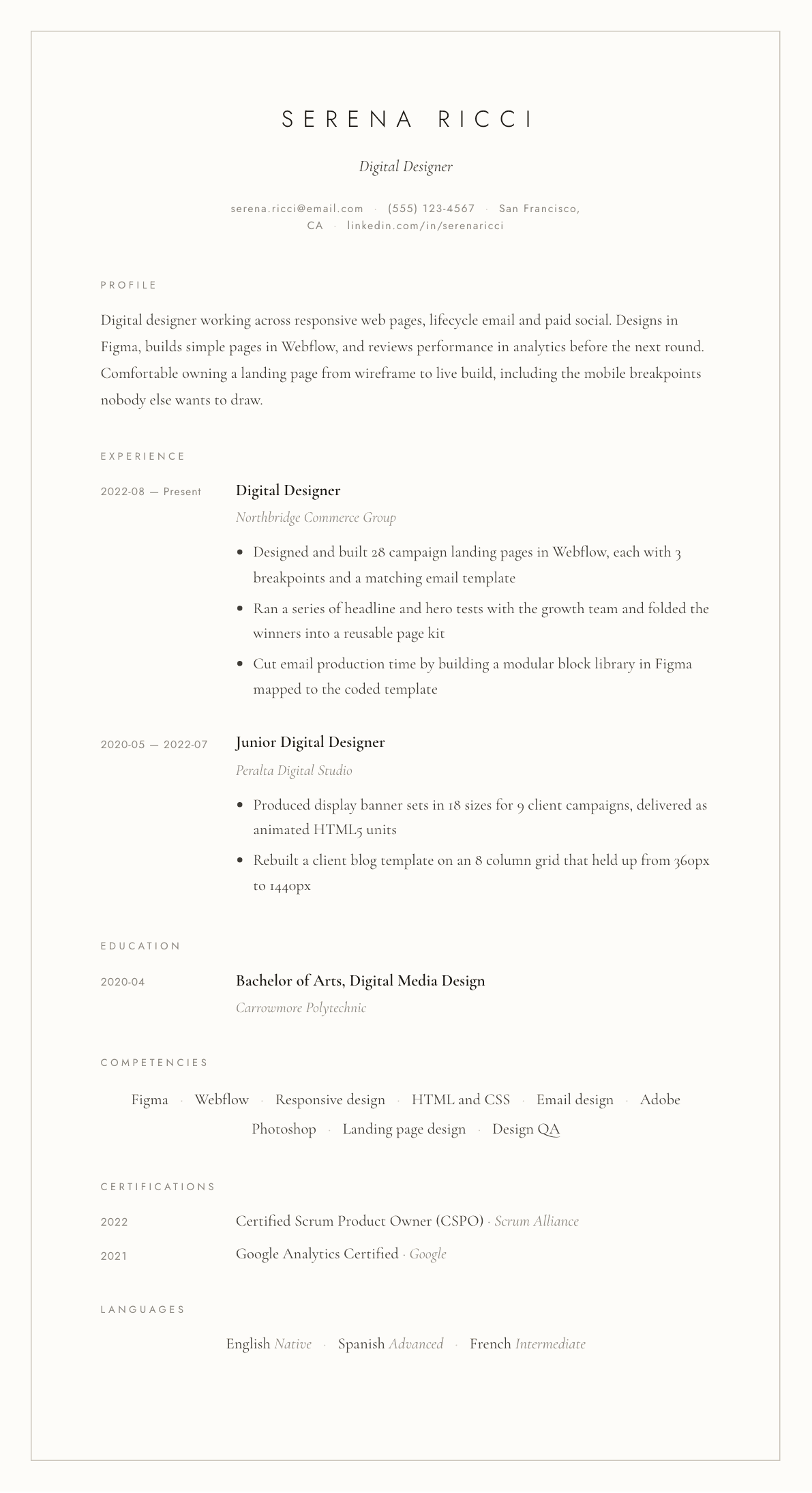
Example Digital Designer summary
Digital designer with four years across responsive web, lifecycle email and paid social creative. Works in Figma, builds pages in Webflow, and edits HTML and CSS well enough to keep a live page moving without waiting on a sprint. Shipped dozens of campaign landing pages with matching email templates and a modular block library. Wants a role where design and growth sit in the same room.
Skills to list on a Digital Designer resume
- Figma
- Webflow
- Responsive web design
- HTML
- CSS
- Email design
- Landing page design
- Display advertising
- Adobe Photoshop
- Adobe Illustrator
- Design systems
- Prototyping
- Design QA
- Content management systems
What actually gets this resume read
- State the digital surfaces you own: web pages, email, display, app screens, or the combination a posting names.
- Give breakpoint and format detail, because responsive craft is what separates a digital designer from a print one.
- Mention the build tools you touch, such as Webflow, WordPress themes or basic HTML and CSS edits.
- Tie at least one project to a measured result the growth or marketing team tracked after launch.
- Describe your design QA habit: browser checks, dark mode, email client rendering, and what you caught.
- Group the tools into design, build and analytics so a recruiter scanning for one of them finds it quickly.
How to write a digital designer resume
Digital designer postings almost always hide a build expectation. The team wants someone who designs the landing page and then puts it live, or at least gets it close enough that a developer only has to review it. That is why the resumes that get calls name a build tool next to the design tool, and why the ones that stop at a Figma file get passed over for a candidate who also knows what breaks in an email client.
The second thing that separates this role from general graphic design is responsive craft. Anyone can center a hero on a desktop artboard. The hire is the person who has drawn the awkward middle breakpoint, decided what the navigation collapses into, kept a data table readable on a narrow screen, and checked the result in a real browser rather than a preview panel.
This guide covers how to state your surfaces, how much build detail to include, how to tie creative work to a number the marketing team already tracks, and how to describe the design quality pass that keeps a live page from embarrassing everyone.
Format: one page, tools grouped by stage, live links where they exist
Reverse chronological, one page, and a tools block split into design, build and analytics. A recruiter scanning for one word finds it in a second, and a hiring manager reading the same block learns instantly whether you stop at the handoff or carry the page to production.
Link live pages rather than static images wherever the work is still up. A reviewer who can resize your page in their own browser gets more from ten seconds there than from a full case study. Keep a small archive of screen recordings for the pages that have since been replaced.
- Header: name, title, city, email, portfolio address, and one live page link.
- Sections: summary, experience, tools grouped by stage, selected projects, education.
- Name the content management system you have worked inside, because most teams live in one.
Summary: which digital surfaces you own
Say it plainly: responsive web pages, lifecycle email, display advertising, app screens, or the combination the posting names. A digital designer who does email well is scarce, and one who can also build in a visual web tool is scarcer still, so lead with the strongest of the three rather than a general statement about digital work.
Add the build line in the summary itself. Something like designs in Figma, builds in a visual web tool, and edits HTML and CSS well enough to keep a live page moving is more persuasive than a skills list, because it describes an end to end capability rather than a set of parts.
Experience: breakpoints, formats and what went live
Give each project its real shape: how many pages, how many breakpoints, whether a matching email template came with it, and how many ad sizes the set covered. Format counts are the fastest way to communicate production volume in a field where the same idea has to be redrawn a dozen times.
Name the systems you built to stop redrawing. A modular email block library in Figma mapped to a coded template, a page kit that lets a marketer assemble a campaign without a design ticket, a master banner file that resizes without redrawing the layout. These are the bullets that separate a production designer from a design operator.
Then attach one project to a result the growth or marketing team already tracks. Not a number you invented: the headline test they ran, the form completion change they measured, the drop in production hours they noticed. Say which creative decision moved it.
The build side: say exactly how far you go
Be honest and specific about the boundary. Building responsive pages in a visual web tool, editing a template in a content management system, adjusting CSS in a live theme and writing a component from scratch are four very different claims, and an interviewer will find out which one is true within a few questions.
If you work in HTML email, say so and name the constraints you handle: table based layouts, inline styles, dark mode inversion, image blocking fallbacks and the clients you test in. Email rendering knowledge is rare enough that it is often the reason one candidate gets picked over another.
- Design: Figma, Photoshop, Illustrator, prototyping.
- Build: a visual web builder, HTML, CSS, a content management system, HTML email.
- Check: analytics dashboards, tag or event naming, browser and email client testing.
Design QA: the habit that keeps you employed
Every team has been burned by a page that broke on a phone the morning a campaign started. One bullet describing your review routine, the browsers and devices you check, the dark mode pass, the email clients you preview in, and something real you caught before release, tells a manager you are the person who prevents that morning.
Include the boring reliability signals too: naming conventions for assets, a source file that someone else can open and understand, and a handoff note that survives your vacation. Digital design work is rarely done alone or once.
Digital Designer resume summary examples
Junior digital designer
Junior digital designer with 2 years in an agency producing display banner sets in 18 sizes across 9 client campaigns, delivered as animated HTML5 units. Rebuilt a client blog template on an 8 column grid that held from 360px to 1440px. Comfortable in Figma and confident editing HTML and CSS.
Four years in
Digital designer with 4 years across responsive web, lifecycle email and paid social creative. Designed and built 28 campaign landing pages with 3 breakpoints each and matching email templates, and created a modular block library that cut email production time. Reads the analytics dashboard before starting the next round.
Senior digital designer
Senior digital designer with 8 years owning web and email creative for consumer brands. Runs the page kit, the email block system and the design quality pass, partners with growth on creative tests, and builds production pages directly rather than waiting on a sprint. Mentors two designers and reviews all live work.
Work experience bullets: before and after
Before: Designed landing pages for marketing campaigns.
After: Designed and built 28 campaign landing pages in a visual web builder, each with 3 breakpoints and a matching email template, and handed the growth team a page kit they assembled the next campaign from.
Page count, breakpoints, the build tool and the reusable kit describe the whole job rather than the drawing part of it.
Before: Created email templates.
After: Built a modular email block library in Figma mapped one to one with the coded template, so marketers could assemble a send from approved blocks without a new design request.
The mapping to the coded template is the detail that proves the library actually worked in production.
Before: Worked with the growth team on A/B tests.
After: Ran headline and hero creative tests with the growth team across a quarter, then folded the winning layout pattern into the reusable page kit so later campaigns started from it.
The result is carried back into the system, which is what a manager wants to see from testing work.
Before: Made banner ads in multiple sizes.
After: Produced display sets in 18 sizes for 9 client campaigns from a single master artwork file, delivered as animated HTML5 units within the file weight limits each network enforces.
The master file method and the weight constraint show production efficiency and platform knowledge.
Before: Checked designs before launch.
After: Ran a pre launch pass on every page across two browsers, dark mode and a narrow phone width, catching a collapsed navigation and an unreadable form label before a campaign went live.
A named routine with a real catch turns quality assurance from a claim into a working habit.
Hard skills
- Figma
- Responsive web design
- Visual web builders
- HTML
- CSS
- HTML email design
- Landing page design
- Display advertising formats
- Adobe Photoshop
- Adobe Illustrator
- Design systems and page kits
- Prototyping
- Design quality assurance
- Content management systems
Soft skills
- Working with growth teams
- Deadline management
- Feedback iteration
- Clear handoff notes
- Curiosity about results
Certifications worth listing
- Google Analytics Certification (Google)
- Certified Professional in Accessibility Core Competencies (CPACC) (International Association of Accessibility Professionals)
- Adobe Certified Professional in Visual Design Using Adobe Photoshop (Adobe)
Mistakes that cost digital designer candidates the interview
- Leaving out the build tools, which makes a team assume you hand over a file and stop there.
- Showing only desktop artboards in a portfolio for a job that is mostly viewed on phones.
- Claiming more code ability than you have, since an interviewer finds the boundary in three questions.
- Never connecting a project to a number the marketing team already tracks.
- Listing every social platform as a skill instead of describing the creative you produced for them.
- Ignoring email work in the portfolio when the posting clearly asks for lifecycle design.
Digital Designer resume questions
Do I need to know how to code to be a digital designer?
Not fully, but the boundary matters. Most teams expect you to read HTML and CSS, edit a template safely, and build pages in a visual web tool. Say exactly how far you go rather than implying full front end development you cannot demonstrate.
How do I show responsive design skill on a resume?
Name breakpoints, grid structures and pixel widths you designed across, and describe one hard case such as a navigation collapse or a data table on a narrow screen. Then link a live page a reviewer can resize in their own browser.
Should email design get its own section?
Give it its own bullets inside the relevant job rather than a separate section. Name the template system, the client testing you do, and constraints such as dark mode inversion and image blocking, because that knowledge is scarce and worth surfacing.
What metrics can a digital designer honestly claim?
The ones the marketing team measured and would confirm: test outcomes on creative you designed, production time reduced by a template system, or asset volume produced per campaign. Never attach a revenue figure to a page you only designed one part of.
How many projects belong in a digital design portfolio?
Five or six, each showing the full surface set rather than one hero image. Include a landing page with its email and ad units so a reviewer sees you carrying a single idea across formats, which is most of the actual job.