UI Designer Resume Examples: free ATS score and gap list
Build a UI Designer Resume That Impresses Product Teams
By Mustafa Tarabya, founder of CVBooster · Published · Updated
Create a UI designer resume highlighting your visual design, prototyping, and design system skills with modern, ATS-optimized templates.
Sample resumes for a ui designer
The same ui designer content laid out in three CVBooster templates, so you can see what the finished document looks like before you write a word.
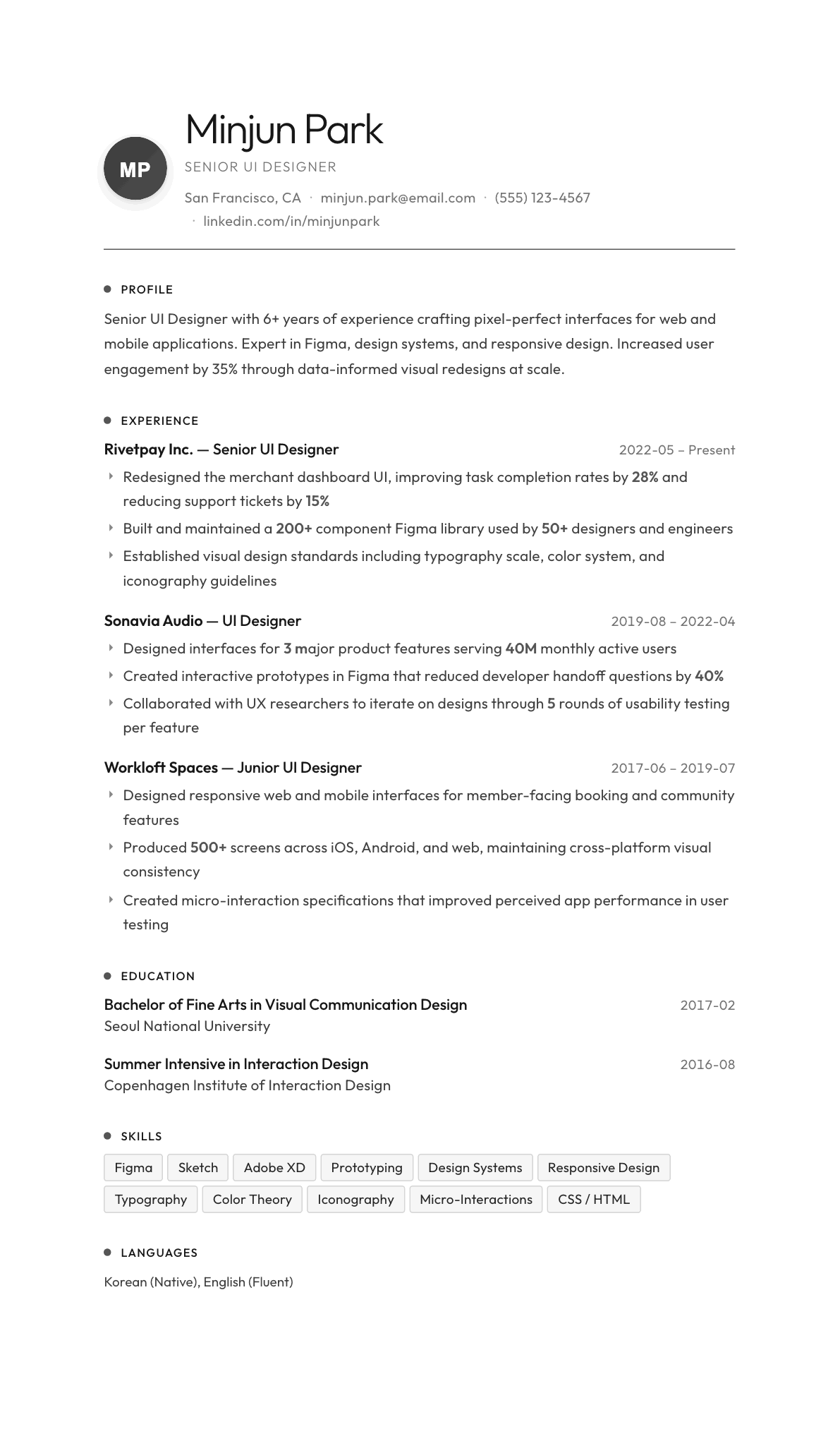
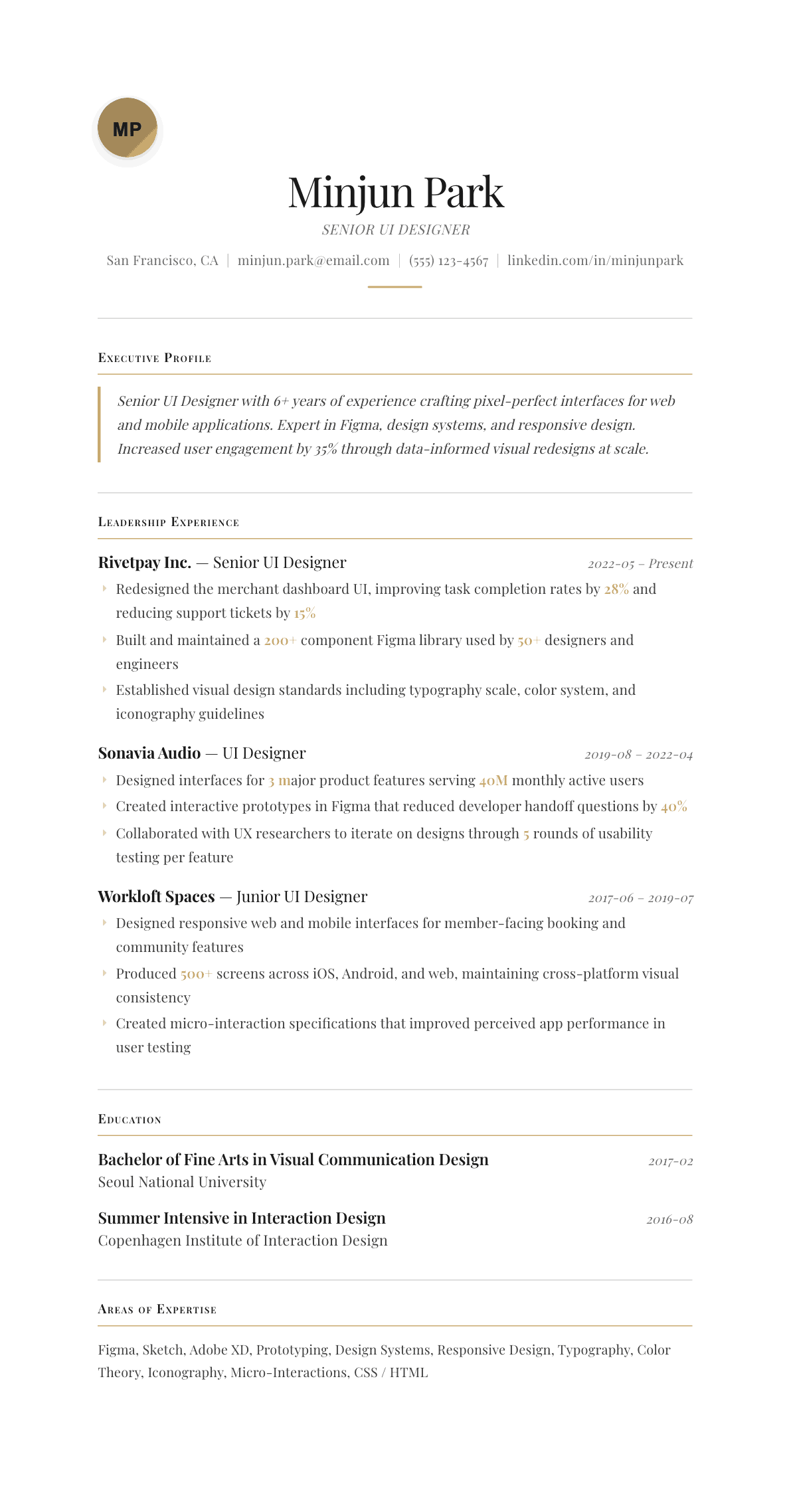
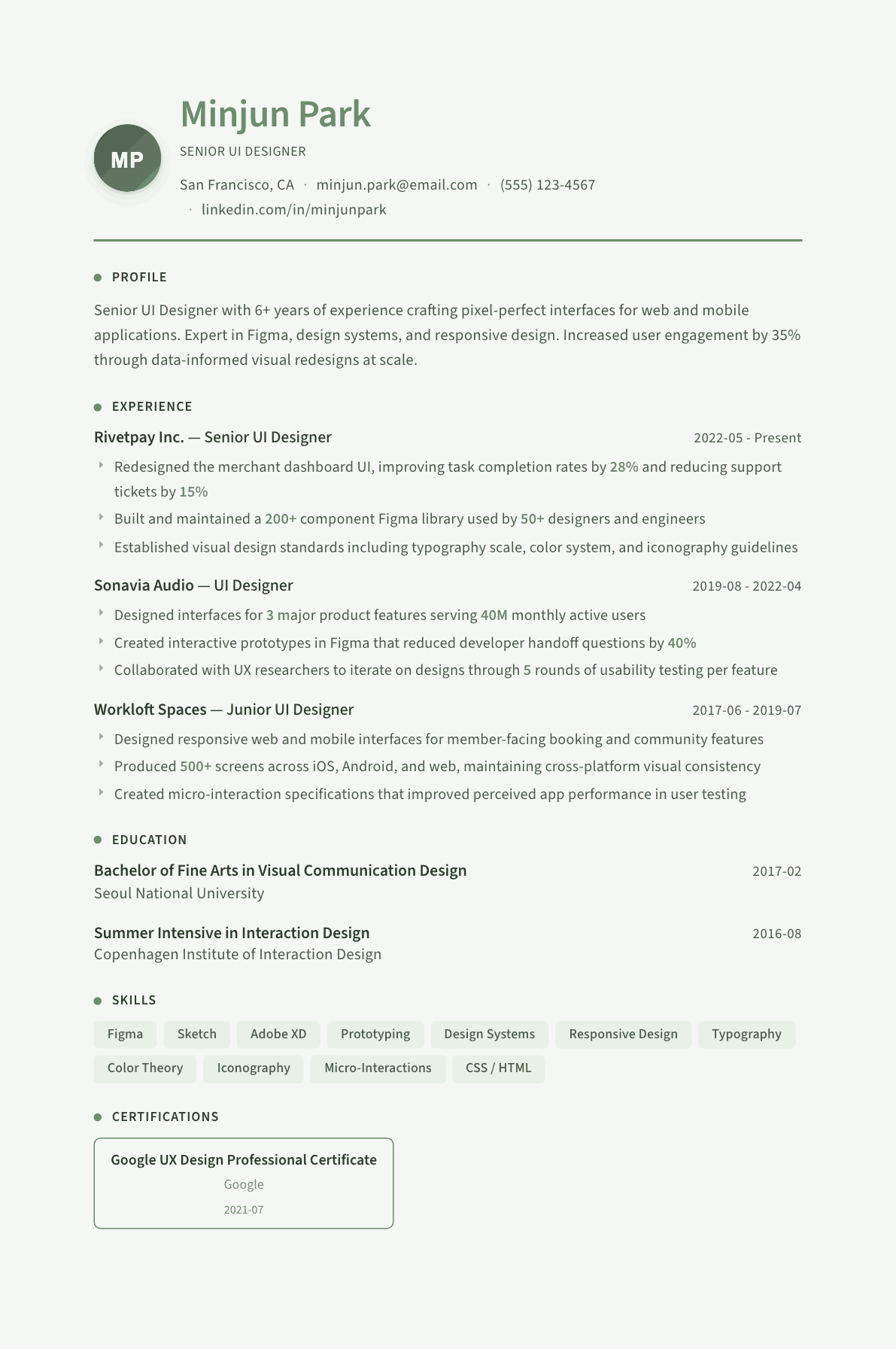
Example UI Designer summary
UI Designer with 6 years on web and mobile products at scale, working in Figma with design systems and responsive layouts. Maintains a 200+ component library used by 50+ designers and engineers, and a dashboard redesign lifted task completion 28% and cut support tickets 15%.
Skills to list on a UI Designer resume
- Figma
- Sketch
- Adobe XD
- Prototyping
- Design Systems
- Responsive Design
- Typography
- Color Theory
- Iconography
- Micro-Interactions
- CSS / HTML
- Accessibility (WCAG)
- Mobile UI Design
- Design Handoff
What actually gets this resume read
- Link to a Figma portfolio or personal site with annotated case studies showing your design decisions.
- Quantify UI impact: conversion lifts, task completion improvements, support ticket reductions, or engagement gains.
- List your design tools: Figma, Sketch, Adobe XD, Framer, Principle, or InVision.
- Highlight design system contributions: components built, tokens defined, adoption rates achieved.
- Show you understand development: mention CSS, HTML, or front-end collaboration experience.
- Include accessibility knowledge: contrast ratios, WCAG standards, screen reader considerations.
How to write a ui designer resume
A UI designer is hired on the surface. Not on process diagrams, not on discovery frameworks, but on whether screens look right, hold together across a hundred states, and survive contact with engineering. The design manager reading your resume is deciding whether to open your portfolio, and once she opens it she is looking at type, spacing, color and craft. The resume exists to frame what she is about to see and to prove you can work inside a system rather than around it.
The role is often confused with UX design and the confusion costs candidates interviews. A UI designer owns visual language, component design, layout, hierarchy, states, motion and the handoff to engineers. Research, information architecture and problem framing may be part of the job at a small company, but at a company with a design team, someone else owns those. Write the resume for the version of the job you are applying to.
Below: the layout that puts your portfolio and your systems work in front of the reader, three summaries by level, before and after bullets that describe visual work in terms a manager can evaluate, and the questions UI designers keep asking about portfolios, systems and case studies.
Format: one page, portfolio link first, craft evidence throughout
One page for almost everyone. The header carries name, city, phone, email and the portfolio URL, plus the password if the site is gated, because a design manager will not email you to ask for it. Make the portfolio link the most prominent thing after your name.
Section order: summary, experience, design systems and tooling, skills, education. Do not lead with a skills grid or a set of proficiency bars, which are the fastest way to look junior. And make the resume itself look designed but readable: a clear type scale, consistent spacing, restrained color. A UI designer is being judged on this document as an artifact whether or not anyone admits it.
- Header: name, city, email, portfolio URL, password if gated, and a professional profile link.
- Two or three case study titles under each job are more useful than ten generic bullets.
- Name the platforms you have designed for: responsive web, iOS, Android, desktop, embedded or TV.
- Keep the document to two typefaces at most and let the spacing carry the hierarchy.
Summary: platform, surface, system, scale
Say what you design and where it ships. Consumer mobile app, enterprise data tooling, marketing site, design system, hardware companion app: these are different visual problems and different hiring pools. Then the scale: users, screens, products supported, or the size of the design and engineering group you work with.
Name your relationship to the design system, because that is the single most common thing a UI job posting asks about. Building one, maintaining one, contributing components to one and consuming one are four different levels of responsibility, and saying which you had is more informative than any adjective about pixel perfection.
Experience: components, states, handoff and the visual result
Write bullets around units of visual work: screens designed, components built, flows covered, platforms supported. Then attach the harder part, which is completeness. Designing the happy path is easy. Designing empty, loading, error, permission denied, offline, long content, short content, right to left and small screen states is the work, and naming it separates a designer who ships from one who makes pretty mocks.
Handoff is where UI designers earn their keep. Describe how you deliver: named layers and organized files, auto layout and constraints, documented tokens for color, type, spacing and radius, redlines only where necessary, and a working relationship with front end engineers who can build from your file without a meeting. Reduced back and forth is a real outcome and managers feel it every sprint.
Where you have measurable results, use them, but choose the ones a UI change can honestly claim: task completion, conversion on a redesigned flow, drop in support contacts about a confusing screen, accessibility issues closed, or engineering time saved by a component library. Do not claim revenue for a color change.
- Count components and variants when you have built a library, since it conveys scope instantly.
- Name the accessibility standard you designed to and how you verified contrast and focus states.
- Describe motion work in terms of purpose: transitions that explain hierarchy, not decoration.
- Say which parts of the design were adopted and shipped, since unshipped work reads as concept work.
Design systems and tooling
Give design systems their own block if you have real experience. Cover the token architecture, the component structure with variants and properties, theming including dark mode, documentation, versioning and how consumers were supported when something changed. A system is a product with users who are designers and engineers, and describing it that way shows you understand why companies invest in one.
Tooling should be short and current. Figma is the baseline, so what matters is depth: components with properties, variables, auto layout, prototyping, branching and libraries. Add whatever else you genuinely use for motion, illustration, icon production, or front end work such as HTML and CSS. Being able to read the code that renders your design is a real advantage and worth stating plainly.
Portfolio, case studies and what the resume should not try to do
The resume should not tell the story of a project. The portfolio does that. What the resume can do is name the projects so the reader knows which case studies to open and in what order, and give the constraint that made each one hard: a legacy code base, a rebrand mid project, an accessibility audit, a two week deadline, an engineering team on another continent.
Choose portfolio work that matches the job. A team hiring for enterprise data tooling will not be persuaded by three consumer app concepts, however beautiful. If your best work is under an agreement you cannot break, say so on the resume and offer to walk through it in the interview instead of leaving a hole the reader fills with doubt.
UI Designer resume summary examples
Junior UI designer
UI designer with two years designing responsive web and mobile screens for a small product team. Works in Figma with a shared component library, covers empty, loading and error states for every flow, and checks contrast and focus states against accessibility guidelines before handoff.
Product UI designer
UI designer with five years on consumer mobile and web products, responsible for the visual language of two flagship features. Contributed 40 components to the company design system, introduced a token based type and spacing scale, and works directly with front end engineers through build.
Senior UI and design systems
Senior UI designer with nine years, currently owning a design system of more than 200 components used by 50 designers and engineers. Sets typography, color and spacing standards, maintains light and dark themes, and reviews visual quality across four product teams before release.
Work experience bullets: before and after
Before: Designed screens for the mobile app.
After: Designed 90 screens for an iOS and Android product release, covering empty, loading, error and offline states for every flow and adapting layouts for the smallest supported device.
Screen count and state coverage show a manager you finish designs instead of delivering only the happy path.
Before: Worked on the company design system.
After: Built and maintained a Figma library of 200 components with variants and properties, documented color, type, spacing and radius tokens, and versioned releases so consuming teams could upgrade without breakage.
It describes the system as a maintained product rather than a folder of shared symbols.
Before: Improved the visual design of the checkout page.
After: Rebuilt the checkout visual hierarchy with a new type scale, clearer field grouping and inline validation states, lifting completion on the payment step by 18% in an A/B test.
It names the specific visual changes and attaches a result a UI change can honestly claim.
Before: Handed off designs to the engineering team.
After: Delivered production ready Figma files with auto layout, named layers, documented tokens and interaction specs, cutting handoff questions per feature to a handful and removing the need for redline documents.
Handoff quality is felt every sprint by engineers, and describing the practice makes the claim believable.
Before: Made sure designs were accessible.
After: Audited color pairings and interactive states against contrast requirements, redesigned the focus treatment for keyboard navigation, and closed 30 accessibility issues raised against the component library.
Specific accessibility work with a count is verifiable, while the word accessible on its own is not.
Hard skills
- Figma components and variables
- Design systems and token architecture
- Typography and type scales
- Color systems and theming
- Layout, grid and spacing systems
- Responsive and adaptive design
- iOS and Android platform patterns
- Interaction states and edge cases
- Prototyping
- Motion and transitions
- Iconography
- Accessibility and contrast standards
- Design to engineering handoff
- HTML and CSS literacy
Soft skills
- Receiving and giving design critique
- Working with front end engineers
- Defending a visual decision with reasons
- Consistency discipline
- Prioritizing craft against a deadline
- Documenting decisions for other designers
Mistakes that cost ui designer candidates the interview
- Burying or omitting the portfolio link, or gating the site without giving the password on the resume.
- Opening with proficiency bars for design tools, which reads as junior to every design manager.
- Showing only happy path screens and never mentioning empty, error, loading or edge case states.
- Blurring the line between UI and UX work so the reader cannot tell which half of the job you owned.
- Claiming business results a visual change could not plausibly produce on its own.
- Submitting a resume with sloppy alignment and mixed type sizes when the job being applied for is visual craft.
UI Designer resume questions
What is the difference between a UI designer resume and a UX designer resume?
A UI resume leads with visual craft: components, states, type and color systems, platform patterns and handoff. A UX resume leads with problem framing, flows, research and outcomes. Choose the emphasis that matches the posting rather than presenting one document as both.
How much design system experience do I need to mention?
Say exactly what your relationship to the system was: you built it, maintained it, contributed components, or consumed it. Even consuming a system well is worth stating, because it proves you can design within constraints instead of inventing a new button every sprint.
Do I need case studies on the resume itself?
No. Name the projects so the reader knows which case studies to open and add the constraint that made each hard, such as a rebrand mid project or a legacy front end. Keep the narrative in the portfolio where it can be shown rather than described.
How do I show UI work covered by a confidentiality agreement?
State on the resume that the work is under agreement and can be walked through in the interview. Then describe the scope in non-identifying terms: platform, screen count, component work and constraints. A missing explanation reads worse than a stated restriction.
Should a UI designer resume be visually designed or plain?
Designed but disciplined. A clear type scale, consistent spacing and restrained color show craft, while heavy graphics, sidebars packed with icons and multi column layouts hurt readability and can confuse resume parsers at larger companies.