Localization Specialist Resume Examples: free ATS score
Write a Localization Specialist Resume That Speaks Product and Process
By Mustafa Tarabya, founder of CVBooster · Published · Updated
Localization specialist resume examples with a guide to locales, TMS platforms, string workflows, linguistic QA and release cadence.
Sample resumes for a localization specialist
The same localization specialist content laid out in three CVBooster templates, so you can see what the finished document looks like before you write a word.
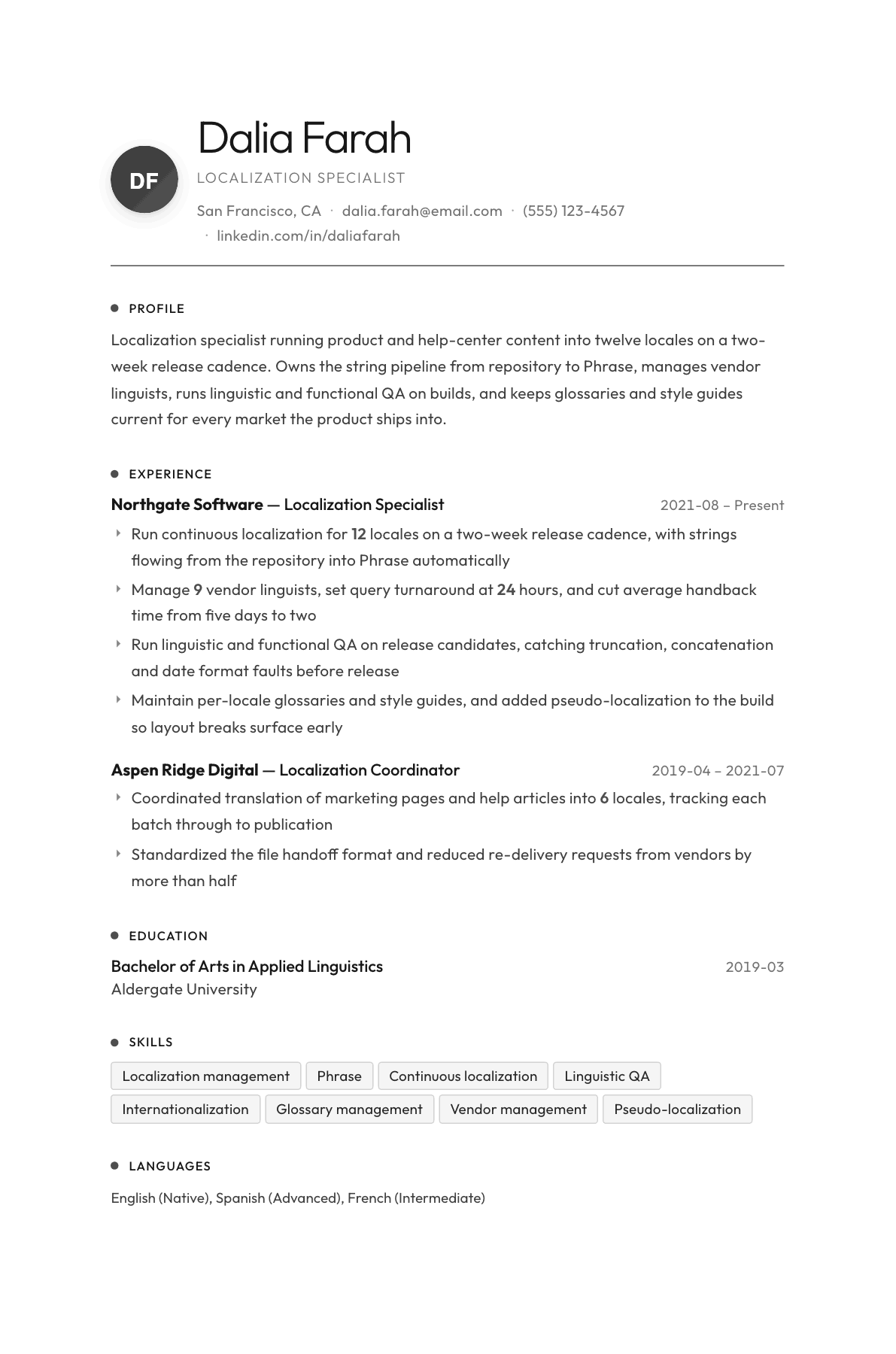
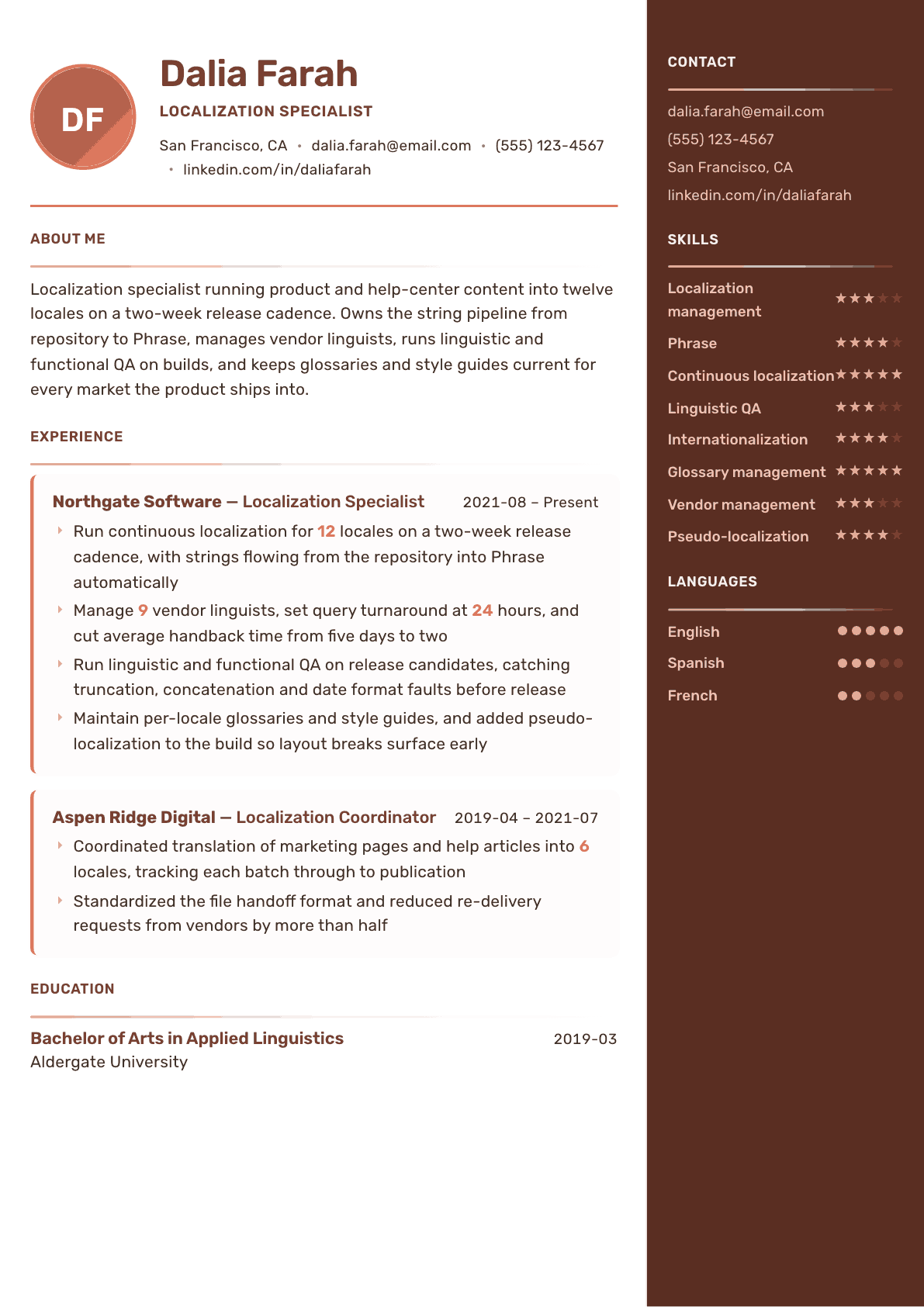
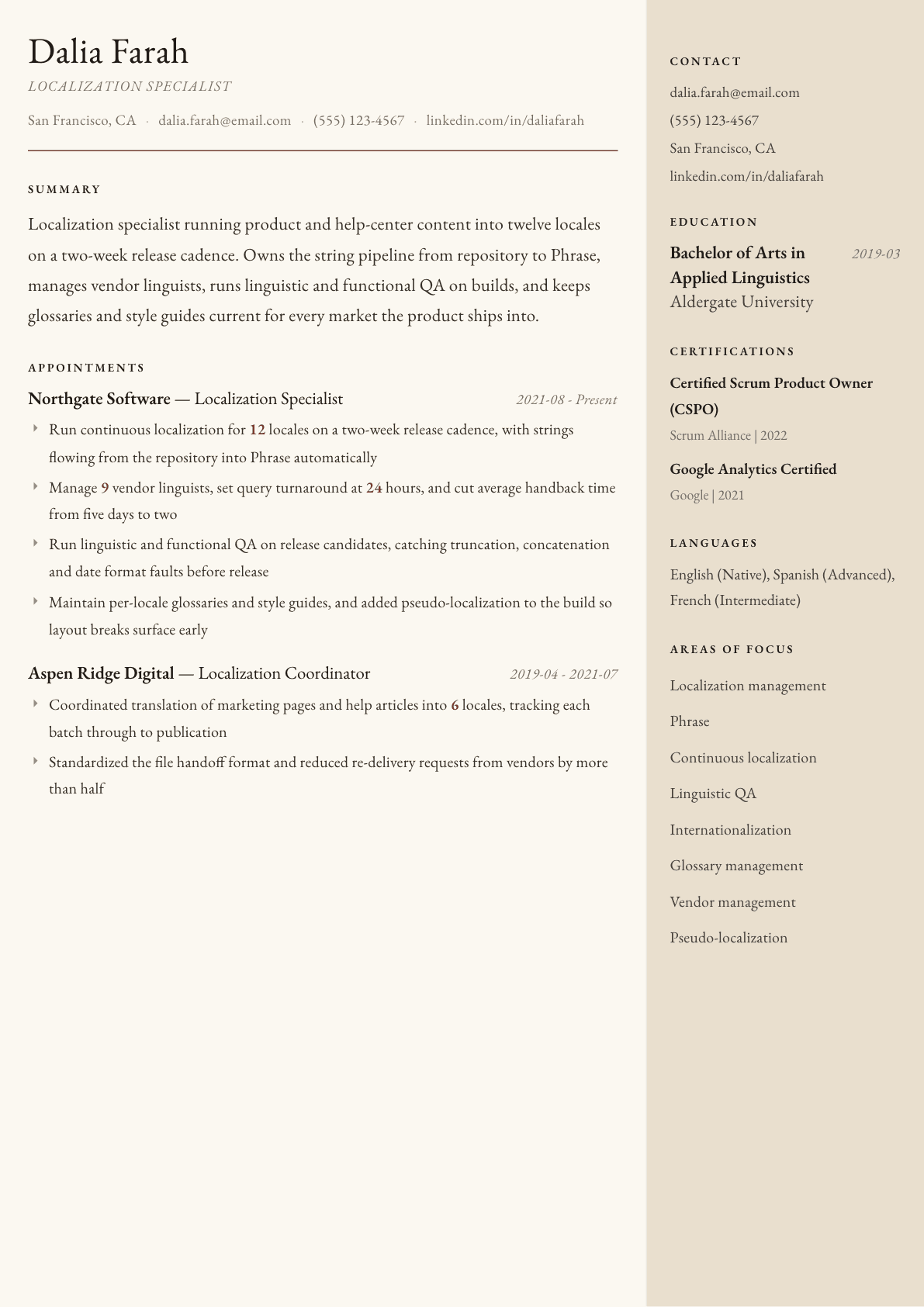
Example Localization Specialist summary
Localization specialist running product and help-center content into twelve locales on a two-week release cadence. Owns the string pipeline from repository to Phrase, manages nine vendor linguists, and runs linguistic and functional QA on every release candidate to catch truncation and format faults. Cut average vendor handback time from five days to two and added pseudo-localization to the build.
Skills to list on a Localization Specialist resume
- Localization management
- Internationalization
- Phrase
- Lokalise
- Crowdin
- Continuous localization
- String management
- Linguistic QA
- Functional QA
- Pseudo-localization
- Glossary and style guides
- Vendor management
- Translation memory
- Locale and regional formats
- Release coordination
What actually gets this resume read
- Name the locales you support and the release cadence, since both tell a hiring manager the scale you operate at.
- List the translation management system by name, whether that is Phrase, Lokalise, Crowdin, Smartling or memoQ.
- Describe the string pipeline you own, from repository to platform to build, because process is what gets hired.
- Separate internationalization work from translation work, as engineering teams treat them as different problems.
- Show linguistic and functional QA: truncation, concatenation, date and currency formats, and right-to-left layout.
- Give one vendor metric such as handback time or query turnaround, since vendor control is a core part of the job.
How to write a localization specialist resume
Localization sits between engineering, product and language, and the resume fails when it picks only one of the three. A file that reads as a translator profile loses to a candidate who can talk about string extraction and release trains. A file that reads as a project manager profile loses to a candidate who knows why a German string breaks a button and why a date format silently corrupts a report. The hire goes to whoever proves both halves on one page.
The reader is usually a localization manager or a product lead who has been burned before: a release went out with untranslated strings, a vendor missed a handback, a right-to-left layout collapsed in production, or a legal disclaimer was adapted when it should not have been. Every bullet you write is being read as evidence that those things happen less often with you in the pipeline.
This guide covers how to structure the file around locales, cadence and pipeline, how to describe linguistic and functional quality work, three summaries from coordinator to lead, and the mistakes that make an experienced localization specialist look like a translation buyer.
Format: locales, cadence and platform in the first three lines
Lead with scale and rhythm. The number of locales you support, the surfaces they cover, and the release cadence tell a hiring manager the operating tempo you are used to. Twelve locales on a two-week cycle is a different discipline from four locales on a quarterly marketing refresh, and the interview will go faster if the reader knows which one you come from.
Keep it to one or two pages, reverse chronological, plain formatting. Ironically, a heavily designed resume is a liability here, since your daily work is fighting layouts that break when text expands. Give the file wide margins and short lines and it will survive any parser.
- Header: name, city and time zone, phone, email, and the platform you run localization in.
- Section order: summary, scope snapshot, experience, tooling and pipeline, quality, vendor management, languages.
- A scope snapshot naming locales, surfaces, word volume and cadence saves a manager a full read.
Summary: locales, pipeline ownership, and one process gain
The first sentence names the content types and the locales: product interface, help center, marketing pages, legal notices and release notes into a stated number of markets. The second names what you own in the pipeline, from repository to the translation management platform to the build. The third gives a process gain, usually vendor handback time, query turnaround, or the elimination of a class of defect.
Do not open with a claim about cultural sensitivity. It is the assumed baseline of the field and it tells a manager nothing about whether you can unblock a release on a Friday afternoon.
Experience: the string pipeline end to end
Describe the pipeline you own as a sequence a reader can picture: strings extracted from the repository, pushed to the translation management platform on merge, assigned to vendor linguists with context and screenshots, returned, validated, merged back, then built and checked in a real build. Naming the stages proves continuous localization experience in a way that the phrase itself does not.
Talk about internationalization separately from translation, because engineering teams treat them as different problems and hire accordingly. Externalized strings, avoided concatenation, plural and gender handling, locale-aware dates, numbers and currencies, character encoding, text expansion allowances in the layout, and right-to-left support are engineering conversations you either can or cannot hold. Say which of them you have driven.
Then quantify the operational side: word volume per cycle, number of vendor linguists managed, query turnaround, average handback time, and the proportion of releases that went out fully localized on the day of the English release. Simultaneous release is the outcome the whole function exists to produce.
Quality: linguistic and functional, and how you catch faults early
Split quality into its two halves. Linguistic quality is terminology, register, style guide conformance and in-country review, usually sampled against a scoring model with error categories. Functional quality is what breaks in the product: truncation, overlapping labels, broken concatenation, untranslated strings, wrong plural forms, mangled encoding, date and currency formats, and layouts that fail when the language runs longer.
Show the preventive practices, since catching faults at review is far cheaper than catching them after release. Pseudo-localization in the build surfaces hard-coded strings and layout breaks before a single word is translated. Screenshot context for linguists removes the most common cause of a wrong term. A locked glossary and a term check in the platform stops disputed terminology from reaching review at all.
- Name the platform: Phrase, Lokalise, Crowdin, Smartling, memoQ or an internal system, and say what you automated in it.
- Say how you handle a locale that fails review close to a release date, since that decision is the job.
- Include the glossaries and style guides you maintain per market and who approves changes to them.
Vendors, stakeholders and the keywords a manager screens on
Vendor control is a core part of the role and most resumes underplay it. Give the number of linguists or agencies you manage, the service levels you set on query turnaround and handback, how you onboard a new linguist with context and a test, and what you did when quality slipped. A candidate who has run a vendor scorecard and made a hard call about replacing a linguist has done the difficult part.
Recurring posting terms are localization, internationalization, continuous localization, translation management system, string management, linguistic quality assurance, functional testing, pseudo-localization, glossary management, vendor management, locale formats and release coordination. Mirror the posting wording once in the skills block and once inside a bullet.
Localization Specialist resume summary examples
Coordinator, first role
Localization coordinator handling marketing pages and help articles into six locales, tracking each batch from request to publication. Standardized the file handoff format with vendors, cut re-delivery requests by more than half, and keeps the per-market glossary and style guide current.
Four years in product localization
Localization specialist running product and help-center content into 12 locales on a two-week release cadence, with strings flowing from the repository into Phrase automatically. Manages nine vendor linguists, runs linguistic and functional checks on every release candidate, and cut average handback time from five days to two.
Localization lead
Localization lead for a product in 24 markets, owning the pipeline, the vendor program and the internationalization backlog with engineering. Introduced pseudo-localization and screenshot context into the build, moved 18 locales to same-day release with English, and set the quality scoring model now used across three product lines.
Work experience bullets: before and after
Before: Managed translations for the product into several languages.
After: Ran continuous localization for 12 locales on a two-week release cadence, with strings extracted from the repository into Phrase automatically on merge.
Locale count, cadence and the automated pipeline show a modern workflow instead of a translation request queue.
Before: Worked with translation vendors.
After: Managed nine vendor linguists against a 24-hour query turnaround, onboarded each with screenshot context and a scored test, and cut average handback from five days to two.
Service levels, onboarding and a measured improvement turn a working relationship into vendor management.
Before: Tested localized builds for issues.
After: Ran linguistic and functional checks on every release candidate, catching truncation, broken concatenation and date format faults before they reached production.
Naming the defect classes proves you test the product rather than proofread the strings.
Before: Improved the localization process.
After: Added pseudo-localization to the build so hard-coded strings and layout breaks surfaced during development rather than after translation started.
A specific preventive technique with its timing benefit is exactly what an engineering-adjacent manager wants to read.
Before: Kept glossaries up to date.
After: Maintained per-locale glossaries and style guides with a named in-country approver for each market, and enforced term checks inside the platform before handback.
Ownership, approval and enforcement show governance rather than a document that exists somewhere.
Hard skills
- Continuous localization pipelines
- Internationalization requirements
- Phrase
- Lokalise
- Crowdin
- String and resource file management
- Linguistic quality assurance
- Functional localization testing
- Pseudo-localization
- Glossary and style guide management
- Translation memory and leverage
- Vendor management and service levels
- Locale, date, number and currency formats
- Release coordination
Soft skills
- Working across engineering and language teams
- Prioritizing under a release deadline
- Clear written context for linguists
- Negotiating scope with product owners
- Judgment on quality versus schedule
- Patience with repeated defect classes
Certifications worth listing
- Localization Certificate Program (California State University, Chico)
- Project Management Professional (PMP) (Project Management Institute)
- Google Project Management Certificate (Google Career Certificates)
Mistakes that cost localization specialist candidates the interview
- Writing the resume as a translator profile, which loses to a candidate who can talk about builds, strings and release trains.
- Never naming the translation management platform, so a manager assumes a manual file-based workflow.
- Merging internationalization and translation into one word when engineering teams hire for them separately.
- Skipping functional testing, which leaves the impression you check text and never open the localized build.
- Giving no locale count or cadence, the two facts that set the operating tempo of the role.
- Underplaying vendor management, when service levels, onboarding and difficult quality calls are a core part of the job.
- Opening with cultural sensitivity, which is the assumed baseline rather than a differentiator.
Localization Specialist resume questions
Do I need to speak several languages to work in localization?
No. Many specialists run programs in languages they do not speak, relying on in-country reviewers and a scoring model. One additional language helps you sanity-check work and talk to linguists, but pipeline and quality process matter more to the hire.
How technical does a localization specialist need to be?
Enough to read resource files, understand how strings are extracted and merged, use version control, and hold a real conversation about plural rules, encoding and text expansion. You do not need to write production code, but you do need to file a precise engineering ticket.
Should I list every locale I have supported?
Give the count and the regions rather than a long list, then name the markets that carried extra difficulty such as right-to-left languages, character-based scripts, or regulated content that required legal review in the target market.
What is the difference between localization quality and translation quality?
Translation quality is whether the text is right. Localization quality also asks whether it works: whether it fits the layout, whether formats and plurals are correct for the locale, and whether the release went out complete. Show both on the resume.
How do I move from translation into a localization specialist role?
Take on the process pieces first: manage a glossary, own the handback checks, learn the translation management platform as an administrator rather than a linguist, and volunteer for functional testing on a build. Then rewrite the resume around the pipeline instead of word counts.