Dialysis Nurse Resume Examples: the lines they read
Build a Dialysis Nurse Resume for Clinic and Acute Units
By Mustafa Tarabya, founder of CVBooster · Published · Updated
Dialysis nurse resume examples covering machine setup, access care, Kt/V targets and the certifications and keywords renal employers screen for.
Sample resumes for a dialysis nurse
The same dialysis nurse content laid out in three CVBooster templates, so you can see what the finished document looks like before you write a word.
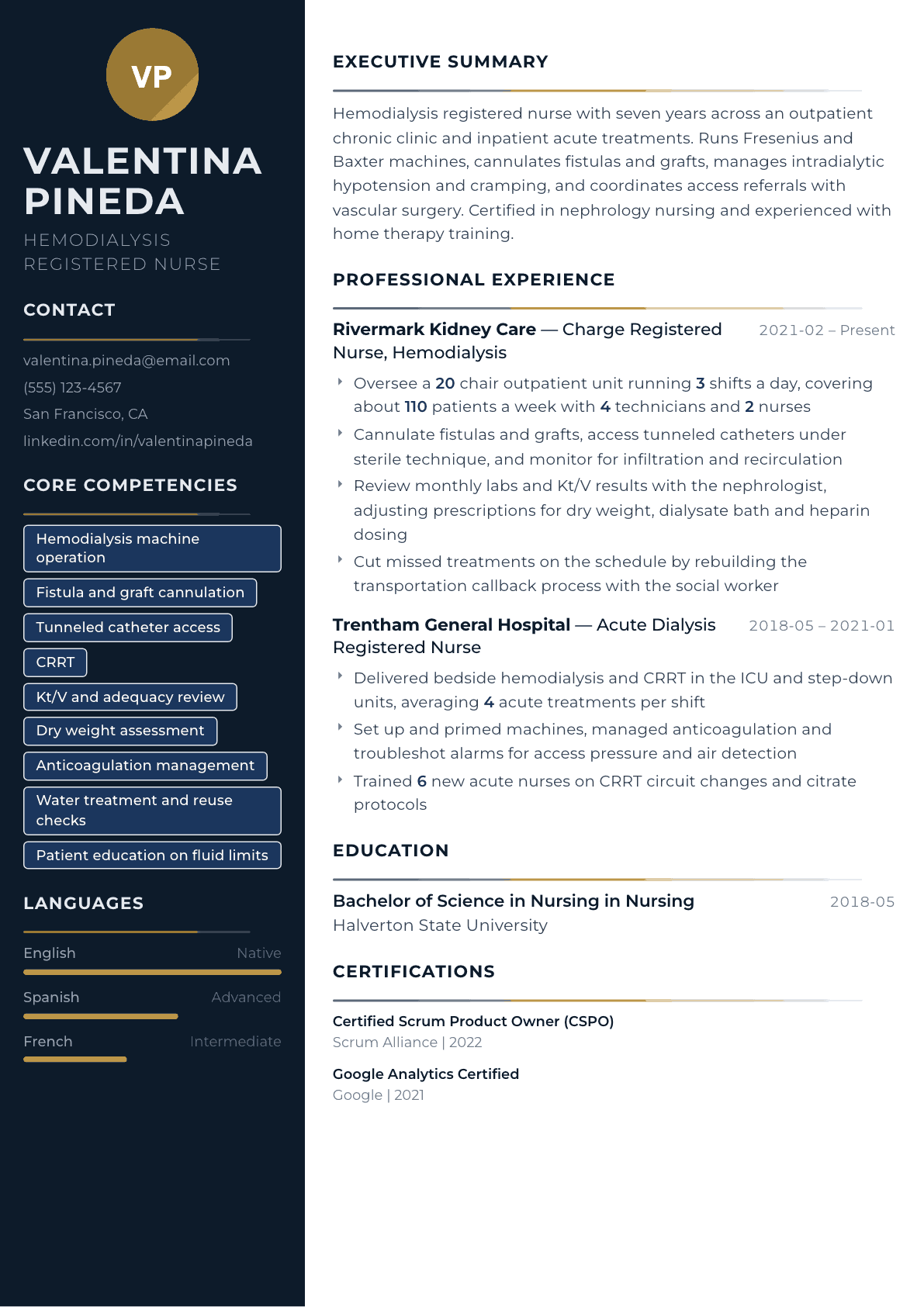
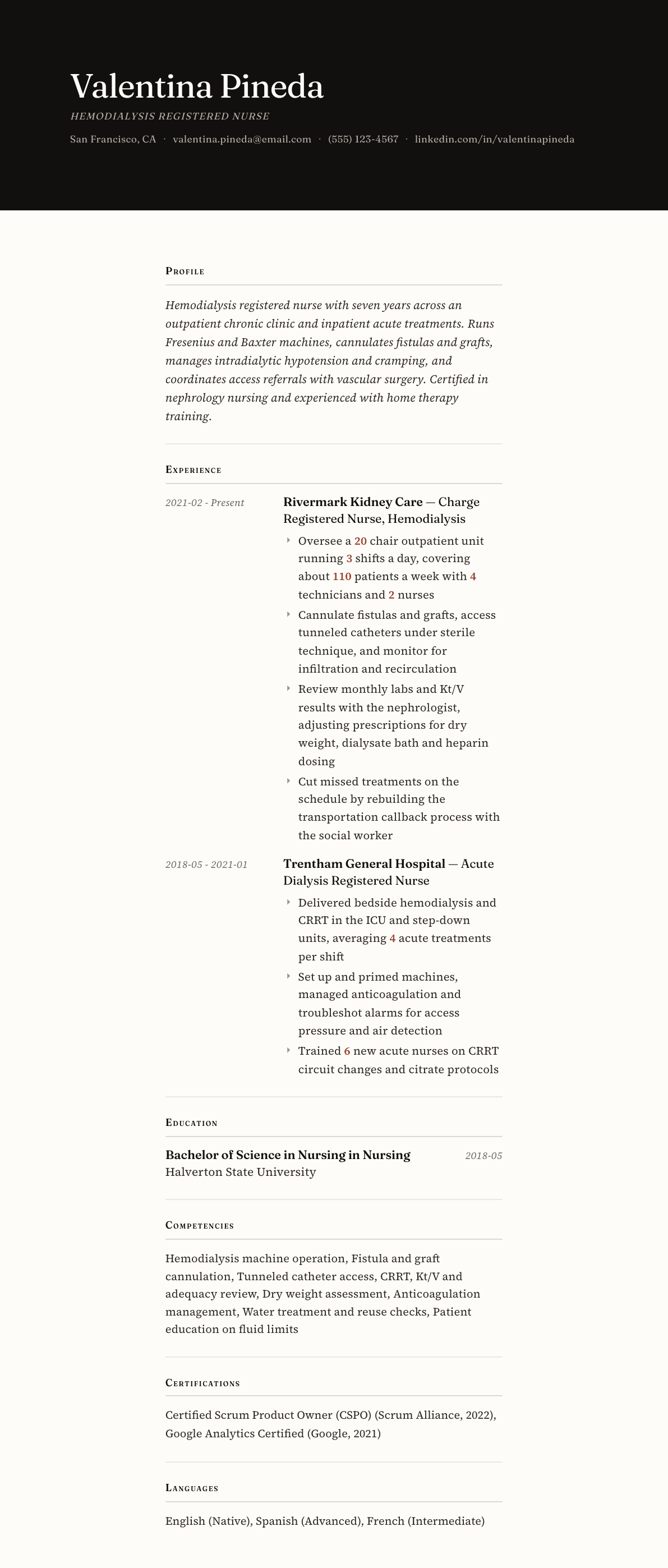
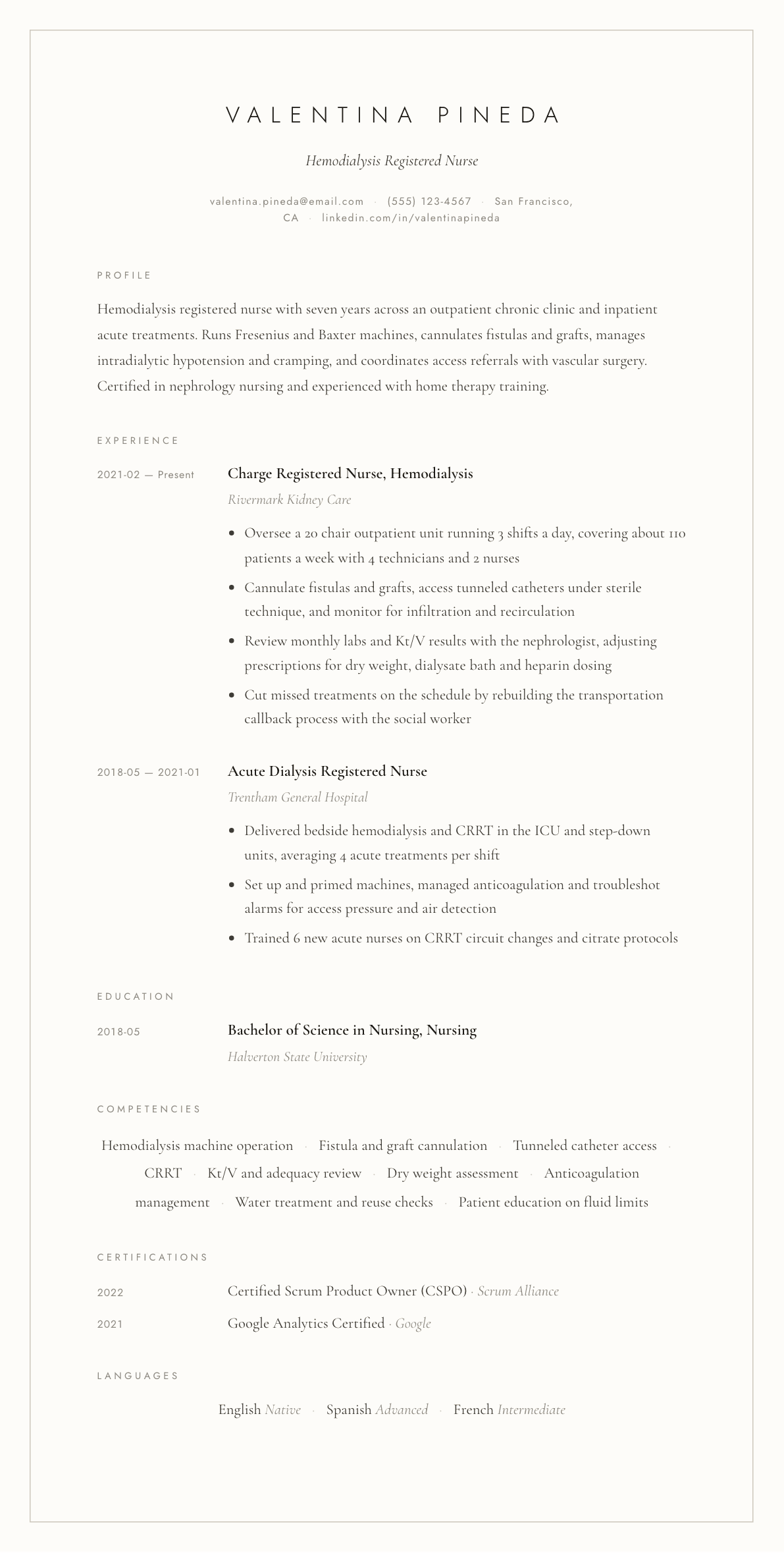
Example Dialysis Nurse summary
Hemodialysis registered nurse with seven years across a 20 chair outpatient clinic and acute bedside treatments, including CRRT in the ICU. Cannulates fistulas and grafts, primes and troubleshoots Fresenius and Baxter circuits, manages intradialytic hypotension, and reviews Kt/V and monthly labs with the nephrologist. Certified in nephrology nursing and trained six acute nurses on citrate protocols.
Skills to list on a Dialysis Nurse resume
- Hemodialysis
- Peritoneal dialysis
- CRRT
- Fistula and graft cannulation
- Central venous catheter care
- Machine setup and priming
- Alarm troubleshooting
- Kt/V and adequacy monitoring
- Dry weight and fluid assessment
- Heparin and citrate anticoagulation
- Infection control and bloodborne precautions
- Water treatment quality checks
- Renal diet and fluid education
- Home dialysis training
What actually gets this resume read
- Say whether your experience is chronic outpatient, acute inpatient, home training or peritoneal, since they hire separately.
- Name the machines and circuits you have run, such as Fresenius, Baxter, NxStage or Prismaflex for continuous therapy.
- Prove access skill with cannulation detail: fistulas, grafts, buttonhole technique and tunneled catheter care.
- Include adequacy and lab work: Kt/V, urea reduction ratio, phosphorus and hemoglobin trends reviewed with the nephrologist.
- Show how you handle intradialytic events like hypotension, cramping, chest pain and clotted circuits during a run.
- List chair count, shifts per day and patients treated weekly so a clinic manager can size your throughput.
How to write a dialysis nurse resume
Dialysis nursing is a machine specialty as much as a patient specialty, and the hiring managers know it. A clinic manager filling a chair schedule and a hospital manager filling an acute call rotation are looking for different things, and both of them start by working out which kind of dialysis you have actually done. Chronic outpatient, acute inpatient, continuous renal replacement in the intensive care unit, home hemodialysis training and peritoneal dialysis are five distinct jobs that share a word.
The second thing they look for is access. A nurse who can cannulate a difficult fistula, recognize infiltration early, assess a thrill and bruit and access a tunneled catheter without contaminating it is the person who keeps a shift on schedule. Access skill is the difference between a unit running three turns a day and a unit running late into the evening.
This guide sorts the modalities so a manager can place you in one read, shows how to write machine, access and adequacy work with real specificity, gives summaries for three career stages, and rewrites the bullets that make every dialysis resume look identical.
Format: declare the modality before anything else
Reverse chronological, one to two pages. The first line of the summary must name the modality and the setting, because that is the sort. Chronic outpatient hemodialysis in a twenty chair clinic reads differently from acute bedside treatments and continuous therapy in an intensive care unit, and a resume that leaves it ambiguous gets read twice or not at all.
Under each job, open with a unit line: chair count, shifts per day, patients treated per week, staffing mix of nurses and patient care technicians, and whether you held charge. Renal managers think in chairs and turns, so hand them the arithmetic.
- Header: name, credentials including CDN or CNN when held, city and state, phone, email, license state.
- Order: summary, licenses and certifications, dialysis experience, other clinical experience, education, skills.
- Say whether you take acute call, since that rotation is the hardest slot for a hospital to fill.
Machines, circuits and troubleshooting
Name the equipment. Fresenius and Baxter machines dominate chronic units, NxStage appears in home programs, and Prismaflex or similar platforms run continuous therapy in critical care. A manager reads product names as a training cost estimate, so a resume that lists them shortens your orientation on paper.
Then show the troubleshooting. Priming and rinseback, air detector and venous pressure alarms, arterial pressure limits, clotted circuits and when you change one, transmembrane pressure changes, dialysate conductivity and temperature alarms, and the reuse or single use practices your unit followed.
Water treatment belongs on the page for anyone who has done chronic outpatient work. Reverse osmosis checks, chlorine and chloramine testing, endotoxin sampling and the log documentation a state surveyor asks to see are duties nurses hold in many clinics and rarely think to write down.
Access: the skill that separates candidates
Write cannulation in detail. Fistulas and grafts, rope ladder and buttonhole technique, needle gauge choices for prescribed blood flow rate, single needle situations, and the assessment before every stick: thrill, bruit, arm inspection, aneurysm and steal signs.
Catheter work needs the same treatment. Sterile access and dressing of tunneled catheters, locking solutions, exit site assessment and infection reporting, and the escalation path when flows will not hold. Add your role in access referrals, because moving a patient off a catheter and onto a fistula is a clinic quality measure and a nurse usually drives it.
Adequacy, labs and the monthly cycle
Chronic dialysis runs on a monthly rhythm that outsiders never see. Describe your part in it: monthly lab draws, Kt/V and urea reduction ratio review, hemoglobin and erythropoiesis stimulating agent protocols, phosphorus and binder education, potassium and bath selection, and the care plan meeting with the nephrologist, dietitian and social worker.
Dry weight assessment deserves its own line. Blood pressure trends across treatments, intradialytic hypotension and cramping, ultrafiltration rate limits, and how you negotiate fluid gains with a patient who drinks between treatments. That last one is the clinical conversation of the specialty.
Skills and keywords a renal employer searches
The vocabulary recurs: hemodialysis, peritoneal dialysis, continuous renal replacement therapy, cannulation, arteriovenous fistula, arteriovenous graft, tunneled catheter, Kt/V, urea reduction ratio, dry weight, ultrafiltration, intradialytic hypotension, anticoagulation, water treatment, end stage renal disease. Mirror the posting wording once in skills and once in a bullet.
Add the certifications by their real names. The Nephrology Nursing Certification Commission issues the CDN and CNN credentials and dialysis employers recognize them immediately, so they belong near the top rather than buried at the bottom of the page.
Dialysis Nurse resume summary examples
First year in renal
Registered nurse with three years of medical-surgical practice and one year in a chronic hemodialysis clinic. Runs Fresenius machines across two daily shifts, cannulates fistulas and grafts, and monitors for intradialytic hypotension and cramping. Learning monthly lab review and adequacy tracking with the nephrologist.
Five years, chronic and acute
Hemodialysis nurse with five years across a 20 chair outpatient unit and bedside acute treatments in critical care. Cannulates difficult fistulas, accesses tunneled catheters under sterile technique, primes and troubleshoots circuits, and reviews Kt/V and monthly labs with the nephrologist. Certified in nephrology nursing.
Clinic charge nurse
Charge nurse for a 20 chair dialysis clinic running three shifts a day for about 110 patients with four technicians and two nurses. Owns water treatment logs, infection surveillance and access referral tracking, and trains new staff on cannulation and continuous therapy circuits. CNN certified with home training experience.
Work experience bullets: before and after
Before: Provided hemodialysis treatments to patients.
After: Ran treatments in a 20 chair unit across three daily shifts covering about 110 patients a week, working alongside four technicians as the nurse responsible for assessment and orders.
Chair count, shifts and weekly volume let a clinic manager measure your throughput immediately.
Before: Cannulated patient access sites.
After: Cannulated fistulas and grafts using rope ladder and buttonhole technique, assessed thrill and bruit before every stick, and identified infiltration early enough to preserve the access.
Technique names and the pre-stick assessment prove access skill instead of asserting it.
Before: Monitored patients during treatment.
After: Managed intradialytic hypotension and cramping by adjusting ultrafiltration rate and sodium profile within protocol, and held treatments for provider review when blood pressure would not recover.
The intervention and the stopping rule show clinical judgment during a run, not observation of it.
Before: Checked lab results monthly.
After: Reviewed monthly Kt/V, urea reduction ratio, phosphorus and hemoglobin trends with the nephrologist and adjusted dry weight, bath and heparin dosing on the prescription.
Naming the measures ties you to the adequacy cycle that a chronic unit is graded on.
Before: Worked with the team on quality.
After: Rebuilt the transportation callback process with the clinic social worker, which reduced missed treatments on the afternoon shift schedule over two quarters.
Missed treatments are a real clinic metric, so a named process change lands with the reader.
Hard skills
- Hemodialysis machine operation
- Continuous renal replacement therapy
- Peritoneal dialysis
- Fistula and graft cannulation
- Tunneled catheter access and dressing
- Circuit priming and rinseback
- Alarm and pressure troubleshooting
- Heparin and citrate anticoagulation
- Kt/V and urea reduction ratio review
- Dry weight and ultrafiltration management
- Water treatment quality testing
- Infection surveillance and bloodborne precautions
- Renal diet, fluid and binder education
- Home dialysis training
Soft skills
- Steady hands under time pressure
- Long-term patient relationships
- Negotiating fluid and diet adherence
- Technician supervision and coaching
- Communication with nephrology providers
Certifications worth listing
- Certified Dialysis Nurse (CDN) (Nephrology Nursing Certification Commission)
- Certified Nephrology Nurse (CNN) (Nephrology Nursing Certification Commission)
- Basic Life Support (BLS) (American Heart Association)
- Advanced Cardiovascular Life Support (ACLS) (American Heart Association)
Mistakes that cost dialysis nurse candidates the interview
- Leaving the modality vague, so the reader cannot tell chronic clinic work from acute bedside treatments.
- Writing provided dialysis treatments without chair count, shifts per day or weekly patient volume.
- Skipping cannulation technique, which is the skill a clinic manager most wants proven before an interview.
- Omitting machine and circuit product names that would otherwise shorten your orientation on paper.
- Ignoring water treatment and infection surveillance duties that state surveyors examine in every chronic unit.
- Listing nephrology certification at the bottom of page two when it is the credential that sorts the pile.
Dialysis Nurse resume questions
Do I need dialysis experience to be hired into a chronic clinic?
Not always. Most large dialysis organizations run paid training programs for licensed nurses with acute care backgrounds. Lead with IV and access skills, fluid and electrolyte management, and any critical care experience, and state clearly that you are seeking a renal training track.
How do I show the difference between acute and chronic dialysis work?
Split them into separate jobs or separate bullet groups. Chronic work is described in chairs, shifts and weekly patient volume. Acute work is described in treatments per shift, unit types covered, continuous therapy circuits and call rotation frequency.
Is peritoneal dialysis experience worth listing separately?
Yes, because home programs staff for it specifically. Note catheter exit site care, cycler training for patients and caregivers, adequacy testing, peritonitis recognition and the teaching visits, since those are a distinct skill set from in-center hemodialysis.
What certifications matter for a dialysis nurse?
The Certified Dialysis Nurse and Certified Nephrology Nurse credentials from the Nephrology Nursing Certification Commission are the ones renal employers recognize. Basic and advanced life support are usually required, and both belong in a certification block near the top of the page.
How do I describe difficult access without exaggerating?
Describe the technique and the decision rather than a success rate. Say which techniques you use, how many attempts you make before escalating, and what you do when flows will not hold. That reads as competence to anyone who has stood at a chair.