Nursing Student Resume Examples: the lines they read
Build a Nursing Student Resume Before You Sit the NCLEX
By Mustafa Tarabya, founder of CVBooster · Published · Updated
Nursing student resume examples, including a Canadian BScN student, with clinical placement hours, capstone details, keywords and a guide to externships.
Sample resumes for a nursing student
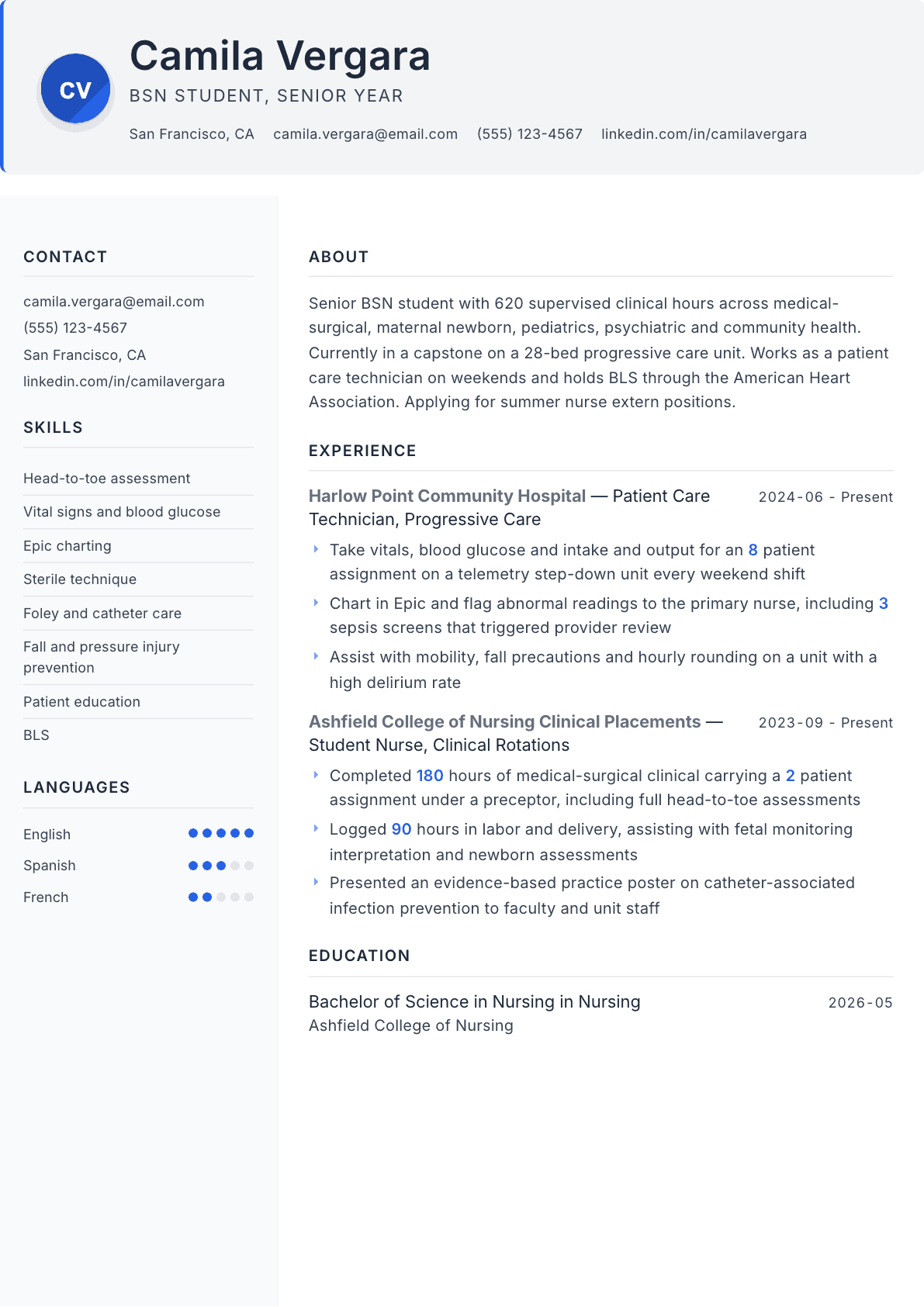
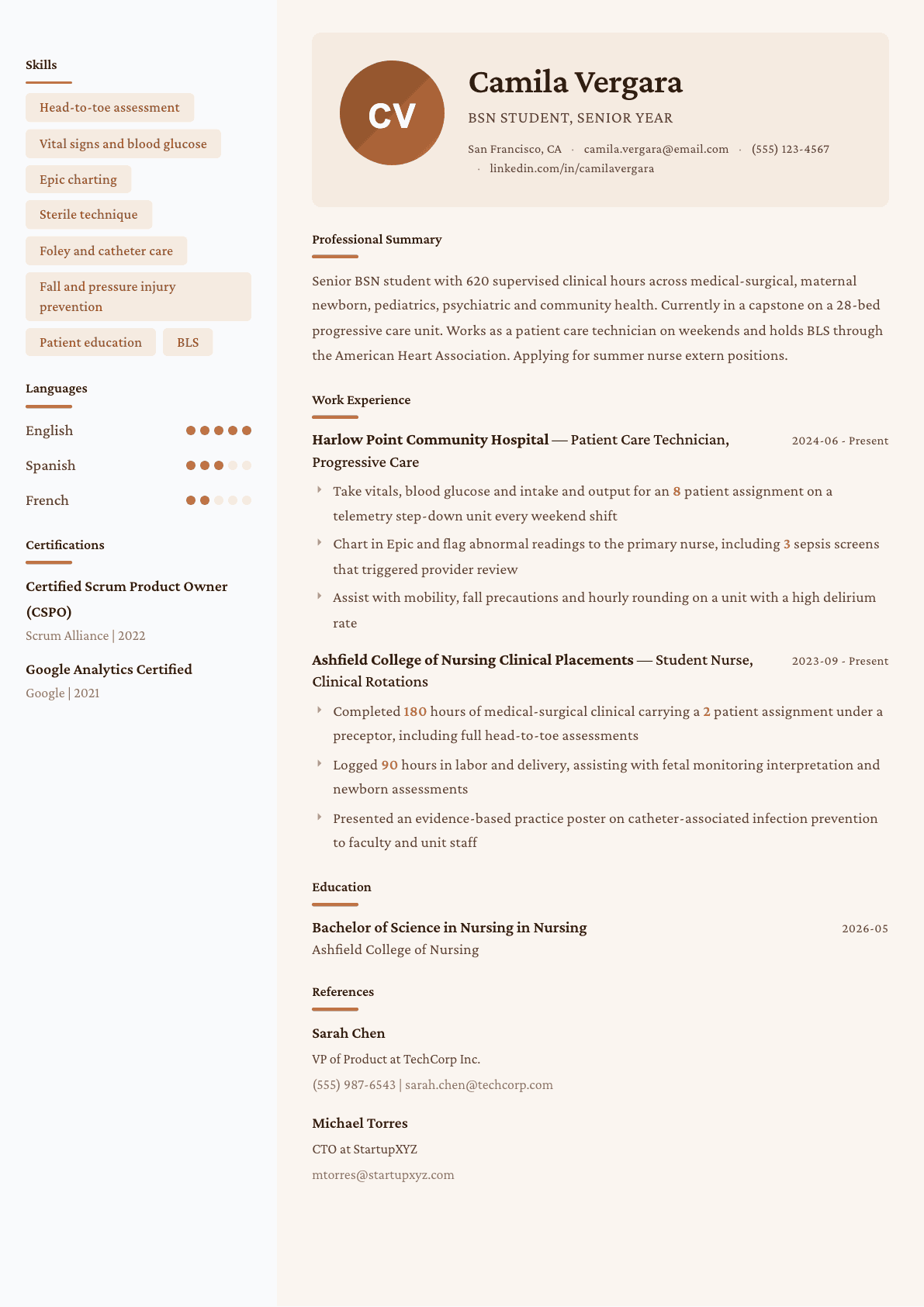
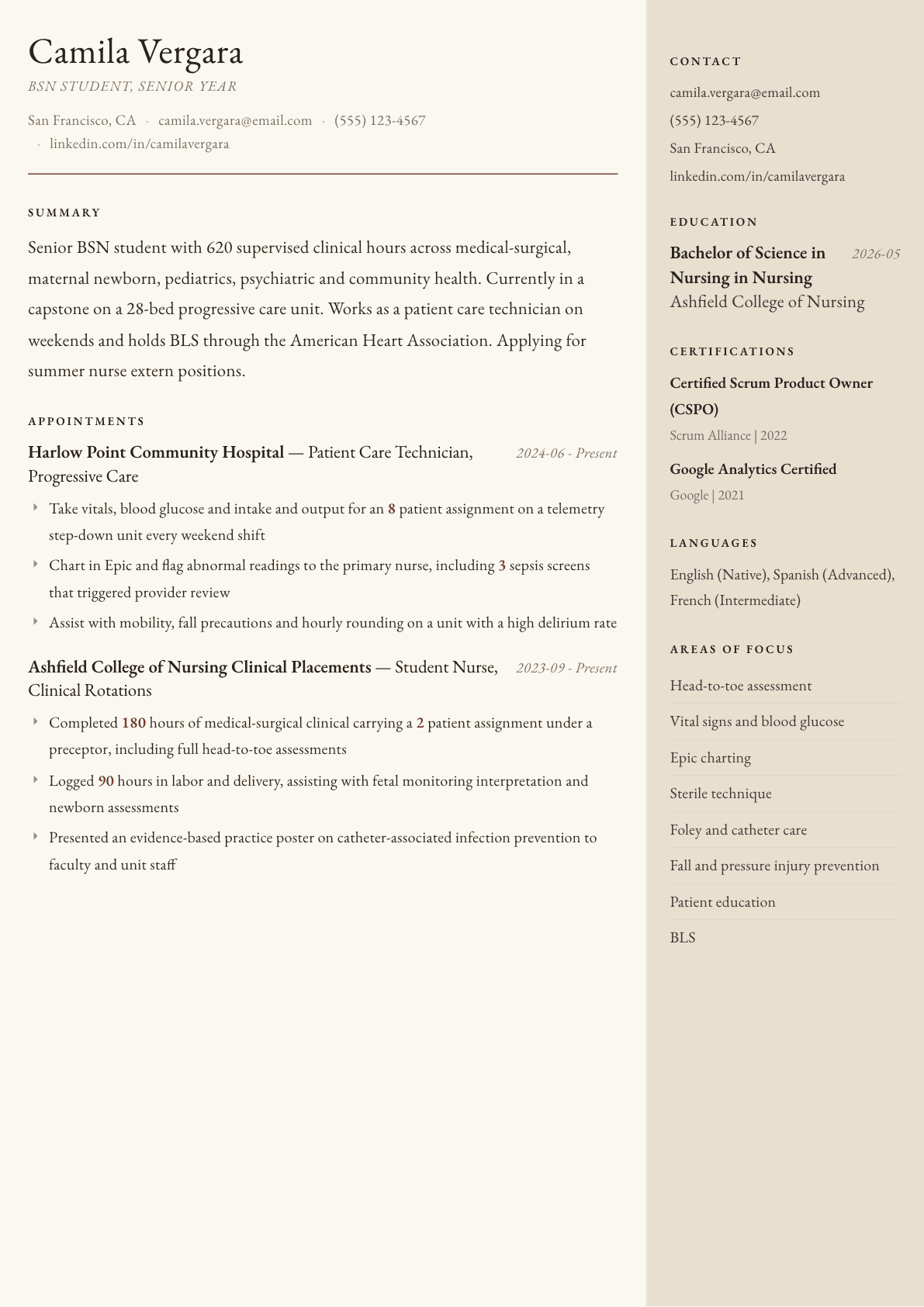
The same nursing student content laid out in three CVBooster templates, so you can see what the finished document looks like before you write a word.
Example Nursing Student summary
Senior BSN student graduating in May with 620 supervised clinical hours across medical-surgical, pediatric, obstetric, psychiatric and community settings, plus a 160 hour capstone on a progressive care unit. Works weekends as a patient care technician charting in Epic. BLS certified and NCLEX date scheduled. Seeking a nurse extern or new graduate residency position in acute care.
Skills to list on a Nursing Student resume
- Clinical rotations
- Head-to-toe assessment
- Vital signs monitoring
- Medication calculation
- Sterile technique
- Wound and dressing care
- Foley catheter care
- Epic charting
- Care plan writing
- Patient education
- Infection control
- Simulation lab
- Nursing process and SBAR
What actually gets this resume read
- Put education at the top with your expected graduation month and the NCLEX date you have scheduled.
- List clinical rotations as their own section with the facility, unit, hours and one line on what you did.
- Give your capstone or preceptorship its own entry, because managers read it as your closest thing to work experience.
- Keep the patient care technician, nursing assistant or unit secretary job on the page, since it proves hospital fluency.
- Add student nurse association roles, simulation awards and evidence-based practice projects rather than padding with hobbies.
- Name the charting system used in your rotations, as Epic or Cerner exposure shortens a residency orientation.
How to write a nursing student resume
A nursing student resume is not a shrunken version of a working nurse resume. You are applying for externships, summer nurse intern programs, student nurse technician roles and eventually a residency, and every one of those screeners knows you have no paid nursing history. What they want to know is how many supervised hours you have, which units you have stood on, and whether you can already move safely around a hospital.
The mistake that costs students interviews is treating clinical rotations as a footnote. Rotations are the experience section at this stage. A recruiter reading two hundred student files is looking for hours, settings, patient loads carried under a preceptor and the charting system you touched, because those things predict how long your orientation will take.
This guide covers the section order a student resume needs, how to write rotations and a capstone so they read as work, a resume for a nursing student in Canada written out in full, three summaries for different points in a nursing program, and the questions students ask when the page looks too empty.
Format: education first, rotations second, jobs third
One page, no exceptions. Reverse chronological within each section. Put education at the top with the program type, the campus, the expected graduation month and your grade point average when it is strong. Directly under education, add a clinical rotations section, because it is the closest thing you have to a work history.
Skip objective statements that say you are seeking an opportunity to grow. Use a short summary that states your program year, your total supervised hours and the setting you are targeting. Keep the layout single column so an applicant tracking system reads your dates in order.
- Header: name, credentials in progress such as SN or NAR, city and state, phone, email.
- Order: summary, education, clinical rotations, work experience, certifications, skills, activities.
- Add expected NCLEX date once you have one, since residency cohorts are built around license dates.
Clinical rotations: hours, unit, load and what you performed
Give each rotation four things: the facility type, the unit, the hours, and one line on what you actually did. Medical-surgical, maternal newborn, pediatrics, psychiatric mental health and community health rotations are standard, so the differentiator is the detail inside them, not the list.
Say how many patients you carried under your preceptor. A student who carried two patients with full assessments and medication passes on a telemetry floor is a different candidate from one who observed. Name the skills you performed rather than watched: head-to-toe assessments, blood glucose checks, Foley care, sterile dressing changes, medication administration under supervision.
The capstone or preceptorship deserves its own entry sized like a job. Give it hours, the unit, the shift pattern and three bullets. It is the single strongest block on a student resume and it should look like it.
Work experience: translate the aide job into clinical language
A patient care technician, nursing assistant, phlebotomy, unit secretary or emergency medical technician job belongs on the page even though it is not nursing. Write it in clinical terms: patients per shift, vitals and blood glucose taken, escalations made to the primary nurse, mobility and skin protocols followed, charting system used.
Non-clinical jobs still earn a place when the page is thin, but compress them to one line each and pull out the parts a nurse manager cares about: shift reliability, handling a queue under pressure, teaching or coaching people, handling money or records accurately.
Skills, certifications and activities that carry weight
List certifications you truly hold with the issuing body: BLS through the American Heart Association, a state nursing assistant certification, ACLS if your program provided it. Do not list a certification you plan to take. Put your charting exposure in the skills block, because Epic or Cerner familiarity shortens an orientation and screeners look for it.
Activities matter more here than at any other career stage. Student nurses association office, simulation competition results, evidence-based practice posters, hospital volunteer hours, a second language spoken with patients, and tutoring in pharmacology or pathophysiology all say something about readiness. Hobbies with no bearing on patient care do not.
- Assessment and procedure skills you have performed under supervision, listed plainly.
- Charting systems touched in rotation, named by product.
- Languages spoken at a level you would use with a patient and family.
Keywords an externship or residency screener searches
Student postings repeat a narrow vocabulary: nursing student, clinical rotations, preceptorship, capstone, supervised clinical hours, patient assessment, care plan, SBAR, infection control, BLS certified. Use the exact terms from the posting once in your summary or skills block and once inside a rotation bullet where the skill is shown.
Avoid padding the skills list with therapies you have only read about. A manager will ask about anything on the page during the interview, and a student who lists central line care they have never touched loses the room in one question.
Resume for a nursing student in Canada, written out
A resume for a nursing student in Canada keeps the same order, with three changes in wording. Programs say clinical placements more often than rotations, the degree is usually written BScN or BN, and student employment programs carry provincial names, such as employed student nurse or undergraduate nursing employee, so copy the posting title exactly. Canadian employers also expect a police information check with the vulnerable sector screening, and RN graduates in Canada write the NCLEX-RN, so the license line reads the same as it does in the United States.
Here is a complete example as plain text; the student and the hospitals are invented. Header: Chloe Tremblay, Nursing Student, city, province, phone, email. Summary: Third year BScN student with medical, surgical and long term care placements, applying for a summer employed student nurse position on a medical unit. Comfortable with head to toe assessment, medication administration under supervision and charting in an electronic record.
Education: Bachelor of Science in Nursing, a university school of nursing, expected convocation month and year. Certifications and checks: BLS for healthcare providers, WHMIS, N95 fit test, immunizations up to date, police information check with vulnerable sector screening. Work: personal support worker, part time, a long term care home, two years.
- Clinical placement, medical unit, a community hospital: cared for two to three patients with a preceptor, completed head to toe assessments each shift and gave report using SBAR.
- Clinical placement, long term care: supported residents with mobility, feeding and skin care, and documented intake, output and behavior notes in the home's charting system.
- Personal support worker: helped residents with bathing, dressing and transfers using mechanical lifts, and reported changes in condition to the charge nurse the same shift.
Nursing Student resume summary examples
Second year student
Second year BSN student with 220 supervised clinical hours in medical-surgical and long-term care, currently working weekends as a certified nursing assistant on a rehabilitation floor. BLS certified through the American Heart Association. Seeking a student nurse technician position in an acute care setting.
Senior year, pre-capstone
Senior BSN student with 480 supervised clinical hours across medical-surgical, pediatric, obstetric and psychiatric rotations, carrying a two patient assignment under preceptor supervision. Charts in Epic and served as class representative to the student nurses association. Applying for a summer nurse extern program in critical care.
Capstone in progress
Final semester BSN student completing a 200 hour capstone on a 28-bed progressive care unit, carrying three patients with a preceptor. Total supervised hours above 600 across five specialties. NCLEX date scheduled for July. Seeking a new graduate residency in progressive or intensive care.
Work experience bullets: before and after
Before: Completed clinical rotation in medical-surgical nursing.
After: Completed a 180 hour medical-surgical rotation on a 32-bed unit, carrying two patients with full head-to-toe assessments, medication passes and shift documentation under a preceptor.
Hours, bed count and patient load turn an attendance record into evidence of practice.
Before: Observed procedures in labor and delivery.
After: Assisted in 90 hours of labor and delivery, performing newborn assessments, fundal checks and fetal monitoring strip review with the preceptor before each provider notification.
Naming what your hands did separates a participant from an observer in a recruiter read.
Before: Worked as a nursing assistant at a nursing home.
After: Cared for twelve long-term residents per shift as a certified nursing assistant, taking vitals and blood glucose, running fall precautions and reporting skin changes to the charge nurse.
Aide work reads as clinical readiness once the volume and the escalations are on the page.
Before: Member of the student nurses association.
After: Served as class representative to the student nurses association, organizing a blood pressure screening event that reached about eighty community members over two days.
A role with an outcome shows initiative, while membership alone shows only that you paid dues.
Before: Did a project on infection prevention.
After: Built an evidence-based practice poster on catheter-associated urinary tract infection prevention and presented it to faculty and unit staff at the end of the rotation.
The topic and the audience make the project verifiable rather than decorative.
Hard skills
- Head-to-toe assessment
- Vital signs and blood glucose monitoring
- Medication administration under supervision
- Dosage calculation
- Sterile technique
- Foley catheter care
- Wound and dressing changes
- Care plan writing
- SBAR handoff
- Epic and Cerner exposure
- Infection control precautions
- Fall and pressure injury prevention
Soft skills
- Receiving preceptor feedback
- Time management across a patient assignment
- Therapeutic communication
- Teamwork with aides and therapists
- Asking for help early
Certifications worth listing
- Basic Life Support (BLS) (American Heart Association)
- Certified Nursing Assistant (state certification) (State board of nursing or health department)
- Emergency Medical Technician (EMT) (National Registry of Emergency Medical Technicians)
- Certified Phlebotomy Technician (CPT) (National Healthcareer Association)
Mistakes that cost nursing student candidates the interview
- Leaving clinical rotations off entirely because they were unpaid, which empties the strongest section on the page.
- Writing rotations as a bare list of specialties with no hours, no unit and no description of what you performed.
- Using a generic objective line that asks for an opportunity to grow instead of stating program year and hours.
- Listing skills you observed but never performed, which collapses at the first interview question about them.
- Hiding the aide or technician job at the bottom when it is the only paid patient care on the resume.
- Running to two pages with high school achievements and unrelated jobs instead of tightening to one page.
Nursing Student resume questions
What goes on a nursing student resume when I have no nursing job yet?
Education, clinical rotations with hours and units, your capstone, any patient care job such as aide or technician, certifications, skills and activities. Rotations are your experience section at this stage and should take the most space on the page.
Should I list my grade point average?
List it when it is strong, and consider a separate nursing course grade point average if it is higher than the overall figure. Leave it off when it is weak and use the space for rotation detail, which programs weigh more heavily anyway.
How do I write a capstone or preceptorship on a resume?
Treat it as a job entry. Give the facility type, the unit, the total hours, the shift pattern and three bullets on the patient load you carried and the skills you performed. It is the closest experience you have to the role you are applying for.
When should I start applying for nurse extern positions?
Most hospitals open summer extern applications in late winter and want students who have finished a medical-surgical rotation. Build the resume a semester early so you can add hours as they accumulate rather than writing it under deadline pressure.
Do I put my expected graduation and NCLEX dates on the resume?
Yes to both. Residency cohorts are built around license dates, so a recruiter needs to know when you graduate and when you sit the exam. Write the month and year for graduation and the scheduled month for the exam once it is booked.