Wound Care Nurse Resume Examples: the lines they read
Craft a Wound Care Nurse Resume That Shows Real Healing Outcomes
By Mustafa Tarabya, founder of CVBooster · Published · Updated
Wound care nurse resume example with caseload numbers, WOCN certification guidance, debridement and NPWT keywords and a complete writing guide.
Sample resumes for a wound care nurse
The same wound care nurse content laid out in three CVBooster templates, so you can see what the finished document looks like before you write a word.
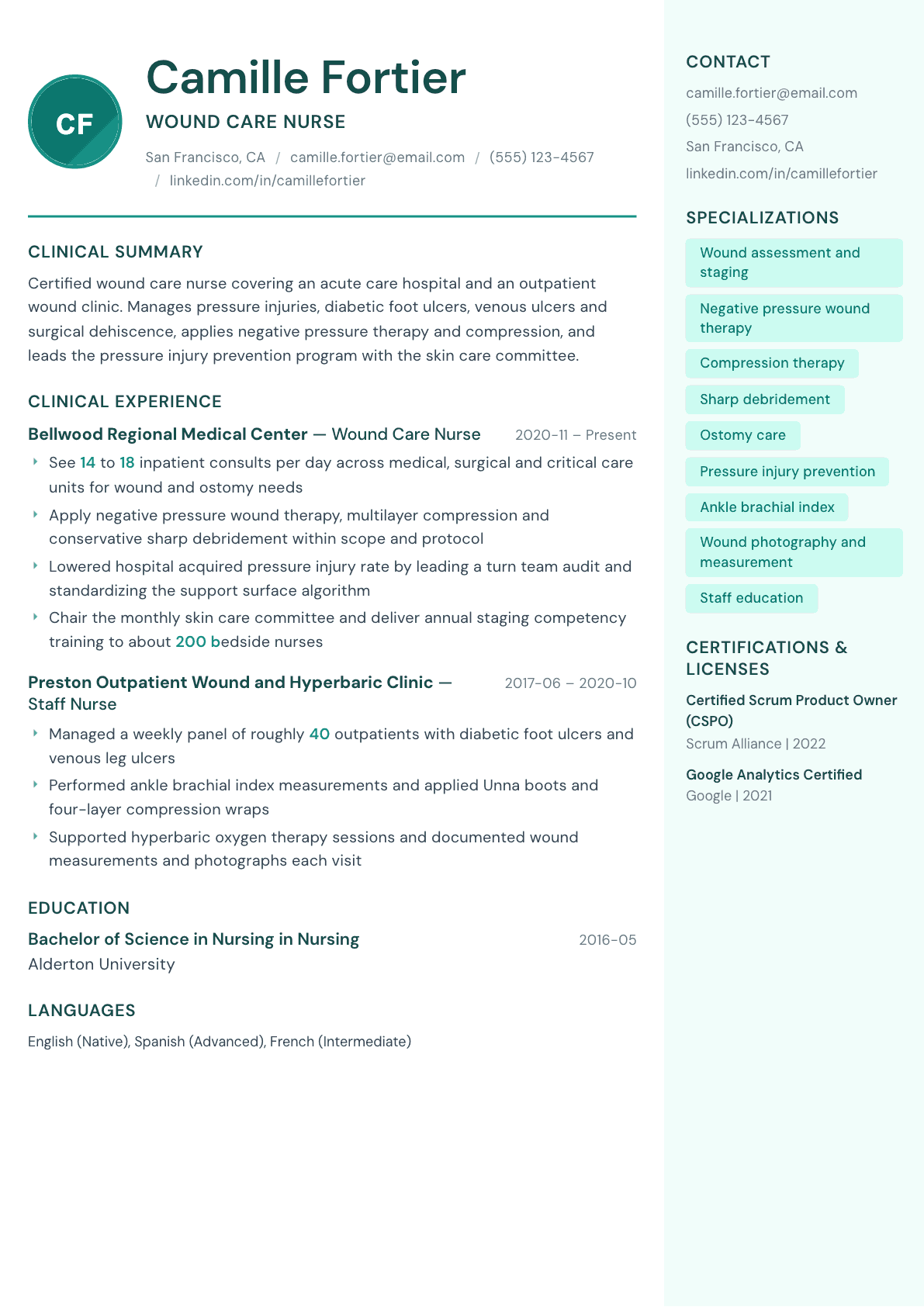
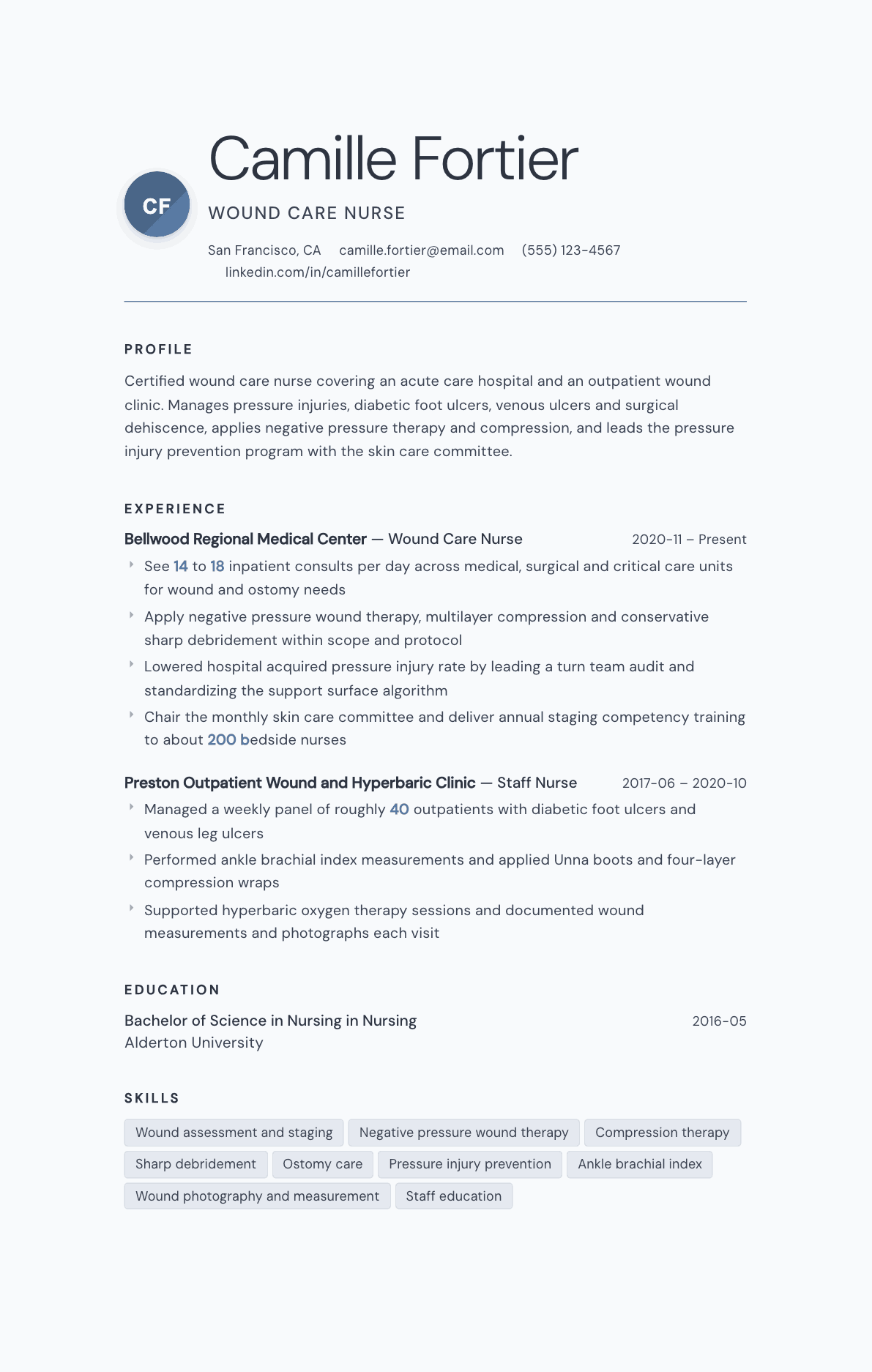
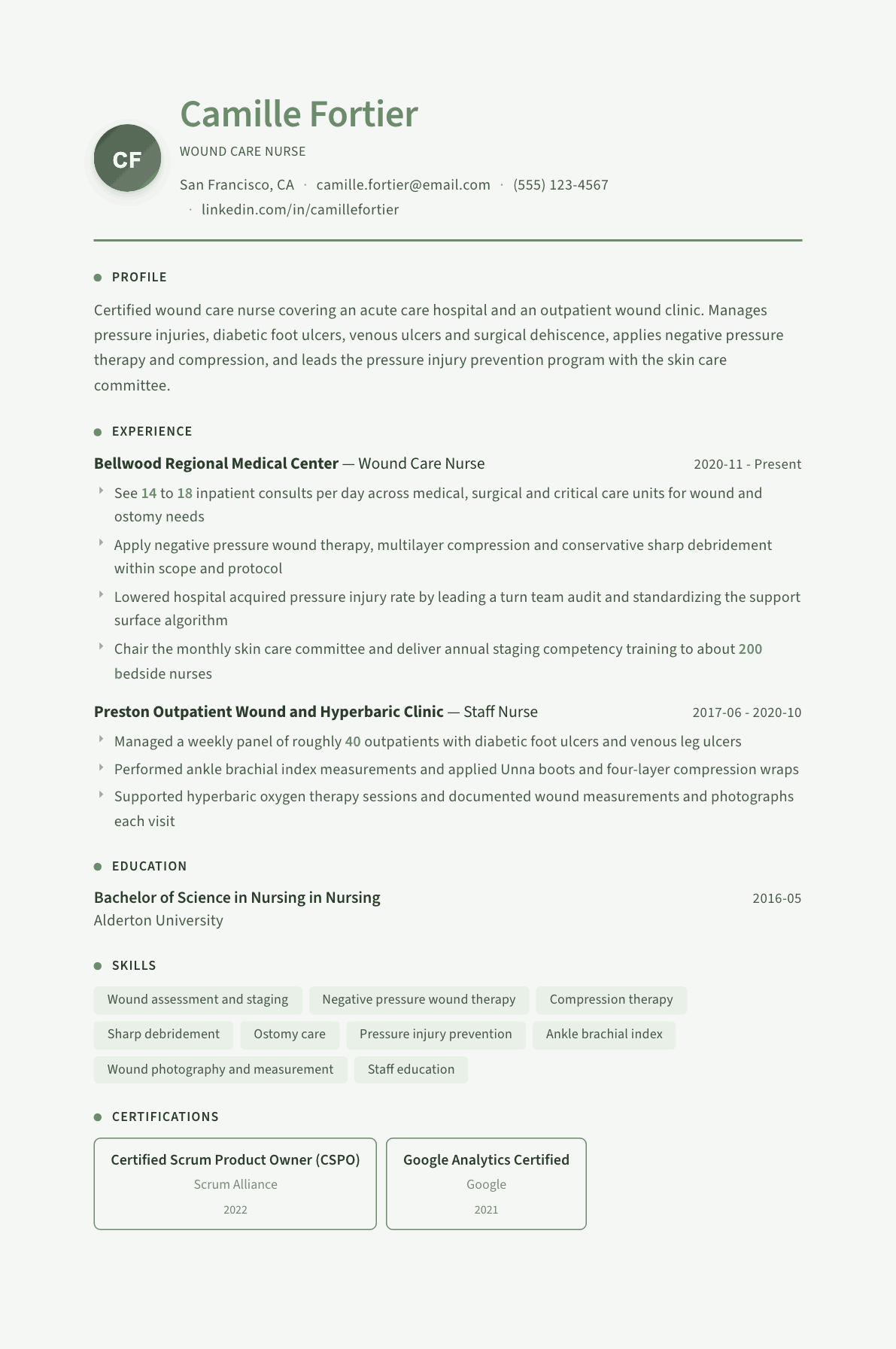
Example Wound Care Nurse summary
Certified wound care nurse with eight years across acute care and an outpatient wound clinic, currently seeing fourteen to eighteen inpatient consults a day. Manages pressure injuries, diabetic foot ulcers, venous ulcers and surgical dehiscence with negative pressure therapy, compression and conservative sharp debridement. Chairs the skin care committee and trains bedside nurses on staging every year.
Skills to list on a Wound Care Nurse resume
- Wound assessment
- Pressure injury staging
- Negative pressure wound therapy
- Compression therapy
- Conservative sharp debridement
- Ostomy and continence care
- Diabetic foot ulcer management
- Venous ulcer management
- Ankle brachial index
- Hyperbaric therapy support
- Wound documentation and photography
- Prevention program leadership
- Staff competency training
- Interdisciplinary rounding
What actually gets this resume read
- Put your RN license and wound certification together near the top, because the credential is what separates you from a floor nurse.
- Give daily consult volume and the settings you cover, since inpatient rounds, outpatient clinic and home health differ in pace and scope.
- Name the wound types you manage, from pressure injuries and diabetic foot ulcers to venous ulcers and surgical dehiscence.
- List the therapies and products you apply, including negative pressure systems, compression wraps, collagen and antimicrobial dressings.
- Show outcomes such as healing rates, reduced hospital acquired pressure injuries or lower readmissions for wound related causes.
- Include the education and committee work you lead, because hospitals hire wound nurses to change bedside practice, not only to dress wounds.
How to write a wound care nurse resume
A wound care nurse resume is judged against a specific business problem. Hospital acquired pressure injuries carry financial and regulatory consequences, outpatient wound clinics are measured on healing rates, and home health agencies live or die on whether wounds close before the episode ends. The manager reading your file wants to know which of those problems you have solved.
That means the certification matters, but the caseload and the outcomes matter more. Consults per day, the wound types you manage, the therapies you apply within your scope, and whether you changed bedside practice across a whole unit rather than dressing wounds one at a time. Nurses who write only about dressing changes read as staff nurses with an interest, not specialists.
This guide covers how to present the credential, how to describe acute, outpatient and home health settings, three summary examples from a nurse building toward certification through a program lead, bullet rewrites that show real wound reasoning, and the questions wound nurses ask when they change settings.
Format: license and certification together at the top
One page under eight years, two after that. Reverse chronological, single column. Hospital systems parse plain files reliably and wound nurse postings often come through the same central recruiting queue as bedside roles.
Put your nursing credentials after your name in the standard order: degree, license, then the wound certification. Repeat them in a credentials block with the certifying board, state of licensure and any compact status, since a wound certification is exactly what separates your file from every medical surgical nurse applying to the same posting.
- Header: name with degree, license and wound certification, city and state.
- Credentials: certification with certifying board, license state, life support cards.
- Sections: summary, credentials, clinical experience, program and education work, formal education.
Summary: setting, caseload, wound types, one outcome
Name the setting first, since acute care consults, outpatient clinic panels and home health visits run on different rhythms. Then daily or weekly caseload, then the wound categories you manage. Close with one outcome you personally moved, whether a prevention rate, a healing rate or a readmission figure.
A nurse moving into wound care from the floor should lead with the exposure already held: pressure injury staging, ostomy support, negative pressure therapy on post-surgical patients and skin assessments on admission. Then name the certification you are pursuing with the certifying body and timeline.
Experience: consults, wound types, therapies, scope
Open each job with volume and reach. Inpatient consults per day and the units covered, outpatient panel size per week, or home visits per day and territory. A manager reads that line to decide whether you can absorb their referral load.
Name the wound categories: pressure injuries by stage, diabetic and neuropathic foot ulcers, venous leg ulcers, arterial ulcers, surgical dehiscence, skin tears, moisture associated damage, burns and fistulas. Add ostomy and continence work if you carry it, because many roles combine the three.
Then the therapies, staying inside your scope and saying so. Negative pressure wound therapy setup and troubleshooting, multilayer and short stretch compression, conservative sharp debridement where your state and facility permit it, enzymatic and autolytic debridement, collagen and antimicrobial dressings, offloading devices and support surface selection.
Do not stop at the bedside. The reason hospitals fund wound nurses is prevention, so show the turn team audits, the support surface algorithm, the admission skin assessment compliance work and the staging competency training you deliver. That is the part that changes a whole unit.
Outcomes, documentation and program work
Wound care is measured, so use the measures. Hospital acquired pressure injury rate, healing rate or time to closure in the clinic, amputation prevention referrals, readmissions for wound related causes and adherence to the prevention bundle are all figures a manager already reports.
Documentation carries weight too. Wound measurement conventions, serial photography with consent, staging accuracy and how your notes support reimbursement for supplies and therapies. In home health, note your comfort with the assessment items that drive the payment and the quality measures.
- Prevention metrics: pressure injury rate, bundle compliance, skin assessment completion.
- Healing metrics: time to closure, panel healing rate, referral to vascular or podiatry.
- Documentation: measurement standards, photography, staging accuracy, supply justification.
- Program work: committee leadership, competency training, protocol authorship.
Keywords wound postings actually contain
Recurring terms include wound assessment, pressure injury prevention and staging, negative pressure wound therapy, compression therapy, debridement, ostomy and continence care, skin integrity, offloading, interdisciplinary rounding, patient and caregiver education, and product formulary management. Mirror the ones you can prove in a bullet.
Wound Care Nurse resume summary examples
Moving into wound care
Medical surgical nurse with four years and a strong skin integrity focus, currently enrolled in an accredited wound care education program with certification planned within the year. Performs admission skin assessments, stages pressure injuries accurately, and manages negative pressure therapy on post-surgical patients under the wound team plan.
Certified, hospital based
Certified wound care nurse covering fourteen to eighteen inpatient consults daily across medical, surgical and critical care units. Manages pressure injuries, diabetic foot ulcers, venous ulcers and surgical dehiscence with negative pressure therapy, compression and conservative sharp debridement, and chairs the monthly skin care committee.
Wound program lead
Wound and ostomy program lead for a two-hospital system, supervising three certified nurses and setting the product formulary with supply chain. Rebuilt the prevention bundle and support surface algorithm, lowered hospital acquired pressure injury rates across both campuses, and reports quarterly to the quality council.
Work experience bullets: before and after
Before: Provided wound care to patients throughout the hospital.
After: Saw 14 to 18 inpatient consults per day across medical, surgical and critical care units for pressure injuries, surgical dehiscence and ostomy complications.
Daily consult volume, the units covered and the wound categories tell a manager whether you can carry their referral load.
Before: Changed dressings and monitored healing.
After: Applied negative pressure wound therapy, multilayer compression and enzymatic debridement based on wound bed assessment, documenting serial measurements and photographs at every visit.
Therapy names tied to assessment reasoning and documentation show specialist decision making, not task completion.
Before: Helped reduce pressure ulcers in the hospital.
After: Lowered the hospital acquired pressure injury rate by leading a turn team audit, standardizing the support surface algorithm and adding a second skin check at shift handoff.
Three named interventions attached to an outcome turn a prevention claim into a program a reader can picture.
Before: Taught staff about wound care.
After: Delivered annual pressure injury staging competency training to about 200 bedside nurses and ran unit huddles when audits showed staging errors on a specific floor.
Audience size plus the targeted follow up shows education that responds to data rather than a yearly slide deck.
Before: Saw patients in the outpatient wound clinic.
After: Managed a weekly panel of roughly 40 outpatients with diabetic foot and venous leg ulcers, performing ankle brachial index measurements and applying four-layer compression with offloading recommendations.
Panel size, wound types and the specific assessments demonstrate independent outpatient practice.
Hard skills
- Wound assessment and measurement
- Pressure injury staging
- Negative pressure wound therapy
- Compression therapy application
- Conservative sharp debridement
- Enzymatic and autolytic debridement
- Ostomy and continence care
- Offloading and support surface selection
- Ankle brachial index measurement
- Advanced dressing selection
- Wound photography and documentation
- Prevention bundle implementation
Soft skills
- Patient and caregiver teaching
- Persuading bedside teams to change practice
- Interdisciplinary collaboration
- Attention to serial detail
- Difficult conversations about nonhealing wounds
- Mentoring newer nurses
Certifications worth listing
- Certified Wound Ostomy Continence Nurse (CWOCN) (Wound, Ostomy and Continence Nursing Certification Board)
- Certified Wound Care Nurse (CWCN) (Wound, Ostomy and Continence Nursing Certification Board)
- Certified Wound Specialist (CWS) (American Board of Wound Management)
- Wound Care Certified (WCC) (National Alliance of Wound Care and Ostomy)
- Basic Life Support (BLS) (American Heart Association)
Mistakes that cost wound care nurse candidates the interview
- Listing the wound certification only in education when it is the single line separating you from every floor nurse applying.
- Describing dressing changes without the assessment reasoning that led to the product choice.
- Leaving out consult volume or panel size, so a manager cannot judge whether you can absorb the referral load.
- Skipping prevention and education work, which is the reason the position is funded in most hospitals.
- Claiming sharp debridement without noting the scope, state rules and facility policy that permit it.
- Using the same resume for acute care, outpatient clinic and home health when the caseload language differs completely.
Wound Care Nurse resume questions
Which wound care certification should I pursue?
It depends on your background and setting. Nursing specific certifications from the wound, ostomy and continence board are the standard in hospitals, while multidisciplinary credentials suit clinics and home health. Check the postings you want and hold the one they name most often.
How do I get into wound care from a medical surgical floor?
Build visible evidence first: accurate staging, admission skin assessments, negative pressure therapy management and a seat on the skin care committee. Then enroll in an accredited education program, name it on the resume with your timeline, and apply while you are enrolled.
What outcomes should a wound care nurse resume show?
Hospital acquired pressure injury rates, prevention bundle compliance, time to closure or healing rate in a clinic panel, and readmissions for wound related causes. Pick the ones you influenced and attach each to the specific change you made to move it.
Is home health wound experience valued by hospitals?
Yes, because home health nurses manage complex wounds with limited supplies and no colleague down the hall. Emphasize autonomous assessment, caregiver teaching, product justification for reimbursement and coordination with physicians by phone rather than in person rounds.
How do I write about debridement on a nurse resume?
Be precise about method and authority. Name conservative sharp debridement only where your state practice act and facility policy allow it and say so, then list enzymatic, autolytic and mechanical methods separately with the wound conditions that led you to choose each.