Marketing Designer Resume Examples: the lines they read
Write a Marketing Designer Resume That Connects Craft to Pipeline
By Mustafa Tarabya, founder of CVBooster · Published · Updated
Marketing designer resume example linking campaign creative to results, with tools, keywords and a full writing guide.
Sample resumes for a marketing designer
The same marketing designer content laid out in three CVBooster templates, so you can see what the finished document looks like before you write a word.
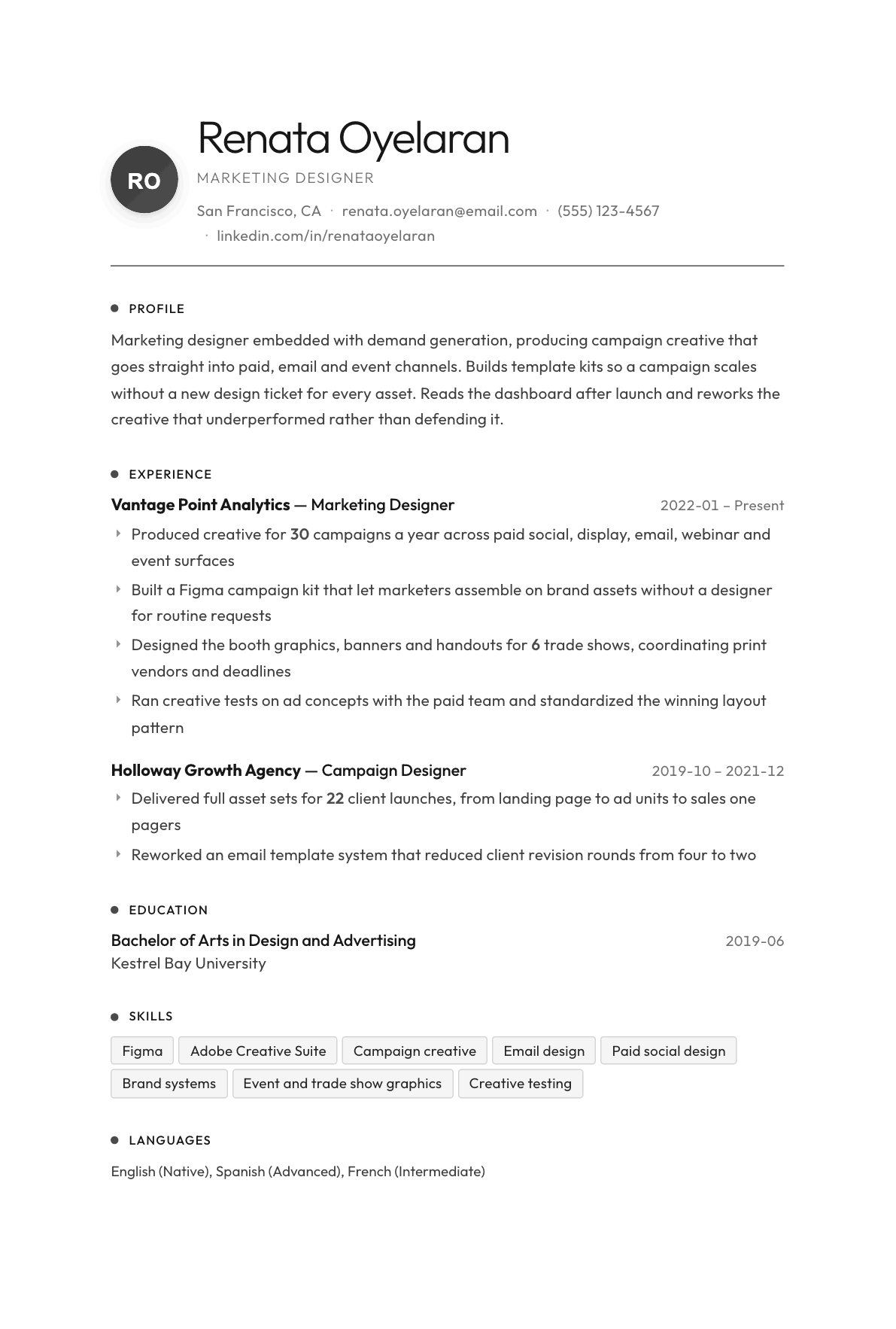
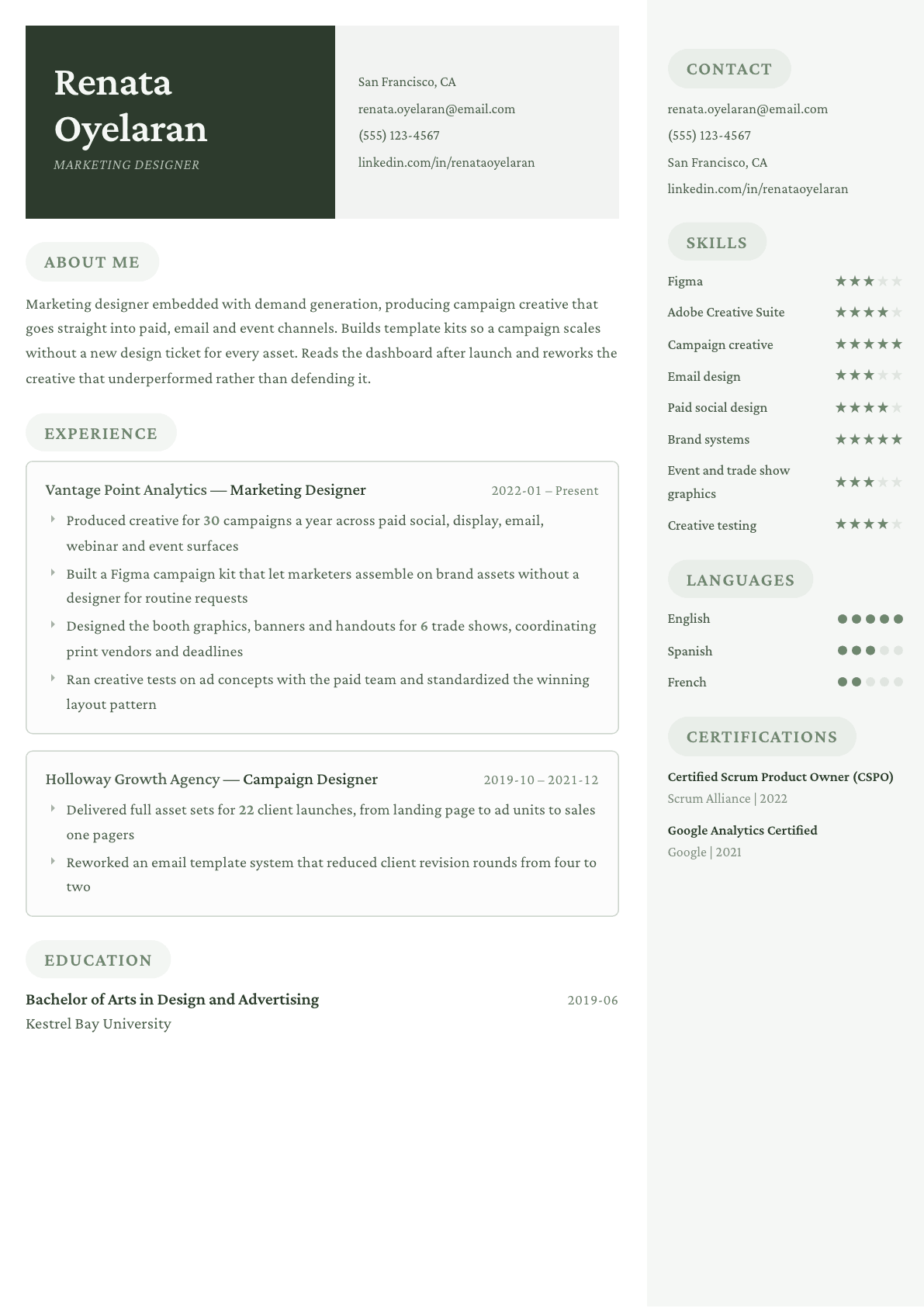
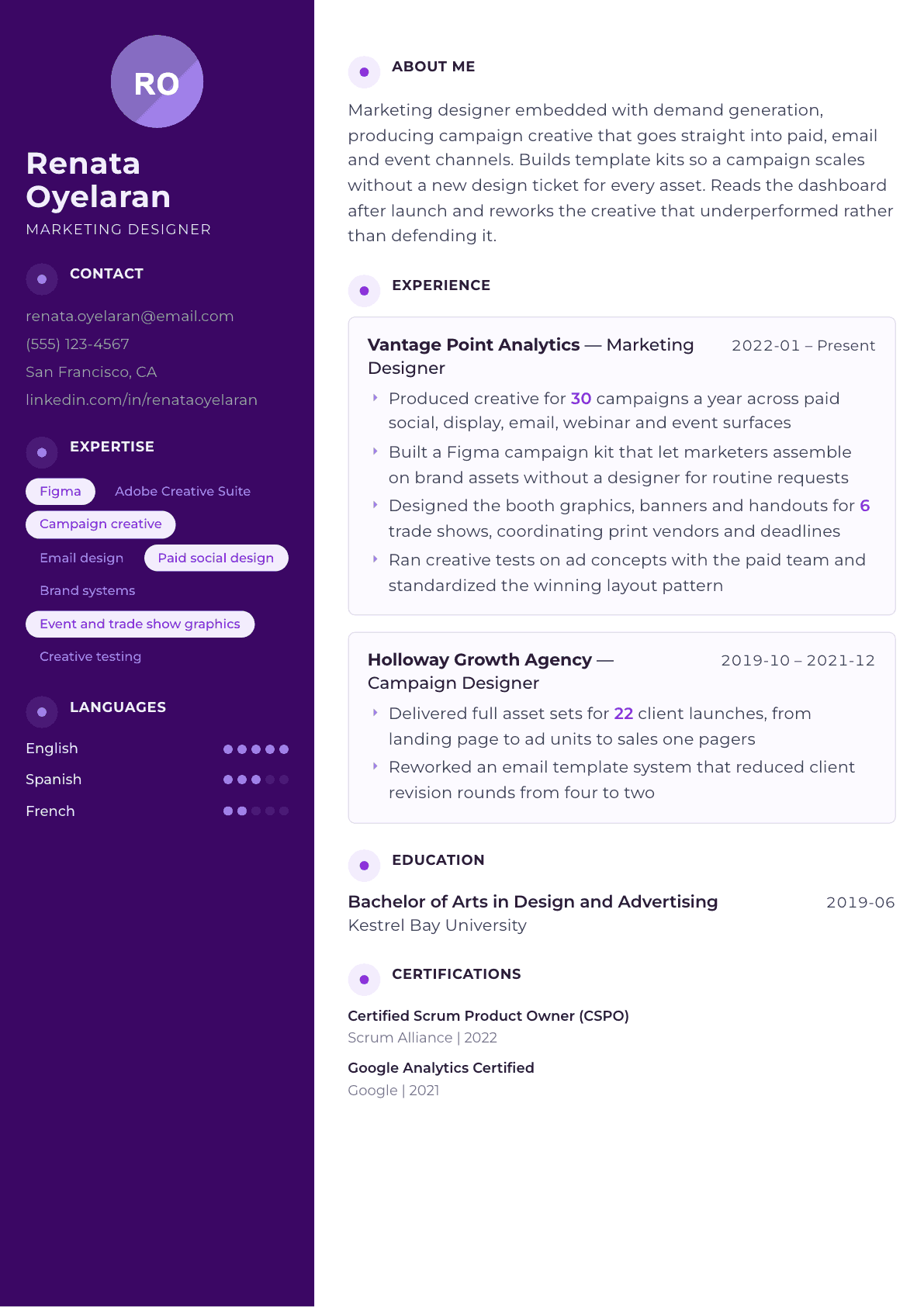
Example Marketing Designer summary
Marketing designer with six years sitting inside demand generation teams and agencies, producing creative for paid social, display, email, web and events. Builds template kits so campaigns scale without a design ticket for every asset, and reviews performance data before the next round. Coordinates print vendors for booths and collateral. Looking for an in house team that treats creative as part of the funnel.
Skills to list on a Marketing Designer resume
- Figma
- Adobe Illustrator
- Adobe Photoshop
- Adobe InDesign
- Campaign design
- Paid social creative
- Display advertising
- Email design
- Landing page design
- Brand systems
- Trade show graphics
- Sales collateral
- Creative testing
- Motion basics
- Design operations
What actually gets this resume read
- Anchor each job in the channels you designed for: paid social, display, email, web, events, sales collateral.
- Report campaign outcomes the marketing team tracked, and say which creative decision moved the number.
- Show template and kit building, because scaling a campaign without new tickets is the real value here.
- Include the print side of marketing work: trade show booths, banners, one pagers and vendor coordination.
- Name the stakeholders you partner with, such as demand generation, product marketing and sales enablement.
- Keep brand consistency evidence in the resume: guidelines you maintained, or a kit others used correctly.
How to write a marketing designer resume
A marketing designer is hired by a marketing leader, not by a design leader, and that changes what the resume has to prove. The person reading it is measured on pipeline, event attendance and campaign performance. They want a designer who produces a full asset set on a campaign calendar, keeps everything on brand, and is genuinely interested in whether the creative worked after it went out.
That is why craft alone rarely wins this role. The strongest resumes show two things next to the portfolio: throughput, meaning the volume and range of assets produced across paid, email, web and events, and leverage, meaning the template kits and brand systems that let marketers produce routine assets without opening a design ticket.
This guide covers how to organize the page around channels, how to report campaign outcomes honestly, why the print and event side of the job deserves its own bullets, and how to describe the stakeholder relationships that make a marketing designer easy to work with.
Format: one page, channels visible, portfolio link that works on a phone
Reverse chronological on one page for most candidates. Group the work by channel inside each job rather than by project, because a marketing leader scans for the channel they are weakest in. If the posting is heavy on events, the booth and banner work needs to be visible without a search.
Keep the portfolio link in the header and make sure it opens quickly on a phone, since marketing managers review candidates between meetings. A short case study format works better here than a long narrative: the campaign, the assets you produced, the audience, and what happened.
- Header: name, title, city, email, portfolio address.
- Sections: summary, experience organized by channel, tools, brand and template systems, education.
- Name the marketing team you sat inside: demand generation, product marketing, brand, or an agency account.
Summary: the channels, the partners, the throughput
Open with the channels you design for and the team you sat inside. A designer embedded with demand generation writes different creative than one attached to brand, and marketing leaders recruit for the specific pattern they need. Naming it removes the guesswork.
Then say something about scale. Producing creative for dozens of campaigns a year across paid social, display, email, webinar and event surfaces communicates a working rhythm that a portfolio image cannot. Close with the systems line: template kits, brand guidelines, or the design operations work that made the volume possible.
Experience: assets produced, systems built, results checked
Every job needs three kinds of bullet. The first is throughput: campaigns supported, asset sets delivered, launches covered end to end from landing page through ad units to sales one pagers. The second is leverage: the campaign kit, the email template system, the brand library that let non designers assemble on brand assets themselves.
The third is outcome. Report what the marketing team measured on creative you designed: the ad concept test the paid team ran, the revision rounds a template system removed, the layout pattern that became the standard after a test. Attribute honestly. Design contributed to the result, it did not produce it alone, and a marketing leader respects a candidate who says so.
Where you can, name what changed because of a creative decision. A layout pattern standardized after testing, an email block library that cut production time, a booth graphic system reused across a season. Specific cause and effect is far more persuasive than a bare number.
The print and event half of the job
Trade show booths, pull up banners, printed handouts, signage and swag are a real part of most marketing design roles, and they involve vendor coordination, print deadlines and file specifications that digital only designers have never handled. If you have done it, give it bullets: the shows, the surfaces, the vendors and the deadlines you held.
Sales collateral belongs here too. One pagers, case study layouts, pitch decks and battlecards are among the most requested and least glamorous marketing design assets, and a designer who produces them reliably is quietly valuable to a revenue team.
- Events: booth graphics, banners, signage, printed handouts, vendor and deadline coordination.
- Sales enablement: one pagers, case study layouts, pitch decks, template systems for the sales team.
- Brand: guideline maintenance, asset libraries, and reviewing work produced by others.
Tools and stakeholders: name both
List the design tools, then the marketing tools you touch: the email platform, the ad platforms whose specifications you design to, the project tracker the requests arrive in, and the analytics dashboard you check afterward. Fluency with the request pipeline is part of the job and rarely mentioned by other candidates.
Name your regular partners: demand generation, product marketing, sales enablement, events, and the agency or freelancers you brief. Marketing leaders hire for collaboration under a calendar, and listing the stakeholder set signals that you understand where the work comes from and where it goes.
Marketing Designer resume summary examples
Campaign designer, first role
Campaign designer with 2 years at a growth agency delivering full asset sets for client launches, from landing page through ad units to sales one pagers. Reworked an email template system that reduced client revision rounds from four to two. Looking for an in house marketing team with a steady campaign calendar.
Six years in
Marketing designer with 6 years embedded in demand generation teams, producing creative for around 30 campaigns a year across paid social, display, email, webinar and event surfaces. Built a campaign kit that lets marketers assemble on brand assets without a design ticket, and coordinates print vendors for trade shows.
Senior or lead
Senior marketing designer with 10 years across agencies and software companies, owning the brand system, the campaign kit and the creative testing cadence. Directs a designer and two freelancers, briefs external production, and works with paid and lifecycle teams to rework creative that underperforms rather than defend it.
Work experience bullets: before and after
Before: Designed assets for marketing campaigns.
After: Produced creative for around 30 campaigns a year across paid social, display, email, webinar and event surfaces, working to a rolling quarterly calendar with demand generation.
Naming the channel set and the working rhythm communicates throughput a portfolio image cannot.
Before: Created brand templates for the team.
After: Built a Figma campaign kit with locked brand elements and editable text and image slots, so marketers assembled routine social and email assets without opening a design request.
Describing the mechanism shows leverage, which is what a marketing leader is actually buying.
Before: Helped with trade show materials.
After: Designed booth graphics, banners and printed handouts for 6 trade shows, coordinating two print vendors and holding every file deadline ahead of freight cutoff.
Vendor coordination and deadline ownership are the parts of event design that a digital only designer has never done.
Before: Ran A/B tests on ad creative.
After: Tested three ad concept directions with the paid team across a quarter, then standardized the winning layout pattern into the campaign kit for later launches.
The learning is carried into the system, which turns a test into a lasting improvement.
Before: Made sales materials as requested.
After: Rebuilt the sales one pager and case study layouts as an editable template set, cutting a recurring request queue down to a self serve library the sales team maintains.
Turning a request queue into a self serve system is a concrete operational win a revenue leader notices.
Hard skills
- Figma
- Adobe Illustrator
- Adobe Photoshop
- Adobe InDesign
- Campaign creative development
- Paid social and display formats
- Email design
- Landing page design
- Brand systems and guidelines
- Template and kit building
- Trade show and event graphics
- Sales collateral design
- Creative testing
- Design operations and request intake
Soft skills
- Stakeholder partnership
- Calendar discipline
- Briefing external vendors
- Receiving performance feedback
- Prioritizing competing requests
Certifications worth listing
- Google Ads Search Certification (Google)
- Google Analytics Certification (Google)
- Adobe Certified Professional in Visual Design Using Adobe Photoshop (Adobe)
Mistakes that cost marketing designer candidates the interview
- Presenting only the prettiest campaign and hiding the volume that makes you useful on a calendar.
- Claiming revenue results for creative you contributed one asset to.
- Leaving out event, print and sales collateral work that most marketing design roles require.
- Never mentioning template systems, which is the difference between a producer and a bottleneck.
- Failing to name the marketing function you sat inside, so a leader cannot place your experience.
- Ignoring platform specifications in the portfolio when ad formats are half the job.
Marketing Designer resume questions
What is the difference between a marketing designer and a graphic designer?
A marketing designer works to a campaign calendar with performance feedback, produces full asset sets per launch, and builds template systems others use. A graphic designer role is defined more broadly by craft and output than by channel ownership and measured results.
How do I show campaign results without overclaiming?
Report what the marketing team measured and name your contribution precisely. Say which creative decision was tested, what the team observed, and what you changed afterward. Attribution honesty reads as maturity to anyone who owns a number.
Should a marketing designer resume include analytics tools?
Yes, at the level you actually use them. Reading a campaign dashboard, checking asset performance by placement and reviewing test results is enough. You do not need to claim analysis ownership, only genuine curiosity about outcomes.
How much print work belongs on the resume?
All of it, if the role involves events. Booths, banners, signage and handouts require vendor coordination and print specifications that many candidates have never handled, so it is a differentiator rather than an old fashioned skill.
What should a marketing design portfolio show?
Complete campaigns rather than single images: the landing page, the ad set, the email and the event surface from one idea. Add a short note on the audience and the result so a marketing leader sees strategy alongside the craft.