Web Designer Resume Examples: free ATS score and gap list
Build a Web Designer Resume That Gets Your Portfolio Opened
By Mustafa Tarabya, founder of CVBooster · Published · Updated
A web designer resume example with portfolio placement advice, the tools hiring managers scan for, and a full guide to writing each section.
Sample resumes for a web designer
The same web designer content laid out in three CVBooster templates, so you can see what the finished document looks like before you write a word.
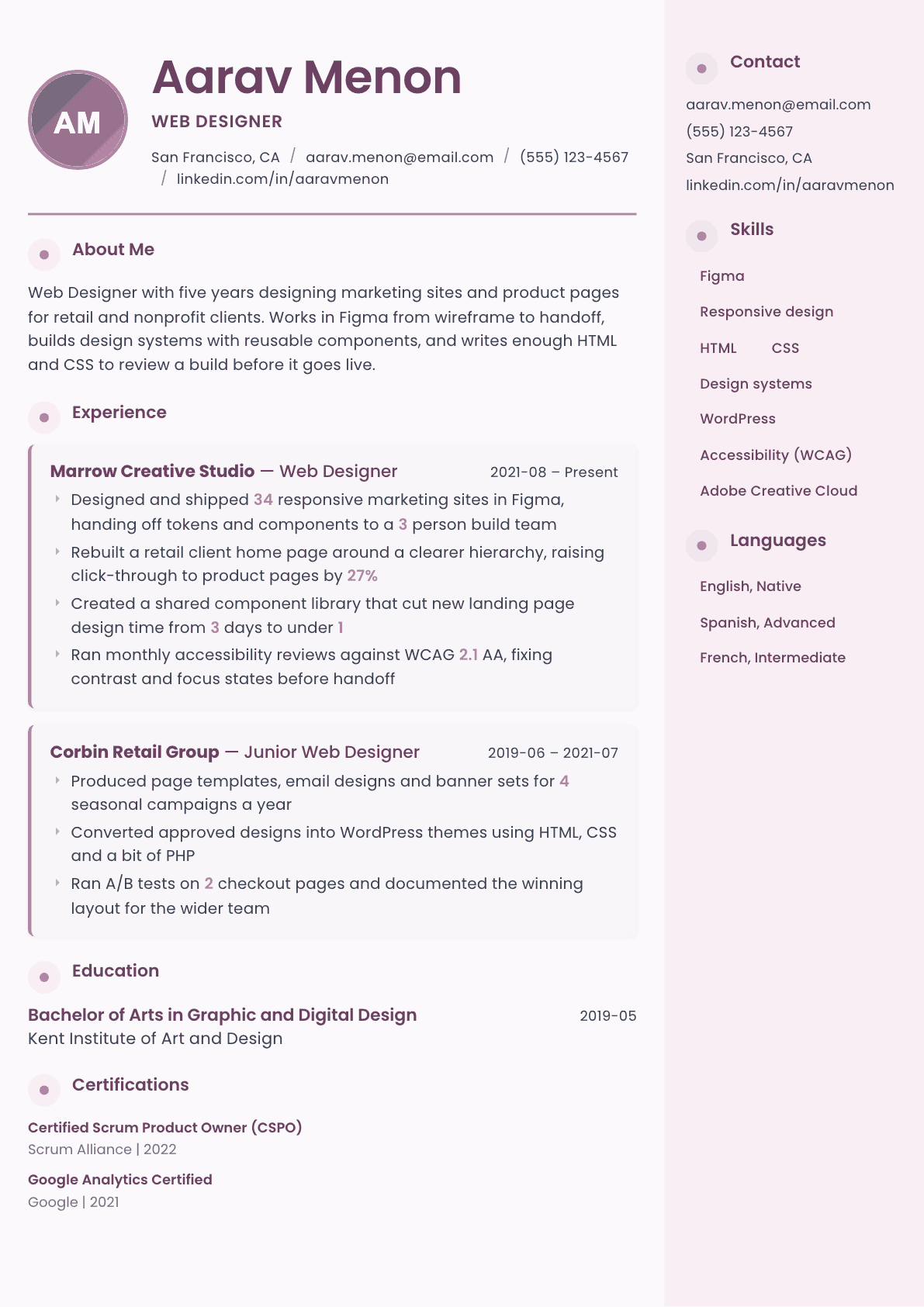
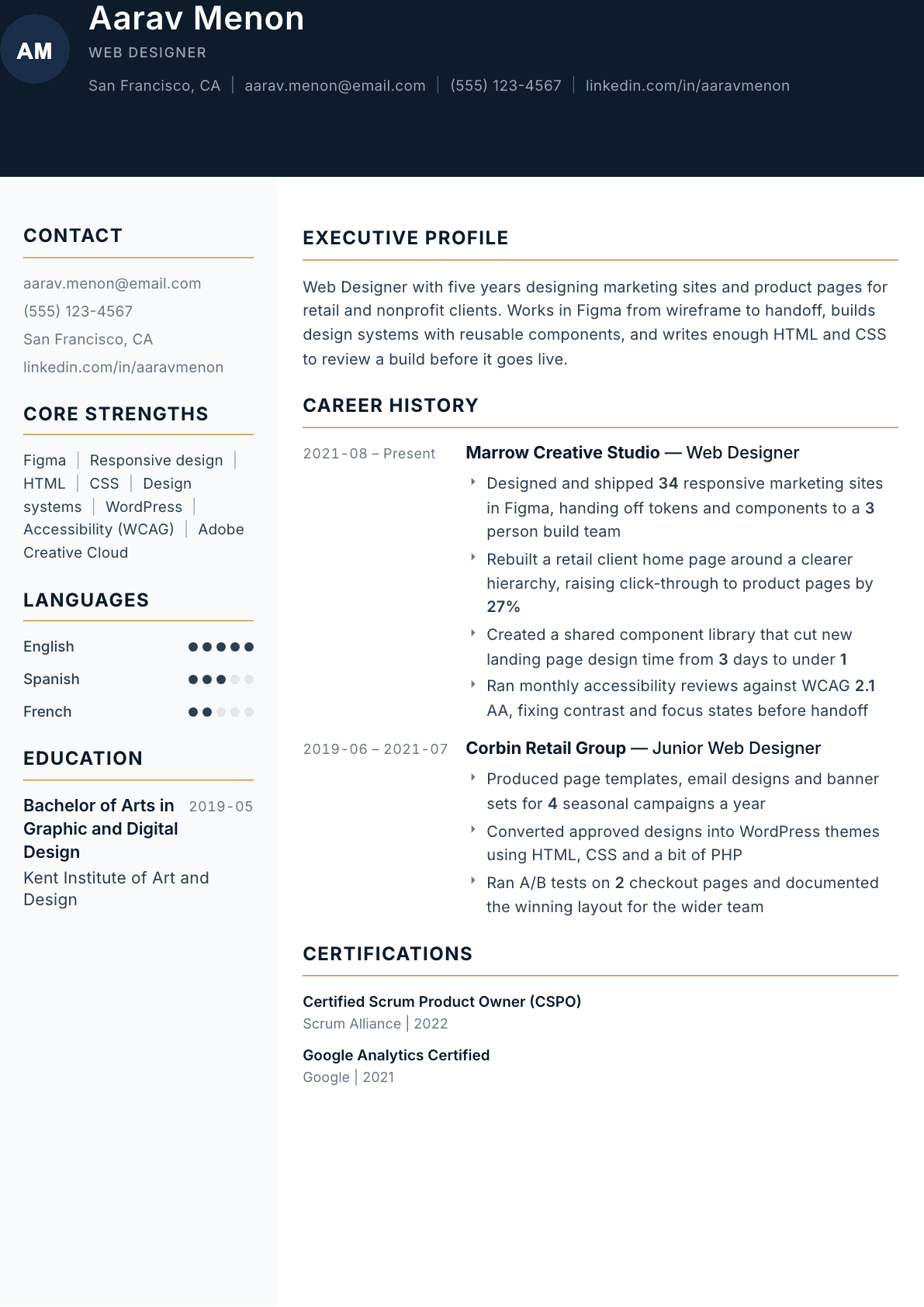
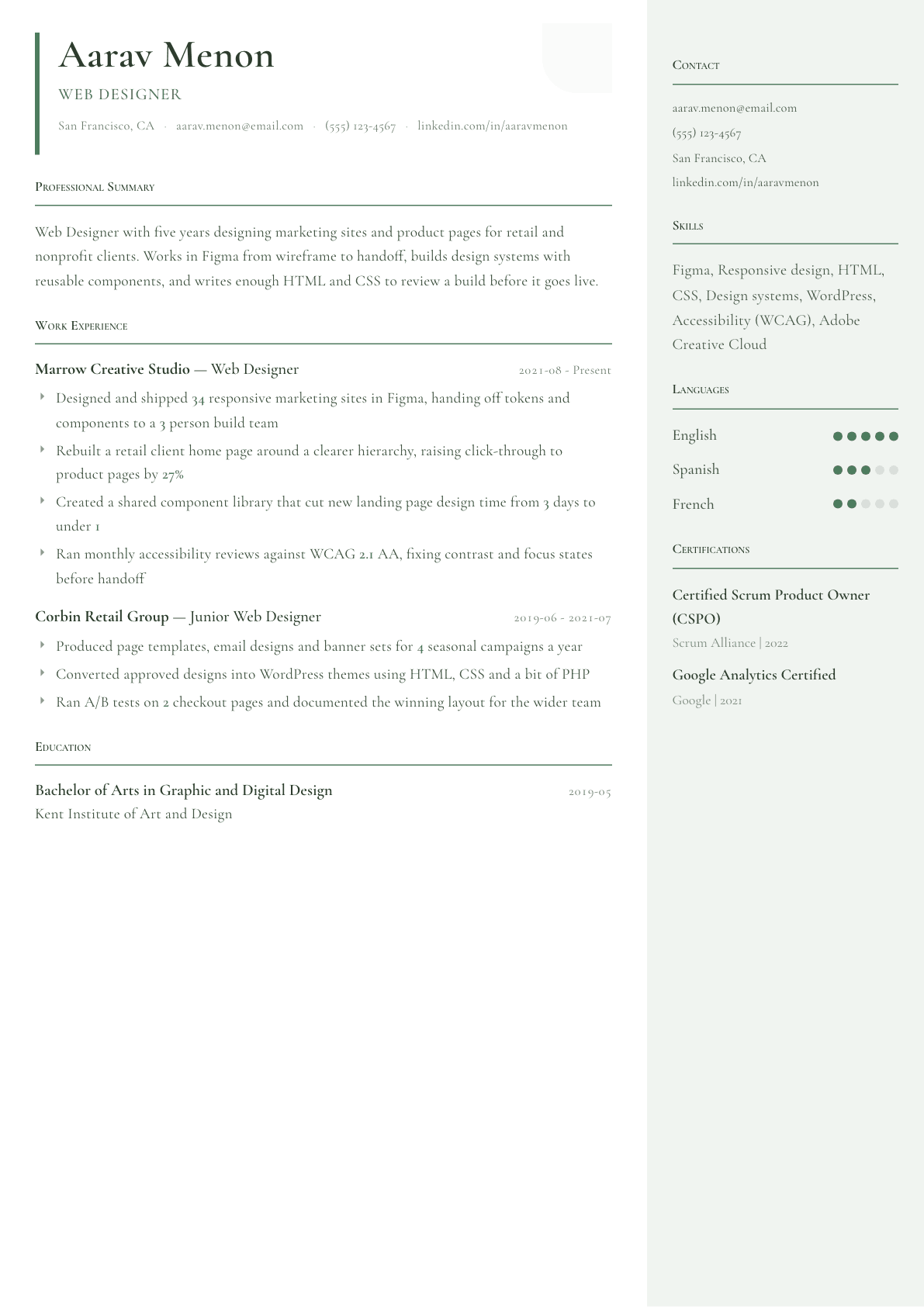
Example Web Designer summary
Web Designer with five years building responsive marketing and ecommerce pages for retail and nonprofit clients. Designs in Figma end to end, maintains a shared component library, and reviews the front-end build against WCAG 2.1 AA before launch. Recent redesign work lifted click-through to product pages by 27%. Seeking a design role on a product team where the system outlives the campaign.
Skills to list on a Web Designer resume
- Figma
- Adobe XD
- Responsive web design
- Design systems
- HTML
- CSS
- Wireframing
- Prototyping
- Typography
- Accessibility (WCAG)
- WordPress
- Webflow
- User research
- Visual hierarchy
- Design handoff
- A/B testing
What actually gets this resume read
- Put the portfolio link in the header next to your email, because a web designer resume without a link gets closed.
- Say what each site was for and who used it, not only that you designed it, since context is what a reviewer weighs.
- Separate design tools from build skills so a hiring manager can see where your hands-on work stops.
- Show responsive and accessibility work explicitly, naming breakpoints, WCAG level, or the audit you ran.
- Attach one business outcome to at least two projects, such as conversion, bounce rate or time on page.
- Name the content management system you designed against, since WordPress, Webflow and Shopify attract different postings.
How to write a web designer resume
A web designer resume has one job that no other resume has: get the portfolio opened. Nobody hires a designer from a document. The resume is the thing that decides whether a creative director clicks the link, and once she clicks, the work argues for itself. That means the header, the link and the first three lines carry almost all the weight, and a page of adjectives about being passionate and detail-oriented carries none.
The second thing a reviewer looks for is where your hands stop. Web design covers a wide spread of people: some do visual comps only, some run research and information architecture, some build the site in Webflow themselves, some hand off tokens to a front-end team. All of them write web designer at the top. A resume that leaves this ambiguous gets sorted into the maybe pile, because the reviewer cannot tell whether hiring you means also hiring a developer.
This guide covers the layout to use, how to write the summary and the project bullets, how to present the tool stack, and the questions designers ask when they sit down to rewrite this document.
Format: one page, portfolio link in the header, restrained design
One page. Web design is not a field where length signals seniority, and a two-page designer resume usually means the projects are described instead of shown. Put the portfolio URL directly beside your email in the header, not at the bottom, and make sure it is a live link in the exported file.
Design the resume with obvious care and no gimmicks. A clean grid, one type family used at two or three sizes, generous white space and consistent alignment tell a reviewer more about your eye than a decorative sidebar does. Avoid skill rating bars: no reader knows what four dots out of five in Figma means, and applicant tracking systems drop the graphic entirely.
- Header: name, title, city, email, phone, portfolio URL, and a LinkedIn or Dribbble handle if it is current.
- Order: summary, selected projects or experience, tools, education, then anything else.
- Export as PDF with real text, never as a flattened image, or the tracking system reads a blank page.
Summary: what you design, for whom, and how far into the build you go
Two or three lines. Name the type of site work you do, marketing sites, ecommerce, product interfaces, content platforms, then the industries, then the boundary of your hands-on build ability. A line as plain as designs in Figma and builds in Webflow, or designs and hands off tokens to a React team, removes the biggest question in the reviewer's head before she reaches the experience section.
If you are early, the summary is where you make the portfolio interesting rather than the resume. Say what kind of problems you like solving and what you built most recently, and let the link do the rest.
Experience: treat each engagement as a case study in three lines
For agency and freelance work, group by employer or by client, then give each project a short case-study shape: what the site was for, what the constraint was, what you designed, and what changed afterward. Reviewers are looking for evidence you design toward a goal instead of decorating a wireframe someone else approved.
Attach an outcome wherever you honestly can. Click-through on a rebuilt home page, form completion after a checkout redesign, page speed after you trimmed the hero video, support tickets after clearer navigation. Not every project has a number, and inventing one is worse than leaving it out, so pick the two or three that do and let the others describe scope instead.
Show system work separately from campaign work. A designer who has built and maintained a component library is doing something structurally different from one producing another seasonal landing page, and that difference is exactly what a product team is buying. Name the library, the number of components, and who else used it.
Accessibility belongs in the bullets, not the skills list. Say which level you designed against, what you checked, and when in the process you checked it. Designers who bring contrast and focus states up before handoff are noticeably rarer than the skills sections suggest.
- Per project: purpose, constraint, what you designed, what moved.
- Name the content management system or framework the design was built into.
- Separate design system work from one-off page work.
- Show responsive thinking with real detail, not the word responsive on its own.
Tools and skills: name versions of the truth, not a wish list
Group tools into design, build and collaboration. Design covers Figma, and Adobe apps if you still use them for asset production. Build covers HTML, CSS, and whichever platform you actually publish in, most often WordPress, Webflow or Shopify. Collaboration covers the handoff and project tools the team will expect you in.
Be specific about the code line. There is a large distance between can read a stylesheet and can build a responsive template from scratch, and both are legitimate positions to hold. State which one is yours, because the interview will find out anyway and the honest version reads as professional maturity.
Keywords hiring teams filter on
Web design postings repeat a predictable set: responsive design, Figma, design system, wireframe, prototype, user flows, accessibility, WCAG, information architecture, HTML, CSS, WordPress, Webflow, and increasingly Core Web Vitals. Mirror the ones that are true of you, once in the tools block and once inside a bullet where they are attached to real work. A skills list alone is easy to write and easy to discount.
Web Designer resume summary examples
First design job
Design graduate with four portfolio projects, including a nonprofit site rebuild that took a volunteer signup flow from six screens to two. Works in Figma, builds simple pages in HTML and CSS, and checks contrast and focus states before handoff. Looking for a junior web design role at an agency.
Five years in
Web designer with five years across retail and nonprofit clients, delivering thirty-four responsive marketing sites in Figma. Built the shared component library that cut new landing page design time from three days to one, and lifted click-through to product pages 27% through a clearer home page hierarchy.
Lead designer
Lead web designer running the design system for a retail brand across nine market sites, with two designers reporting in. Owns typography, component governance and the accessibility standard, and works directly with the front-end lead on tokens, breakpoints and performance budgets for every release.
Work experience bullets: before and after
Before: Designed websites for various clients.
After: Designed thirty-four responsive marketing sites for retail and nonprofit clients, handing off components and tokens to a three person build team.
Volume, sector and the handoff model tell a reviewer what kind of designer she is reading in one line.
Before: Improved the homepage design.
After: Rebuilt a retail home page around a single primary action and a clearer product hierarchy, raising click-through to product pages by 27%.
It names the design decision and the result, so the redesign reads as intentional rather than cosmetic.
Before: Created a design system.
After: Built a forty component library in Figma with typography and spacing tokens, cutting new landing page design time from three days to under one.
Component count and a time saving show the system was used, not just documented and abandoned.
Before: Made sure sites were accessible.
After: Ran accessibility reviews against WCAG 2.1 AA before every handoff, correcting contrast ratios, focus indicators and heading order across all page templates.
The standard, the timing and the specific defects prove the work happened rather than being claimed.
Before: Worked with developers on the build.
After: Reviewed each staging build against the Figma file at three breakpoints and logged discrepancies in Jira, so visual defects were closed before client review.
It describes a repeatable quality process instead of a generic collaboration statement.
Hard skills
- Figma
- Responsive web design
- Design systems and component libraries
- Wireframing and prototyping
- Typography and layout
- HTML
- CSS
- Accessibility to WCAG standards
- WordPress
- Webflow
- Information architecture
- Design handoff and specification
Soft skills
- Presenting design rationale
- Client feedback handling
- Working within brand constraints
- Collaboration with developers
- Scoping and estimating
- Attention to detail
Certifications worth listing
- Adobe Certified Professional in Visual Design (Adobe)
- Webflow Certified Partner (Webflow)
- Google UX Design Certificate (Google)
- Web Accessibility Specialist (WAS) (International Association of Accessibility Professionals)
Mistakes that cost web designer candidates the interview
- Burying the portfolio link at the bottom of the page, or including one that opens on a password prompt.
- Using skill rating bars and icon grids, which mean nothing to a reader and disappear inside a tracking system.
- Describing projects only by client name, so the reviewer never learns what the site had to achieve.
- Leaving the build boundary unstated, which makes a hiring manager assume the smallest possible technical range.
- Exporting the resume as an image because the layout looked better, which produces a blank parse and an automatic rejection.
- Listing every Adobe application ever opened instead of the four tools the job actually runs on.
Web Designer resume questions
Do I need a portfolio if my web designer resume is strong?
Yes, without exception. Hiring for design is a judgment about work quality, and no written description substitutes for looking at the screens. Treat the resume as the argument for clicking the link and keep the portfolio to six or eight projects you can talk about in depth.
Should a web designer resume be visually designed or plain?
Designed, but quietly. Show control of type, spacing and alignment rather than decoration. The document should look like something a careful designer made, while still parsing cleanly as text so a tracking system can read your job titles and dates.
How much coding should a web designer put on a resume?
Exactly as much as you can defend in an interview. If you build in Webflow or write your own templates, say so clearly, because it widens the roles you qualify for. If you stop at design handoff, say that instead and lean on your system and specification work.
How do I show freelance web design work on a resume?
Create one entry with your own business name and your active dates, then list clients as projects underneath with a line each. This keeps the timeline continuous and stops a reviewer from reading a series of short engagements as job hopping.
What is the difference between a web designer and a UX designer on paper?
A web designer resume leads with visual craft, page structure and the sites produced. A UX designer resume leads with research, flows, testing and iteration. Many people do both, so decide which the posting is buying and put that evidence in the top third of the page.
Related resume examples
- UX Designer Resume example
- UI Designer Resume example
- Frontend Developer Resume example
- Shopify Developer Resume example
- UX Engineer Resume example
- Game Designer Resume example