Fleet Coordinator Resume Examples: the lines they read
A Fleet Coordinator Resume That Shows Uptime and Cost Control
By Mustafa Tarabya, founder of CVBooster · Published · Updated
A fleet coordinator resume covering preventive maintenance, DOT files, fuel cards and telematics, with a sample resume and a step by step writing guide.
Sample resumes for a fleet coordinator
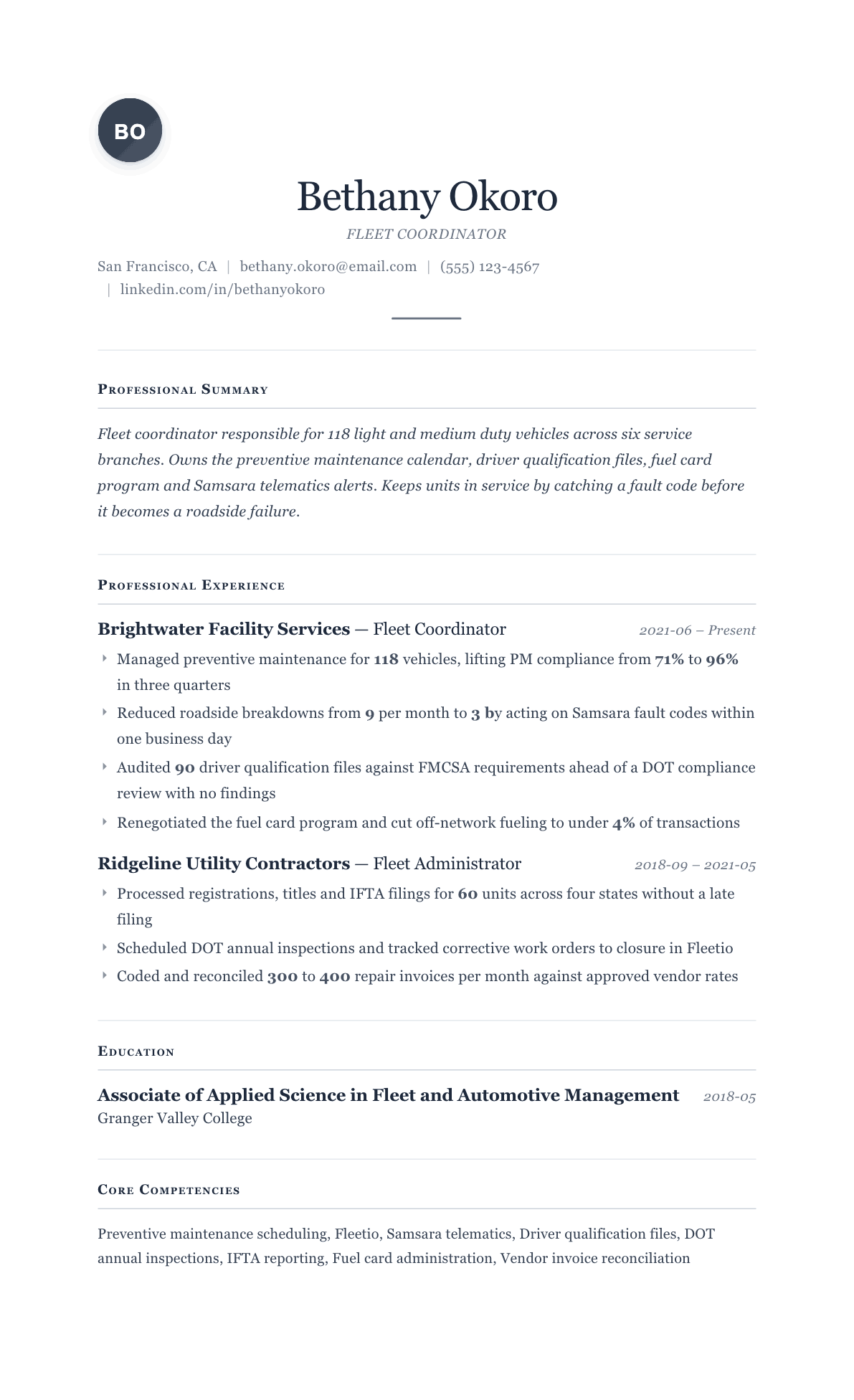
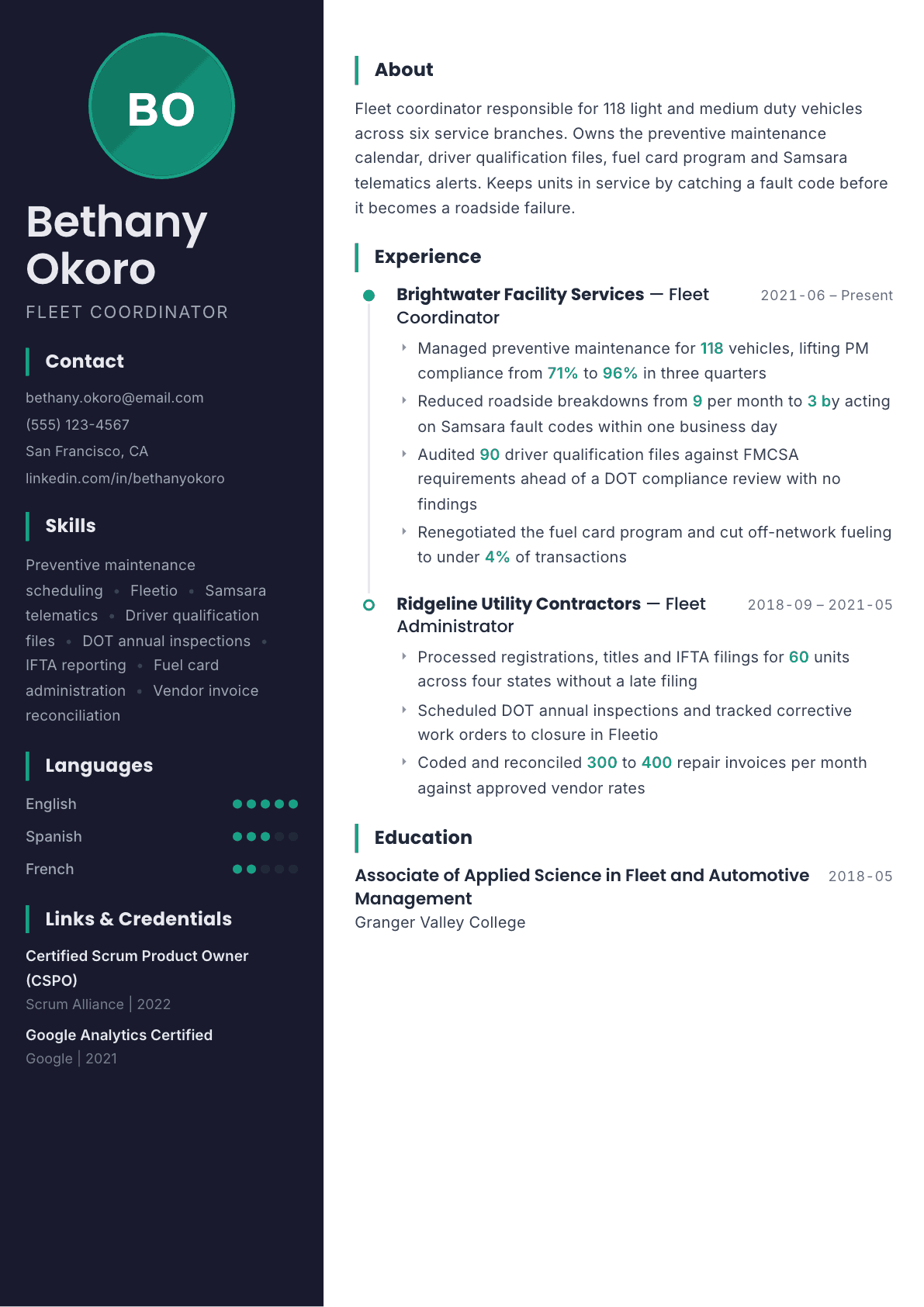
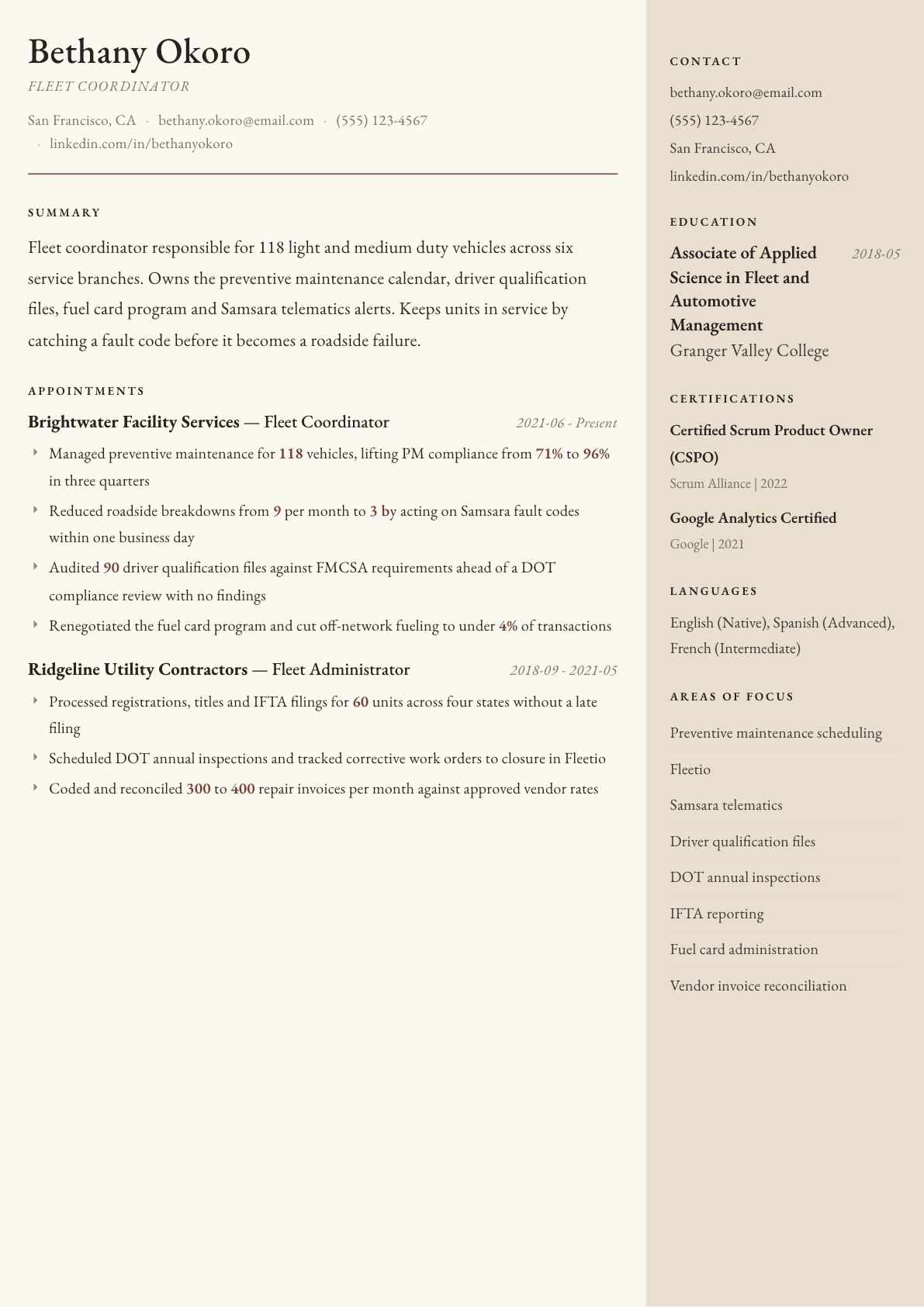
The same fleet coordinator content laid out in three CVBooster templates, so you can see what the finished document looks like before you write a word.
Example Fleet Coordinator summary
Fleet coordinator with six years supporting mixed light and medium duty fleets of up to 120 units across multiple branches. Owns preventive maintenance calendars, driver qualification files, telematics alerts and fuel card exceptions. Lifted PM compliance into the mid nineties and cut roadside failures by two thirds through earlier fault triage. Seeking a fleet operations role with replacement planning scope.
Skills to list on a Fleet Coordinator resume
- Fleet maintenance scheduling
- Telematics monitoring
- DOT compliance
- Driver qualification files
- IFTA and IRP filings
- Fuel card programs
- Fleetio
- Samsara
- Work order management
- Vendor management
- Vehicle registration and titling
- Warranty recovery
- Accident and claims reporting
- Asset replacement planning
What actually gets this resume read
- Open every job with the fleet size and vehicle classes, because coordinating vans is not the same as coordinating tractors.
- Quantify uptime: PM compliance, breakdowns per month, days out of service or cost per mile on the units you owned.
- Name the fleet management platform and the telematics vendor, since employers hire around the systems they already run.
- Show the compliance side clearly: driver qualification files, DOT inspections, IFTA, IRP and accident reporting.
- Include the vendor and cost work, from repair approvals and warranty recovery to fuel card exception reviews.
- If you have handled vehicle replacement cycles or upfitting specifications, give the unit count and the outcome.
How to write a fleet coordinator resume
A fleet coordinator resume answers two questions for the person hiring: how many vehicles have you kept on the road, and what did that cost. Fleet is an asset job dressed as an administrative one. The manager reading your page is thinking about uptime, maintenance spend per unit, and whether a compliance review would find clean driver files if it landed tomorrow.
The common failure is a page full of tasks. Scheduling maintenance, ordering parts and processing registrations describe the routine of the role rather than your performance in it. Fleet numbers are easy to get from any decent system, so a resume without them reads as though the candidate never looked.
Below is the section order a fleet manager reads, summaries for an administrator moving up, a working coordinator and a senior one, five rewritten bullets, and the questions candidates in fleet operations ask when they cannot tell what to put on the page.
Format: one page, asset detail up front
Reverse chronological, one page for under eight years, two beyond that only if you have run several fleets. The header carries name, city, phone and email. Under it, a summary of three lines that names the fleet size, the vehicle classes, the number of sites and the systems you run.
Fleet reports live in tables, so the temptation is to build a resume that looks like one. Resist it. A single column with tight bullets survives parsing and reads faster, and the numbers land better inside sentences than in a grid a reader has to decode.
- Summary naming units under management, vehicle classes, sites and platforms.
- Experience with the fleet described first, results in the bullets underneath.
- A systems line covering fleet management software, telematics and any ERP or procurement tool.
- A compliance line covering DOT files, inspections, registrations and fuel tax filings.
Summary: units, classes, sites, systems
Fleet size alone is not enough. A hundred sedans and a hundred class 8 tractors are different jobs with different regulatory weight. Name the classes: light duty vans, medium duty box trucks, tractors and trailers, off-road or specialty equipment, and say how many locations they sat at.
Then name the platforms, because employers hire around the systems they already own. A candidate who has run preventive maintenance in the same software the employer uses starts producing in week one, and that is worth more on a summary line than an adjective.
Experience: uptime, compliance, cost, in that order
Uptime is the headline. Preventive maintenance compliance rate, roadside breakdowns per month, average days out of service, and the number of units you kept in rotation. If you improved any of them, give the before and the after. Fleet managers read those figures the way a plant manager reads downtime.
Compliance is the second block. Driver qualification files, DOT annual inspections, medical card tracking, fuel tax filings, registrations and titles, and how a review or audit went while you owned the records. Saying that a compliance review closed with no findings is one of the strongest single lines a fleet resume can carry.
Cost is the third. Maintenance spend per unit or per mile, warranty recovery, repair invoice audits against agreed vendor rates, fuel exception review, and anything you renegotiated. Coordinators often control more spend than their title suggests, and the page should say so.
Systems, vendors and the parts of the job people forget
Name the fleet management platform, the telematics provider and the fuel card program by product. Add the ERP or purchasing system if repair orders and invoices flowed through one. If you built reports, say what they measured and who read them, because a coordinator who reports upward is being groomed for a manager seat.
Then include the work that rarely reaches the page: vehicle replacement cycles, upfitting specifications, accident and claims intake, pool vehicle assignment, toll and violation administration, and vehicle disposal at end of service. Each of these is a genuine scope signal and most candidates leave them out entirely.
- Fleet management software and telematics platform, named by product.
- Fuel card program and how you handled exceptions.
- Compliance records you owned, with the regulator or program they answer to.
- Replacement, upfitting or disposal work with the unit counts involved.
Keywords employers filter on
Fleet postings converge on a short vocabulary: preventive maintenance, uptime, driver qualification files, DOT compliance, telematics, work orders, fuel management, motor pool, asset utilization, registration and titling, fuel tax reporting, and total cost of ownership. Use the ones you have lived and attach a number to each in the experience section.
Where a posting names a system, mirror the exact product name. Recruiters searching a database type a product name far more often than a job title.
Fleet Coordinator resume summary examples
Fleet administrator moving up
Fleet administrator supporting 60 light duty vehicles across four states, handling registrations, titles and fuel tax filings without a late submission. Schedules annual inspections, tracks corrective work orders to closure in Fleetio, and reconciles roughly 350 repair invoices a month against vendor rates.
Four years coordinating
Fleet coordinator managing 118 light and medium duty vehicles at six branches. Owns preventive maintenance scheduling, driver qualification files, telematics alerts and the fuel card program. Lifted maintenance compliance from 71% to 96% and cut roadside breakdowns from nine a month to three.
Senior fleet coordinator
Senior fleet coordinator for a mixed fleet of 240 units including tractors, trailers and service trucks across nine sites. Runs the replacement cycle model, leads vendor negotiations, and passed two DOT compliance reviews with no findings while reducing maintenance cost per unit for three consecutive years.
Work experience bullets: before and after
Before: Scheduled preventive maintenance for company vehicles.
After: Managed preventive maintenance on 118 light and medium duty vehicles at six branches, raising compliance from 71% to 96% over three quarters.
Unit count, site count and a compliance movement replace a task with a measured result.
Before: Monitored vehicle tracking system alerts.
After: Triaged Samsara fault codes and harsh-event alerts within one business day, cutting roadside breakdowns from nine per month to three.
Naming the platform, the response window and the breakdown outcome shows the alert work actually changed something.
Before: Maintained driver files for DOT compliance.
After: Audited 90 driver qualification files against FMCSA requirements ahead of a compliance review, correcting medical card and MVR gaps before the review closed with no findings.
The file count, the standard applied and the review outcome make the compliance claim verifiable.
Before: Reviewed repair invoices from vendors.
After: Audited 300 to 400 repair invoices per month against contracted labor rates and recovered charges on out-of-scope work and duplicate diagnostics.
Volume plus the specific error types found proves cost control rather than paperwork processing.
Before: Helped with the fuel card program.
After: Rebuilt fuel card controls by product code and time of day and reduced off-network fueling to under 4% of transactions.
The control method and the resulting exception rate turn assistance into ownership.
Hard skills
- Preventive maintenance scheduling
- Fleet management software
- Telematics monitoring
- Driver qualification file management
- DOT annual inspection tracking
- Fuel tax and registration filings
- Fuel card administration
- Work order and repair approval
- Vendor rate negotiation
- Warranty recovery
- Vehicle replacement planning
- Accident and claims intake
Soft skills
- Vendor relationship management
- Driver communication
- Record discipline
- Prioritizing competing repairs
- Cost consciousness
- Cross-site coordination
Certifications worth listing
- Certified Automotive Fleet Manager (CAFM) (NAFA Fleet Management Association)
- Certified Automotive Fleet Specialist (CAFS) (NAFA Fleet Management Association)
- Automotive Service Excellence Parts Specialist (P2) (National Institute for Automotive Service Excellence)
Mistakes that cost fleet coordinator candidates the interview
- Giving a fleet size with no vehicle classes, leaving the reader unable to judge regulatory weight.
- Listing maintenance tasks with no compliance rate, breakdown count or days out of service.
- Skipping the compliance records entirely, which is the part a fleet manager worries about most.
- Ignoring cost work such as invoice audits, warranty recovery and fuel exceptions that you actually performed.
- Naming software generically as a fleet system instead of the product the employer can search for.
- Leaving out replacement planning, upfitting or disposal work that shows scope beyond scheduling.
- Building the resume as a table of vehicle statistics that a parser flattens into unreadable text.
Fleet Coordinator resume questions
What metrics belong on a fleet coordinator resume?
Units under management, preventive maintenance compliance rate, breakdowns per month, days out of service, maintenance cost per unit or per mile, and fuel exception rate. Pick the ones your systems actually reported so you can discuss the method behind each figure.
Do I need a fleet certification to get hired?
Not usually for a coordinator seat, though a recognized fleet credential separates you when two candidates have similar experience. If you are working toward one, list it as in progress with the issuing association named so the reader can see the direction.
How much compliance detail should I include?
Enough to prove you owned records rather than filed them. Name the file types, the inspections and the filings, and state how any audit or review turned out. That block often decides the interview at companies running regulated vehicles.
Should I list the vehicles by make and model?
No. List classes and counts instead, such as light duty vans, medium duty box trucks or class 8 tractors. Specific models only help when a posting names a specialty asset like refrigerated units, aerial equipment or emergency vehicles.
How do I move from fleet coordinator to fleet manager?
Show budget influence and analysis on your current page: replacement cycle modeling, total cost of ownership work, vendor negotiations and the reports leadership acted on. Those are the responsibilities a manager posting screens for beyond day to day scheduling.
Related resume examples
- Fleet Manager Resume example
- Fleet Mechanic Resume example
- Truck Dispatcher Resume example
- Transportation Coordinator Resume example
- Transportation Manager Resume example
- Dispatch Coordinator Resume example