Truck Dispatcher Resume Examples: the lines they read
Write a Truck Dispatcher Resume Carriers Call Back
By Mustafa Tarabya, founder of CVBooster · Published · Updated
A truck dispatcher resume built around load boards, hours-of-service rules and driver retention, with a full sample resume and a writing guide.
Sample resumes for a truck dispatcher
The same truck dispatcher content laid out in three CVBooster templates, so you can see what the finished document looks like before you write a word.
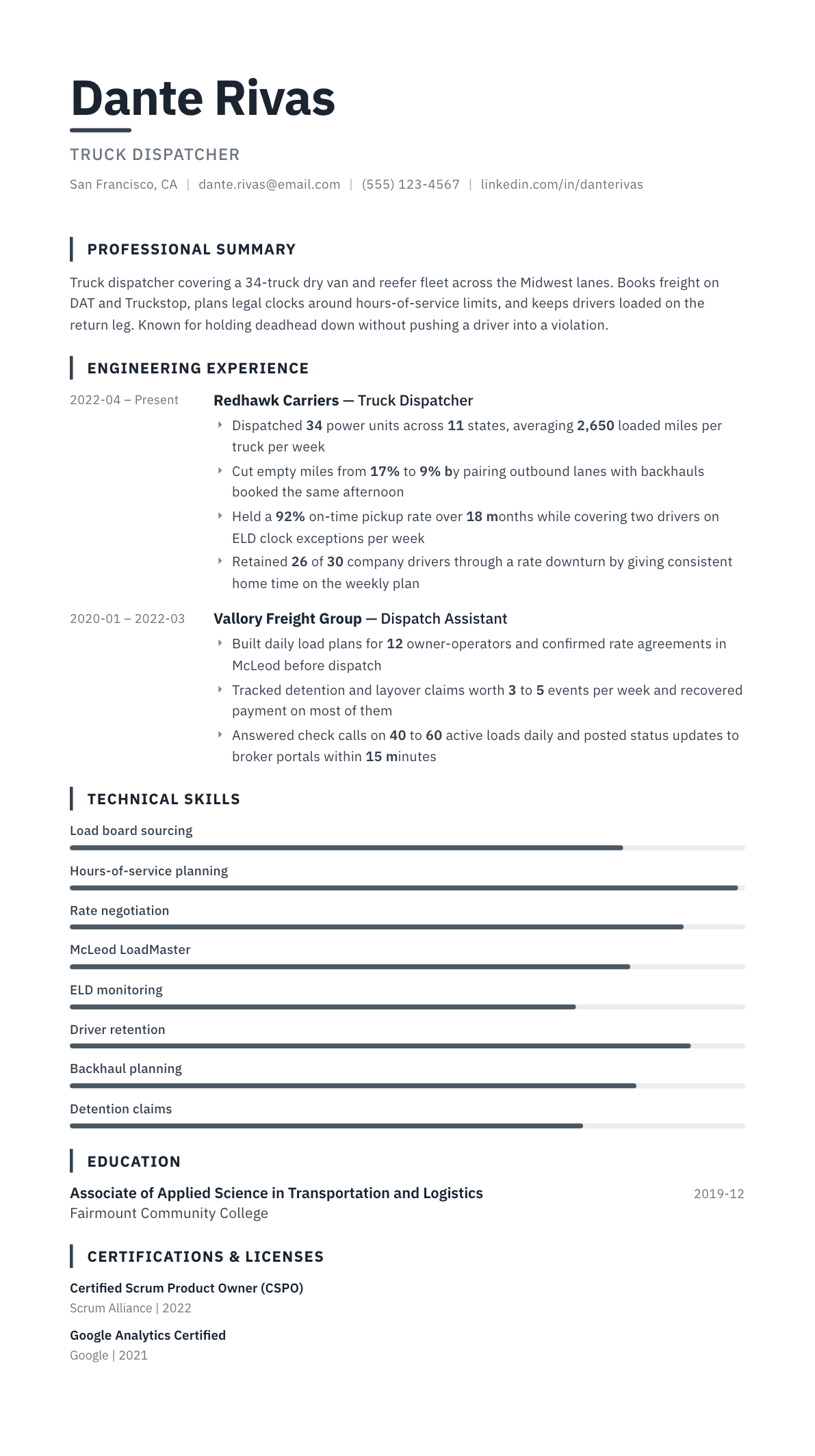
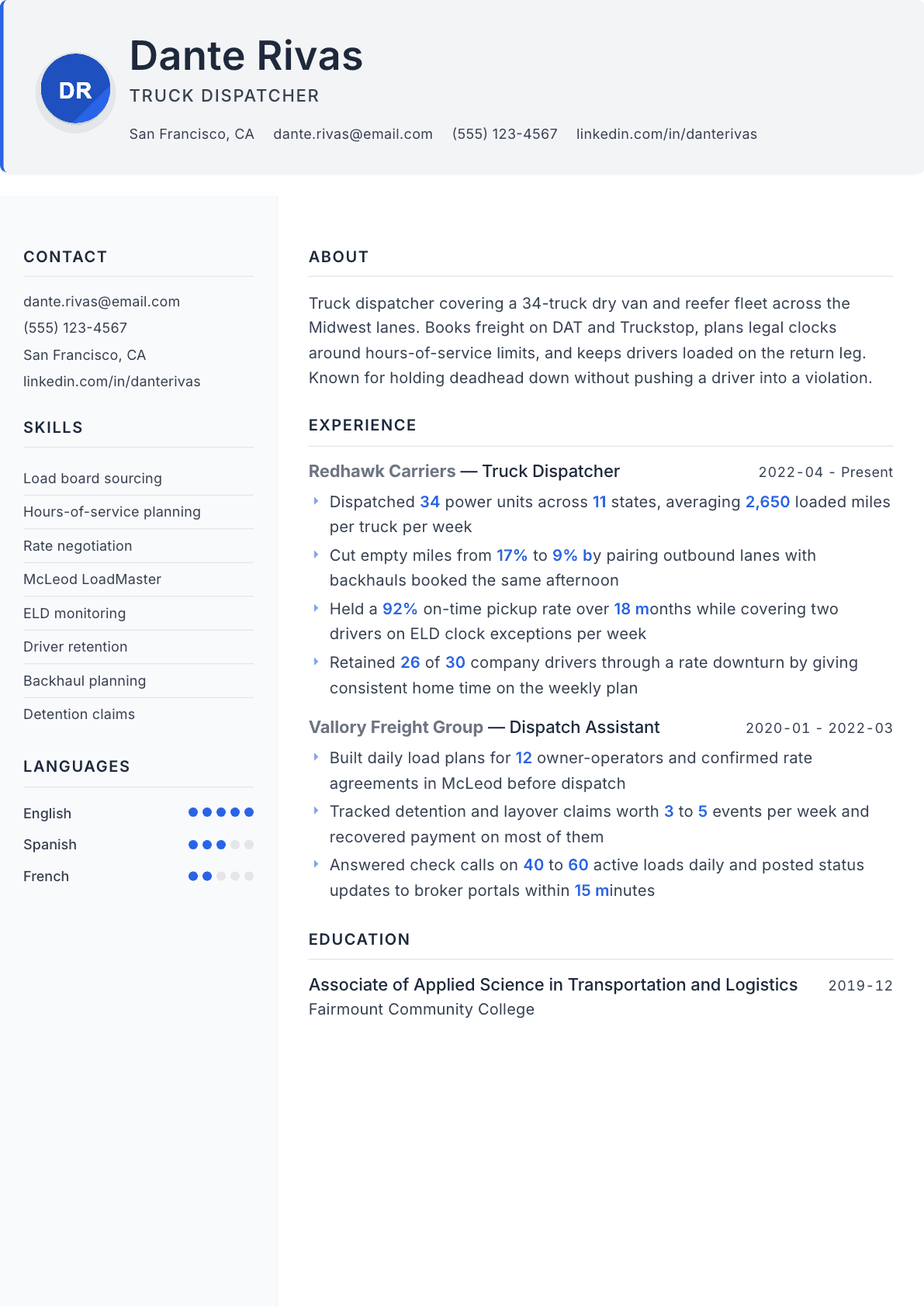
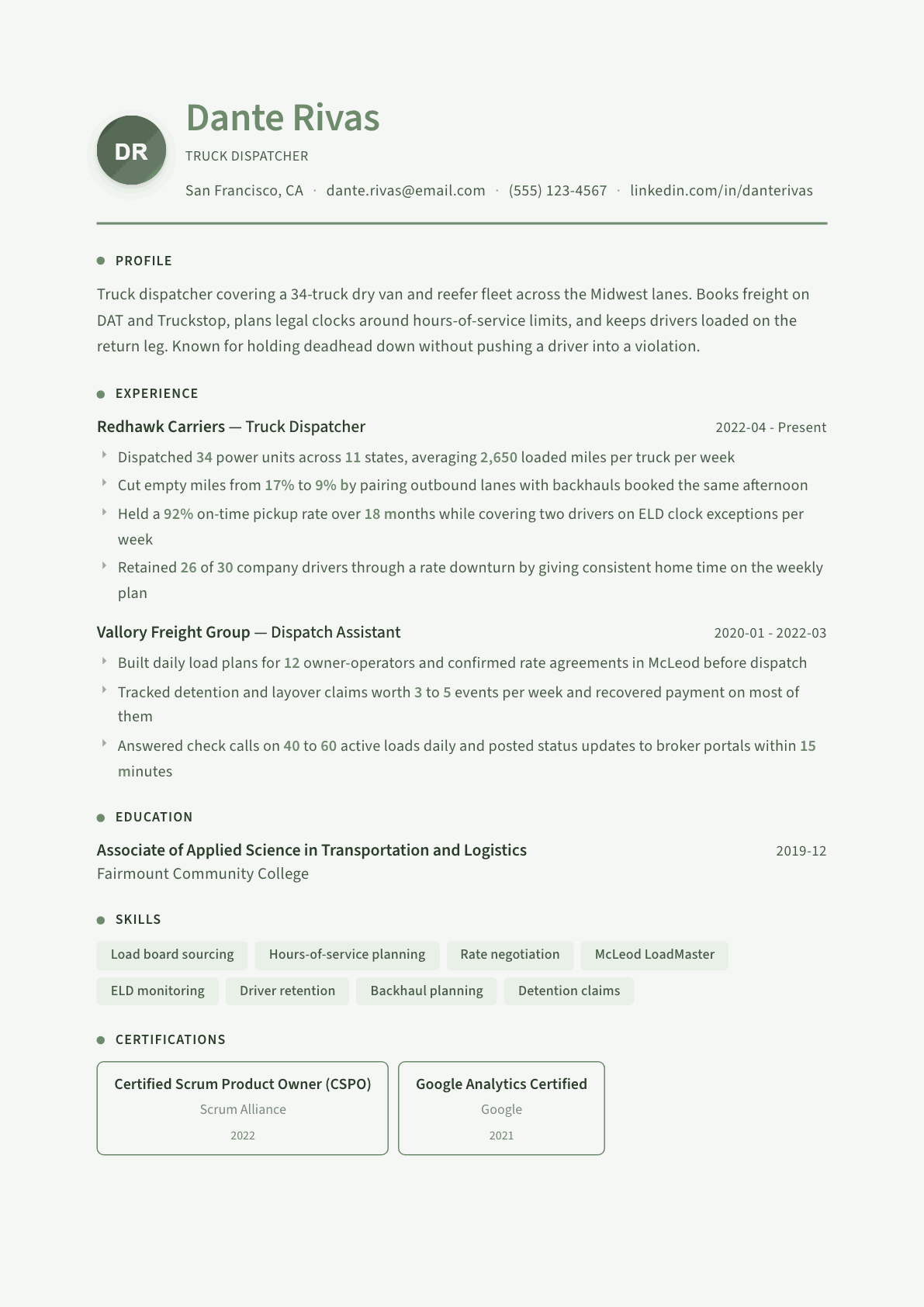
Example Truck Dispatcher summary
Truck dispatcher with four years running a mixed dry van and reefer desk of 30-plus power units across regional Midwest lanes. Sources freight on DAT, negotiates rates directly with brokers, and builds weekly plans that respect hours-of-service clocks and driver home time. Cut empty miles to single digits while holding on-time pickup above 90%. Looking for a desk with owner-operator volume.
Skills to list on a Truck Dispatcher resume
- Load planning
- DAT load board
- Truckstop.com
- Hours-of-service compliance
- ELD systems
- Rate negotiation
- Backhaul sourcing
- Driver communication
- McLeod LoadMaster
- TMW Suite
- Detention and accessorial billing
- Broker relations
- Route sequencing
- DOT regulations
- Check calls and tracking
What actually gets this resume read
- State the fleet size, the trailer types and the lanes you covered, because a reefer desk and a flatbed desk are different jobs.
- Give a deadhead or empty-mile figure for every dispatch job you list, since that single number is how carriers grade a desk.
- Name the transportation management system you worked in, whether McLeod, TMW, Prophesy or an in-house tool.
- Show that you plan around hours-of-service clocks rather than around them, because safety departments read for that.
- Add driver retention or turnover on your desk if you know it, since keeping seats filled is half of what the job protects.
- Include the load boards you source on and whether you negotiated rates yourself or worked to a set rate confirmation.
How to write a truck dispatcher resume
A truck dispatcher resume is judged by an operations manager who is trying to work out one thing: can this person keep our trucks loaded without burning drivers or breaking a clock. Everything else on the page is context. The reader wants fleet size, trailer types, lanes, the load boards you source on, the transportation management system you live in, and the numbers that show what your desk produced.
Most dispatcher resumes fail because they describe the workflow instead of the desk. Booking loads, calling drivers and updating brokers is what every dispatcher does. What separates candidates is the size of the operation, the empty mile figure, the on-time record, and whether drivers stayed on the desk or quit off it.
This guide covers the sections in the order a carrier reads them, gives you summaries for a first dispatch job, a settled desk and a lead role, rewrites five bullets that show up on almost every dispatcher resume, and answers the questions dispatchers ask when their applications go quiet.
Format: one page, operations first, no clever layout
Carriers hire fast and read fast. Keep it to one page until you have run a desk for eight years or more, use reverse chronological order, and put a short header with your name, city, phone and email. Skip the objective line. A three line summary that names your fleet size and lanes does the same work with more information in it.
Order the sections as summary, dispatch experience, systems and load boards, certifications if you hold any, then education. Education matters least here. Nobody hires a dispatcher for a degree, and a candidate who leads with one looks like a candidate with no desk time to show.
- Header: name, city and state, phone, email, and whether you can work nights or weekends if that is your edge.
- Summary of three lines: fleet size, equipment type, lane region, and the one number you are proudest of.
- Experience with the operation described in the first line and results in the bullets underneath.
- A short systems line naming your TMS, load boards, ELD platform and any broker portals you used daily.
Summary: fleet, equipment, lanes, and one result
The summary should read like a desk description. Name the number of power units you covered, the trailer mix, the region, and one measurable outcome. A reader who sees thirty reefer trucks on Midwest lanes with single digit empty miles already knows whether to keep reading.
If you are coming in from driving, from a broker desk or from customer service, say so plainly and name the transferable part. Former drivers understand clocks and detention better than anyone hired off the street, and that is worth a sentence rather than a hidden line halfway down page one.
Experience: describe the desk before you describe the wins
Give each job a first line that sets the operation: how many trucks, what trailers, which lanes, company drivers or owner-operators, and whether the freight came from contract customers, a routing guide or the spot market. A desk covering fifteen owner-operators on spot freight is a different job from covering ninety company trucks on dedicated lanes, and a reader cannot guess which one you ran.
Then write bullets that carry the numbers a carrier tracks. Loaded miles per truck per week, empty or deadhead percentage, on-time pickup and delivery, revenue per truck, driver turnover on your desk, and detention or layover recovered. If you do not have exact figures, use the range you can defend rather than inventing a precise one.
Leave out the bullets that describe dispatching itself. Assigning loads, making check calls and communicating with drivers is the job description, not your record in it. Every line should tell the reader something they could not have assumed.
Systems, compliance and the safety angle
Name the transportation management system by product. McLeod, TMW, Prophesy, Axon and in-house tools all read differently to a hiring manager who needs someone productive in the first week. Do the same for load boards and ELD platforms, and mention broker portals if you spent real time in them.
Compliance is where dispatchers lose or win credibility. Show that you plan around hours-of-service limits rather than pushing drivers to the edge of them: split sleeper planning, a realistic appointment reset, refusing a load that would not have run legally. Safety departments read dispatcher resumes with that exact question in mind.
- Transportation management systems you have actually used, not ones you have heard of.
- Load boards and rate tools you source and price on.
- ELD platform and how you used the clocks in planning rather than only to react.
- Any DOT, FMCSA or hazmat exposure you carry, described honestly.
Keywords carriers and staffing firms search on
Applications for dispatch roles often move through a staffing firm or an applicant tracking system before a human sees them. The phrases that get pulled are load planning, hours of service, deadhead, backhaul, rate confirmation, owner-operator, dry van, reefer, flatbed, intermodal, DOT compliance and the name of your TMS. Use the ones that are true of you in the summary and again inside a bullet where they carry a result.
Match the posting language on equipment. A carrier hiring for a flatbed desk is filtering for tarping, securement and permit knowledge, and a generic freight resume will not surface for it even if you have done the work.
Truck Dispatcher resume summary examples
First dispatch desk
Former company driver with four years over the road moving into dispatch. Understands hours-of-service planning, detention and appointment realities from the seat, holds a clean CDL record, and completed a dispatcher training program covering DAT sourcing, rate confirmations and load documentation.
Three years on the desk
Truck dispatcher covering 28 dry van and reefer power units on regional Midwest lanes. Sources on DAT and Truckstop, negotiates rates directly, and holds empty miles near 9% with on-time pickup above 90%. Works in McLeod LoadMaster and keeps drivers home on their scheduled weekends.
Lead dispatcher
Lead dispatcher running a five-person desk covering 90 company trucks and 20 owner-operators on national lanes. Owns the weekly load plan, rate strategy and driver assignment, trains new dispatchers to independent coverage, and reduced driver turnover on the group from 68% to 41%.
Work experience bullets: before and after
Before: Dispatched trucks and communicated with drivers daily.
After: Dispatched 34 power units across 11 states, averaging 2,650 loaded miles per truck per week with two daily check-in windows instead of constant calls.
Fleet size, geography and miles per truck turn a job description into a measurable desk.
Before: Reduced empty miles for the fleet.
After: Cut empty miles from 17% to 9% by booking backhauls the same afternoon the outbound load was covered rather than waiting for delivery.
The before and after figure plus the method shows the reader how the result was produced.
Before: Worked with brokers to book freight.
After: Sourced 60 to 80 loads per week on DAT and Truckstop and negotiated rates directly, holding a lane average above the posted market on six recurring runs.
Volume and the negotiation outcome prove commercial skill rather than order taking.
Before: Made sure drivers followed hours-of-service rules.
After: Planned split sleeper and reset schedules around delivery appointments so no driver on the desk logged a form or manner violation in 18 months.
A compliance claim only lands when it names the planning method and the record it produced.
Before: Helped keep drivers happy.
After: Retained 26 of 30 company drivers through a rate downturn by publishing the weekly plan every Thursday and protecting scheduled home time.
Retention numbers and the specific practice behind them replace an unmeasurable claim.
Hard skills
- Load planning and sequencing
- DAT and Truckstop sourcing
- Rate negotiation
- Hours-of-service planning
- ELD monitoring
- McLeod LoadMaster
- TMW Suite
- Backhaul and deadhead reduction
- Rate confirmations and BOL handling
- Detention and accessorial claims
- DOT and FMCSA compliance basics
- Broker and customer portals
Soft skills
- Calm under load
- Driver communication
- Negotiation
- Prioritizing competing appointments
- Conflict resolution
- Shift handoff discipline
Certifications worth listing
- Certified Transportation Broker (CTB) (Transportation Intermediaries Association)
- Certified Supply Chain Professional (CSCP) (Association for Supply Chain Management)
- Hazardous Materials Employee Training (Pipeline and Hazardous Materials Safety Administration)
Mistakes that cost truck dispatcher candidates the interview
- Writing the job description instead of the desk, so a reader cannot tell fifteen trucks from ninety.
- Leaving out equipment type, which makes a reefer or flatbed carrier skip the resume entirely.
- Claiming to reduce costs with no empty mile, revenue per truck or on-time figure attached.
- Listing every load board and TMS ever seen in a training video instead of the ones you worked in.
- Hiding driver retention, which is often the number a carrier cares about most on a dispatch desk.
- Using a two-column template with icons that a staffing firm parser reads out of order.
- Inflating volume figures that fall apart in the first interview when the manager asks about a normal week.
Truck Dispatcher resume questions
Do I need a CDL to work as a truck dispatcher?
No, a commercial license is not required for a dispatch desk. It does help you read clocks, detention and road conditions the way a driver does, so if you hold one or used to drive, put that experience high on the page rather than burying it.
How do I write a dispatcher resume with no dispatch experience?
Lead with the closest adjacent work: driving, customer service in freight, warehouse scheduling or a broker support desk. Name the volume you handled, then list the dispatch training, load board practice and software you have covered so the reader sees a short ramp.
What numbers should a truck dispatcher put on a resume?
Power units covered, loaded miles per truck per week, empty mile percentage, on-time pickup and delivery, loads booked per week, revenue per truck, and driver turnover on your desk. Give the ones you can defend in an interview and skip the rest.
Should I list the load boards I use?
Yes, because carriers filter for them. Name the boards you source and price on, note whether you negotiated rates yourself or worked from a routing guide, and mention rate tools if you used them to justify a number to a broker.
How long should a truck dispatcher resume be?
One page covers almost every dispatcher. Move to two pages only when you have run multiple desks, managed other dispatchers, or carried several distinct equipment types across separate employers that each deserve their own operating detail.
Related resume examples
- Dispatch Coordinator Resume example
- Truck Driver Resume example
- Fleet Coordinator Resume example
- Freight Coordinator Resume example
- Dispatcher Resume example
- Freight Broker Resume example