Distribution Center Manager Resume Examples: free score
Craft a Distribution Center Manager Resume With Real Site Numbers
By Mustafa Tarabya, founder of CVBooster · Published · Updated
Distribution center manager resume examples with square footage, units per hour, safety and labor metrics, plus keywords and a full writing guide.
Sample resumes for a distribution center manager
The same distribution center manager content laid out in three CVBooster templates, so you can see what the finished document looks like before you write a word.
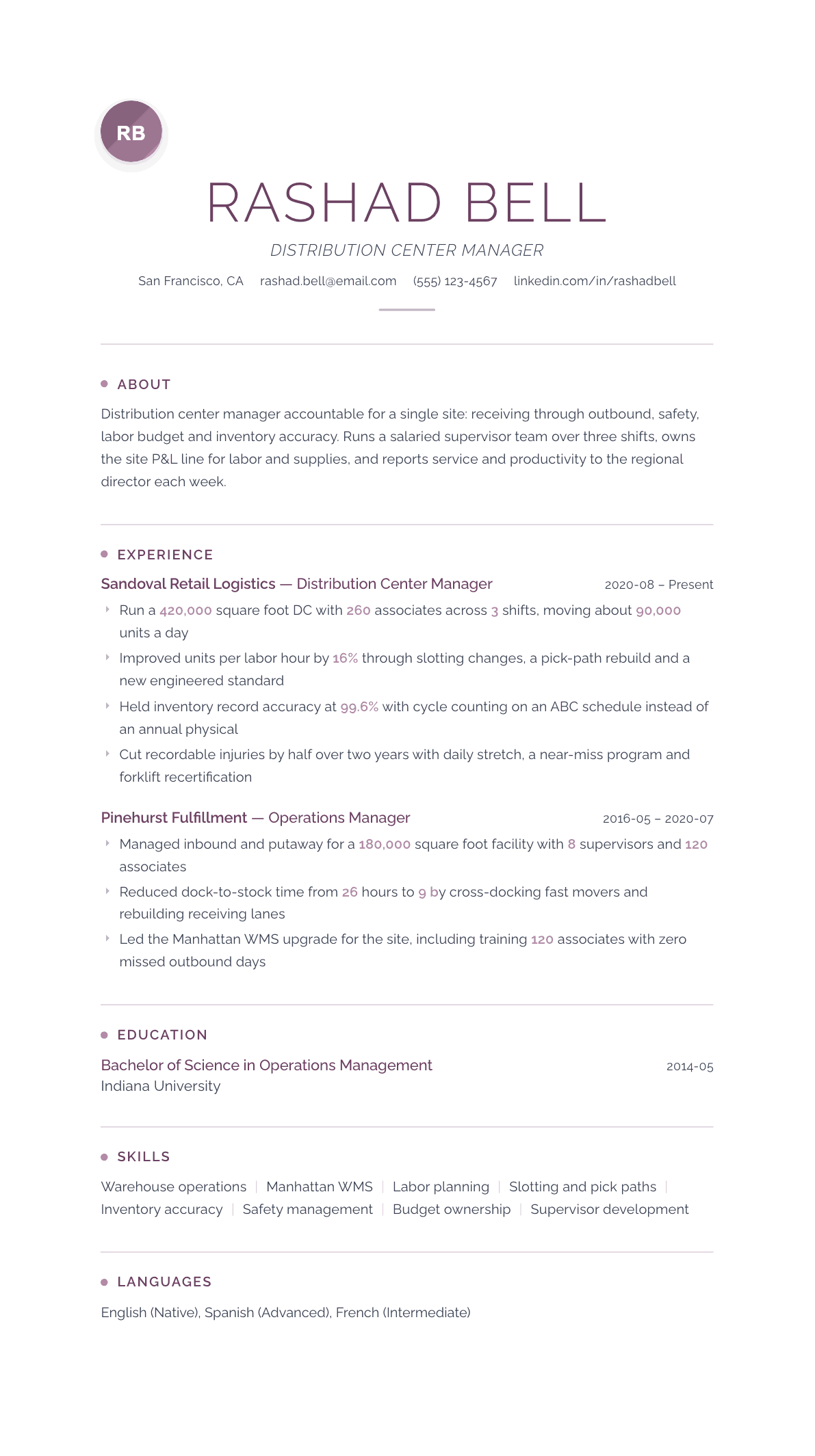
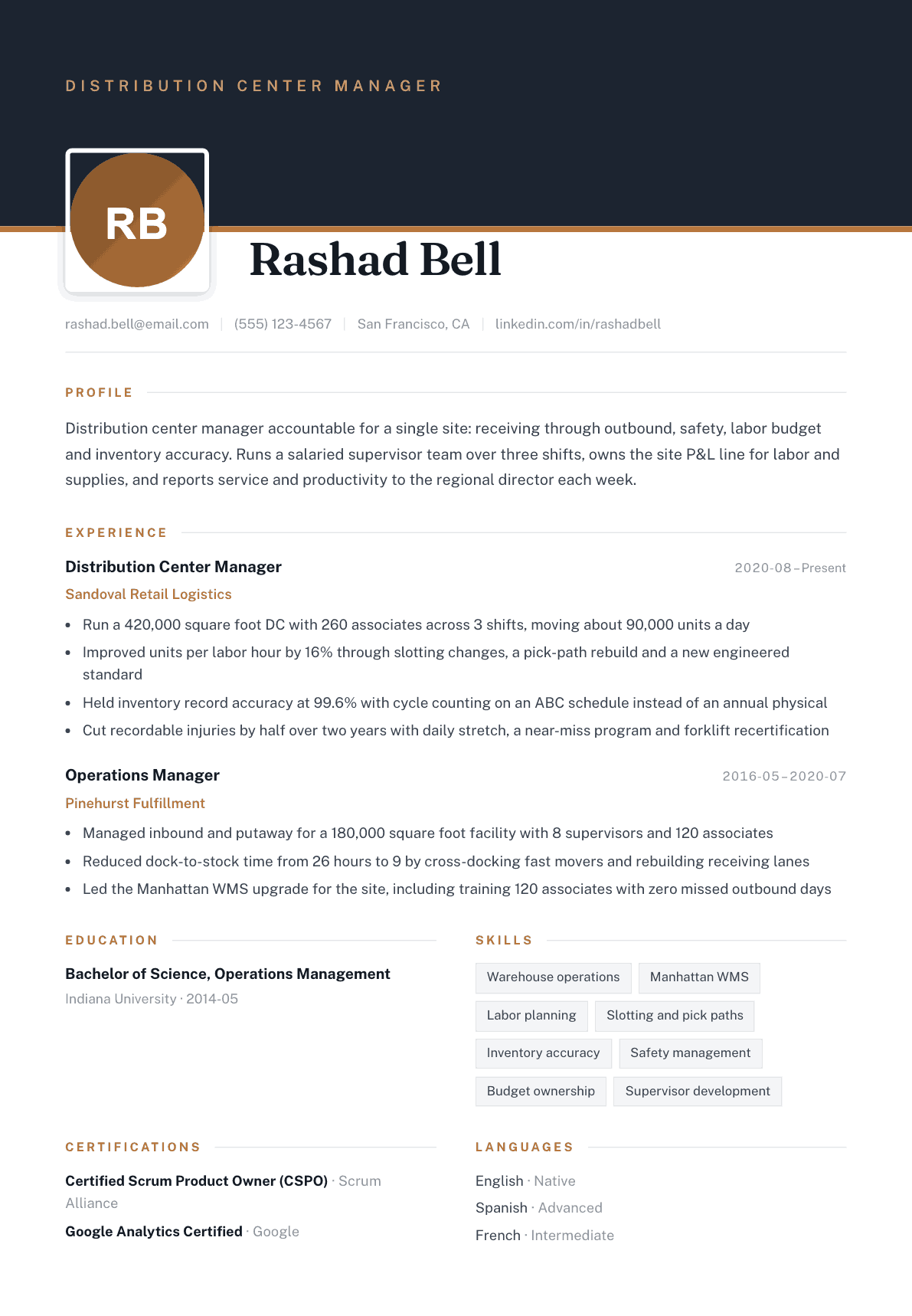
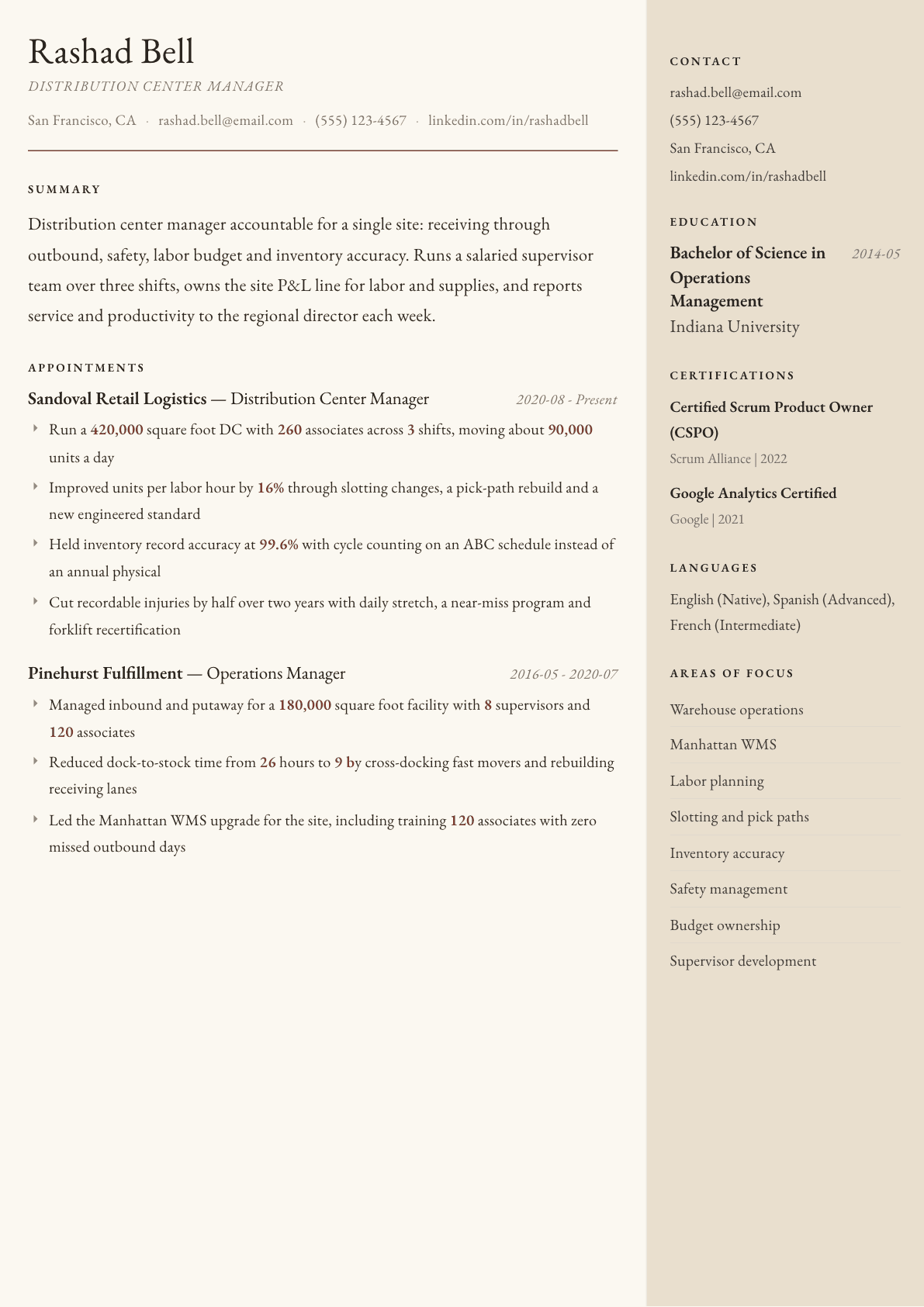
Example Distribution Center Manager summary
Distribution center manager running a large retail site with several hundred associates across three shifts. Raised units per labor hour by rebuilding slotting and pick paths, held inventory record accuracy above ninety-nine through disciplined cycle counting, and cut recordable injuries in half over two years. Led a warehouse system cutover without losing an outbound day. Looking for a multi-site operations role.
Skills to list on a Distribution Center Manager resume
- Distribution center operations
- Warehouse management systems
- Manhattan Associates WMS
- Labor management and planning
- Units per labor hour
- Slotting optimization
- Cycle counting
- Inventory record accuracy
- Safety and OSHA compliance
- Continuous improvement
- Budget management
- Supervisor coaching
- Automation and material handling
- Peak season staffing
What actually gets this resume read
- Give the site profile in the first line of every job: square footage, headcount, shifts and daily unit volume.
- Use the productivity measure your industry uses, such as units per labor hour, lines per hour or cases per hour.
- Report inventory record accuracy and how you got there, because a DC manager who cannot count stock is a risk.
- Put safety on the resume with a real program, not a claim, since recordable rate is on every operations scorecard.
- Name the warehouse management system and any automation, from conveyor and sorters to goods-to-person systems.
- Show budget ownership in words rather than figures: labor plan, supplies, overtime and temporary labor mix.
- Include a startup, expansion or system cutover if you have one, because those projects are why sites hire outside.
How to write a distribution center manager resume
Hiring a distribution center manager is hiring someone to run a building. The regional director reading your resume wants the physical facts first: how big is the site, how many associates, how many shifts, what moves through it in a day, and what the productivity number was under you. Those five facts decide whether your file goes forward, and a resume that opens with leadership philosophy instead of site profile rarely survives the first pass.
The second filter is whether you ran the site or only supervised inside it. Owning a labor plan, defending a budget, holding inventory record accuracy, driving a safety program and developing salaried supervisors are the responsibilities of the top job in a building. Candidates who write only about daily execution get read as strong operations managers, which is a different hire.
This guide covers the section order regional operations leaders read in, how to present productivity, safety and inventory accuracy so they hold up, three summary examples across levels, before-and-after bullets, and the questions site leaders ask when preparing to move up or across networks.
Format: two pages, site profile at the top of every role
Two pages is normal for a site leader. Reverse chronological, plain text, no columns. Every role opens with the same profile line so the reader can compare buildings across your career: square footage, associate count, shift structure, daily volume in units, cases or orders, and the customer type the site serves.
Keep a short block for systems and automation. The warehouse management system, the labor management system and the material handling equipment on site are a fast read on the sophistication of the operations you have run, and they are matched literally by recruiters.
- Header: name, city and state, phone, email, and the operation type such as retail replenishment, wholesale or direct fulfillment.
- Section order: summary, systems and automation, professional experience, education, certifications.
- Add a line on union or non-union environment if relevant, since employers screen on that experience directly.
Summary: the building, the number, the team
Three lines. The site you run and its size, the productivity and accuracy figures you hold, and the leadership structure below you. A distribution center manager summary should read like a site scorecard in prose, because that is the document the reader compares you against.
If you have led a startup, an expansion, a system cutover or a site closure, put it in the summary. Those projects are the reason a company recruits a site leader from outside rather than promoting an internal operations manager, and they are the fastest route to an interview.
Experience: productivity, accuracy, safety and cost
Productivity comes first. Use the measure the industry uses, whether that is units per labor hour, lines per hour, cases per hour or orders per hour, and say how you moved it. Slotting changes, pick path redesign, engineered labor standards, batch and wave strategy, and equipment rebalancing are the mechanisms; naming one turns a number into a method.
Inventory record accuracy deserves its own bullet. Describe the counting discipline behind it: cycle counting on an ABC schedule, control group counts, location audits and root cause on variances. A site leader who reports accuracy without a counting method has usually inherited the number rather than earned it.
Safety needs a program, not an adjective. Near miss reporting, powered equipment certification cycles, daily stretch, ergonomic redesign of a pick station, and behavior-based observation programs are all concrete. Pair the program with a movement in recordable incidents over a stated period.
Finish with cost. You do not need to publish a budget figure to show ownership. Describe the lines you controlled: regular and overtime labor, temporary labor mix, supplies, equipment maintenance and third-party services, and how you managed them through a seasonal swing.
- Give volume in the unit your industry uses and keep it consistent across roles so progression is visible.
- Name the automation you operated: conveyor and sortation, pick to light, goods to person, autonomous mobile robots.
- State how many salaried leaders reported to you, since span of control defines the level of the job.
Systems, compliance and credentials
Name the warehouse management system, the labor management system and any transportation system you touched. Manhattan Associates, Blue Yonder, Korber and Oracle are the names most often filtered on, and a cutover or upgrade you led is worth a bullet of its own because implementations are where sites break.
Compliance in a building means occupational safety standards, powered industrial truck certification, and often food safety or controlled goods handling depending on the product. Say which frameworks you operated under. Useful credentials include the CLTD from the Association for Supply Chain Management and the safety and health certificates offered through the OSHA Training Institute Education Centers.
Keywords site leadership postings repeat
Distribution center operations, warehouse management system, labor management, units per labor hour, slotting, cycle counting, inventory record accuracy, dock to stock, order accuracy, safety program, continuous improvement, budget ownership, peak staffing and supervisor development. Use the ones true for your buildings, in the profile line and the bullets.
Distribution Center Manager resume summary examples
Stepping up from operations manager
Operations manager ready for site leadership after four years running inbound and putaway in a 180K square foot facility with eight supervisors and 120 associates. Reduced dock to stock time from 26 hours to 9 by cross-docking fast movers, and led a warehouse system upgrade for the site with no missed outbound days.
Single site leader
Distribution center manager running a 420K square foot retail site with 260 associates across three shifts and roughly 90K units moved daily. Improved units per labor hour by 16% through slotting and pick path redesign, held inventory record accuracy at 99.6%, and halved recordable injuries over two years.
Multi-site operations leader
Senior site leader with responsibility for two distribution centers and a returns facility, leading four salaried managers and roughly 500 associates. Standardized labor standards and cycle counting across the group, opened a new building from empty shell to full volume in eleven weeks, and built the supervisor development pipeline.
Work experience bullets: before and after
Before: Managed daily operations of a large distribution center.
After: Ran a 420K square foot distribution center with 260 associates across 3 shifts, moving about 90K units a day to retail and direct customers.
Square footage, headcount, shifts and daily volume give the reader the site profile that every comparison depends on.
Before: Improved warehouse productivity across the site.
After: Raised units per labor hour by 16% by reslotting the top 500 movers, rebuilding pick paths and introducing an engineered standard for each function.
Three named mechanisms explain how the productivity moved, which is the question every operations interview opens with.
Before: Maintained accurate inventory in the building.
After: Held inventory record accuracy at 99.6% by replacing the annual physical count with ABC cycle counting, control group audits and same-day root cause on every variance over 10 units.
The counting method and the variance threshold prove the accuracy figure was managed rather than reported.
Before: Focused on safety in the workplace.
After: Cut recordable injuries by half over two years through daily stretch, a near miss reporting program with weekly review, and a forklift recertification cycle for all 90 licensed operators.
Named programs with a population and a period make the safety result verifiable instead of aspirational.
Before: Involved in a warehouse system implementation.
After: Led the site through a Manhattan warehouse management system cutover, training 120 associates over 6 weeks and completing go live without losing an outbound day.
Ownership, scale of training and a protected outcome turn involvement into the project experience that gets site leaders hired.
Hard skills
- Distribution center operations
- Warehouse management systems
- Labor management and engineered standards
- Slotting and pick path design
- Cycle counting and inventory accuracy
- Dock to stock cycle time
- Material handling automation
- Occupational safety compliance
- Budget and cost center management
- Peak season staffing plans
- Continuous improvement methods
- Third-party labor management
Soft skills
- Developing salaried supervisors
- Presence on the floor
- Hourly workforce engagement
- Steady decision making at volume
- Communication across shifts
- Accountability without churn
Certifications worth listing
- Certified in Logistics, Transportation and Distribution (CLTD) (Association for Supply Chain Management)
- Certified Supply Chain Professional (CSCP) (Association for Supply Chain Management)
- OSHA 30-Hour General Industry (OSHA Training Institute Education Centers)
- Certified Six Sigma Black Belt (CSSBB) (American Society for Quality)
Mistakes that cost distribution center manager candidates the interview
- Opening with leadership language instead of the building profile, which forces a regional director to guess how big your operation was.
- Reporting a productivity gain with no mechanism, so the reader cannot tell whether it came from design work or from a volume mix change.
- Claiming inventory accuracy without describing the counting discipline that produced and defended the number.
- Treating safety as a value statement rather than a program with named elements and a measured movement in incidents.
- Leaving automation off the resume, since operating conveyor, sortation or robotics is a distinguishing experience employers filter for.
- Understating span of control by counting only hourly associates and omitting the salaried leaders who reported to you.
- Skipping startups, cutovers and expansions, which are the exact projects that justify recruiting a site leader externally.
Distribution Center Manager resume questions
How much detail should I give about the size of my building?
Give square footage, associate headcount, shift structure and daily volume for every site you led. Those four numbers are how operations leaders compare candidates, and leaving any of them out usually means the reader assumes the smaller version of your experience.
Which productivity metric should I use?
Use the one your operation reported, and keep it consistent across roles. Units per labor hour suits high-piece environments, lines per hour suits order fulfillment and cases per hour suits full case picking. Define the measure briefly if your industry uses it differently.
Do I need automation experience to run a modern distribution center?
Not always, but state clearly what you have operated. Conveyor and sortation, pick to light, goods to person systems and mobile robots each change the labor model, and employers investing in automation will filter for hands-on exposure to something comparable.
How do I show budget ownership without publishing numbers?
Describe the structure instead. Say which cost lines rolled up to you, whether you built the annual labor plan, how you managed overtime and temporary labor through peak, and how variance was reviewed. That demonstrates ownership without exposing employer financial detail.
Is union experience worth mentioning?
Yes, in both directions. If you have led a represented workforce, say so, including grievance handling and contract administration exposure. If you have not, do not obscure it, because a mismatch discovered at interview stage wastes everyone's time and damages credibility.
Related resume examples
- Warehouse Manager Resume example
- Operations Manager Resume example
- Distribution Manager Resume example
- Warehouse Supervisor Resume example
- Inventory Control Specialist Resume example
- Warehouse Worker Resume example