Warehouse Manager Resume Examples: the lines they read
Build a Warehouse Manager Resume That Proves Site Ownership
By Mustafa Tarabya, founder of CVBooster · Published · Updated
Warehouse manager resume example with budget and throughput bullets, operations keywords, skills to list, and a guide to writing each section well.
Sample resumes for a warehouse manager
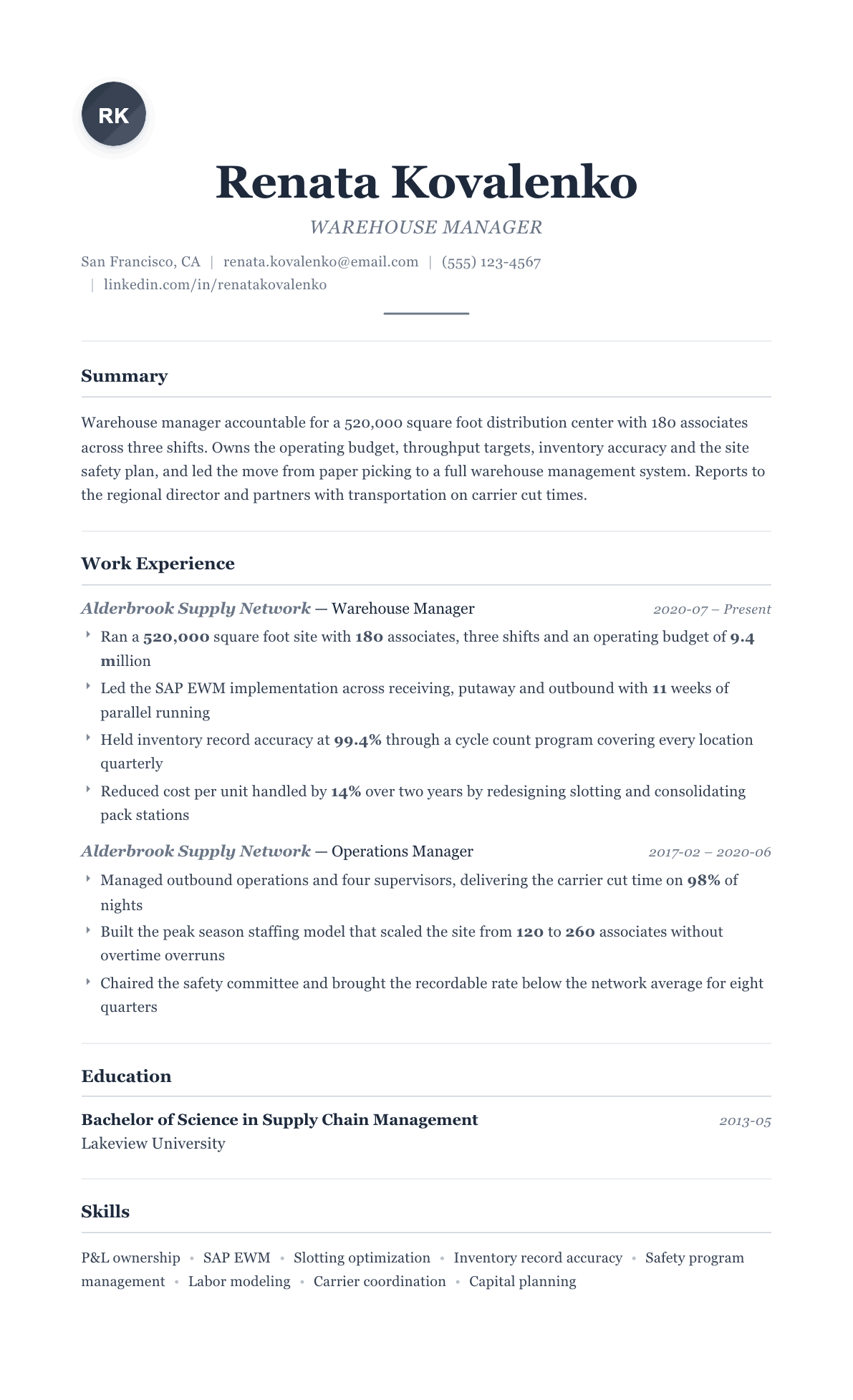
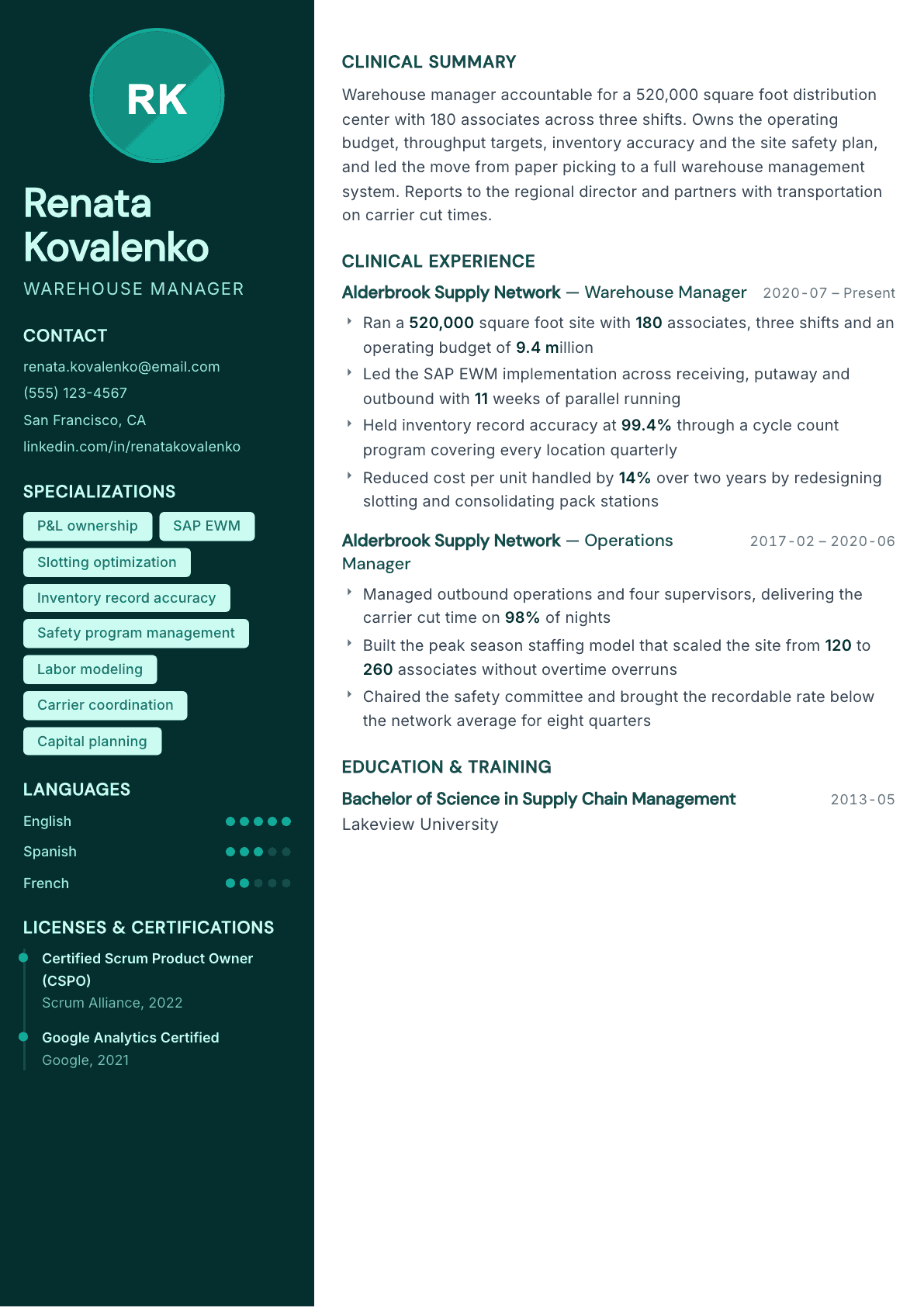
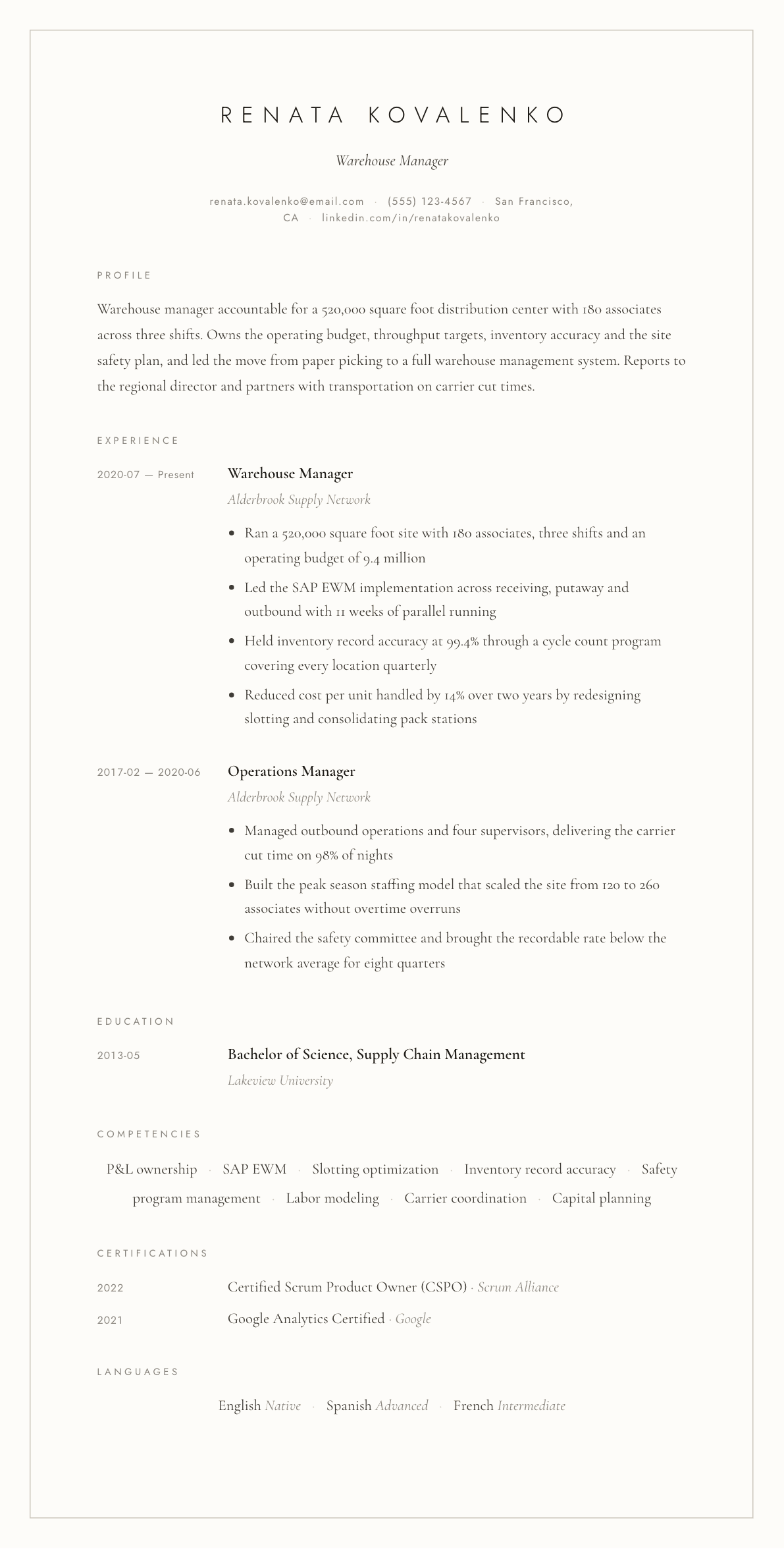
The same warehouse manager content laid out in three CVBooster templates, so you can see what the finished document looks like before you write a word.
Example Warehouse Manager summary
Warehouse manager with twelve years in distribution, currently running a 520,000 square foot center with 180 associates across three shifts and a multi-million operating budget. Led an SAP EWM implementation, holds inventory record accuracy at 99.4%, and reduced cost per unit handled by 14% through slotting and pack station redesign. Seeking a multi-site operations leadership role in regional distribution.
Skills to list on a Warehouse Manager resume
- Distribution center operations
- Operating budget ownership
- Labor modeling and forecasting
- Slotting and layout design
- SAP EWM
- Inventory record accuracy
- Cycle count programs
- Safety program management
- Carrier and yard coordination
- Automation and conveyor projects
- Cost per unit handled
- Supervisor development
- Peak season planning
- Vendor and 3PL management
- Lean and continuous improvement
What actually gets this resume read
- Open each role with square footage, headcount, shift count and budget, because that is how sites are compared.
- Give cost per unit handled or cost per order alongside throughput, since managers are graded on both together.
- Describe a system implementation or automation project with the scope, the timeline and what changed afterward.
- Show inventory record accuracy and the counting program behind it, not just the number on its own.
- Name the safety results and the mechanism, because a recordable rate without a practice behind it reads as luck.
- Include the leaders you developed, listing supervisors promoted or hired, because succession is part of the job.
How to write a warehouse manager resume
By the time a resume reaches a regional director or a vice president of operations, the question is no longer whether you can run a shift. It is whether you can own a building: the operating budget, the labor model, inventory integrity, the safety plan, the customer service level, and the supervisors who make all four hold when you are not on the floor.
Warehouse manager applications usually fail for the opposite reason to associate applications. They are long, they are full of responsibility statements, and they never state the size of the building or the money attached to it. A reader cannot compare two managers without square footage, headcount, shift count, throughput and cost, so give those four numbers before anything else and the rest of the page becomes readable.
This guide covers the structure a distribution executive expects, three summaries running from a first single site role to a multi-site leader, before and after bullets that turn management language into evidence, and the questions warehouse managers ask when they update a resume after several years in one building.
Format: two pages, scoped, with a site profile under every title
Two pages is normal at this level and one page usually costs you. Keep it reverse chronological and keep the layout conservative, because large operators still push executive applications through the same automated screening as hourly ones.
Under each job title write a short site profile line rather than a paragraph: square footage, headcount by shift, functions in scope, order profile, budget responsibility. That line is the unit of comparison a director uses, and it lets every bullet underneath be about results rather than context.
- Site profile line: size, headcount, shifts, functions, order volume, budget scope.
- Sections: summary, site leadership experience, projects and systems, certifications, education.
- A projects block is worth having when you have led automation, a system cutover or a network move.
Summary: the building, the money, the outcome
Four lines at most. Name the size of the operation you run now, the scope you own, one cost result and one service result. Cost without service reads as a manager who squeezed the site, and service without cost reads as a manager who bought performance with overtime. Directors look for both because they are hiring for the tension between them.
If you are moving between industries, name the transferable physics. Case flow in grocery, unit flow in e-commerce, pallet flow in industrial distribution and mixed flow in third party logistics behave differently, so say which you have run and what you have studied about the one you are moving toward.
Experience: cost, service, inventory, safety, people
Write to five headings even if you never print them. Cost is dollars per unit handled, dollars per order, labor as a share of controllable spend, overtime against plan. Service is on-time to carrier cut, dock to stock hours, order accuracy, fill rate. Inventory is record accuracy and the counting program that sustains it. Safety is recordable rate plus the practices behind it. People is supervisor development, turnover and succession.
Give each result a mechanism, because at this level the mechanism is the interview. Slotting redesign, wave strategy changes, pack station consolidation, cross-dock introduction, an engineered standards rollout, a shift pattern change that removed a handoff. A director reads the mechanism to decide whether the improvement was yours or the network's.
Projects deserve their own treatment. A warehouse management system cutover, a conveyor or sorter installation, a building expansion, a network consolidation or a site startup are the events that separate managers, and each one should carry scope, timeline, parallel running approach and what performance did afterward. Say plainly what went wrong and how you recovered if you can, because every experienced reader knows something did.
Systems, budget and the vocabulary of ownership
Name the enterprise and warehouse platforms by product, and separate the ones you used from the ones you implemented. Being the site lead on an implementation is a different claim from being a user of the same software, and conflating them is the fastest way to lose credibility in a technical interview.
Be explicit about the budget you controlled and what sat inside it: labor, consumables, equipment leases, maintenance, outside storage, temporary labor spend. Add capital requests you built and won, because capital discipline is one of the traits that decides between a strong supervisor and a genuine manager.
Certifications, education and what a director checks last
A supply chain credential, a continuous improvement belt or a thirty hour general industry safety course all earn a line, and a degree in supply chain, logistics or operations management is common but not universal at this level. Put education after experience unless you are early in a management career.
The last thing a director checks is whether your record is portable. Ten years in one building can read as depth or as dependence on a single process, so include anything that shows range: covering another site, leading a network project, standing up a temporary operation, mentoring managers outside your building.
Warehouse Manager resume summary examples
First warehouse manager role
Warehouse manager promoted from operations supervisor, running a 120K square foot site with 55 associates across two shifts and full responsibility for the labor budget. Holds inventory record accuracy at 99.1% through a quarterly count program and reduced overtime by rebuilding the staffing model against actual order profiles.
Established single site manager
Warehouse manager for a 520K square foot distribution center with 180 associates on three shifts and a multi-million operating budget. Led a warehouse management system cutover with eleven weeks of parallel running, cut cost per unit handled by 14%, and brought the recordable rate below the network average.
Multi-site operations leader
Distribution leader accountable for three buildings, 420 associates and the regional labor and consumables budget. Consolidated two sites into one campus without a service interruption, installed a sorter that lifted outbound throughput, and developed four site managers now running their own buildings.
Work experience bullets: before and after
Before: Managed all warehouse operations for the facility.
After: Ran a 520K square foot distribution center with 180 associates across three shifts, owning the operating budget, the safety plan and the customer service level for two regional accounts.
Size, headcount, shifts and the specific things you owned make the role comparable to other buildings.
Before: Reduced operating costs.
After: Reduced cost per unit handled by 14% over two years by reslotting the fast moving half of the catalog, consolidating six pack stations into four, and cutting outside storage.
A cost metric with three named levers behind it shows the reasoning a director wants to test in interview.
Before: Implemented a new warehouse system.
After: Led the site implementation of SAP EWM across receiving, putaway and outbound, running eleven weeks in parallel and returning to prior throughput within three weeks of cutover.
Scope, method and recovery time turn an implementation claim into a project a reader can evaluate.
Before: Maintained good inventory accuracy.
After: Held inventory record accuracy at 99.4% by moving from an annual physical count to a cycle count program that touched every location quarterly and closed variances inside one shift.
The counting method behind the number is what proves the accuracy will survive after you leave.
Before: Responsible for hiring and staffing.
After: Built a peak staffing model that scaled the site from 120 to 260 associates on a fixed overtime plan, and promoted four supervisors into manager roles across the region.
Scaling numbers plus succession outcomes show workforce leadership rather than requisition administration.
Hard skills
- Distribution center operations
- Operating budget and cost per unit
- Labor modeling and forecasting
- Slotting and facility layout
- Warehouse management system implementation
- Inventory record accuracy programs
- Automation and material handling projects
- Safety program management
- Carrier and yard coordination
- Capital request preparation
- Third party logistics oversight
- Continuous improvement and standard work
Soft skills
- Supervisor development
- Cross-functional negotiation
- Calm escalation handling
- Executive communication
- Change leadership
- Long range planning
Certifications worth listing
- Certified Supply Chain Professional (CSCP) (Association for Supply Chain Management)
- Certified in Logistics, Transportation and Distribution (CLTD) (Association for Supply Chain Management)
- Certified Six Sigma Black Belt (CSSBB) (American Society for Quality)
- OSHA 30-Hour General Industry (OSHA Outreach Training Program)
Mistakes that cost warehouse manager candidates the interview
- Writing responsibility statements with no building size, headcount or budget attached to any of them.
- Reporting cost savings without the service level, which reads as a site squeezed rather than improved.
- Claiming a system implementation when you were a user, a claim that collapses in the first technical interview.
- Compressing ten years in one building into three bullets and hiding every project inside them.
- Leaving out safety, which is the first item a regional director raises and the fastest way to lose an offer.
- Never mentioning the supervisors you developed, in a field where succession is the scarcest thing a director buys.
- Squeezing a multi-site record onto one page and deleting exactly the numbers that make it credible.
Warehouse Manager resume questions
How long should a warehouse manager resume be?
Two pages, with the first page carrying your current site profile, the headline results and the projects. Managers who force this onto one page usually delete headcount, budget and square footage, which are the details a director compares.
What numbers matter most to a hiring director?
Cost per unit or per order handled, on-time to carrier cut, inventory record accuracy, recordable incident rate, overtime against plan, and turnover. Pair a cost number with a service number so the reader can see you managed the trade-off.
How do I present an automation or systems project?
Give the scope, the budget band, the timeline, your specific role, how you ran parallel operations, and what throughput and accuracy did after go-live. Include the recovery period honestly, because experienced readers distrust a cutover with no dip.
Do I need a supply chain degree to be a warehouse manager?
No. Many strong managers came up from the floor, and postings routinely accept equivalent experience. A credential in supply chain, logistics or continuous improvement helps when you are competing against degreed candidates for a larger building.
How do I show range if I have only run one site?
Point at anything that stretched outside the building: covering a sister site, leading a network project, hosting a system pilot, mentoring managers elsewhere, or standing up a temporary overflow operation during peak. Range is about exposure, not job changes.
Related resume examples
- Fleet Manager Resume example
- Logistics Coordinator Resume example
- Distribution Center Manager Resume example
- Warehouse Supervisor Resume example
- Distribution Manager Resume example
- Delivery Operations Manager Resume example