Drywall Installer Resume Examples: the lines they read
Build a Drywall Installer Resume Contractors Call Back
By Mustafa Tarabya, founder of CVBooster · Published · Updated
A drywall installer resume with a full sample, board and finish-level keywords estimators search, and a writing guide for hangers and tapers.
Sample resumes for a drywall installer
The same drywall installer content laid out in three CVBooster templates, so you can see what the finished document looks like before you write a word.
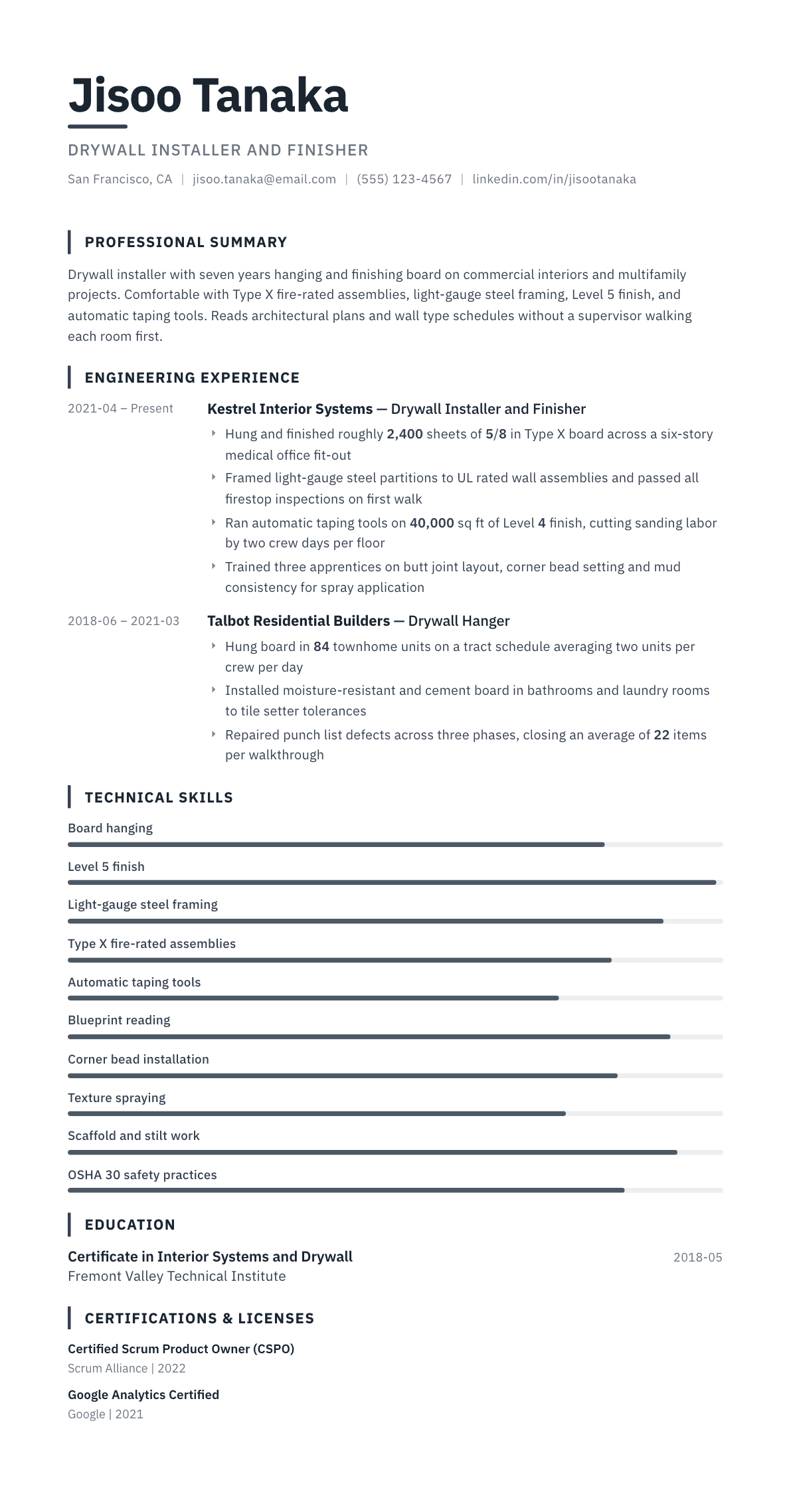
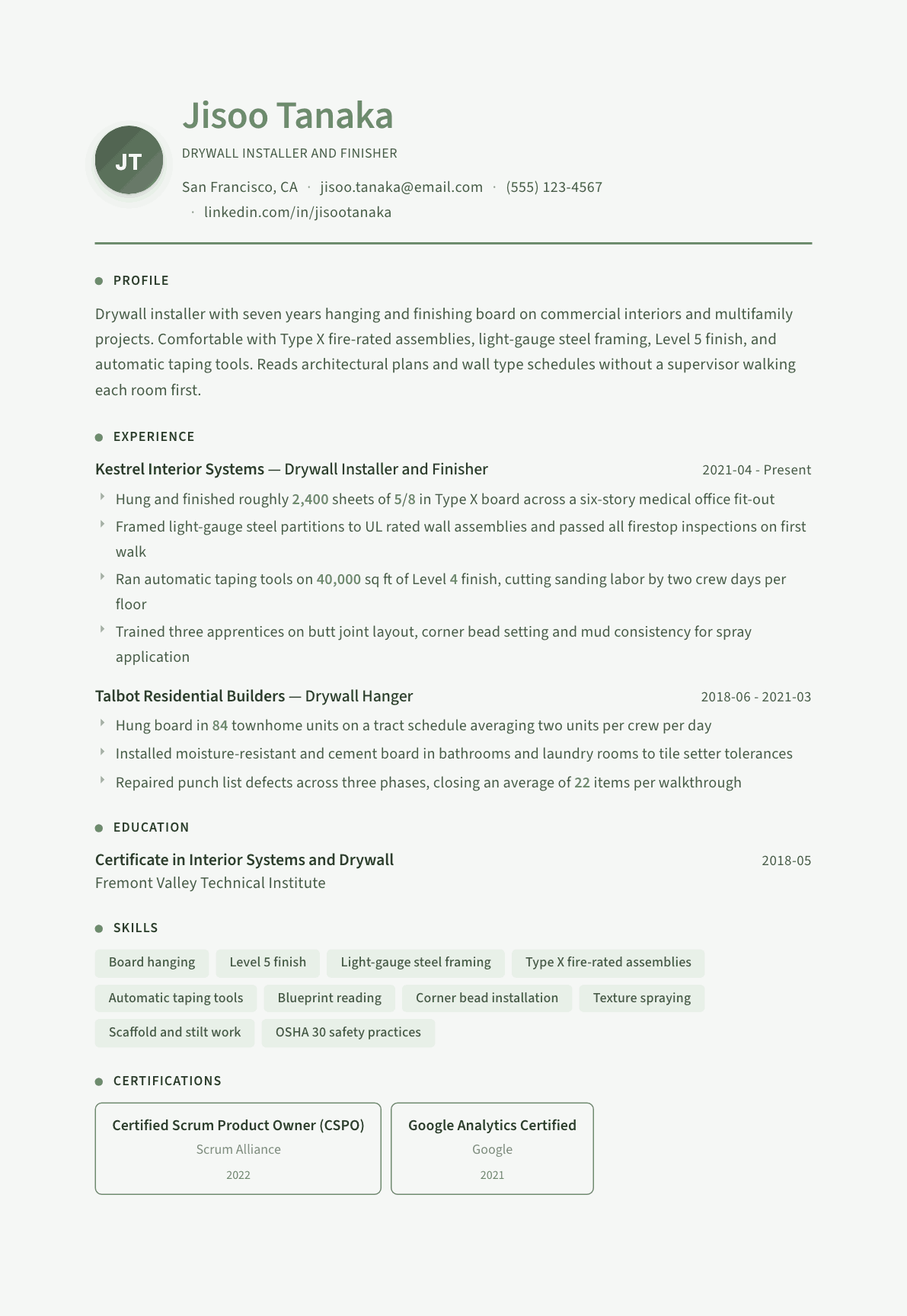
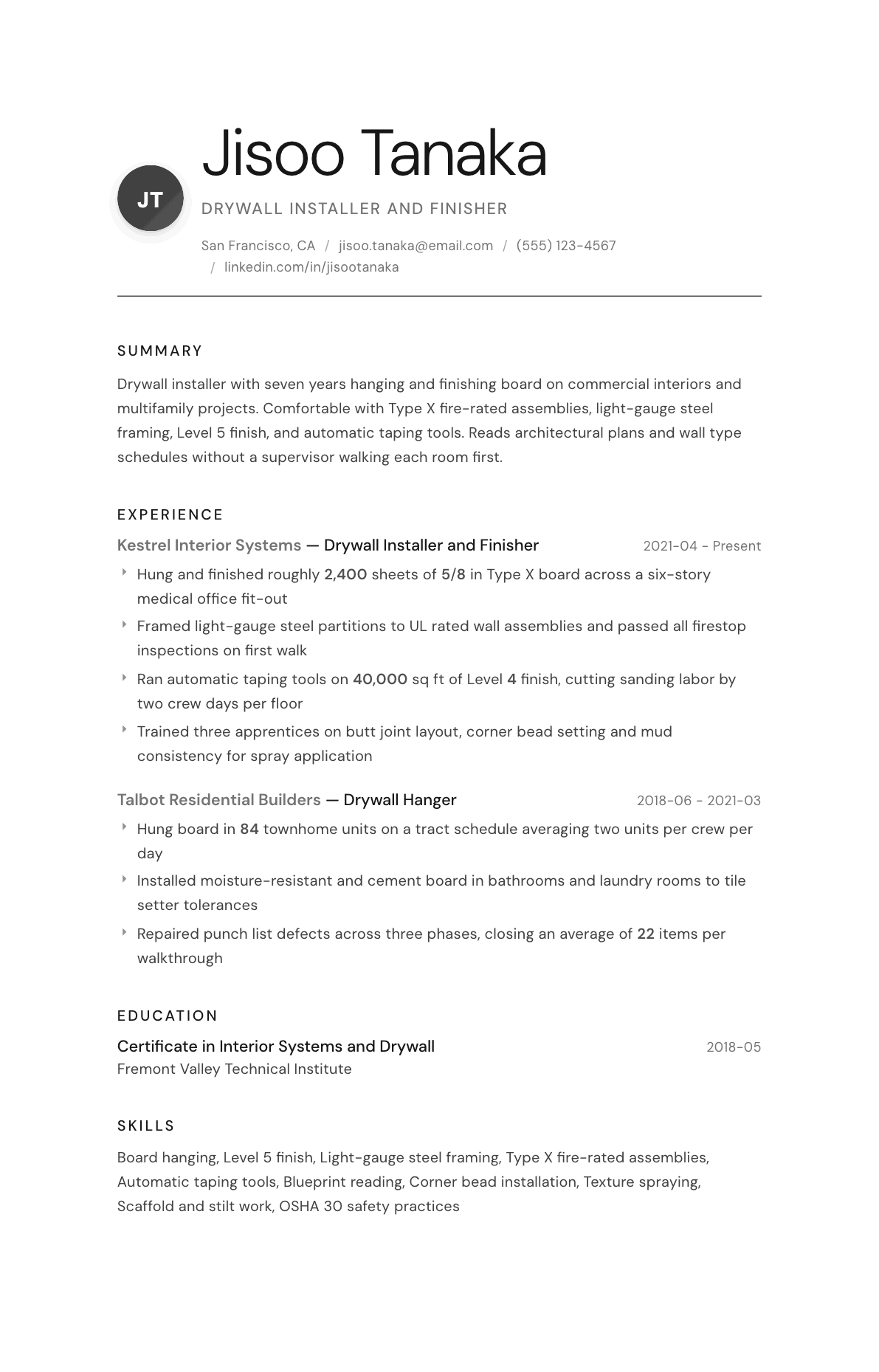
Example Drywall Installer summary
Drywall installer with seven years on commercial interiors and multifamily builds, hanging and finishing board to Level 5 on fire-rated and acoustic assemblies. Frames light-gauge steel partitions from wall type schedules, runs automatic taping tools, and closes punch lists without rework. OSHA 30 certified and comfortable leading a three-person crew on a tight fit-out schedule.
Skills to list on a Drywall Installer resume
- Drywall hanging
- Taping and finishing
- Level 4 and Level 5 finish
- Metal stud framing
- Fire-rated assemblies
- Acoustic wall systems
- Corner bead and trim
- Skim coating
- Texture application
- Blueprint and wall type schedules
- Automatic taping tools
- Ceiling grid coordination
- Patch and repair work
- Scaffold and lift operation
- Fall protection
- Material takeoff
What actually gets this resume read
- Name the finish levels you deliver, because a Level 5 finisher and a Level 2 hanger are hired for different scopes.
- State board types by name: Type X, moisture-resistant, abuse-resistant, cement board and sound-rated assemblies.
- Give square footage or sheet counts per project so an estimator can judge your production rate against a bid.
- Separate commercial interior work from residential tract work, since the tolerances and inspections differ sharply.
- List the taping tools you run, from banjo and flat box to bazooka, because tool ownership changes what a crew pays.
- Mention fire-rated and UL assembly work explicitly, as inspectors and general contractors screen for that experience.
How to write a drywall installer resume
Nobody in a drywall company reads a resume for pleasure. An estimator is trying to work out how many sheets you can hang in a day, and a superintendent is trying to work out whether he can hand you a fire-rated corridor and walk away. Those two questions decide whether your name goes on the callback list or the maybe pile.
That means the useful information is production and scope, not adjectives. Which board did you hang, on what framing, to what finish level, on what kind of building, and who inspected it afterward. A resume that says hardworking and reliable answers none of it.
This guide sets out the sections in the order a drywall contractor scans them, gives three summaries for a helper, a journey-level hanger and a lead finisher, rewrites bullets the way a foreman would want to read them, and answers the questions that come up when a hanger sits down to write.
Format: one page, projects grouped by contractor
Trade resumes work best on a single page in reverse-chronological order. Group your work by the contractor who paid you, then list the notable projects underneath, because in interior systems you may run through six buildings under one employer and a list of six employers would look like job hopping when it was not.
Skip the graphics and the skill bars. Interior contractors often use plain applicant tracking software or print the file and carry it into a trailer, and a two-column layout comes out of both scrambled. Put your city, your phone number, whether you own a truck and hand tools, and whether you travel for work directly under your name.
- Header: name, trade, city and state, phone, email, and whether you carry your own tools and transport.
- Order: summary, certifications and safety cards, work history with projects, skills, training.
- Helpers and apprentices put the training program above the work history until the second year.
Summary: hang, finish, or both, and to what level
The first line has to tell a reader which half of the trade you belong to. Hangers and finishers are scheduled separately, paid on different rates and often hired at different times of the job. Say whether you hang board, tape and finish, or run both, and name the highest finish level you deliver consistently rather than the highest you have attempted once.
Then add the setting. A drywall installer who has spent years on tract housing and one who has spent years on hospitals are not the same hire, because the second has worked under smoke barrier detail, UL assemblies and an inspector who checks the firestop before the board closes the wall.
Experience: sheets, square footage and wall types
Every job entry needs the contractor, your title, the building type and the scope. Then two to four bullets, each carrying a number or a system name. Sheet counts, square footage per floor, unit counts on multifamily, or the number of crew you led all give the reader a production rate to compare against a bid.
Name the assemblies rather than the material in general terms. Type X board on a one-hour rated corridor, shaft wall with C-H studs and liner panel, sound assemblies with resilient channel and acoustic sealant, moisture-resistant board behind tile, abuse-resistant panels in a school hallway. Each of those signals a class of work an estimator prices differently.
Leave out the bullets that describe drywall itself. Measured and cut sheets, installed drywall on walls and ceilings, and used hand tools apply to every drywall installer alive and eat the space a real detail needs.
- Contractor, building type, and your role on the crew for every entry.
- One bullet on framing if you frame: stud gauge, spacing, deflection track, header detail.
- One bullet on finishing: level achieved, tools run, and the coating that followed.
- One bullet on rated or acoustic work, because that is what separates commercial from residential experience.
Skills and tools: list what you own and run
For a drywall installer the skills block doubles as a tool list, and contractors read it that way. Automatic taping tools change what a crew can produce, so say which ones you run: banjo, flat boxes, angle heads, corner rollers, a bazooka, a texture rig, a screw gun with a collated attachment. If you own them, say so, because tool ownership is a real cost the company does not have to carry.
Add the access equipment and the safety cards in the same area. Stilts, baker scaffold, scissor lift, boom lift and any lift card you hold tell a superintendent whether you can work a fourteen-foot ceiling without a conversation first.
Keywords a drywall contractor searches for
Interior systems postings reuse a narrow vocabulary, so mirror it. Board hanging, taping and finishing, Level 4 and Level 5, metal stud framing, light-gauge steel, shaft wall, fire-rated assembly, acoustic wall, skim coat, texture, corner bead, punch list. Use the wording of the posting once in your summary and once inside a real bullet, where a human can see the claim standing on evidence.
Drywall Installer resume summary examples
Second-year helper
Drywall helper with two years stocking board, framing metal studs and hanging on residential and light commercial jobs. Trained on corner bead, screw pattern and butt joint layout, comfortable on stilts and baker scaffold, and holding an OSHA 10 card. Looking to move into full hanging on a commercial crew.
Journey-level hanger
Drywall installer with six years hanging Type X, moisture-resistant and abuse-resistant board over light-gauge steel on schools and medical offices. Frames partitions from wall type schedules, sets shaft wall, and finishes to Level 4. Averaged 55 sheets a day on the last two fit-outs and passed firestop inspection without rework.
Lead finisher and foreman
Lead drywall finisher and foreman with twelve years on commercial interiors, running crews of six through hospital and hotel fit-outs. Delivers Level 5 finish with automatic tools and spray application, manages board takeoff and delivery sequencing, and closes punch lists ahead of the paint schedule.
Work experience bullets: before and after
Before: Installed drywall on walls and ceilings.
After: Hung 5/8 in Type X board on one-hour rated corridors over 20-gauge steel studs, averaging 48 sheets per shift across four floors.
The board type, rating, framing gauge and daily count let an estimator price your production instead of guessing at it.
Before: Did taping and finishing work.
After: Taped and finished roughly thirty thousand square feet to Level 5 using flat boxes and angle heads, then skim coated for a gloss paint specification.
Naming the finish level, the tools and the coating that followed shows the reader which grade of work you are trusted with.
Before: Worked on a hospital project.
After: Built smoke barrier and shaft wall assemblies on a hospital tower, installing C-H studs, liner panel and firestop at every penetration before board close.
The assemblies are the point, because rated hospital work is the experience a commercial contractor is actually screening for.
Before: Helped train new guys on the crew.
After: Trained four apprentices on screw pattern, butt joint layout and mud consistency for spray texture, cutting first-coat rework on their walls noticeably.
Naming what you taught turns a vague mentoring claim into evidence that you know the craft well enough to explain it.
Before: Fixed problems found during inspection.
After: Closed an average of 22 punch list items per walkthrough across three multifamily phases, coordinating patch and repaint timing with the painting crew.
Volume and coordination show you finish work rather than leaving a trail another trade has to clean up.
Hard skills
- Board hanging on wood and steel framing
- Taping and finishing to Level 4 and Level 5
- Light-gauge steel stud framing
- Type X and fire-rated assemblies
- Shaft wall and C-H stud systems
- Acoustic assemblies and resilient channel
- Automatic taping tools
- Corner bead and trim installation
- Skim coating and texture spraying
- Wall type schedule and blueprint reading
- Suspended ceiling grid coordination
- Patch, repair and punch list work
- Scissor lift and scaffold operation
- Material takeoff and stocking
Soft skills
- Crew coordination
- Schedule awareness
- Attention to tolerance
- Clear handover to the next trade
- Reliability on early starts
- Coaching apprentices
Certifications worth listing
- OSHA 30-Hour Construction (OSHA Outreach Training Program)
- OSHA 10-Hour Construction (OSHA Outreach Training Program)
- Aerial and Scissor Lift Operator Training (Scaffold and Access Industry Association)
Mistakes that cost drywall installer candidates the interview
- Writing hung drywall for five years with no board type, framing or finish level, which tells a contractor nothing he can price.
- Hiding whether you hang, finish or both, when the two roles are scheduled and paid separately on almost every commercial job.
- Leaving out rated and acoustic assembly work, which is the exact experience that moves a resume from residential to commercial.
- Listing every small remodel as its own employer, so a steady four years with one contractor reads like four short jobs.
- Skipping the tool list, when automatic taping equipment and lift experience change what a crew can be assigned.
- Using a two-column template that scrambles in parsing, so the project details never reach the person who wanted them.
- Claiming Level 5 on every job when the work was mostly Level 3 and Level 4, because a lead finisher will test that claim on day one.
Drywall Installer resume questions
Should a drywall installer resume be one page or two?
One page is right for almost everyone in this trade. Group projects under the contractor who employed you so a long run with one company reads as stability. Only move to two pages if you have foreman experience across many named buildings worth listing individually.
How do I show production rate without sounding like I am bragging?
State it as a plain average tied to a project, such as sheets per shift on a specific fit-out or units per week on multifamily. Numbers attached to a real job read as a fact a foreman can check, not a boast, and every estimator wants them.
Do I need certifications to get hired as a drywall installer?
Most hangers are hired on experience alone, but a safety card removes friction because many commercial sites require one before you badge in. An OSHA card and lift training are cheap to hold and get you through the gate on the first morning rather than the third.
What if my experience is all residential and I want commercial work?
Pull forward anything that overlaps: metal stud framing, moisture-resistant board, ceilings, fire caulking around penetrations, and any multifamily job with rated corridors. Then say plainly that you are moving into commercial interiors, and list your safety training so the site access question is answered.
Should I list the general contractors I worked under?
Yes, when the buildings are recognizable in your market and the relationship was real. Naming the general contractor and the building type gives your experience a reference point a superintendent can verify with one phone call, which is often what turns a resume into an interview.
Related resume examples
- Carpenter Resume example
- Painter Resume example
- Insulation Installer Resume example
- Framer Resume example
- Finish Carpenter Resume example
- Construction Worker Resume example