Framer Resume Examples: what a hiring manager reads first
Build a Framer Resume That Proves You Can Keep Pace
By Mustafa Tarabya, founder of CVBooster · Published · Updated
Framer resume examples with production rates, wall and roof systems, layout skills and the keywords residential builders screen for.
Sample resumes for a framer
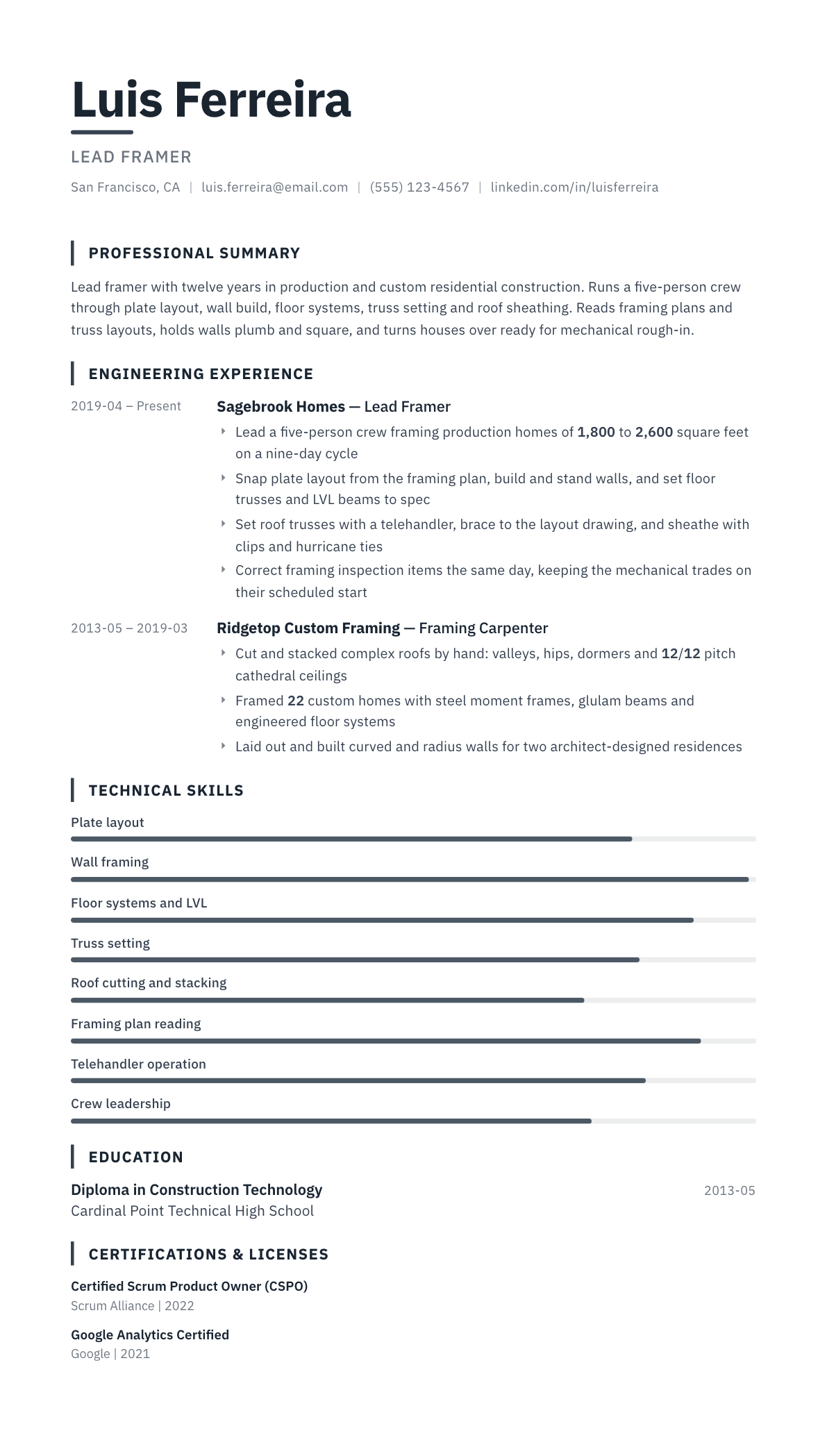
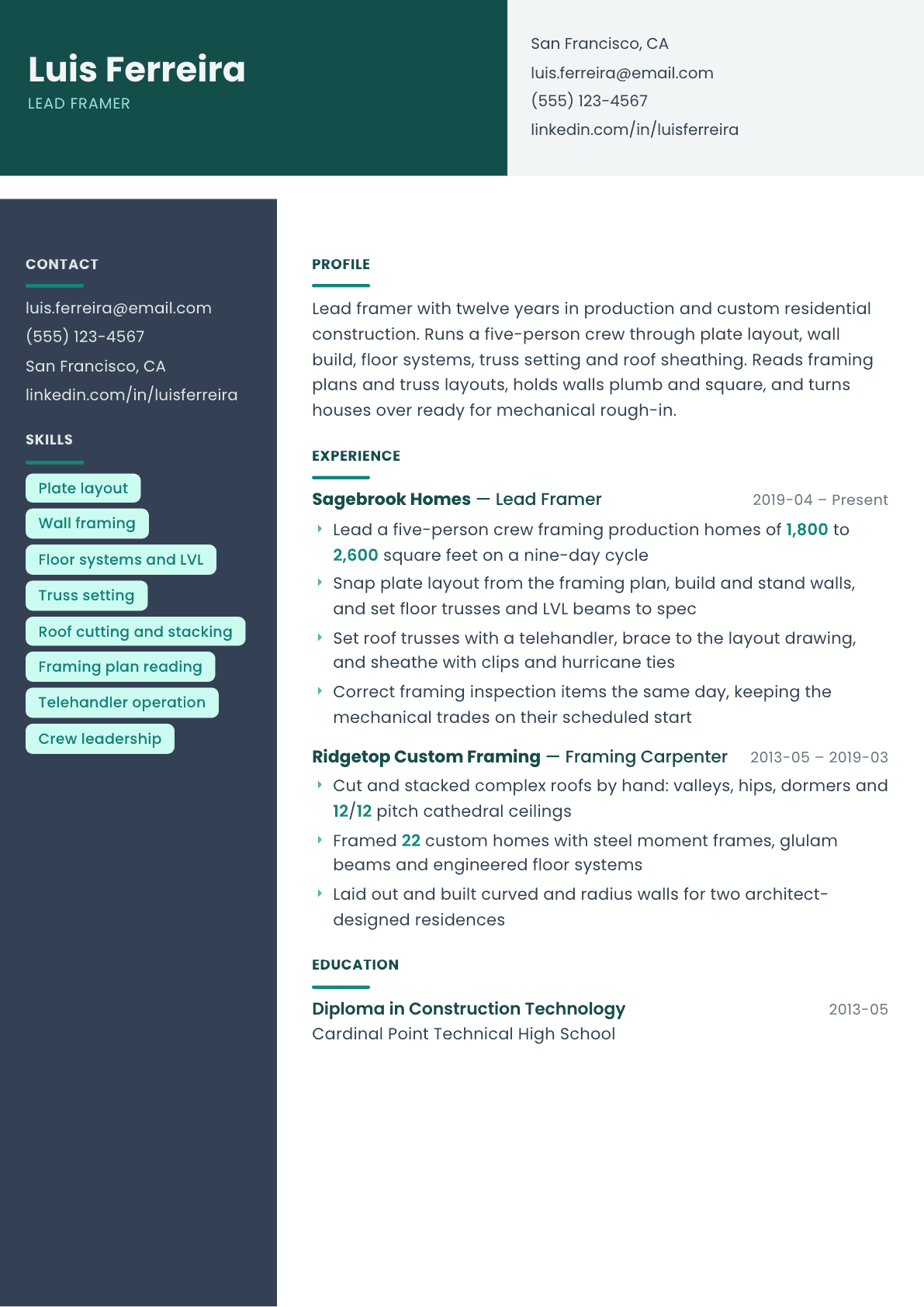
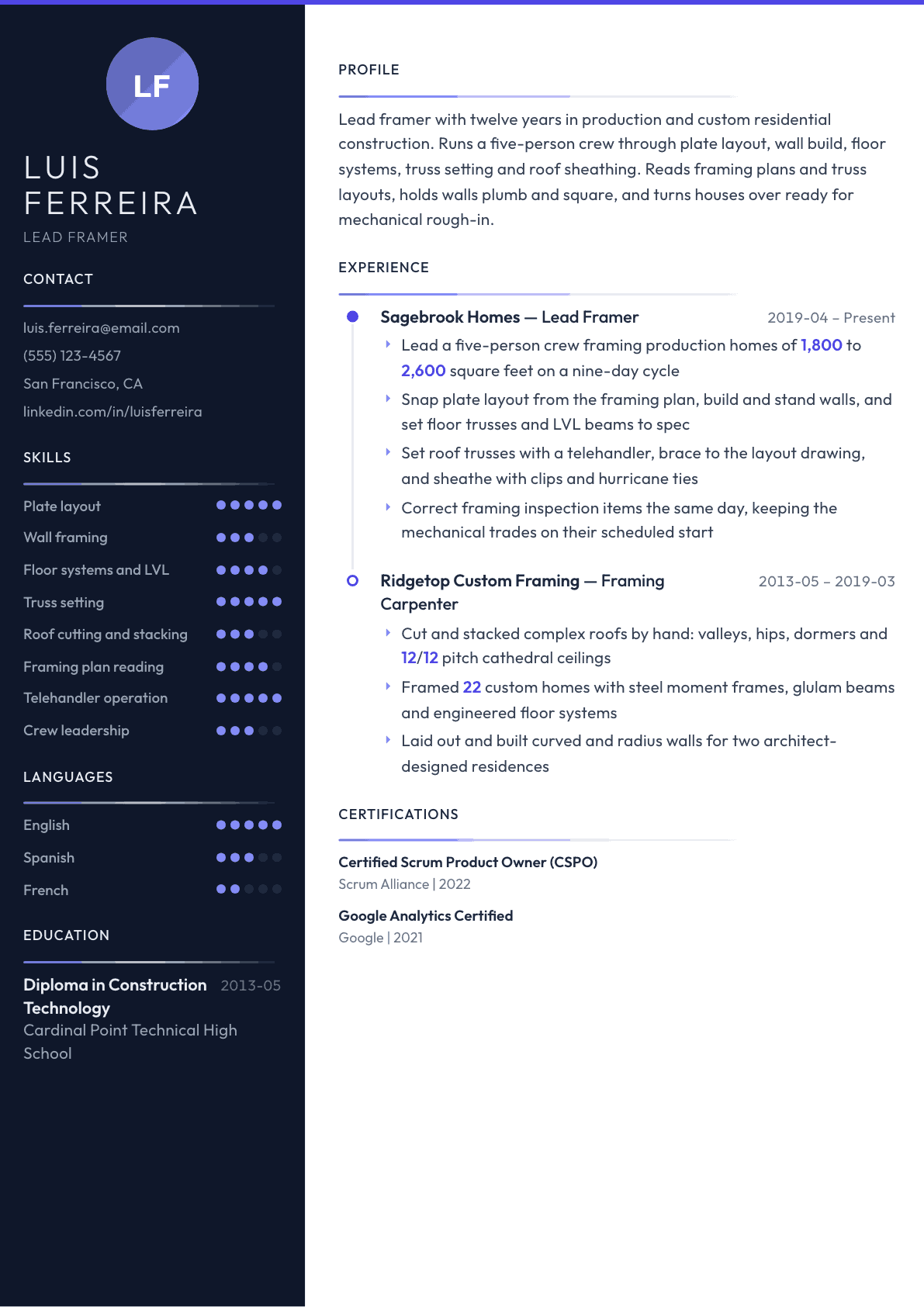
The same framer content laid out in three CVBooster templates, so you can see what the finished document looks like before you write a word.
Example Framer summary
Lead framer with twelve years across production and custom residential work. Runs a five-person crew from plate layout through wall build, floor systems, truss setting and roof sheathing on a nine-day house cycle. Also cuts complex roofs by hand, including hips, valleys and dormers, and frames with LVL, glulam and steel moment frames. Passes framing inspections without holding up the mechanical trades.
Skills to list on a Framer resume
- Plate and wall layout
- Wall framing and standing
- Floor systems and I-joists
- LVL and glulam beams
- Truss setting and bracing
- Roof cutting and stacking
- Sheathing and shear walls
- Hurricane ties and hold-downs
- Framing plan reading
- Telehandler and forklift
- Framing nailers and saws
- Crew leadership
- Framing inspection readiness
- Fall protection
What actually gets this resume read
- Give the house size and the cycle time you frame to, because production builders hire on pace.
- Separate production framing from custom framing, since the crews and the skill set are judged differently.
- Say whether you cut roofs by hand or set trusses, and name the pitches and roof shapes you have stacked.
- List the engineered materials you work with: LVL, glulam, I-joists, open web trusses and steel moment frames.
- Show inspection results, such as passing framing inspections without corrections, rather than generic quality claims.
- Include equipment you are checked out on, from telehandler and scissor lift to a pneumatic nailing system.
How to write a framer resume
A framer is hired on pace and on accuracy, in that order. The builder or framing contractor reading your resume wants to know how fast a crew moves with you on it and whether the walls come out plumb, square and to the plan. Those two things can be shown on paper with cycle times, house counts, crew sizes and inspection results, and almost nothing else on the page matters as much.
The second thing that gets checked is which kind of framing. Production framing on repeated plans and custom framing with cut roofs, engineered beams and odd geometry are different skills, and the crews are not interchangeable. A production builder wants cycle time. A custom builder wants to know whether you can cut a hip and valley roof by hand. Say which one you are, or say honestly that you do both.
Below is the structure that works for framers, how to write scope so a superintendent can price it, three summaries from framing laborer to lead, before and after bullets, and the questions framers ask when the season turns and they need work with a better outfit.
Format: one page, pace in the first five lines
One page unless you have a long custom project list. Plain single column, reverse chronological, no graphics. The header carries your contact details, driver license class, whether you own a full framing kit, and your willingness to travel between lots or job sites. Framing crews rotate through subdivisions, so travel is a real question.
Immediately under the header, state the kind of framing you do and the pace you frame at. A line naming production homes in a stated square footage band and a stated crew cycle answers more than a paragraph of description, and a superintendent staffing a subdivision reads nothing else first.
- Header: contact details, driver license, own framing tools, travel radius.
- Pace line: framing type, typical house size band, crew size, cycle time.
- Then experience, equipment checkouts, safety cards, skills.
Experience: cycle, crew and the assemblies you own
For each employer, give the builder type and the product: production homes, semi-custom, custom, multifamily, or light commercial wood frame. Then give the numbers a superintendent tracks: square footage band, houses per season, crew size and the cycle in days from slab to dried in. Those figures are the language of framing production.
Then name the assemblies you personally handle. Plate layout snapped from the framing plan, wall build and stand, floor systems with joists or trusses, engineered beams, stair openings, truss setting and bracing, roof sheathing with clips, shear walls and hold-downs. A framer who lists layout and roof stacking is a different hire from one who only stands walls.
For custom work, describe the geometry. Cut roofs with hips, valleys and dormers, cathedral ceilings, curved and radius walls, steel moment frames and glulam beams. These are the lines that make a custom builder pick up the phone, because most applicants cannot write them.
Inspections, corrections and rework
Framing inspections gate every trade that follows, so a framer who passes them cleanly protects the whole schedule. Say what you do to get there: checking hold-down and strap placement against the plan, verifying hanger nailing, walking headers and point loads, and pulling a string before the sheathing goes on.
Then give the result. Passing framing inspection without corrections, or correcting flagged items the same day so the mechanical trades keep their start date, is the outcome a superintendent will repeat to their boss when they defend hiring you.
Equipment, safety and the crew you run
List the machines you are checked out on: telehandler, forklift, scissor lift, and any crane signaling you have done for truss sets. Setting trusses is where equipment and safety meet, and a framer who can run the telehandler and brace to the layout drawing is worth two people on set day.
Give safety its own short block: construction outreach training, fall protection, and any scaffold or lift training. Then, if you lead, state the crew size and what portion of the house you run. A lead framer line should name the people and the scope, not just the title.
Keywords that get a framer found
Framing postings and searches use a tight vocabulary: framer, framing carpenter, lead framer, layout, wall framing, floor joists, trusses, roof stacking, sheathing, shear wall, hold-down, engineered lumber, telehandler, framing inspection. Attach each to a real assembly in the experience. A superintendent who has framed will spot a keyword with no house behind it instantly.
Framer resume summary examples
Framing laborer
Framing laborer with a year on production crews, carrying and standing walls, sheathing decks and roofs with a coil nailer, and cutting studs and blocks at the saw station. Holds an OSHA 10 card and fall protection training, owns a full framing bag, and arrives before the first cut.
Six years framing
Framing carpenter with six years on production and semi-custom homes. Snaps plate layout from the framing plan, builds and stands walls, sets floor trusses and engineered beams, braces and sheathes roofs, and corrects framing inspection items the same day they are flagged.
Lead framer
Lead framer with twelve years across production and custom residential, running a five-person crew on a nine-day house cycle. Cuts complex roofs by hand including hips, valleys and dormers, frames with engineered lumber and steel moment frames, and turns houses over ready for mechanical rough-in.
Work experience bullets: before and after
Before: Framed houses for a home builder.
After: Framed production homes in the eighteen hundred to twenty six hundred square foot range on a nine-day crew cycle, from plate layout through roof sheathing.
The size band and the cycle give a superintendent the two production numbers they use to staff a subdivision.
Before: Set roof trusses.
After: Set roof trusses with a telehandler, braced to the truss layout drawing, and sheathed with hurricane ties and clips installed to the engineering detail.
Equipment, bracing to a drawing and the connector detail show a truss set done to spec rather than by memory.
Before: Cut roofs on custom homes.
After: Cut and stacked complex roofs by hand including valleys, hips, dormers and cathedral ceilings at a twelve in twelve pitch on architect-designed residences.
Naming the roof features and the pitch is the shortest proof of hand-cutting ability a custom builder can read.
Before: Made sure framing passed inspection.
After: Walked hold-downs, straps, hangers and point loads against the plan before calling the inspector, and corrected any flagged item the same day so the mechanical trades kept their start.
Describing the pre-inspection walk and the schedule protection explains why your inspections go through.
Before: Led a crew of framers.
After: Led a five-person crew through layout, wall build, floor systems, truss setting and sheathing, assigning lots each morning and checking plumb and string before sheathing went on.
Crew size plus the scope and the quality checkpoint make leadership something a builder can actually evaluate.
Hard skills
- Plate layout from framing plans
- Wall framing, standing and bracing
- Floor systems, joists and trusses
- Engineered lumber and glulam beams
- Roof truss setting and bracing
- Hand-cut roofs, hips and valleys
- Sheathing, shear walls and hold-downs
- Hangers, straps and connector details
- Stair openings and headers
- Telehandler and forklift operation
- Framing nailers and saws
- Framing inspection preparation
Soft skills
- Setting crew pace
- Reading a plan before cutting
- Lot sequencing
- Fall protection discipline
- Coordinating with the truss delivery
Certifications worth listing
- OSHA 30-Hour Construction (OSHA Outreach Training Program)
- Carpentry Level Three (NCCER)
- Signalperson (National Commission for the Certification of Crane Operators)
Mistakes that cost framer candidates the interview
- Writing framing experience with no cycle time or house count, which removes the one number production builders buy.
- Failing to distinguish production framing from custom framing, so neither kind of builder can place you.
- Leaving out layout, which is the skill that separates a framer from a person carrying walls.
- Never mentioning trusses or roof stacking, the assemblies that decide whether you can finish a house.
- Omitting equipment checkouts such as telehandler operation, which changes how a crew can use you on set day.
- Ignoring inspection results when framing inspections gate every trade that follows you into the house.
Framer resume questions
How do I show framing speed on a resume?
Use the crew cycle. State the house size band, the crew size and the number of days from slab to dried in. That combination gives a superintendent a production rate they can compare against their current crews.
Is hand-cutting roofs still worth listing?
Yes, and it is one of the strongest lines a framer can write. Most residential work uses trusses now, so a framer who can lay out and cut a hip and valley roof is scarce and gets custom work others cannot take.
Should a framer list multifamily and commercial wood frame work?
List it as its own group. Podium and multifamily framing involves shear walls, hold-downs and fire assemblies that residential work does not, and contractors bidding that work search for exactly those terms.
What if I have only worked as a framing laborer?
Write what you actually did: carrying and standing walls, sheathing, cutting at the saw station and stocking material. Then say which assemblies you have started to lay out, because that is the step a crew is watching for.
Do framers need to include safety training?
Yes. Framing puts people on walls and roofs from the first week, so fall protection and construction outreach training are practical requirements. Add any lift or scaffold training in the same block so a badge can be issued quickly.
Related resume examples
- Carpenter Resume example
- Construction Worker Resume example
- Carpenter Apprentice Resume example
- Construction Foreman Resume example
- Roofer Resume example
- Landscaper Resume example