Finish Carpenter Resume Examples: the lines they read
A Finish Carpenter Resume That Shows Your Tolerances
By Mustafa Tarabya, founder of CVBooster · Published · Updated
Finish carpenter resume examples covering trim, millwork, stair and door work, tool lists and the keywords builders and shops search for.
Sample resumes for a finish carpenter
The same finish carpenter content laid out in three CVBooster templates, so you can see what the finished document looks like before you write a word.
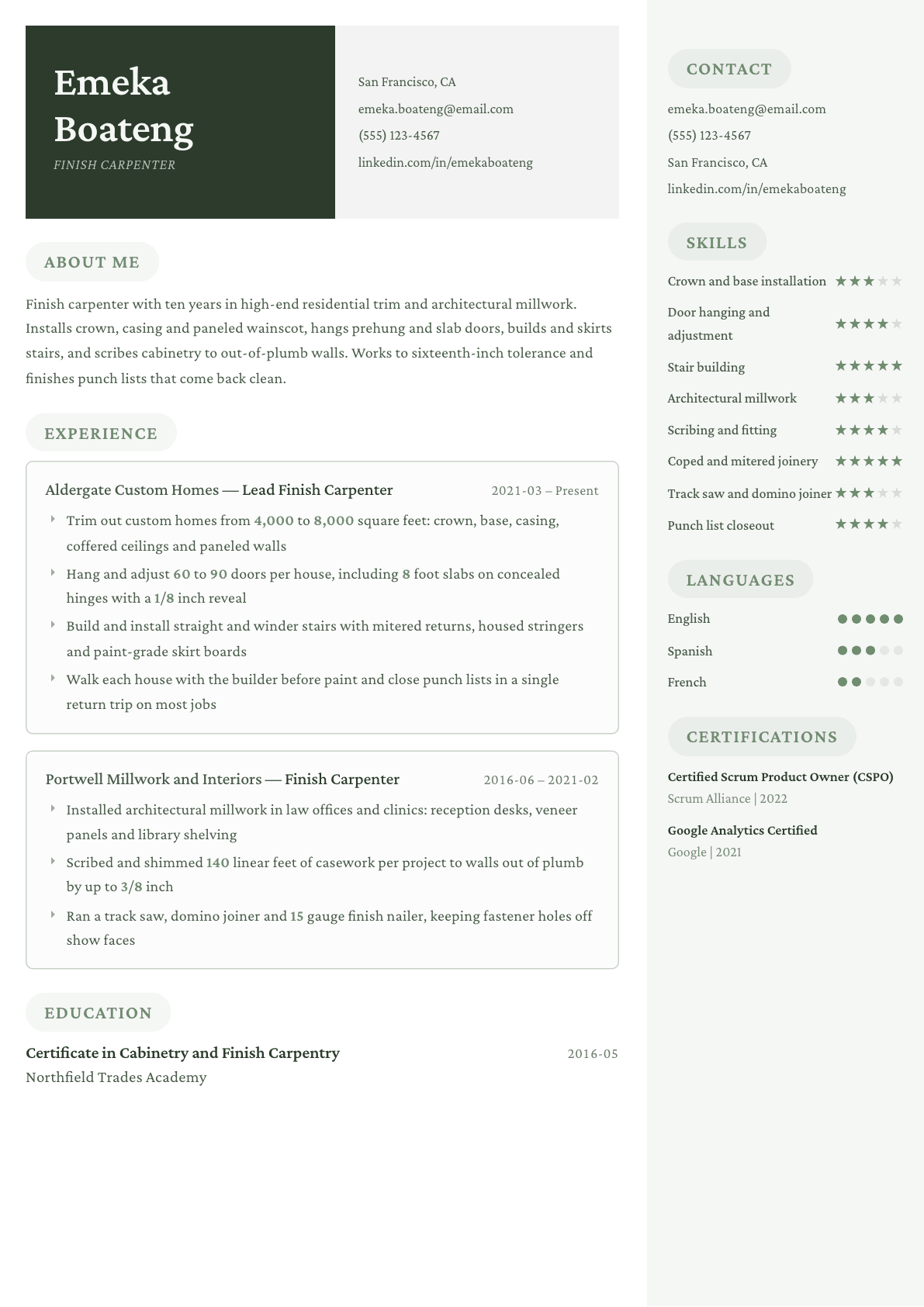
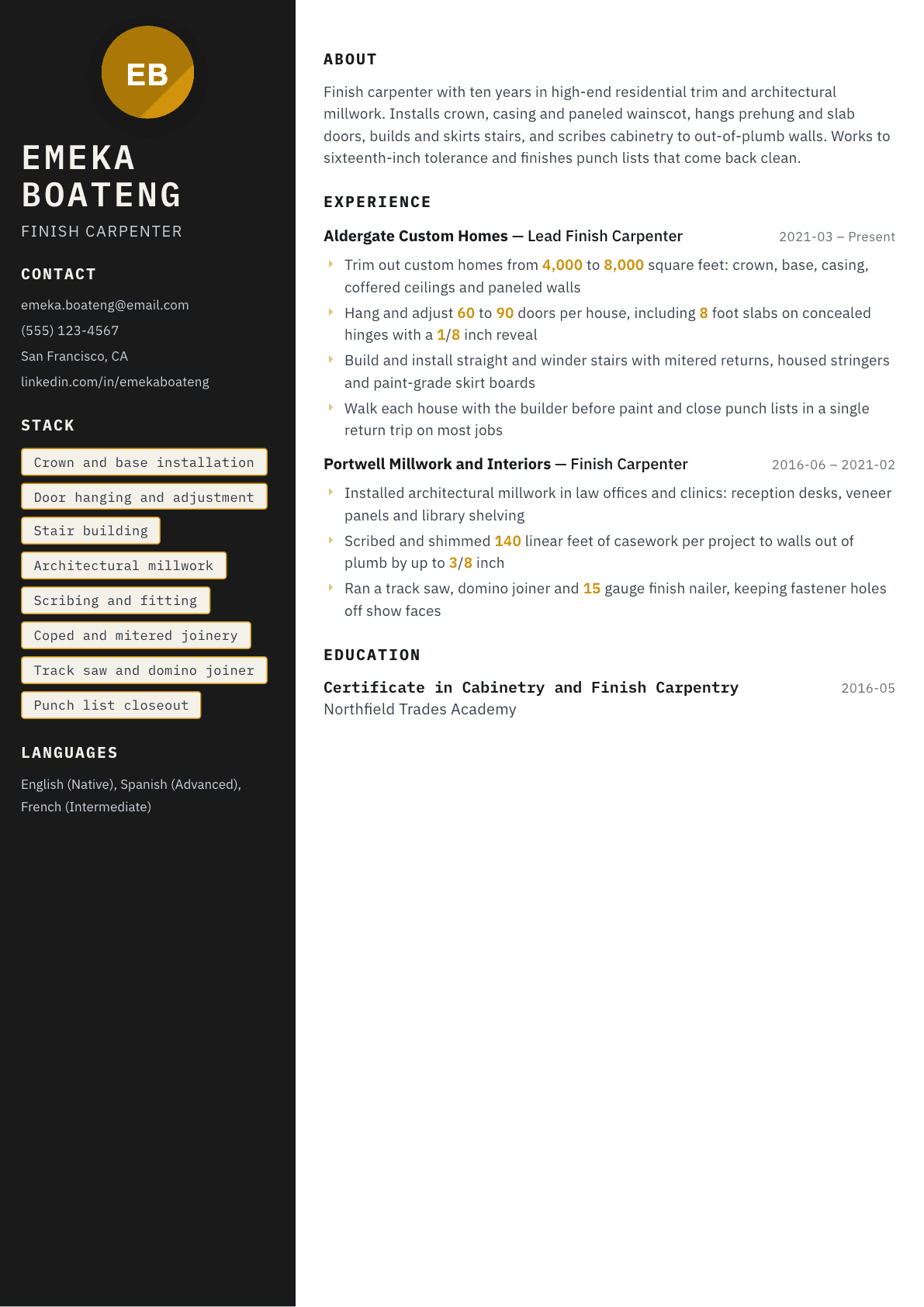
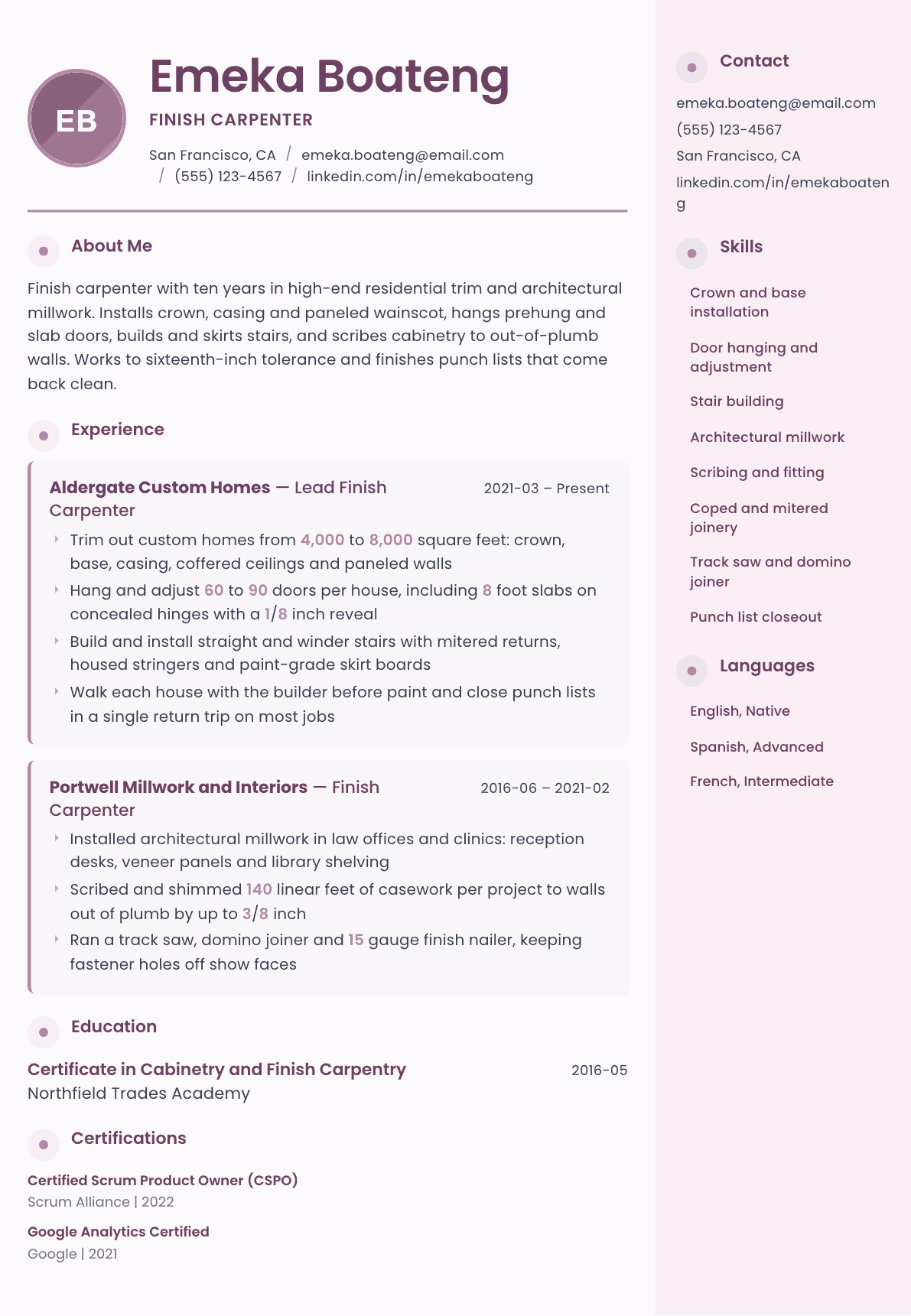
Example Finish Carpenter summary
Finish carpenter with ten years in custom residential trim and commercial millwork. Installs crown, casing, wainscot and coffered ceilings, hangs and adjusts doors to a consistent reveal, builds stairs with mitered returns, and scribes casework into walls that are never plumb. Works from shop drawings and closes punch lists in one trip. Looking for a builder or millwork shop where the standard is set by the carpenter.
Skills to list on a Finish Carpenter resume
- Crown molding installation
- Casing and base trim
- Door hanging and hardware
- Stair building and skirting
- Wainscot and paneling
- Architectural millwork
- Cabinet installation and scribing
- Coping and mitering
- Track saw and miter saw
- Domino and biscuit joinery
- Finish and pin nailers
- Laser and level layout
- Shop drawing reading
- Punch list closeout
- Wood species and grain matching
What actually gets this resume read
- Name the tolerance you hold and the reveals you set, because that is how a builder judges a trim carpenter.
- List the trim types you install by name: crown, casing, chair rail, wainscot, coffered ceilings and beams.
- Include door counts per house and whether you hang prehung, slab or concealed hinge doors.
- Say whether you build stairs, since stair work separates a trim installer from a full finish carpenter.
- Describe your own tool kit, from track saw and miter station to pinners, joiners and a laser level.
- Add photographs of finished work to a portfolio link line, because this trade is judged by eye.
How to write a finish carpenter resume
A finish carpenter is hired on tolerance. The builder or millwork shop reading your resume is trying to work out whether your reveals are consistent, whether your miters close, and whether the punch list after you leave is short. Nothing communicates that faster than the specifics: the reveal you set doors to, the trim profiles you install, the tolerance you scribe to, and how many return trips your punch lists take.
The second thing they are checking is scope. Trim installation, stair building, cabinet installation and architectural millwork are related but separately valued. A carpenter who builds and installs stairs is scarce, and a carpenter who scribes casework into an out-of-plumb wall without a gap is worth more than one who nails base and casing. Say which of those you do.
This guide covers how to structure a finish carpenter resume, the details that prove craft on paper, three summaries from trim helper to lead, bullets rewritten with real tolerances, and the questions that come up when a carpenter with a strong portfolio has a weak resume.
Format: one page plus a portfolio link
One page is usually right, two only when you carry a long list of named projects or shops. Keep the layout plain and reverse chronological. Add one line in the header for a portfolio: a simple gallery of finished rooms, stair runs and millwork installations. This trade is judged by eye, and a builder will look at the photographs before reading the second job.
Under the contact block, put a short capability line that names the four scopes you cover, such as trim, stairs, cabinet installation and architectural millwork. That single line does the work of a whole summary paragraph for a reader who is trying to fill one specific gap on a crew.
- Header: name, city and state, phone, email, portfolio link.
- Capability line: trim, doors, stairs, cabinet installation, millwork.
- Then experience, tools owned, education and training, skills.
Experience: house type, room count and the reveal
Give each employer the kind of work they do: custom residential, production builder, commercial interiors, millwork shop. Then describe the houses or spaces by size and by trim package. Crown, base, casing, chair rail, wainscot, coffered ceilings, beams, built-ins. The trim package is the scope, and a builder recognizes the difference between paint-grade base and a stain-grade coffered ceiling immediately.
Doors are their own measure. Give the count per house, whether they are prehung or slab, whether you hang on concealed hinges, and the reveal you set. A carpenter who hangs 8 foot slabs on concealed hinges to a consistent reveal is describing a level of work that cannot be faked.
If you build stairs, give that its own bullets. Housed stringers, mitered returns, winders, skirt boards, handrail fittings and volutes are all specific and all scarce. Stairs are the single fastest way to separate yourself from every trim installer applying for the same job.
Tolerance, scribing and punch list results
Say what tolerance you work to and how you achieve it. Scribing cabinets and panels into walls that are out of plumb, shimming to a laser line, coping inside corners instead of mitering them, and keeping fastener holes off show faces are all craft decisions that a reader in the trade will register instantly.
Then close the loop with punch list performance. Walking a house with the builder before paint, and closing the list in one return trip, is the outcome a general contractor cares about because it protects their schedule and their retainage. State it plainly if it is true.
Tools and materials you bring
Finish carpenters usually supply their own kit, so list it. Miter saw and stand, track saw, table saw, domino or biscuit joiner, routers, pinner and finish nailers by gauge, laser level, and a dust collection setup for occupied homes. A builder reading a full kit knows you can start without borrowing.
Materials matter as much as tools. Name the species and products you have worked in, from paint-grade poplar and MDF to walnut, quartersawn oak and prefinished veneer panels. A carpenter who has run stain-grade hardwood trim is trusted with a different budget than one who has only run paint grade.
Keywords a builder or shop searches on
The terms that get a finish carpenter found are concrete: trim, crown, casing, base, wainscot, coffered, door hanging, prehung, stairs, skirt, handrail, cabinet installation, scribing, millwork, punch list. Use them inside the experience where the work is described. A reader in this trade will discount a keyword list that no bullet supports.
Finish Carpenter resume summary examples
Trim helper
Carpenter with two years on trim crews in production housing, installing base, casing and shoe, hanging prehung interior doors, and setting closet systems. Runs a miter station and a 16 gauge finish nailer, copes inside corners, and fills and sands ahead of the painter.
Ten years, custom residential
Finish carpenter with ten years in custom residential trim and commercial millwork. Installs crown, casing, wainscot and coffered ceilings, hangs and adjusts 60 to 90 doors per house to a consistent reveal, builds stairs with mitered returns, and scribes casework into walls that are never plumb.
Lead finish carpenter
Lead finish carpenter running trim and millwork packages on custom homes, directing a two to three person crew. Takes off material from architectural drawings, sets the standard for reveals and joinery, coordinates with cabinet and paint trades, and closes builder punch lists in a single return visit.
Work experience bullets: before and after
Before: Installed trim in custom homes.
After: Trimmed custom homes from four thousand to eight thousand square feet with crown, base, casing, coffered ceilings and paneled accent walls in both paint and stain grade.
House size, the full trim package and the grade tell a builder which tier of work you are used to.
Before: Hung doors.
After: Hung and adjusted 60 to 90 doors per house including 8 foot slabs on concealed hinges, setting an even reveal on every edge before the hardware went on.
Door count, slab size, hinge type and the reveal standard are the four things a builder judges door work by.
Before: Built staircases.
After: Built and installed straight and winder stairs with housed stringers, mitered returns and paint-grade skirt boards, fitting handrail and fittings on site.
Naming stair construction methods separates a stair builder from a carpenter who only installs treads.
Before: Installed cabinets and fixed gaps in the walls.
After: Scribed and shimmed long runs of casework into walls out of plumb by more than a quarter inch, closing every joint without caulk doing the work.
The out-of-plumb condition and the refusal to hide it with caulk describe a standard, not just an installation.
Before: Fixed items on the builder punch list.
After: Walked each house with the builder before paint and closed the resulting punch list in one return trip on most jobs, keeping the paint crew on schedule.
A punch list closed in one trip is the outcome a general contractor uses to decide who gets the next house.
Hard skills
- Crown, base and casing installation
- Coped and mitered joinery
- Door hanging and hardware fitting
- Stair building and skirt fitting
- Wainscot, paneling and coffered ceilings
- Architectural millwork installation
- Cabinet installation and scribing
- Track saw, miter saw and table saw
- Domino and biscuit joinery
- Finish and pin nailers by gauge
- Laser layout and leveling
- Shop drawing and elevation reading
Soft skills
- Standard setting on a crew
- Working cleanly in finished homes
- Coordination with paint and cabinet trades
- Client-facing conduct
- Patience on difficult fits
Certifications worth listing
- Carpentry Level Four (NCCER)
- OSHA 10-Hour Construction (OSHA Outreach Training Program)
- Lead-Safe Renovator (United States Environmental Protection Agency)
Mistakes that cost finish carpenter candidates the interview
- Describing trim work with no profiles, grades or reveals, which leaves a builder unable to judge the tier of work.
- Failing to say whether you build stairs, the one scope that separates you from most trim installers applying.
- Sending a resume with no portfolio link in a trade where the hiring decision is made by looking at photographs.
- Listing tool brands without the tasks, so a reader learns what you own but nothing about what you can fit.
- Ignoring punch list performance, which is the outcome a general contractor uses to award repeat work.
- Mixing framing and rough carpentry into the same bullets, which dilutes the finish work a shop is hiring for.
Finish Carpenter resume questions
Does a finish carpenter resume need a portfolio?
It should have a link to one. Builders and millwork shops look at photographs of completed rooms, stairs and casework before they read a job history. A simple gallery of ten clean images is enough.
How do I show quality without sounding boastful?
Replace adjectives with standards. Name the reveal you set, the tolerance you scribe to, the joints you cope rather than miter, and how many trips your punch lists take. Standards read as competence, praise reads as noise.
Should I include cabinet installation on a trim resume?
Yes, and give it its own bullets. Cabinet installation and scribing are separately valued, and many builders want one carpenter who can trim the house and set the kitchen without a second subcontractor.
How much rough carpentry should I include?
One condensed line at most, and only if it is recent. A finish carpenter resume that spends half a page on framing signals that the finish work is thin, which is the opposite of the impression you want.
What if most of my work was for one builder?
Break the single employer into project types instead of years: custom homes by size band, remodels, and any commercial interiors. That gives the page variety and shows range without inventing a second employer.
Related resume examples
- Carpenter Resume example
- Construction Worker Resume example
- Cabinet Maker Resume example
- Carpenter Apprentice Resume example
- Drywall Installer Resume example
- Flooring Installer Resume example