Electronics Assembler Resume Examples: read this first
An Electronics Assembler Resume Built on IPC and Solder Skill
By Mustafa Tarabya, founder of CVBooster · Published · Updated
Electronics assembler resume example with IPC, soldering and ESD keywords, plus a guide to writing board volumes, yield and inspection work.
Sample resumes for a electronics assembler
The same electronics assembler content laid out in three CVBooster templates, so you can see what the finished document looks like before you write a word.
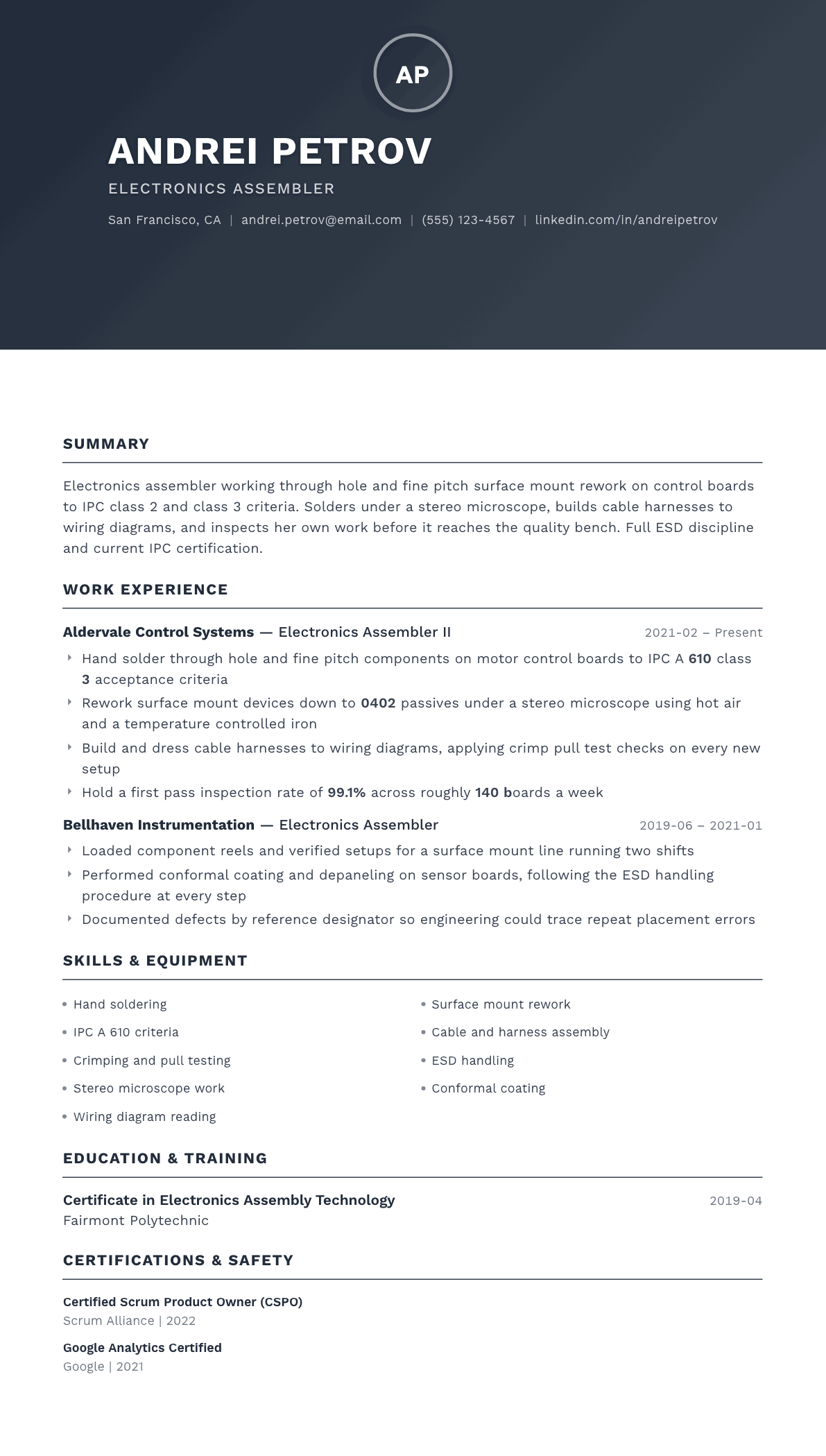
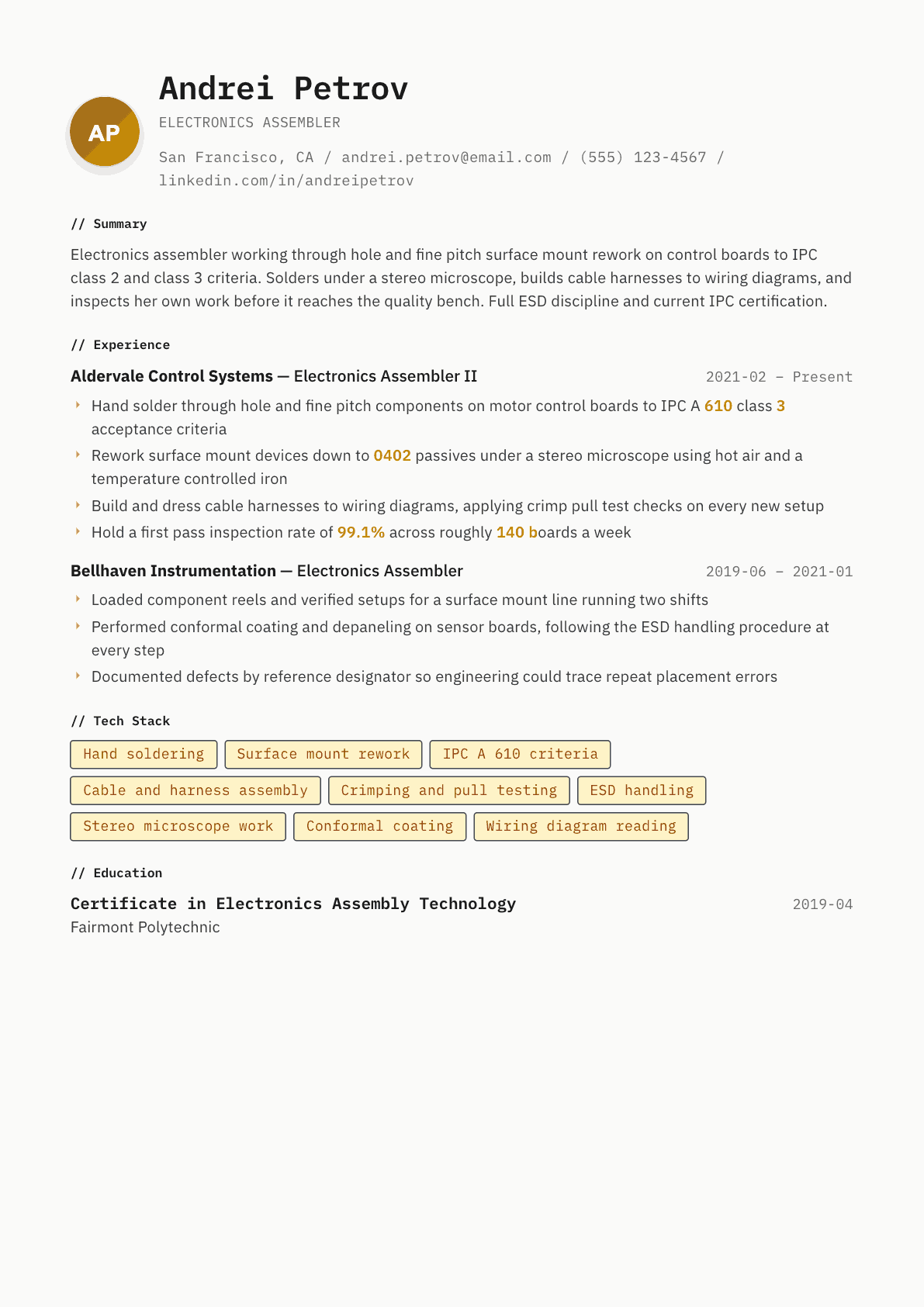
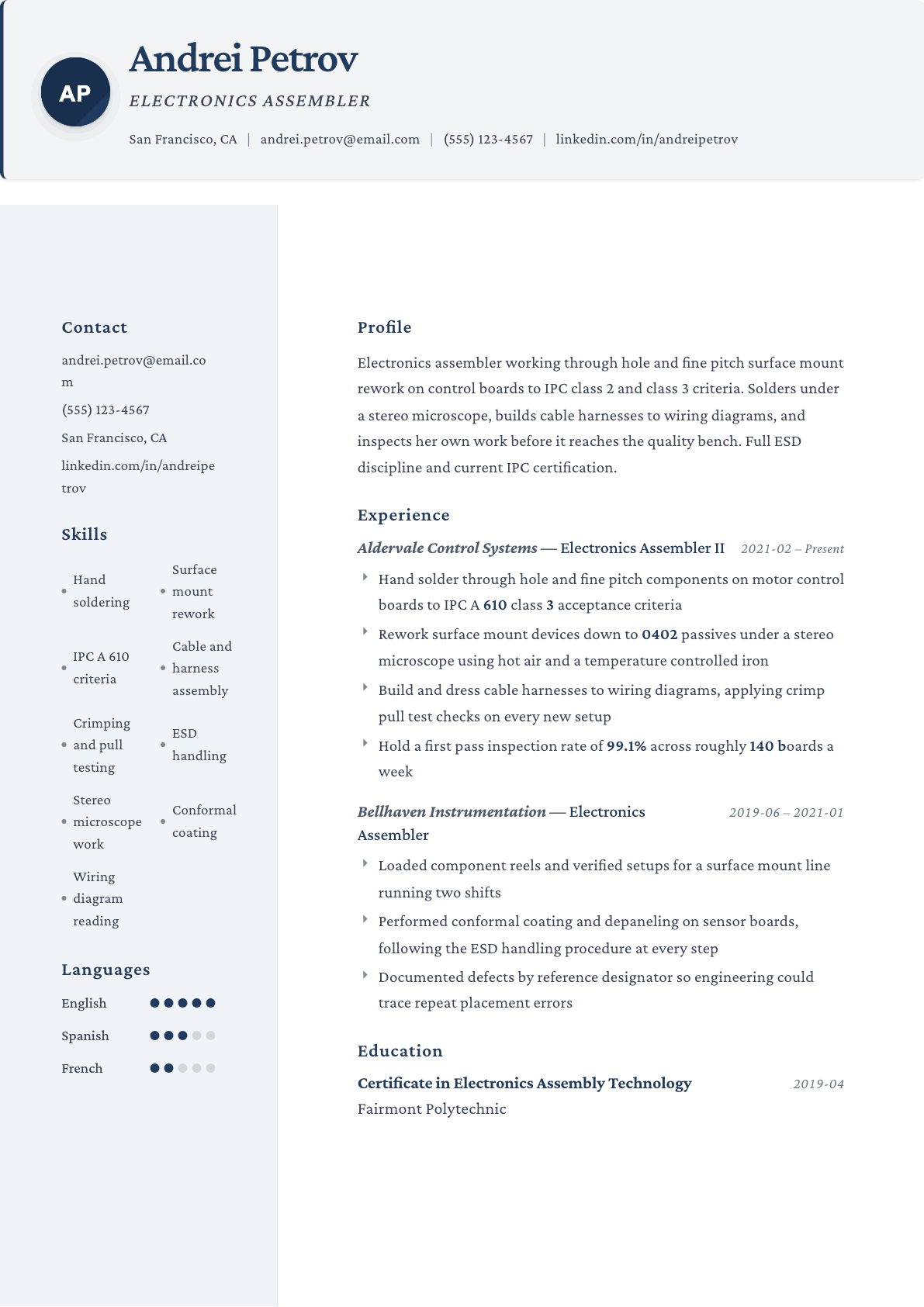
Example Electronics Assembler summary
Electronics assembler soldering through hole and fine pitch surface mount components on control boards to IPC class 3 acceptance criteria. Reworks parts down to 0402 under a stereo microscope with hot air and a temperature controlled iron, builds harnesses to wiring diagrams with crimp pull testing, and keeps full ESD discipline. Documents defects by reference designator so engineering can trace repeat placement errors.
Skills to list on a Electronics Assembler resume
- Hand soldering through hole
- Surface mount rework
- Fine pitch and 0402 components
- IPC A 610 acceptance criteria
- J STD 001 soldering requirements
- Cable harness assembly
- Crimping and pull testing
- ESD control procedures
- Stereo microscope inspection
- Conformal coating
- Depaneling
- Wiring diagram and schematic reading
- Component identification
- Defect documentation by reference designator
What actually gets this resume read
- Put your IPC certification and its class near the top, because electronics plants filter on it before anything else.
- Name the smallest package you rework confidently, since 0402 passives and fine pitch parts prove real bench skill.
- Separate through hole soldering from surface mount rework, because hiring managers treat them as different skills.
- Show ESD discipline explicitly: wrist straps, mats, bags and the audit you passed, not just the acronym.
- Give a board count per week and a first pass inspection rate rather than saying you assembled circuit boards.
- List harness work separately if you crimp and dress cable, since many postings hire for that alone.
How to write a electronics assembler resume
Electronics assembly is one of the few production roles with a genuine industry standard behind it, and that standard is the first thing a hiring manager checks. IPC certification, the acceptance class you build to, and the smallest package you can rework tell an electronics manufacturer nearly everything it needs to know before the interview starts.
The rest of the read is about discipline. Electrostatic discharge damage does not announce itself, a cold joint can pass a visual check and fail in the field, and a miscrimped contact can survive a tug and let go six months later. So the manager is looking for a candidate who describes procedure, inspection and handling as habits rather than as rules imposed from above.
This guide covers where certification belongs, how to separate through hole from surface mount work, how to write bench numbers that a quality engineer will believe, and the questions electronics assemblers ask when moving between contract manufacturers and product companies.
Format: certification block high, one page unless you have a long bench history
One page for under about eight years. Reverse chronological, plain text, no columns. What changes here is placement: the IPC credential and its class belong directly under the summary, not at the bottom with education, because it is the single filter most electronics postings apply first.
Give equipment a compact block too. Temperature controlled irons, hot air rework stations, preheaters, stereo microscopes, crimp tooling and pull testers, conformal coating equipment and depaneling routers are all worth naming. A contract manufacturer reads this block to work out how quickly you become productive on its bench.
- Certification block near the top: the standard, the role level and the class you build to.
- Sections: summary, certifications, bench experience, equipment and tooling, education.
- State the product class you have built: industrial control, medical, aerospace, consumer or telecom.
Summary: standard, class, package size, volume
Four facts in three sentences: the standard you work to, the acceptance class, the smallest component you handle confidently, and roughly how many boards pass your bench. An assembler who hand solders fine pitch parts to class 3 criteria and reworks down to a very small passive package under a microscope has said everything a screener needs.
Do not blur the classes. Class 2 and class 3 acceptance criteria differ in ways that matter, and a manager building medical or aerospace hardware treats a class 3 background as a distinct qualification. Say which one your work was actually inspected against.
Experience: through hole, surface mount, harness and inspection
Split your bullets by discipline instead of blending them. Through hole hand soldering, surface mount rework, cable and harness work, conformal coating and depaneling are separately hired skills, and a manager filling a rework bench will not dig through a paragraph to find out whether you have done it.
For rework, name the package types and the tooling. Hot air with a preheater on a multi layer board is a different claim from a soldering iron on a single sided board. For harness work, name the crimp tooling and say whether you pull test new setups, since that habit is what prevents a field failure nobody can trace.
Add the inspection layer. Working under a stereo microscope, checking your own boards against the acceptance criteria before they reach the quality bench, and documenting defects by reference designator so engineering can find a repeat placement error are the bullets that mark an experienced assembler.
Then give the numbers: boards per week and a first pass inspection rate. These exist in every electronics plant, and they are the most persuasive lines you can put on the page.
- Separate through hole soldering, surface mount rework, harness build and coating into distinct bullets.
- Name the smallest package you rework and the tooling you use to do it.
- Give board volume per week and a first pass inspection rate.
- Say how you record defects, ideally by reference designator.
Electrostatic discharge and handling: write it as practice, not as a word
Every electronics resume lists the acronym for electrostatic discharge control. Almost none describe the practice. Wrist strap checks at the start of shift, grounded mats and stools, static shielding bags for every move between benches, humidity awareness and an internal handling audit you passed are the details that make the claim credible.
The same applies to moisture sensitive devices, if you have handled them. Bake schedules, dry storage cabinets and floor life tracking are specialized handling knowledge that surface mount lines value, and very few candidates think to mention it.
Keywords and honesty about your level
The vocabulary electronics manufacturers search on is narrow and precise: the acceptance standard, the soldering requirements standard, the cable and wire harness standard, reference designator, solder wick, flux type, reflow, wave solder, selective solder, tombstoning, solder bridging and cold joint. Use the ones you have actually worked with.
Be exact about level. An assembler who has been through certification training but never sat the exam should say training completed rather than certified. Electronics is a small industry with tight networks, and the claim will be checked before you touch a board.
Electronics Assembler resume summary examples
New to the bench
Electronics assembly graduate trained in through hole soldering, component identification and electrostatic discharge handling, with bench practice on multi layer boards under a stereo microscope. Comfortable reading wiring diagrams and reference designators. Seeking a first assembler seat at a contract manufacturer with rework training available.
Two years on production boards
Electronics assembler hand soldering through hole components and performing surface mount rework on control boards to class 2 criteria. Builds and dresses cable harnesses to wiring diagrams with crimp pull testing on every new setup, and documents defects by reference designator for engineering follow up.
Senior assembler, class 3 work
Senior electronics assembler working to class 3 acceptance criteria on motor control and instrumentation boards, reworking fine pitch and very small passive packages under a microscope with hot air and a preheater. Holds a first pass inspection rate of 99.1% across roughly 140 boards a week and trains new hires on handling discipline.
Work experience bullets: before and after
Before: Soldered components onto circuit boards.
After: Hand soldered through hole and fine pitch components on motor control boards to the class 3 acceptance criteria in the standard the plant inspected against.
The board type and the acceptance class turn a common claim into a qualification a quality engineer can verify.
Before: Did rework on boards when needed.
After: Reworked surface mount devices down to very small passive packages under a stereo microscope using hot air, a preheater and a temperature controlled iron.
Package size and tooling define the difficulty of the rework, which is the only thing a rework bench cares about.
Before: Made cable assemblies.
After: Built and dressed cable harnesses to wiring diagrams, applying crimp pull test checks on every new setup before the first production run.
Pull testing new setups is the specific habit that prevents intermittent failures nobody can trace later.
Before: Followed ESD procedures.
After: Verified wrist strap and mat grounding at the start of every shift and moved boards between benches only in static shielding bags, passing every internal handling audit.
Describing the practice makes handling discipline believable in a way the acronym alone never does.
Before: Reported defects to the supervisor.
After: Documented every defect by reference designator so engineering could trace a repeat placement error back to a specific feeder on the surface mount line.
Precise defect reporting is what lets a plant fix a cause instead of repairing symptoms board by board.
Hard skills
- Through hole hand soldering
- Surface mount rework
- Fine pitch and small passive component handling
- Acceptance criteria class 2 and class 3
- Cable and harness assembly
- Crimping and pull testing
- Electrostatic discharge control
- Stereo microscope inspection
- Hot air rework and preheating
- Conformal coating
- Depaneling and routing
- Wiring diagram and schematic reading
Soft skills
- Steady hands over long shifts
- Procedure discipline
- Self inspection habit
- Precise written reporting
- Mentoring at the bench
Certifications worth listing
- IPC-A-610 Certified IPC Specialist (IPC)
- J-STD-001 Certified IPC Specialist (IPC)
- IPC/WHMA-A-620 Certified IPC Specialist (IPC)
Mistakes that cost electronics assembler candidates the interview
- Burying the IPC credential at the bottom of the page when it is the first filter most electronics postings apply.
- Blending through hole and surface mount work into one bullet, so the reader cannot tell which bench you belong on.
- Writing the electrostatic discharge acronym with no handling practice behind it.
- Skipping the acceptance class, which is the difference between consumer work and medical or aerospace work.
- Never naming the smallest package you can rework, which is the real measure of bench skill.
- Claiming certification when only the training was completed, in an industry small enough to check.
Electronics Assembler resume questions
Do I need IPC certification to get an electronics assembler job?
Not always for an entry seat, since many manufacturers train and certify internally. But certification moves you past the first filter on most postings, and holding the soldering requirements credential alongside the acceptance standard is stronger than either alone.
How do I explain the difference between the classes on my resume?
State the class your work was inspected against inside the job bullet rather than explaining the standard itself. A hiring manager in this industry already knows what the classes mean and only needs to see which one applied to you.
Should I list the equipment brands on my bench?
Name the equipment types first, since those transfer everywhere, and add brands only where a plant is likely to run the same tooling. Rework station, preheater, microscope, crimp frame and pull tester matter more than any specific manufacturer.
How do I move from consumer electronics to medical or aerospace work?
Lead with the class 3 exposure you have, however limited, and with your handling and documentation discipline. Those regulated sectors buy traceability and procedure adherence, so build the summary around inspection habits rather than around output volume.
What if I mostly did machine tending on a surface mount line?
Say so honestly and describe the setup work: reel loading, feeder verification, stencil and paste handling, and first article checks. That is genuine surface mount line experience and it is what a placement operator posting is actually hiring for.
Related resume examples
- Assembler Resume example
- Electronics Technician Resume example
- Manufacturing Technician Resume example
- Quality Control Inspector Resume example
- Production Technician Resume example
- Manufacturing Associate Resume example