Assembler Resume Examples: free ATS score and gap list
Write an Assembler Resume That Shows Print and Torque Skill
By Mustafa Tarabya, founder of CVBooster · Published · Updated
Assembler resume example with blueprint, torque and fixture keywords, plus a guide to writing build accuracy, tooling and inspection results.
Sample resumes for a assembler
The same assembler content laid out in three CVBooster templates, so you can see what the finished document looks like before you write a word.
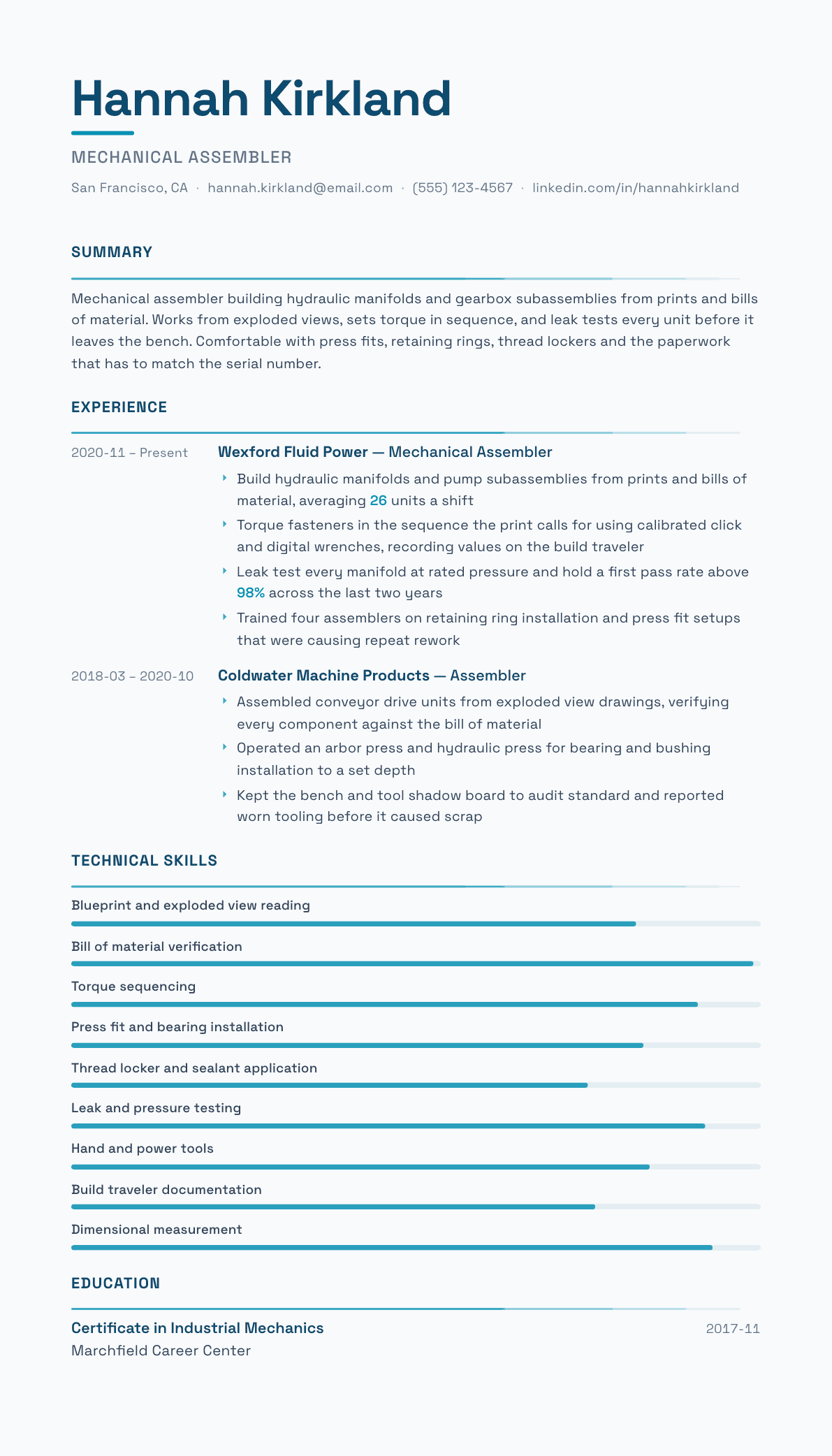
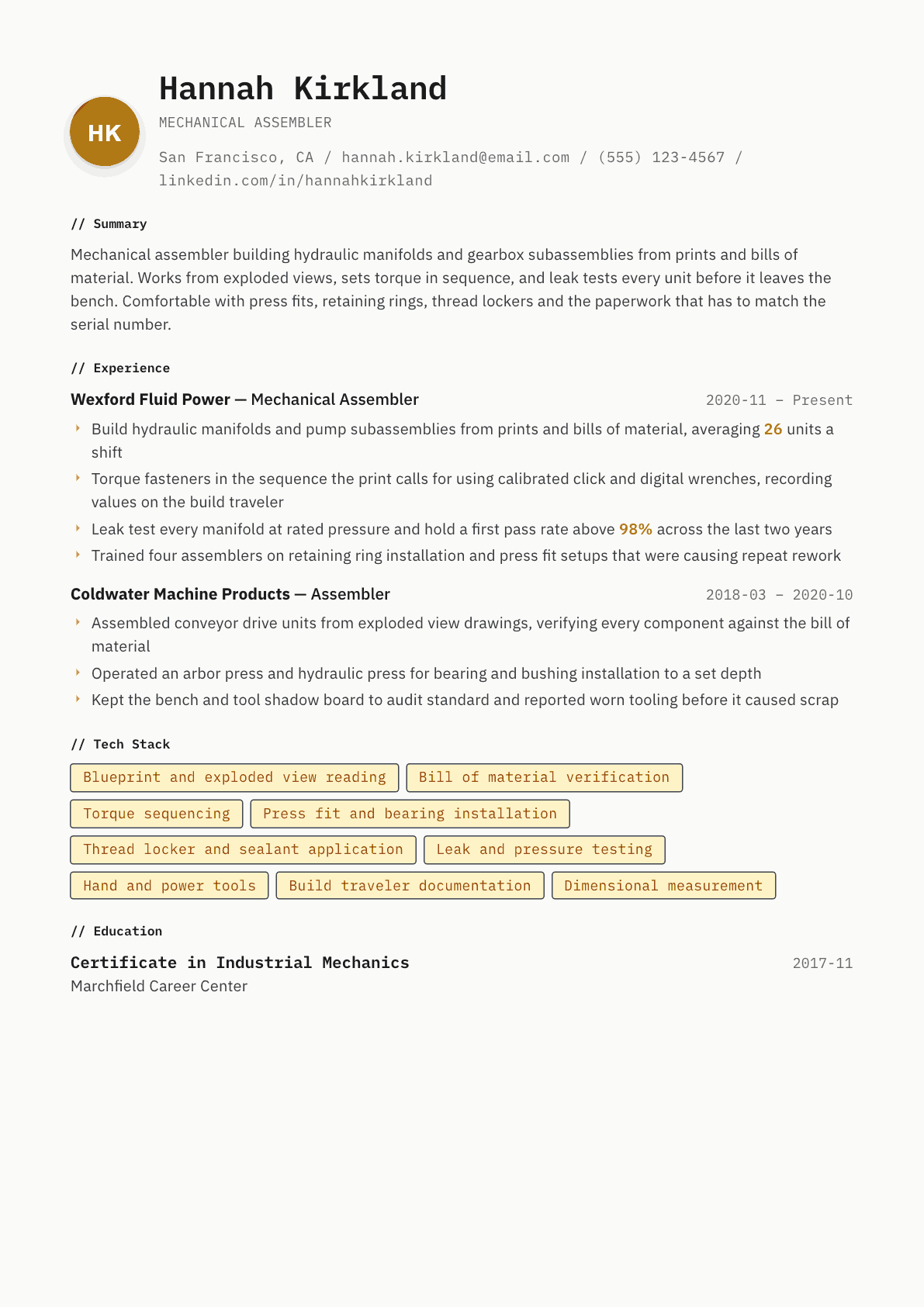
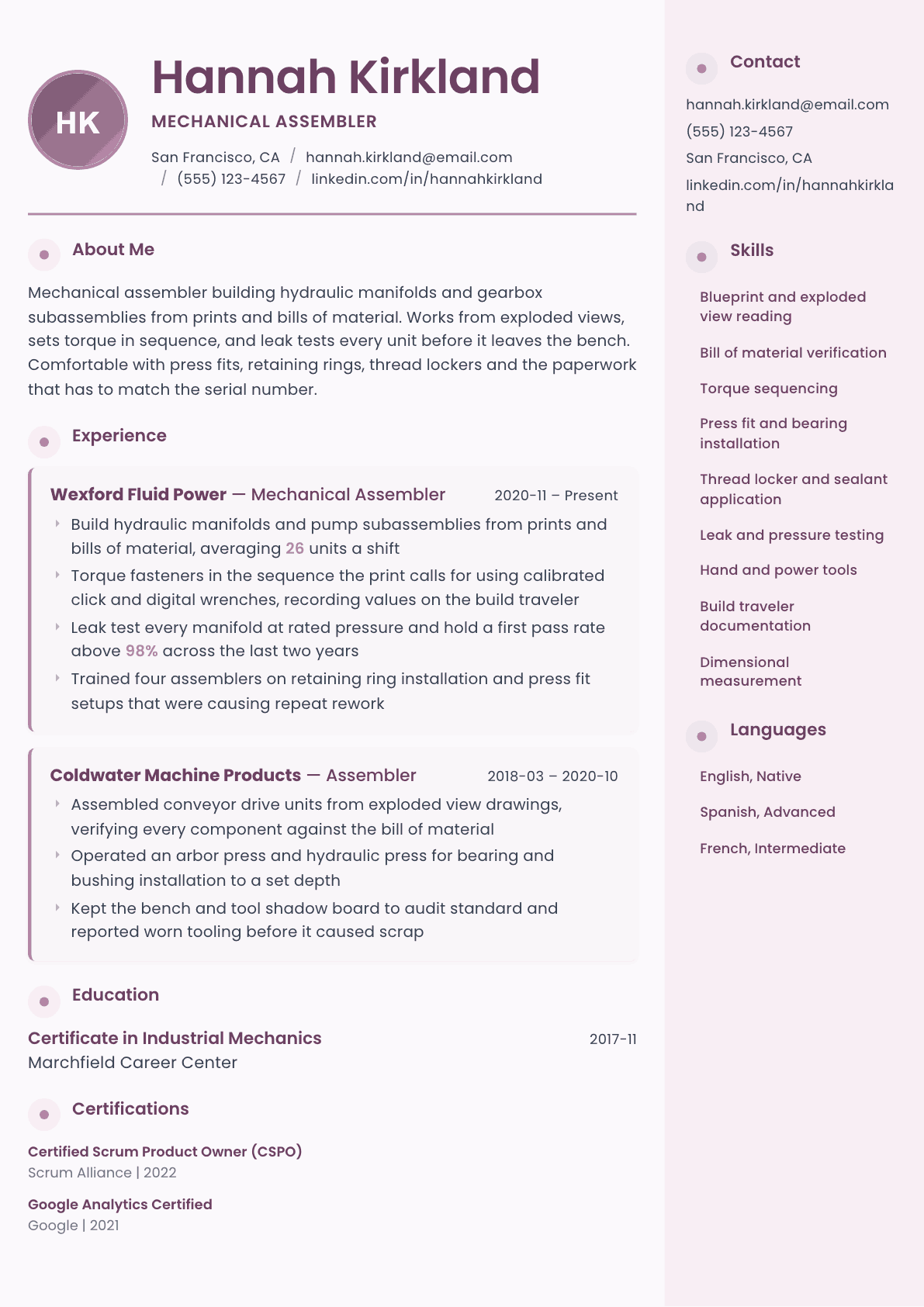
Example Assembler summary
Mechanical assembler building hydraulic manifolds and drive subassemblies from prints and bills of material. Torques fasteners in the sequence the drawing calls for with calibrated wrenches, presses bearings to set depth, and leak tests every unit at rated pressure before release. Records values on the build traveler against the serial number and trains newer assemblers on the setups that cause repeat rework.
Skills to list on a Assembler resume
- Blueprint reading
- Exploded view assembly
- Bill of material verification
- Torque specification and sequencing
- Calibrated torque wrenches
- Press fit and bearing installation
- Retaining rings and snap rings
- Thread locker and sealants
- Leak and pressure testing
- Calipers and micrometers
- Hand and pneumatic tools
- Build traveler documentation
- Serial number traceability
- Rework and repair
What actually gets this resume read
- Say what you assemble, because hydraulic manifolds, gearboxes and cable harnesses are three different skill sets.
- Prove print reading with the document type: exploded views, bills of material, weldment drawings or wiring diagrams.
- List the measuring tools you use, such as calipers, micrometers, bore gauges and calibrated torque wrenches.
- Give a first pass or rework rate, since an assembler who builds it right the first time is the whole job.
- Mention any testing you perform at the bench: leak, pressure, continuity, functional or run in testing.
- Note the documentation you complete, because traveler and serial number records are audited in most plants.
How to write a assembler resume
Assembler covers a wide range of work, and that is the first problem your resume has to solve. A hydraulic manifold builder, a cable harness builder and a furniture assembler all apply to postings titled assembler, and a hiring manager who cannot tell within five seconds which one you are will move to the next page.
Once he knows what you build, he wants two proofs: that you can read the drawing, and that the unit works when it leaves your bench. Print reading and first pass quality are the whole conversation. Torque values, press depths, leak tests and traveler paperwork are how you demonstrate them.
This guide covers naming your assembly discipline early, writing bullets around prints and specifications rather than tasks, listing measuring and testing equipment correctly, and answering the questions assemblers ask when their resume keeps landing in a general labor pile.
Format: one page, and say what you build in the first line
One page, reverse chronological, plain headings. The title line under your name should be specific: mechanical assembler, hydraulic assembler, electromechanical assembler, harness assembler. That single word before assembler does more sorting work than the rest of the resume, and leaving it generic sends you into the general labor pool.
A dedicated tools and equipment block belongs near the top. Assemblers are hired against a bench: calibrated torque wrenches, arbor and hydraulic presses, crimpers, calipers, micrometers, bore gauges, leak test stands. That list is the fastest way for a reader to judge whether your bench looks like his.
- Title line under your name naming the assembly discipline, not the word assembler alone.
- Sections: summary, assembly experience, tools and measuring equipment, certifications, education.
- Keep a short line on the documents you work from: prints, exploded views, bills of material, wiring diagrams.
Summary: the product, the documents, the test
Three sentences covering what you build, what you build it from, and how it is verified. Building hydraulic manifolds from prints and bills of material, torquing in sequence with calibrated wrenches, and leak testing at rated pressure before release is a summary that leaves nothing for the reader to guess at.
If you have moved across product families, say so and name them. Assemblers who have built both fluid power and rotating equipment carry transferable habits, but the reader will only credit them if the resume connects them rather than listing two unrelated jobs.
Experience: prints, specifications, testing and traceability
Open each job with the product family and the build volume. Then write bullets around specification compliance. Torquing fasteners in the sequence the print calls for, pressing bearings to a set depth, applying the correct thread locker grade and installing retaining rings without deforming them are the details that separate an assembler from someone who owns a socket set.
Give one bullet to testing. Leak test at rated pressure, continuity check, functional run in, dielectric test: whatever your bench performs, name it and give the pass rate. A first pass rate is the assembler equivalent of a yield number and it is the strongest single line you can write.
Give another to documentation. Build travelers, serial number records, torque value logs and rework tags are audited in most regulated and aerospace adjacent shops. An assembler whose paperwork matches the physical unit every time is the one a quality manager wants on the critical builds.
Close with training or process improvement if you have it: teaching a setup that was causing repeat rework, building a fixture that removed a mistake, or updating a work instruction that was wrong.
- Give units per shift or per week alongside the complexity of the build.
- Name the specification type you work to: torque sequence, press depth, gap, clearance or preload.
- State the test you perform and your first pass rate.
- Include the documents you complete and how they tie to the serial number.
Measuring and print reading: prove it, do not claim it
Print reading is claimed on nearly every assembler resume, so the word alone carries no weight. Prove it by naming the drawing types you use and what you take from them: an exploded view for build order, a bill of material for component verification, a detail drawing for a clearance, a weldment print for orientation.
Do the same with measurement. Say that you verify a bore with a bore gauge, a shaft with a micrometer and a step with a depth caliper. If you have read geometric dimensioning and tolerancing callouts, say which ones you actually use rather than listing the whole system.
Rework, scrap and the honest quality story
Assemblers are often the last hands before a unit reaches a customer, so how you handle a problem is part of the job description. Describe what you do with a component that does not fit: stop, tag it, check the print revision, and raise it rather than forcing the fit. That single sentence tells a manager more about you than any adjective.
If you have done rework and repair on returned units, list it separately. Diagnosing someone else's build and correcting it demands more skill than building fresh, and shops running warranty repair specifically look for it.
Assembler resume summary examples
Entry level assembler
Hands on builder from an automotive repair background, comfortable with torque wrenches, presses and hand tools, and used to working from a parts diagram. Completed an industrial mechanics certificate covering print reading and precision measurement. Seeking a bench assembly seat where first pass quality is the standard.
Three years at the bench
Mechanical assembler building conveyor drive units and gear cases from exploded view drawings and bills of material. Presses bearings and bushings to set depth, torques in the sequence the print calls for, and verifies every component against the bill before the first fastener goes in. Calipers and micrometers daily.
Senior assembler and trainer
Senior mechanical assembler with six years on hydraulic manifolds and pump subassemblies, holding a first pass leak test rate above 98%. Records torque values against the serial number on every build traveler, trains newer assemblers on retaining ring and press fit technique, and handles warranty rework on returned units.
Work experience bullets: before and after
Before: Assembled parts using hand tools and read blueprints.
After: Built hydraulic manifolds and pump subassemblies from prints and bills of material, averaging 26 completed units a shift.
The product family, the document types and the daily volume replace three unverifiable claims with facts.
Before: Tightened bolts to the correct torque.
After: Torqued fasteners in the sequence the print called for using calibrated click and digital wrenches, recording each value on the build traveler.
Sequence, calibrated tooling and recorded values are what a quality manager checks, and they are what the bullet now proves.
Before: Tested finished products.
After: Leak tested every manifold at rated pressure and held a first pass rate above 98% across two years on the bench.
Naming the test and the first pass rate gives the assembler equivalent of a yield figure.
Before: Installed bearings and bushings.
After: Pressed bearings and bushings to the depth called out on the print using an arbor and a hydraulic press, checking seat depth with a depth caliper.
The tooling and the verification step show controlled work instead of an operation performed by feel.
Before: Trained other assemblers.
After: Trained four assemblers on retaining ring installation and press fit setups that had been causing repeat rework on the drive unit line.
Tying the training to the specific defect it eliminated turns a duty into a measurable contribution.
Hard skills
- Print and exploded view reading
- Bill of material verification
- Torque sequencing to specification
- Calibrated torque wrench use
- Arbor and hydraulic press operation
- Bearing and bushing installation
- Retaining and snap ring installation
- Thread locker and sealant application
- Leak and pressure testing
- Calipers, micrometers and bore gauges
- Build traveler and serial traceability
- Rework and warranty repair
Soft skills
- Care with tolerances
- Patience on complex builds
- Willingness to stop and question a fit
- Bench organization
- Peer coaching
Certifications worth listing
- OSHA 10-Hour General Industry (OSHA Outreach Training Program)
- Certified Production Technician 4.0 (CPT 4.0) (Manufacturing Skill Standards Council)
- IPC/WHMA-A-620 Certified IPC Specialist (IPC)
Mistakes that cost assembler candidates the interview
- Using the bare title assembler with no product family, which drops the resume into a general labor pile.
- Claiming blueprint reading without naming a drawing type or anything you took from one.
- Leaving out the test performed at the bench, when the pass rate is the strongest number this role has.
- Skipping the measuring instruments, so a reader cannot tell whether you work to a tolerance or to feel.
- Omitting traveler and serial number documentation, which regulated and aerospace adjacent shops require.
- Describing torque as tightening bolts, which erases the sequence and calibration that make it skilled work.
Assembler resume questions
How do I make an assembler resume stand out from general labor applicants?
Anchor it in specifications. Torque sequences, press depths, clearances, leak tests and calibrated tooling are things general labor applicants cannot claim, and naming them puts you in a different reading pile before the reader reaches your job history.
What if my shop never measured a first pass rate?
Use whatever quality signal exists: rework tags returned to your bench, warranty claims on your product family, or an audit result. If none exist, describe your verification routine step by step, since the process itself is evidence of how you work.
Should electromechanical assembly go on the same resume as mechanical assembly?
Yes, and it is an advantage when written clearly. Keep them as separate bullet groups under each job so the reader can see which units involved wiring, connectors and continuity checks and which were purely mechanical builds.
Do assemblers need certifications to get hired?
Not usually for a first job, but they change the shortlist. A soldering or cable and wire harness credential, an OSHA card, or a manufacturing technician certificate all signal that you invested in the trade rather than landing in it.
How far back should an assembler resume go?
Ten to twelve years in detail is plenty. Compress anything older into a single line per employer, and keep older roles only when the product family matches the posting you are targeting right now.
Related resume examples
- Electronics Assembler Resume example
- Assembly Line Worker Resume example
- Machinist Resume example
- Manufacturing Technician Resume example
- Manufacturing Associate Resume example
- Press Operator Resume example