Electronics Technician Resume Examples: read this first
Write an Electronics Technician Resume That Shows Board-Level Skill
By Mustafa Tarabya, founder of CVBooster · Published · Updated
Electronics technician resume example with keywords and a guide to writing board-level repair, soldering standards, test gear and yield numbers.
Sample resumes for a electronics technician
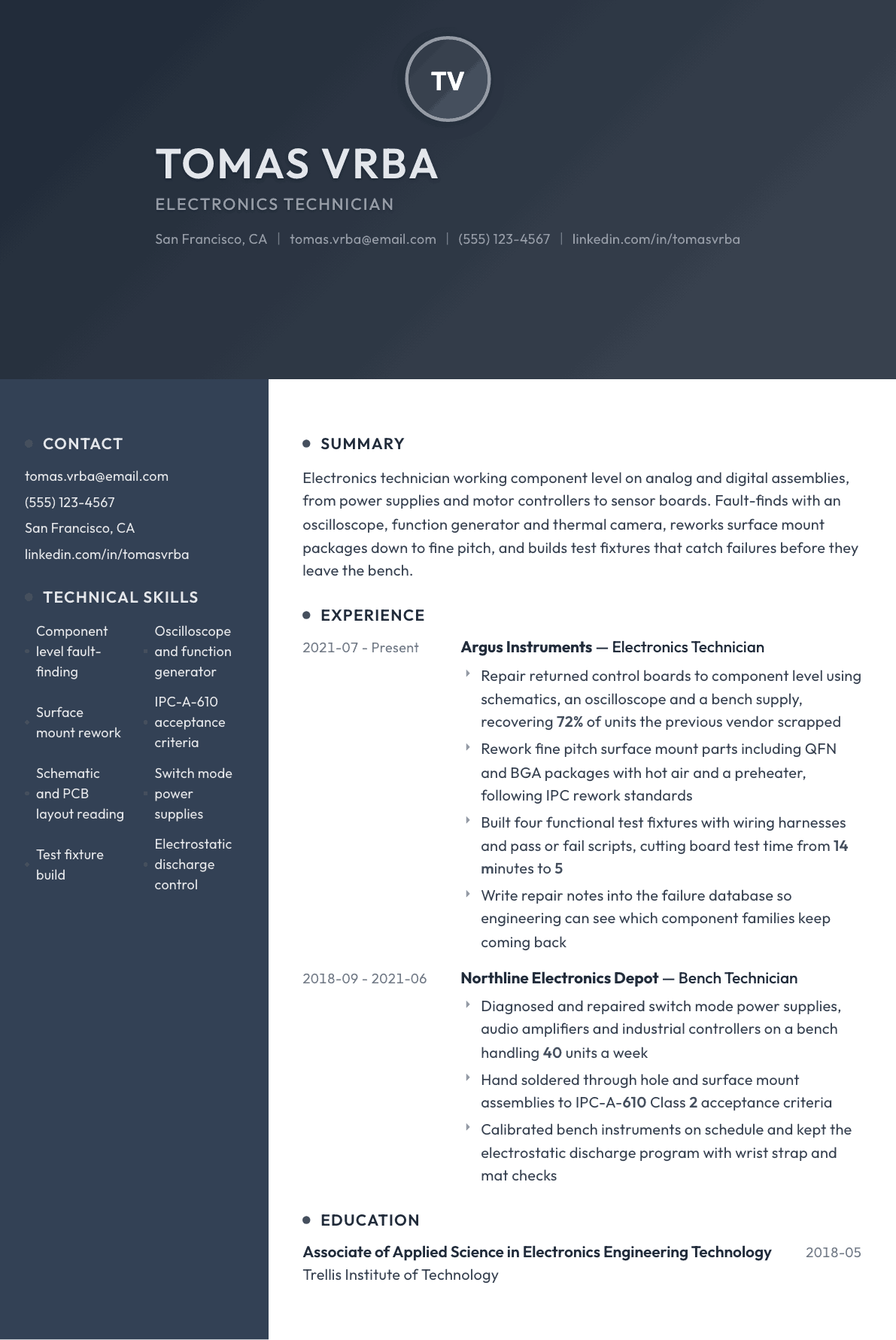
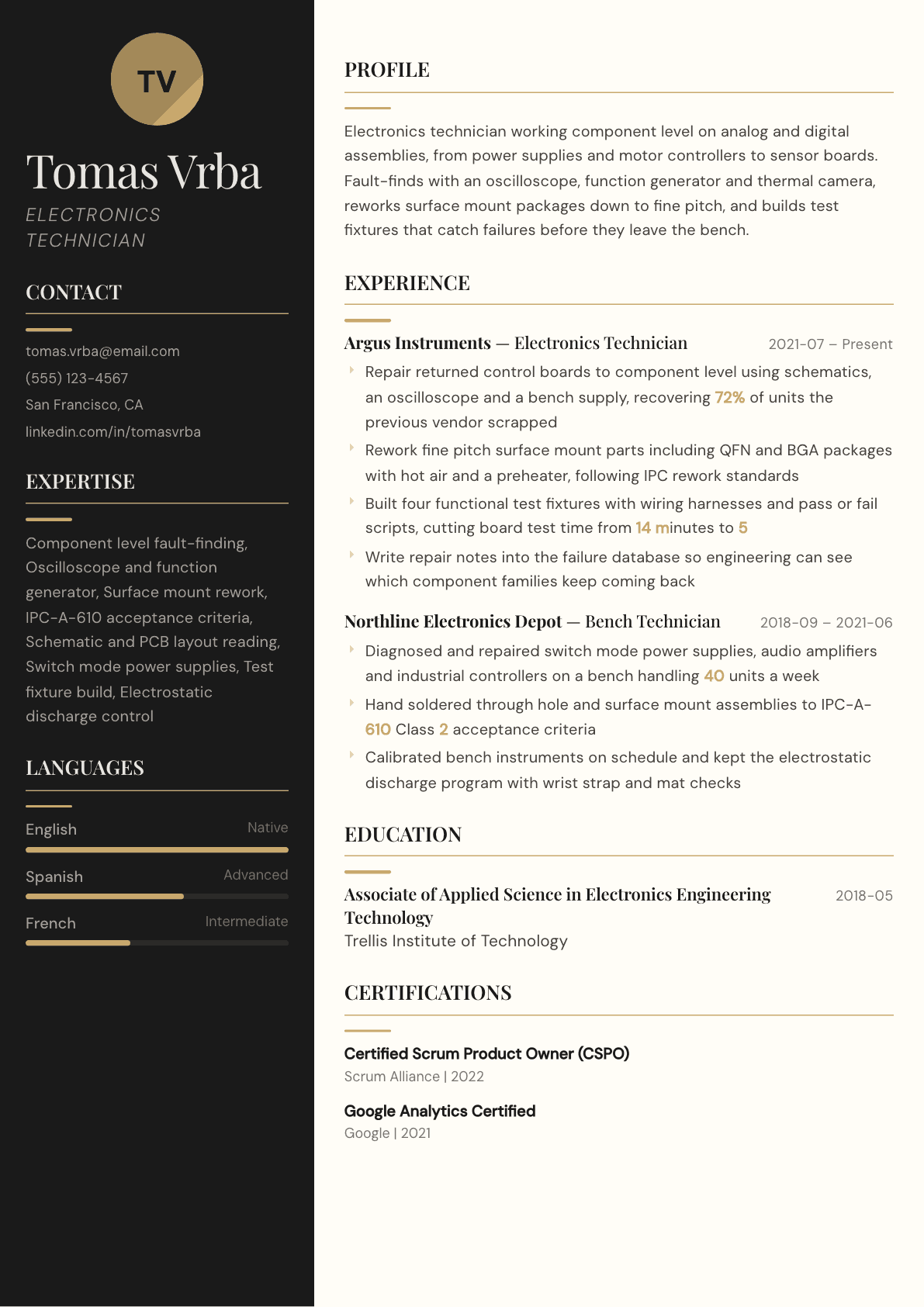
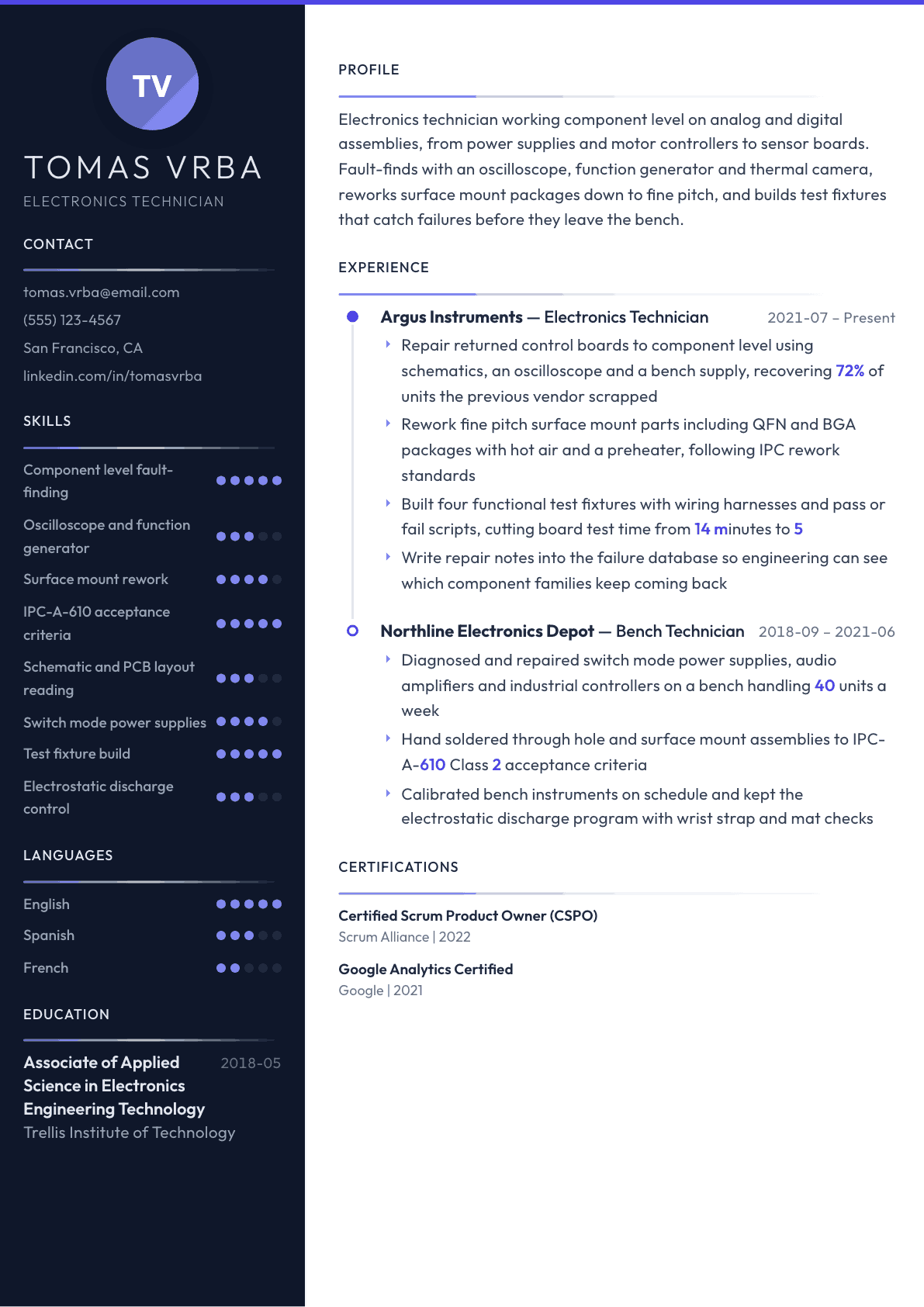
The same electronics technician content laid out in three CVBooster templates, so you can see what the finished document looks like before you write a word.
Example Electronics Technician summary
Electronics technician working component level on analog and digital assemblies including switch mode supplies, motor controllers and sensor boards. Fault-finds from schematics with an oscilloscope and thermal camera, reworks fine pitch surface mount packages to IPC standards, and builds functional test fixtures that cut board test time. Feeds repeat failure data back to engineering rather than closing tickets quietly.
Skills to list on a Electronics Technician resume
- Component level troubleshooting
- Analog and digital circuit theory
- Oscilloscope measurement
- Function generator and bench supply use
- Digital multimeter and LCR meter
- Through hole soldering
- Surface mount rework and hot air
- BGA and QFN handling
- IPC-A-610 acceptance criteria
- Schematic and PCB layout reading
- Switch mode power supplies
- Microcontroller board bring-up
- Functional test fixture build
- Electrostatic discharge control
- Failure reporting and root cause notes
- Instrument calibration schedules
What actually gets this resume read
- Say plainly whether you repair to component level or to board swap, because those are different jobs.
- Name the soldering and acceptance standards you work to, since IPC class decides who is allowed at the bench.
- List your test equipment by type and how you use it, not as a bare inventory of instruments.
- Give a recovery or yield figure, because an electronics manager measures the bench on units saved.
- Name the package types you rework, from through hole to fine pitch QFN and BGA, and the tooling you use.
- Show that you feed failure data back to engineering, which separates a technician from a parts replacer.
- Add electrostatic discharge practice and instrument calibration, both of which auditors ask about first.
How to write a electronics technician resume
There are two very different jobs hiding behind the title electronics technician. One replaces boards and modules until the unit works. The other puts a probe on a node, reads what the waveform is telling him and lifts a single failed component off a board with hot air. Both are valid careers, and both are hired constantly, but the pay and the interview questions are not the same. Your resume has to declare which one you are in the first three lines.
A bench manager reading applications is triaging on that distinction plus a second one: does this person work to a standard. Anyone can push solder around. Working to an acceptance class, controlling electrostatic discharge, keeping instruments in calibration and recording what failed and why is what makes a technician safe to leave alone with customer hardware.
This guide walks through what a bench or field electronics manager reads, in order, with summaries for a new graduate, a working bench technician and a senior, before and after bullets built from real fault-finding, and the questions technicians ask when they move between repair depots, manufacturing and test engineering support.
Format: declare your depth, then list the bench
Reverse chronological, one page under ten years. Under the header, write a short capability line that states your repair depth outright: component level on analog and digital assemblies, or module level with functional testing. That single sentence saves the manager the guessing that makes most electronics resumes unreadable.
Follow it with a compact bench inventory: the instruments you use and the assemblies you work on. Oscilloscope bandwidth, whether you use a logic analyzer, hot air and preheat equipment, microscope magnification, and the board technologies you handle from through hole to fine pitch. A manager matches that against his own bench before reading further.
- Header: name, city and state, phone, email, and your soldering acceptance class if you hold a current certificate.
- Capability line: repair depth, assembly types, and whether you also build test fixtures or write test procedures.
- Each job names the setting: repair depot, contract manufacturer, original equipment manufacturer, field service, or a laboratory support bench.
- Graduates lead with the electronics program, lab projects, the instruments used in them and any soldering certification earned.
Summary: what you fix, how deep, and how many
Three lines that carry four facts: the assemblies you repair, the level you repair them to, your throughput, and your yield or recovery rate. Throughput and yield are the two numbers a bench is measured on, and a technician who volunteers them reads as someone who has been measured before.
If you are strongest at a specific technology, put it in the first line. Switch mode power supplies, motor drives, radio frequency assemblies and mixed signal boards all attract their own hiring. A technician who says he specializes in switching supplies and can read a current sense loop is more interesting than one who repairs a wide range of electronic equipment.
Experience: waveforms, not workflows
Start each job with the volume and the assembly types. Forty units a week across power supplies, audio amplifiers and industrial controllers is a picture of a bench. Repaired various electronic equipment is not. Then write bullets that show measurement leading to a conclusion, because that is the only real evidence of component level ability.
Good bullets name the instrument and the observation. A ripple measurement on the output rail pointing to a dried electrolytic in the secondary. A gate drive waveform showing missing edges from a failed optocoupler. A cold joint found by thermal imaging under load. Those sentences cannot be faked by someone who has only swapped boards, which is exactly why they work.
Add the systems work too. Building a functional test fixture, writing a repair procedure, tightening a rework process, or feeding failure data back into a design review are the tasks that turn a bench technician into someone an engineering group will keep. Give the outcome: test time cut, escapes reduced, a component family designed out.
- Give weekly or monthly unit throughput and your recovery or first-pass yield.
- Name package types you rework by hand: through hole, fine pitch surface mount, QFN, BGA, and the tooling used for each.
- State the acceptance standard you work to and whether your certification is current.
- Include any test fixture, harness or procedure you built, with the time or defect result it produced.
Standards, electrostatic discharge and calibration
These three subjects look like housekeeping and are actually hiring criteria. Contract manufacturers and regulated customers audit them. A technician who writes that he solders to a stated acceptance class, checks wrist straps and mats on a schedule, and keeps bench instruments inside their calibration interval is describing a bench that will survive an audit.
Be exact rather than impressive. Say which class you work to and where you were trained. Say what your electrostatic discharge program covers: wrist straps, mats, ionizers, packaging, humidity. Say who calibrates your instruments and how you handle one found out of tolerance. Precision here is worth more than a longer list of skills.
Skills and keywords an electronics posting filters on
The vocabulary repeats across postings: component level, board level, oscilloscope, logic analyzer, schematic capture, surface mount rework, BGA, reflow, hot air, ESD, IPC acceptance, functional test, in-circuit test, root cause. Use the posting words in your skills block and again inside a bullet where the work is shown.
Do not overstate design ability. Many technicians read schematics fluently, modify a prototype and lay out a simple harness without being circuit designers. Say what you actually do: bring up boards, run test scripts, characterize a rail, or build fixtures. A clear boundary reads as competence, while a blurred one reads as a risk the hiring engineer will not take.
Electronics Technician resume summary examples
Recent graduate
Electronics engineering technology graduate with lab work across analog amplifiers, switching regulators and microcontroller boards. Solders through hole and surface mount to Class 2 criteria, measures with an oscilloscope and function generator, and completed a capstone building a functional test fixture for a motor driver board.
Four years on the bench
Electronics technician repairing 40 units a week to component level across switch mode power supplies, industrial controllers and audio amplifiers. Reworks fine pitch surface mount parts with hot air and preheat, recovers 72% of boards previously scrapped, and keeps the bench inside its calibration and electrostatic discharge program.
Senior bench technician
Senior electronics technician with 10 years across a repair depot and a contract manufacturer. Handles BGA rework, mixed signal fault-finding and new product bring-up, built 4 functional test fixtures that cut board test time from 14 minutes to 5, and trains technicians to a current IPC acceptance class.
Work experience bullets: before and after
Before: Repaired circuit boards using test equipment.
After: Repaired returned control boards to component level from schematics using an oscilloscope, bench supply and thermal camera, recovering 72% of units the previous vendor had scrapped.
Naming the depth, the instruments and the recovery figure separates real component work from board swapping.
Before: Found the cause of a power supply failure.
After: Measured excessive ripple on the 12V rail under load, traced it to a dried electrolytic in the secondary filter, replaced the capacitor family across the batch and closed a repeat failure on 30 units.
The measurement, the component and the batch action show root cause thinking rather than a single lucky fix.
Before: Did surface mount rework.
After: Reworked fine pitch QFN and BGA packages with hot air and a preheater to IPC rework criteria, including paste application, alignment under a microscope and post-rework continuity checks.
Package types, tooling and the verification step make the rework claim credible to anyone who does it themselves.
Before: Helped improve testing.
After: Built 4 functional test fixtures with wiring harnesses and pass or fail scripts, cutting board test time from 14 minutes to 5 and catching 2 intermittent faults that had been escaping the bench.
Quantity, time saved and defects caught turn a vague improvement into an engineering contribution.
Before: Followed ESD procedures at the bench.
After: Ran the electrostatic discharge program for a 6-station bench including daily wrist strap and mat checks, ionizer verification and moisture sensitive device handling with dry storage.
Scope and specific controls show ownership of a program that auditors check, not just personal compliance.
Hard skills
- Component level fault-finding on analog and digital boards
- Oscilloscope and logic analyzer measurement
- Function generator and programmable bench supply use
- Digital multimeter and LCR meter measurement
- Through hole and surface mount hand soldering
- Hot air rework and preheating
- BGA and fine pitch package handling
- IPC acceptance criteria for electronic assemblies
- Schematic and PCB layout interpretation
- Switch mode power supply diagnosis
- Microcontroller board bring-up and firmware loading
- Functional test fixture design and build
- Electrostatic discharge program control
- Instrument calibration tracking
Soft skills
- Patience with intermittent faults that only appear warm
- Writing repair notes an engineer can use as failure data
- Knowing when a board is not economically repairable
- Keeping a shared bench organized for the next shift
- Explaining a failure mode to production without jargon
Certifications worth listing
- Certified Electronics Technician (CET) (Electronics Technicians Association International)
- Certified IPC Specialist for IPC-A-610 (IPC)
- Certified IPC Specialist for J-STD-001 (IPC)
- Certified Electronics Technician (International Society of Certified Electronics Technicians)
Mistakes that cost electronics technician candidates the interview
- Leaving the repair depth unstated, so a manager cannot tell component level ability from module replacement.
- Listing instruments as an inventory without ever showing a measurement that led somewhere.
- Claiming surface mount rework without naming package types, tooling or the verification step afterward.
- Skipping throughput and yield, the two numbers every repair bench is actually managed by.
- Treating electrostatic discharge and calibration as too basic to mention, when audited customers screen on both.
- Overstating design ability, which collapses the moment an engineer asks how you would compensate a feedback loop.
Electronics Technician resume questions
Is component level repair still worth listing when many companies swap boards?
Yes, because the companies that still repair are exactly the ones hiring for skill rather than headcount. Depots, industrial equipment makers, medical and aerospace suppliers all need someone who can save a board that is no longer manufactured, and they pay for that ability.
Do I need an IPC certification to get a bench job?
It is not universally required, but it removes doubt and many contract manufacturers make it a condition of employment. If you are not certified, state the acceptance class you were trained to and who trained you, then say you are prepared to certify at hire.
How do I show fault-finding ability with no impressive numbers?
Write one complete diagnostic story per job. Give the symptom, the instrument, the observation and the component. A hiring engineer can tell within two sentences whether you actually did the work, and that recognition matters more than a throughput figure you never collected.
Should a technician moving into test engineering support change the resume?
Yes. Move fixtures, scripts, procedures and data analysis to the front, and keep repair work as the credibility layer beneath it. Test engineering groups hire technicians who can build and maintain the thing that measures, so evidence of fixture and documentation work becomes the lead argument.
How much firmware or software should I claim?
Claim only what you do unsupervised: loading firmware, running test scripts, editing configuration files, reading serial output. If you have written scripts to automate a measurement, name the language and what it did. Anything beyond that belongs in an interview, not on the page.
Related resume examples
- Electrical Technician Resume example
- Computer Repair Technician Resume example
- Avionics Technician Resume example
- Lab Technician Resume example
- Cell Phone Repair Technician Resume example
- Collision Repair Technician Resume example