Production Technician Resume Examples: read this first
A Production Technician Resume That Proves You Fix the Line
By Mustafa Tarabya, founder of CVBooster · Published · Updated
Production technician resume example with troubleshooting, calibration and process keywords, plus a guide to writing uptime and yield results.
Sample resumes for a production technician
The same production technician content laid out in three CVBooster templates, so you can see what the finished document looks like before you write a word.
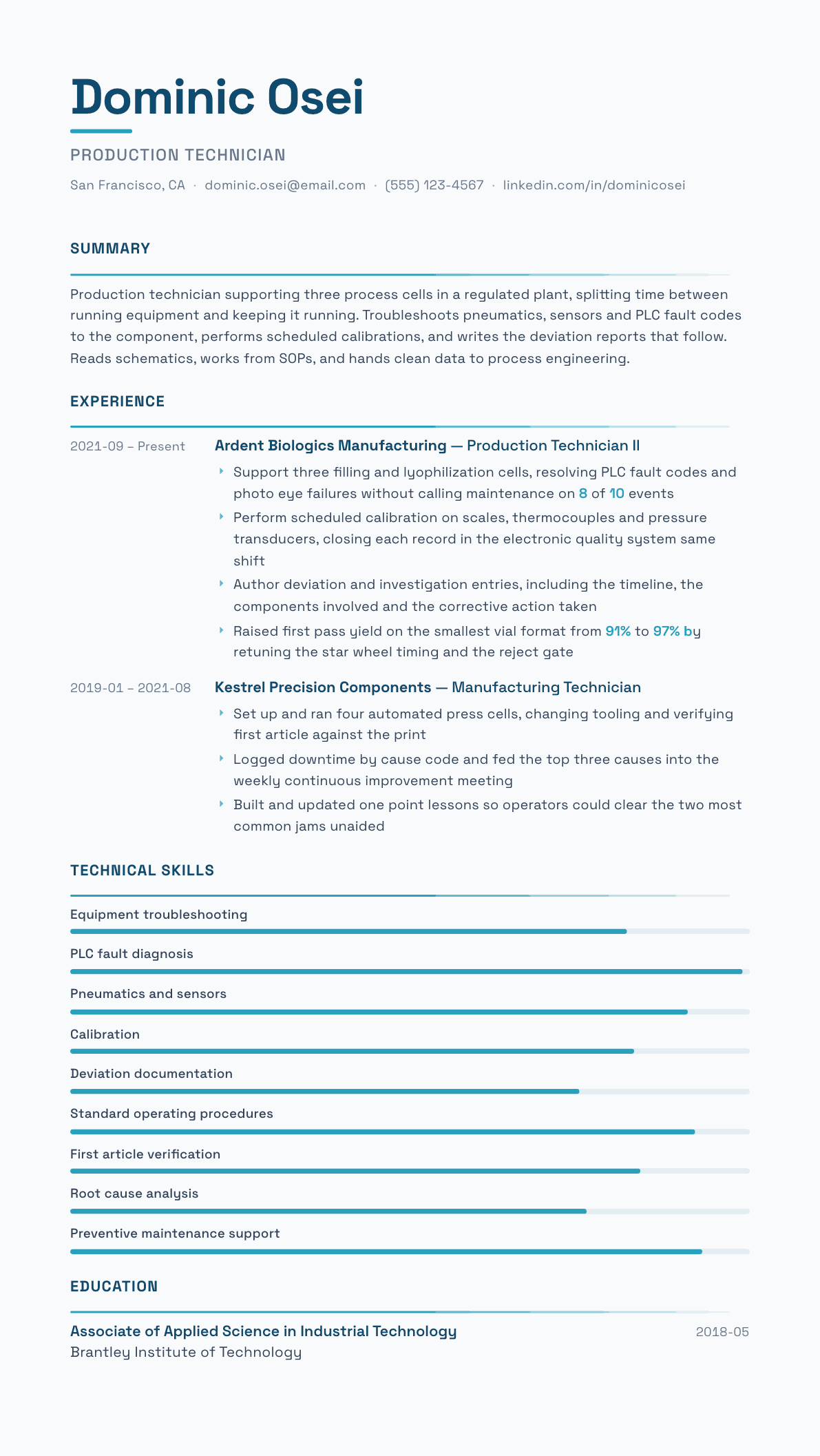
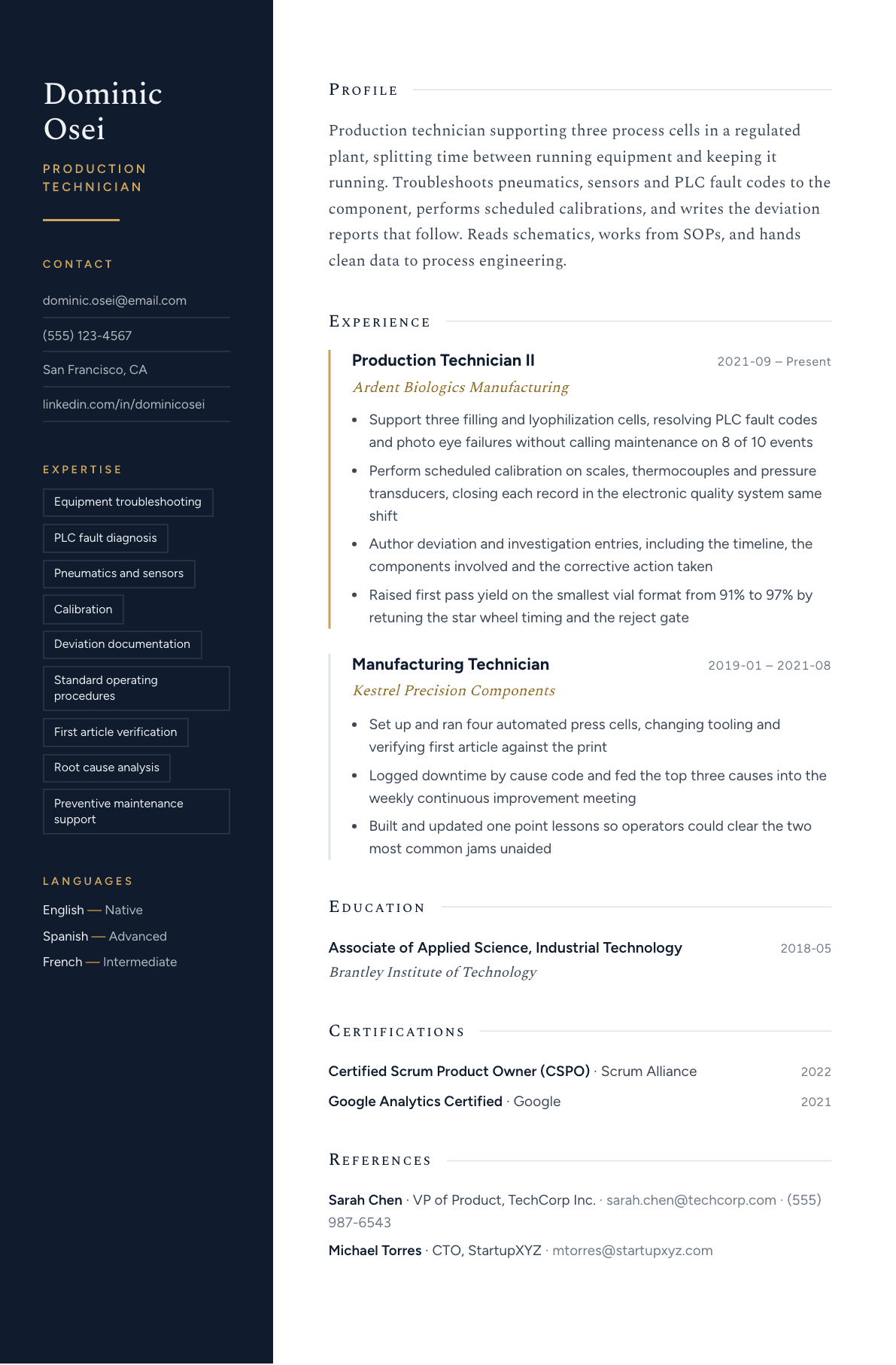
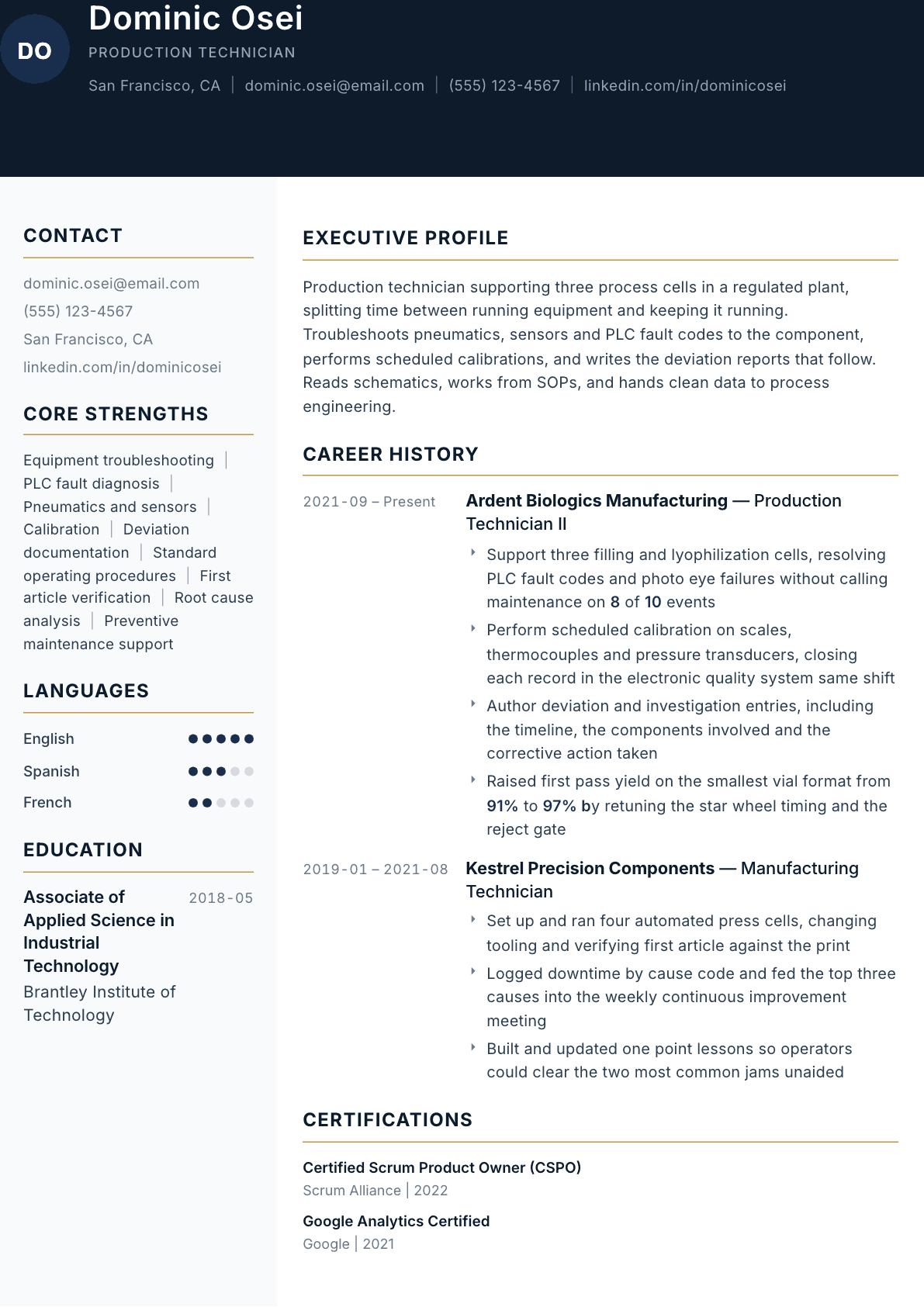
Example Production Technician summary
Production technician supporting filling and press cells in a regulated plant, splitting the shift between running equipment and restoring it. Diagnoses PLC faults, pneumatic leaks and sensor misalignment to the component, calibrates scales and transducers on schedule, and writes deviation records that close without a quality follow up. Raised first pass yield on the hardest format by retuning timing and reject logic.
Skills to list on a Production Technician resume
- Process troubleshooting
- PLC fault code diagnosis
- Pneumatic and hydraulic systems
- Sensor and photo eye alignment
- Instrument calibration
- Preventive maintenance
- Schematic and print reading
- First article inspection
- Deviation and CAPA documentation
- Standard operating procedures
- Root cause analysis
- Data collection and reporting
- Tooling changeover
- Continuous improvement
What actually gets this resume read
- Separate the run work from the fix work, because a technician is hired for the second and screened on both.
- Say how deep your troubleshooting goes: fault code, subsystem, or down to the sensor and the wiring.
- List the calibrations you perform and the instruments you touch, since audited plants check this line by line.
- Give a yield or uptime figure with the format or cell it belongs to, not a plant wide number you did not own.
- Name the quality system you document in and whether you have written deviations or investigation reports.
- Add any PLC, hydraulics or electrical coursework, because it separates you from operators applying up.
How to write a production technician resume
The production technician sits in the gap between the operator who runs the equipment and the maintenance mechanic who rebuilds it. Plants create the role because they need someone on the floor who can read a fault, decide whether it is a sensor, a setting or a real breakdown, and act on that decision without stopping the shift to open a work order.
So the resume has to prove diagnostic depth, not familiarity. A hiring manager reading a production technician resume is asking how far down you go: do you acknowledge the alarm and call maintenance, do you check the photo eye and the air supply, or do you meter the circuit and change the proximity switch. Every candidate claims troubleshooting. Very few show the depth.
This guide walks through the sections a technician resume needs, how to write the run half and the fix half of the job separately, which documentation matters in a regulated plant, and the credentials that move you from operator pay into technician pay.
Format: one page early, two once you have real equipment history
Stay on one page until you have around five years and several equipment platforms behind you. After that a second page is fine, because equipment lists, calibration scope and documentation systems are all things a manager wants to read in full rather than compressed into a phrase.
Use reverse chronological order with a dedicated equipment and systems block. Technicians are hired against a machine list, so that block does the heavy lifting the way a certification section does on a clinical resume. Keep the formatting plain so the plant applicant tracking system does not scramble the machine names you worked hard to earn.
- Header: name, city and state, phone, email, and your shift pattern if you accept nights or a call rotation.
- Sections: summary, technical experience, equipment and systems, certifications and training, education.
- Give calibration scope its own sub list when you work in a regulated plant, because auditors read it that way.
Summary: how deep you troubleshoot and on what
Open with the equipment family and the depth. A technician who writes that he supports three filling and lyophilization cells and resolves fault codes to the component without a maintenance call has said more in one sentence than a page of duty statements.
Add the regulated dimension if it applies. Working under standard operating procedures, closing calibration records in an electronic quality system and writing deviations is a distinct skill set that pharmaceutical, medical device and food plants pay for, and it does not transfer automatically from a general machine shop background.
Experience: split the run work from the fix work
Give each job an anchor line naming the plant type, the cells or lines you supported, and the equipment. Then write bullets in two groups without labeling them as such: the first two cover operating and process work, the next two or three cover diagnosis, calibration and repair.
Make the fix bullets concrete about the fault and the resolution. Photo eye misalignment causing false rejects, a pneumatic leak dropping cylinder speed below the timing window, a servo alarm traced to a loose encoder connector: these are the sentences that convince a maintenance manager you belong on his floor. A generic bullet about troubleshooting equipment issues convinces nobody.
Then show the improvement layer. Technicians earn their cost back on yield and uptime, so one bullet should tie a change you made to a number: a first pass yield that moved, downtime that fell, a repeat fault that stopped repeating after you fixed the root cause rather than the symptom.
- Name the fault types you resolve, not the word faults.
- State what proportion of events you clear without escalating to maintenance.
- Give the calibration instruments and the interval you work to.
- Attach one yield, scrap or uptime figure to a change you personally made.
Documentation: deviations, SOPs and the quality system
In a regulated plant the writing is half the job. Say which electronic quality system you close records in, whether you have authored deviations or investigation entries, and whether your records come back for correction. A technician whose paperwork closes on the first pass saves the quality unit hours every week and that is a genuine selling point.
Mention procedure work as well. Redlining a standard operating procedure, building a one point lesson so operators can clear a common jam themselves, or writing the setup sheet for a new format all show that you turn your knowledge into something the plant keeps after you leave.
Skills and credentials: the block that sets your pay grade
Split the skills block into equipment, control systems, instruments and documentation. Under control systems, be honest about your level: reading fault codes and navigating an HMI is common, monitoring ladder logic online is a step above, and editing logic is a different job entirely. Overclaiming here is caught in the first interview question.
On credentials, a manufacturing technician certification, an OSHA card and any electrical, pneumatics or hydraulics coursework are all worth listing. A quality improvement belt matters if the plant runs formal problem solving, because it shows you can carry a fault through to a documented root cause.
Production Technician resume summary examples
Operator moving into technician work
Line operator with three years running automated press cells, moving into technician work after completing pneumatics and industrial electrical coursework. Already clears jams, aligns sensors and performs tool changes unassisted, and logs downtime by cause code. Seeking a technician seat with formal troubleshooting responsibility.
Four years in
Production technician supporting four automated cells, resolving PLC fault codes, pneumatic leaks and sensor failures without a maintenance call on most events. Performs scheduled calibration on scales and thermocouples, closes records in the electronic quality system the same shift, and feeds top downtime causes into the weekly improvement meeting.
Senior technician in a regulated plant
Senior production technician with seven years across biologics filling and lyophilization, authoring deviations and investigation entries that close without quality follow up. Raised first pass yield on the hardest vial format by retuning star wheel timing and reject logic, and trains junior technicians on calibration and fault isolation.
Work experience bullets: before and after
Before: Troubleshot equipment issues on the production floor.
After: Resolved PLC fault codes, photo eye failures and pneumatic leaks on three filling cells without a maintenance call on 8 of 10 events.
Naming the fault types and the escalation ratio shows exactly how deep the troubleshooting goes.
Before: Performed equipment calibrations.
After: Calibrated scales, thermocouples and pressure transducers on the scheduled interval and closed every record in the electronic quality system the same shift.
The instrument list and same shift closure prove both the technical scope and the documentation discipline an audited plant needs.
Before: Improved production yield.
After: Raised first pass yield on the smallest vial format from 91% to 97% by retuning star wheel timing and the reject gate position.
The specific format and the mechanism behind the gain make the improvement checkable rather than decorative.
Before: Wrote reports when problems happened.
After: Authored deviation and investigation entries covering the event timeline, the components involved and the corrective action, with none returned by quality for rework.
It shows the content of the writing and the standard it met, which is what a regulated plant is buying.
Before: Helped operators with machine problems.
After: Built one point lessons for the two most common jams so operators could clear them unaided, removing roughly forty technician callouts a month.
Turning knowledge into a tool the plant keeps is a stronger claim than being available to help.
Hard skills
- Fault isolation to component level
- PLC fault code diagnosis
- Pneumatic and hydraulic troubleshooting
- Sensor and photo eye alignment
- Instrument calibration
- Preventive maintenance execution
- Electrical and mechanical schematic reading
- First article and in process verification
- Deviation and corrective action writing
- Standard operating procedure authoring
- Root cause analysis
- Tooling and format changeover
Soft skills
- Diagnostic patience
- Calm under a stopped line
- Clear written explanation
- Coaching operators
- Knowing when to escalate
Certifications worth listing
- Certified Production Technician 4.0 (CPT 4.0) (Manufacturing Skill Standards Council)
- Certified Manufacturing Technologist (CMfgT) (SME)
- OSHA 30-Hour General Industry (OSHA Outreach Training Program)
- Certified Six Sigma Yellow Belt (CSSYB) (American Society for Quality)
Mistakes that cost production technician candidates the interview
- Writing troubleshooting as a bare skill without naming a single fault you have actually isolated and fixed.
- Reading like an operator resume, so the hiring manager offers operator pay for a technician posting.
- Claiming PLC experience when you only acknowledge alarms, which collapses in the first technical interview question.
- Leaving out the calibration instrument list, which is the first thing a regulated plant checks against its own scope.
- Skipping the documentation half of the job, when deviation writing is often why the role exists at all.
- Giving a plant wide uptime number you did not own instead of the cell figure you actually moved.
Production Technician resume questions
What separates a production technician resume from an operator resume?
Diagnostic depth and documentation. An operator resume proves you hold the rate. A technician resume proves you find the cause, fix or escalate it correctly, calibrate the instruments, and write the record afterward in language the quality unit accepts without rework.
How do I show PLC experience honestly?
State your level in plain terms: reading and clearing fault codes, navigating HMI screens, monitoring ladder logic online, or editing logic. Name the platform family you have worked with and let the interview go deeper rather than overclaiming on the page.
Do I need an associate degree for technician roles?
Many postings ask for one in industrial or electronics technology, but plants routinely hire operators who completed pneumatics, electrical or PLC coursework and can demonstrate the work. List the coursework by name even when the degree is unfinished.
Should I list preventive maintenance work if maintenance owns it?
Yes, when you actually perform it. Say what you complete: lubrication routes, belt and chain checks, filter changes, sensor cleaning. Also say where the boundary sits, because a manager wants to know what you touch and what you hand over.
How much detail should I give about the products I supported?
Enough to establish the regulatory environment and the equipment class, and no more. Sterile injectable filling, medical device molding or automotive stamping each tell the reader a great deal. Confidential process details do not belong on a resume.
Related resume examples
- Manufacturing Technician Resume example
- Maintenance Technician Resume example
- Quality Control Technician Resume example
- Production Supervisor Resume example
- Semiconductor Technician Resume example
- Electronics Assembler Resume example